IBD Short Takes -Fall 2017

From ImproveCareNow: Real-World Experience with Adalimumab

An excerpt:

A total of 174 children and adolescents were treated with adalimumab as their first anti-TNF therapy…The mean age at the time of Crohn’s disease diagnosis was 13 years and, on average, they started adalimumab at 14.5 years of age…

  • At 3 months after adalimumab was started, all 174 were still on the medication, and 69-71% were in steroid-free remission
  • At 6 months after adalimumab was started, of the 174 who had a clinic visit, 95% were still on the medication, and 75-77% were in steroid-free remission
  • At 12 months after adalimumab was started, of the 154 who had a clinic visit, 94% were still on the medication, and 79-80% were in steroid-free remission
  • At 24 months after adalimumab was started, of the 71 who had a clinic visit, 97% were still on the medication, and 91-94% were in steroid-free remission
  • At 36 months after adalimumab was started, of the 39 who had a clinic visit, 80-86% were still on the medication, and 81-86% were in steroid-free remission

No positive or negative effect on remission was seen with concomitant immunomodulator therapy. However, the number of patients studied during the retrospective analysis is too small to detect all but the greatest impact of this approach.

EC Maxwell et al. JPGN 2017; 65: 299-305  CHOP experience with diverting ileostomy for severe IBD (2000-2014).

  • In this retrospective study, a diverting ileostomy in 24 patients had improvement: 71% –>22% on chronic steroids, improved growth, hemoglobin, blood transfusion and hospitalization.
  • 10 patients underwent subsequent colectomy, 7 had successful reanastomosis, and 7 remain diverted.
  • Diversion allowed a definitive diagnosis in 7 subjects (initially 13 patients were considered IBD-U).
  • Surgical complications were common (n=13 in 7 subjects) and included stoma obstruction, stoma prolapse, and resection of ischemic bowel.
  • One notable feature regarding this cohort was that 50% were 5 or younger when diagnosed with IBD.
  • The authors conclude that a diverting ileostomy can induce clinical stability and allow time to clarify diagnosis.

A Assa et al. JPGN 2017; 65: 293-98. In this study involving findings from 234 patients extracted from the ImageKids database (prospective multicenter cohort), the authors found that pediatric patients with perianal Crohn’s disease have a greater inflammatory burden; however, this was driven mainly by those who had fistulizing disease.

L Lian et al. Clin Gastroenterol Hepatol 2017; 15: 1226-31. This retrospective study from the Cleveland Clinic compared outcomes of endoscopic balloon dilation (EBD) (n=176) or surgery (n=131) for Crohn’s disease-related strictures (1998-2013). Patients who had EBD had an “average time to surgery delayed by 6.45 years.” Immediate success rate for EBD was 91.3%; the perforation rate was 1.1%.. Ultimately, 52% of patients who had EBD required surgery.  Earlier surgery lowered the risk of further surgery but also was associated with significant perioperative complications. In the operative group, 8.8% of patients experienced complications, mainly intra-abdominal abscesses and enterocutaneous fistula. Thus, in the right hands and with careful selection, EBD may be useful.

I Lawrance et al. Clin Gastroenterol Hepatol 2017; 15: 1248-55. This study reported the results of 11 patients who received rectal tacrolimus for resistant ulcerative proctitis. Dosing: The concentration of tacrolimus was 0.5 mg/mL and 3 mL was administered twice a day.Clinical response, using the Mayo Clinic score, was achieved in 73% of tacrolimus subjects compared with 10% (n=1) of placebo-treated subjects.  Mucosal healing at week 8 was noted in 73% of tacrolimus-treated patients, as well.

Soapes Creek Trail

Therapeutic Drug Monitoring: Ustekinumab (Stelara)

The ability to measure drug levels has changed how we think about refractory medical disease, particularly in patients with inflammatory bowel disease.  Prior to the availability of therapeutic drug monitoring (TDM), in some situations poor response to therapy could be ascribed to variability in host immune response. Now, it is clear that many cases of refractory medical disease are due to insufficient drug level.  TDM allows for dose individualization to target the right amount of medication.

TDM has an accepted role in anti-TNF therapy.  Now, a study (R Battat et al. Clin Gastroenterol Hepatol 2017; 15: 1427-34) extends the concept of TDM to ustekinumab.  This study which took place between 2014-2015 examined ustekinumab use in 62 patients with refractory Crohn’s disease (CD).  Ustekinumab dosing: 90 mg SC at weeks 0, 1, and 2 for induction, then 90 mg every 4 or 8 weeks for maintenance.

Key findings:

  • At week 26, 80.7% of patients had a clinical response, 66.1% had a clinical remission, and 58.9% had an endoscopic response.
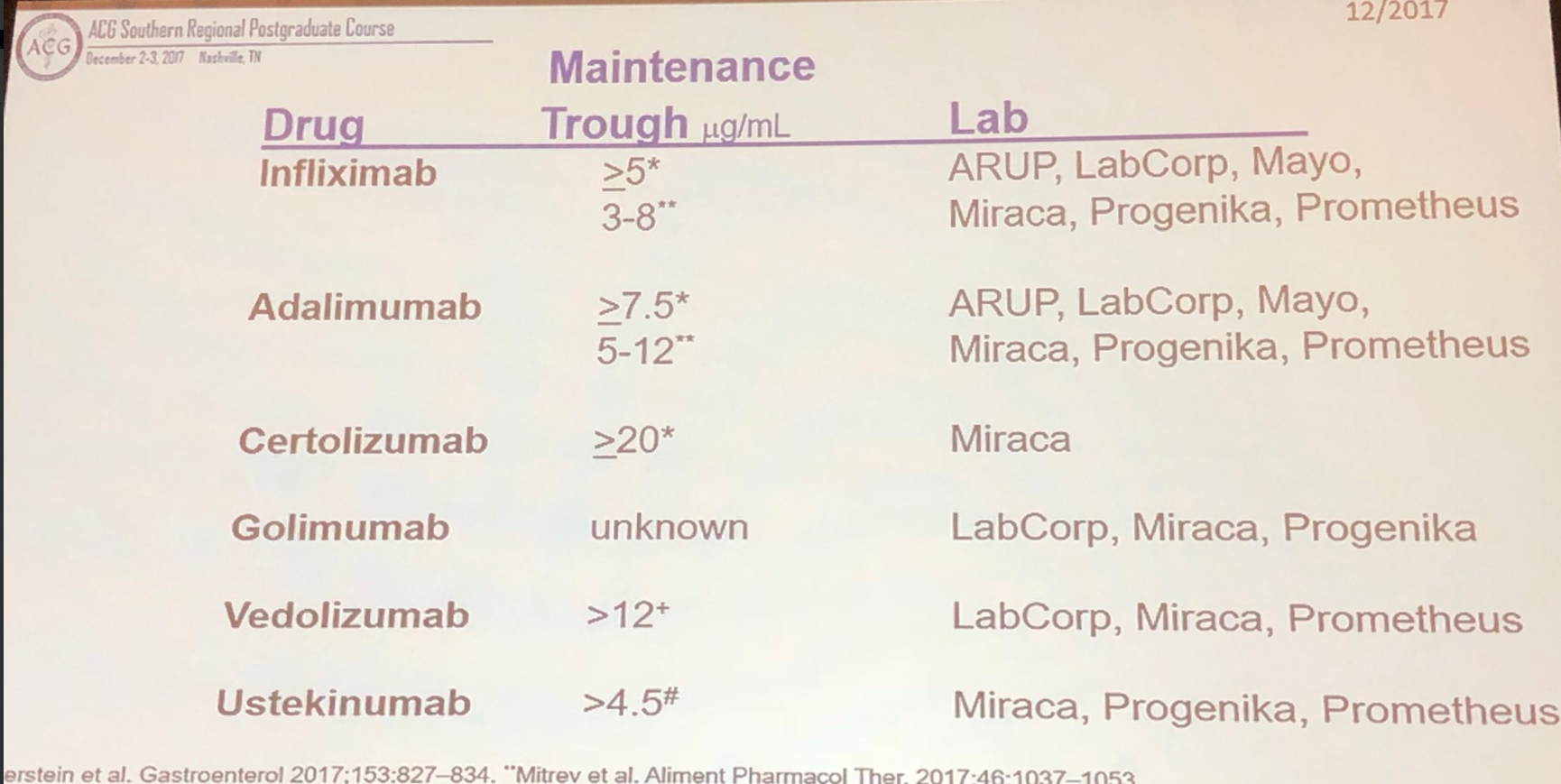
  • In those with an endoscopic response, the mean trough concentration of ustekinumab was 4.7 mcg/mL compared with 3.8 mcg/mL those without an endoscopic response.
  • Using a trough threshold of 4.5 mcg/mL at week ≥26, 75.9% had an endoscopic response whereas those with a level below this trough had a 40.7% endoscopic response
  • The authors did not detect antibodies to ustekinumab in any patient. The authors note that ustekinumab has low immunogenicity and prior UNITI studies indicated antibody formation in 0.2% after induction and 2.3% at 1 year.
  • Unlike combination therapy with anti-TNF therapy, “concurrent immunosuppressive therapy does not explain low immunogenicity, as only 25.8% of patients received these and had neither improved clinical outcomes nor higher drug concentrations.”

Thus far, no clinical studies have demonstrated improved clinical outcomes with dose escalation in the setting of low ustekinumab levels.  A prospective trial would be helpful.

My take: This study shows promising results for ustekinumab for refractory CD.  The low immunogenicity indicates that monotherapy is likely appropriate.  A target level of >4.5 mcg/mL indicates a higher likelihood of response.

Related blog posts:

#NASPGHAN17 Therapeutic Drug Monitoring Associated with Increased Clinical Remission

In support of Dr. Baldassano’s talk (NASPGHAN17: Treat to Target and Tight Control), this poster from the Cincinnati group (A Mulgand et al) showed that therapeutic drug monitoring has been associated with improved clinical remission scores (80% to 87%).  Correlation with a more objective marker of remission along with longer followup is now needed. One of the authors, Dana Dykes, has joined our group in Atlanta!


Related blog posts:

#NASPGHAN 17 More Abstracts

This link for the NASPGHAN abstracts :NASPGHAN 2017 Scientific Abstracts

The following slides are from some of the abstract posters. This first poster (next 5 pics) showed that symptom association with meals is not predictive of aspiration among a selected group of children who underwent swallow study evaluations. In the figures, the blue bars are children who passed the swallow study whereas the red bars indicate the children who failed the swallow study.

This next slide demonstrated that a six food diet for EoE could be administered blenderized via a gastrostomy tube.

The next slide showed that irritable bowel syndrome was more frequent (overall hazard ratio of 1.52) following a urinary tract infection in the first year of life.

The next pictures are from a poster discussing high rates of recurrent C difficile infection following fecal microbial transplantation in pediatric patients with inflammatory bowel disease (mainly ulcerative colitis).  An inference from this study would be that many cases of C difficile that were attributed as causing symptoms could in fact have been from a flare up of their IBD.  More details about the diagnosis of C difficile (based on PCR or ELISA) would be helpful

The next poster provides data from CHOP experience with Ustekinumab.  Overall, in this highly-selected (refrcactory) population the long term improvement was low; while one-third had steroid-free remission at week 8, this was not maintained at week 16 and week 24.  In addition, among the 22 patients, one developed transverse myelitis.

This study that follows (next two pics) documented the relative safety of liver biopsies (mainly percutaneous without interventional radiology) in the post-transplant period.  The two most serious adverse events, cholangitis and bile leak, helped identify biliary strictures.

The following collaborative study examined the neurocognitive status of children with Alagille syndrome.  Overall, this study shows that children with Alagille syndrome are at increased risk of low IQ compared to children with other cholestatic diseases.


#NASPGHAN17 IBD Treat to Target and Tight Control

More information from this year’s annual NASPGHAN meeting.

This blog entry has abbreviated/summarized these presentations. Though not intentional, some important material is likely to have been omitted; in addition, transcription errors are possible as well.

IBD Treat to Target: Treat the Patient or Treat the Disease

Robert Baldassano  Children’s Hospital of Philadelphia

I missed the first few minutes of this presentation, even though I had highlighted this as one of my top priorities.  So, if anyone reading this post has some additional comments, they are certainly welcome.

Key points:

  • Do not rely on symptoms alone to assess patient improvement.
  • Best surrogate marker: calprotectin.  Frequent calprotectin levels can help determine objective improvement; it is much more helpful than CRP as ~25% of patients do not elevate their CRP levels
  • Therapeutic drug monitoring is important in improving outcomes. Dose optimization improves response rate and durability of infliximab response.
  • Evolving targets in ulcerative colitis.  Even histologic activity, in the absence of endoscopic activity, is associated with relapsing disease
  • Dr. Baldassano indicated that he no longer is starting patients on thiopurine therapy. There are “36 phase 3 trials underway.” Thus, many promising options for those who may burn through current treatments
  • This lecture reviewed data from the RISK study showing that early (1st 90 days w/in diagnosis) TNF therapy helps prevent penetrating disease (related post: CCFA Update 2017/RISK study)

Another presentation by Philip Minar et al (Cincinnati Children’s Hospital Medical Center) shows that CD64 suppression is an early biomarker of response to infliximab therapy.

#NASPGHAN17 Is it time to stop using thiopurine therapy?

This blog entry has abbreviated/summarized this presentation. Though not intentional, some important material is likely to have been omitted; in addition, transcription errors are possible as well.

Safety in Pediatric IBD Therapy: Is it time to stop using thiopurines?

Jeffrey Hyams  Connecticut Children’s Medical Center

Key points from this lecture:

  • Dr. Hyams:  “There are better options than thiopurines in 2017 due to infrequent but serious risks”
  • The DEVEVOP study showed that anti-TNF agents did NOT increase the risk of lymphoma or hemophagocytic lymphohistiocytosis (HLH).  In contrast, these risks do occur with thiopurines –this is infrequent but remains significant.
  • Therapeutic drug monitoring may obviate the need for combination/dual therapy which has been shown to improve response rates to anti-TNF agents; methotrexate may work for combination therapy and may be safer than thiopurines
  • If a thiopurine is used as part of combination therapy, short duration (~6 months) is likely to have low risks
  • In addition to Dr. Hyams, Dr. Baldassano, in his discussion of treat to target (discussed in subsequent post), echoed the sentiment that he no longer recommends thiopurine therapy

Dr. Hyams slides list some of the relative risks of thiopurine therapy.  To understand these risks, the absolute risk is probably more helpful.

My take: This lecture did not focus on the main benefit of thiopurines which is its use in combination therapy. Many experts consider combination therapy to be the standard of care for adults with Crohn’s disease.  The advantages of combination therapy are mainly due to improved durability of anti-TNF therapy and lower antidrug antibodies.  How this benefit stacks up against the risks discussed in this lecture and whether this benefit can be supplanted by the use of therapeutic drug monitoring is uncertain.


Related blog posts:

Disclaimer: These blog posts are for educational purposes only. Specific dosing of medications (along with potential adverse effects) should be confirmed by prescribing physician.  This content is not a substitute for medical advice, diagnosis or treatment provided by a qualified healthcare provider. Always seek the advice of your physician or other qualified health provider with any questions you may have regarding a condition.

NASPGHAN Postgraduate Course 2017 (Part 4): Therapeutic drug monitoring, Anti-TNF management, Postoperative Crohn’s disease

This blog entry has abbreviated/summarized these presentations. Though not intentional, some important material is likely to have been omitted; in addition, transcription errors are possible as well.

Here is a link to postgraduate course syllabus: NASPGHAN PG Syllabus – 2017

Therapeutic Drug Monitoring

Andrew Grossman  Children’s Hospital of Philadelphia

The topic of therapeutic drug monitoring, both reactive and proactive, has been discussed numerous times on this blog.  This talk provided a good review of this topic.

Key points:

  • Greatest predictor of infliximab treatment failure was a low infliximab (<0.9 mcg/mL at anytime or <2.2 mcg/mL at 14 weeks) (Castelle et al Am J Gastro 2013; 108: 962-71)
  • Low level antibodies to infliximab may be transient in ~28% and may be overcome with escalation of therapy
  • Tissue levels of infliximab (and other agents) may be inadequate despite good serum levels

What if anti-TNF fails

Maria Oliva-Hemker   Johns Hopkins University School of Medicine

Key points:

  • Discussed prevalence of problem with anti-TNF failures and main options: vedolizumab, ustekinumab, and surgery
  • Vedolizumab can take a while to work, particularly for Crohn’s disease
  • Limited data in pediatrics for these newer agents
  • Ustekinumab has some preliminary data indicating benefit with anti-TNF induced psoriaform rashes
  • Newer agents also likely to need therapeutic drug monitoring
  • Overall, ustekinumab and vedolizumab have good safety profiles at this point


Prevention of postoperative Crohn’s disease

Miguel Regueiro   University of Pittsburgh

  • Rationale for postoperative preventative treatment: high rate of recurrent disease which can be silent for several years despite progressive damage to GI tract
  • Large study (PREVENT) to compare infliximab and placebo after surgery.  Primary endpoint was clinical recurrence (was endpoint demanded by FDA) even though clinical recurrence can be a late finding.  Endoscopic recurrence rate was a secondary endpoint.

Dr. Regueiro’s approach

  • Low risk patient –repeat scope at 6 months post-op, then every 1-3 yrs if no disease and Rx with anti-TNF or immunomodulator in those with endoscopic recurrence
  • Moderate risk patient -possible use of thiopurine or use the ‘low risk’ approach
  • High risk patient-combination therapy and if doing well for several years, consider monotherapy
  • In pediatrics, the postoperative management is unclear due to difficulty with risk stratification.  If postoperative treatment is not given, consider colonoscopy 3-4 months afterwards and treat if recurrence.  Then could use calprotectin every 3 months to monitor and when >50, likely will need to be treated

PREVENT Trial Data:


Three Studies Show Benefit of Concomitant Therapy for Inflammatory Bowel Disease (Part 1)

In the first study (J Cheng et al. Inflamm Bowel Dis 2017; 23: 1762-73), the authors retrospectively reviewed 148 children (113 with Crohn’s disease, 35 with ulcerative colitis). 90 patients received concomitant therapy (infliximab with either a thiopurine [n=67], methotrexate [n=23]) and 58 received infliximab monotherapy. Key findings:

  • Concomitant therapy >6 months  significantly lowered the risk of secondary loss of response in Crohn’s disease (CD) (HR =0.39) compared to monotherapy.   A similar trend was noted with ulcerative colitis (UC) but did not reach statistical significance.
  • Steroid-free remission rates at 1 year were 78% for CD patients with concomitant therapy compared with 54% on monotherapy
  • Among primary nonresponders, 67% of CD patients and 75% of UC patients were receiving IFX monotherapy.
  • No differences in adverse events were evident between patients receiving monotherapy compared with concomitant therapy. One patient (receiving azathioprine) developed a follicular lymphoma; this patient was well 10 years later.

The second study (Y Qui et al. Clin Gastroenterol Hepatol 2017; 15: 1359-72) was a systemic review of 35 studies that met the authors’ inclusion criteria. In total, 6790 patients with inflammatory bowel disease were enrolled in these studies. This study looked at multiple anit-TNF agents including infliximab, adalimumab, certolizumab, and golimumab. Key finding:

  • Antidrug antibodies were reduced by 51% in patients receiving concomitant therapy
  • Conclusion from authors: “concomitant use of immunomodulators should be considered in patients treated with anti-TNF treatment.”

My take: Overall, for most pediatric patients with CD, to date, concomitant therapy has been the most effective treatment.  More prospective studies are needed to determine more conclusively the benefit and optimal duration/timing of combined therapy, particularly with the more frequent use of therapeutic drug monitoring.  Also, as will be noted in future posts from annual meeting, thiopurine use is declining.

More on this topic tomorrow.

Related blog posts:

Disclaimer: These blog posts are for educational purposes only. Specific dosing of medications (along with potential adverse effects) should be confirmed by prescribing physician.  This content is not a substitute for medical advice, diagnosis or treatment provided by a qualified healthcare provider. Always seek the advice of your physician or other qualified health provider with any questions you may have regarding a condition.

Infliximab Infusions Without Premedication

Briefly noted:

A recent study (SQ Hutsell, M Wu, KT Park. JPGN 2017; 65: 430-31) examined two practice changes with regard to infliximab (IFX) infusions:

  1. 1-hour infusions
  2. Omission of premedications

The authors reviewed ~900 IFX infusions; though, only 111 infusions were administered without premedications.  These two changes resulted in a 51% decrease in infusion hours, despite a 9% increase in total number infusions. No increase in adverse reactions was identified.

The authors state that these changes improve patient experience, shorten monitoring time, and reduce costs.


Breastfeeding: Protection from Inflammatory Bowel Disease

Xu L, et al. Systematic review with meta-analysis: breastfeeding and the risk of Crohn’s disease and ulcerative colitisAliment Pharmacol Ther2017;46:780-789.

https://doi.org/10.1111/apt.14291Thanks to Mike Hart for this reference.

From abstract:

Results

A total of 35 studies were included in the final analysis, comprising 7536 individuals with CD, 7353 with UC and 330 222 controls. Ever being breastfed was associated with a lower risk of CD (OR 0.71, 95% CI 0.59-0.85) and UC (OR 0.78, 95% CI 0.67-0.91). While this inverse association was observed in all ethnicity groups, the magnitude of protection was significantly greater among Asians (OR 0.31, 95% CI 0.20-0.48) compared to Caucasians (OR 0.78, 95% CI 0.66-0.93; P = .0001) in CD. Breastfeeding duration showed a dose-dependent association, with strongest decrease in risk when breastfed for at least 12 months for CD (OR 0.20, 95% CI 0.08-0.50) and UC (OR 0.21, 95% CI 0.10-0.43) as compared to 3 or 6 months.

From associated editorial by David Rakel:

This meta-analysis of 35 studies shows that there is a dose–response protective effect of the duration of breastfeeding on inflammatory bowel disease. The association shows as much as an 80% reduction in risk for both Crohn’s disease and ulcerative colitis for breastfeeding more than 12 months.

Breast Feeding Graph

Inflammatory bowel disease arises from a complex set of interactions related to genetic susceptibility, environmental exposures, and a dysregulated immune response to dysbiotic intestinal microbiota, according to the study authors. These data will give us one more reason to encourage breastfeeding, ideally for a year or more.

Related blog post: Nutrition Week (Day 7) Connecting Diet and Epidemiology in IBD