Avoidant/Restrictive Food Intake Disorder (ARFID) with Irritable Bowel Syndrome and with Inflammatory Bowel Disease

Last week, this blog highlighted a study regarding the prevalence of ARFID in pediatric neurogastroenterology (Prevalence of Avoidant/Restrictive Food Intake Disorders in Pediatric Neurogastroenterology).

Today, this post reviews a study with 955 adult patients from 4 prospective studies who had completed the IBS Quality of Life Instrument (IBS-QOL). The 3 questions constituting the food domain were used to identify patients with reported severe food avoidance and restriction.

Key findings:

  • In total, 13.2 % of the patients reported severe food avoidance and restriction, and in these patients all aspects of quality of life were lower (P < .01) and psychological, GI, and somatic symptoms were more severe (P < .05). 

The associated editorial provides a lot of information on ARFID in this setting.

Key points:

  • “The sine qua non of ARFID is a reduction in food intake, in terms of volume and/or variety, not primarily motivated by body image disturbance”
  • “Motivations behind changes in eating in ARFID need to be 1 or more of 3 prototypical presentations: (1) fear of aversive consequences (eg, IBS symptoms), (2) a lack of interest in eating or low appetite, and (3) sensitivity to sensory characteristics of food (eg, taste, texture, smell)”
  • “Weight suppression has similar deleterious health effects as is seen in anorexia nervosa, including cardiac abnormalities and bone mineral density loss”
  • “Up to 90% of patients in IBS reporting avoidance of specific foods”
  • “To identify presence of problematic avoidant/restrictive eating, there are ARFID measures validated with cutoffs (eg, the 9-item ARFID Screen;22,23 the PARDI-ARFID questionnaire).24 Nevertheless, more research is needed on the utility of these screening measures in IBS populations”

My take: Patients with ARFID and IBS need much more careful dietary counseling. So, it is important to consider the possibility of ARFID in this patient population.

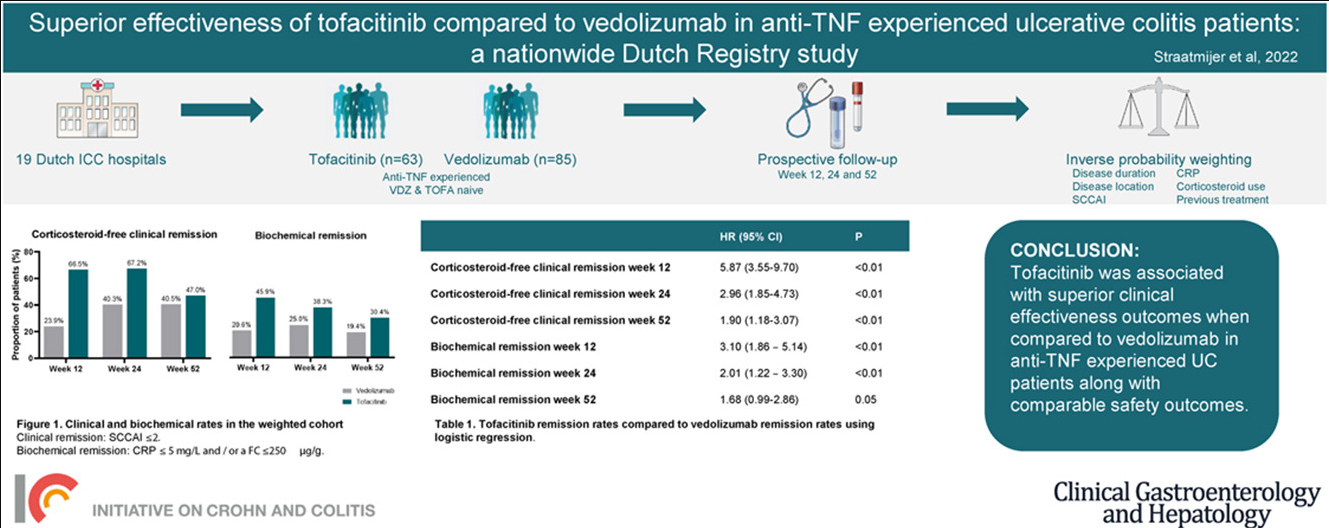
Related article: E Yelencich et al. Clin Gastroenterol Hepatol 2022; 20: 1282-1289. Open Access PDF: Avoidant Restrictive Food Intake Disorder Prevalent Among Patients With Inflammatory Bowel Disease In this cross-sectional study of adults with IBD, 28/161 (17%) had a positive ARFID risk score (>/=24). Most participants (92%) reported avoiding 1 or more foods while having active symptoms, and 74% continued to avoid 1 or more foods even in the absence of symptoms. Patients with a positive ARFID risk screen were significantly more likely to be at risk for malnutrition (60.7% vs 15.8%; P < .01)

Related blog post:

Afraid to Eat -Could be “Avoidant Restrictive Food Intake Disorder”
Increased Risk, Increased Reward (possibly) with Tofacitinib

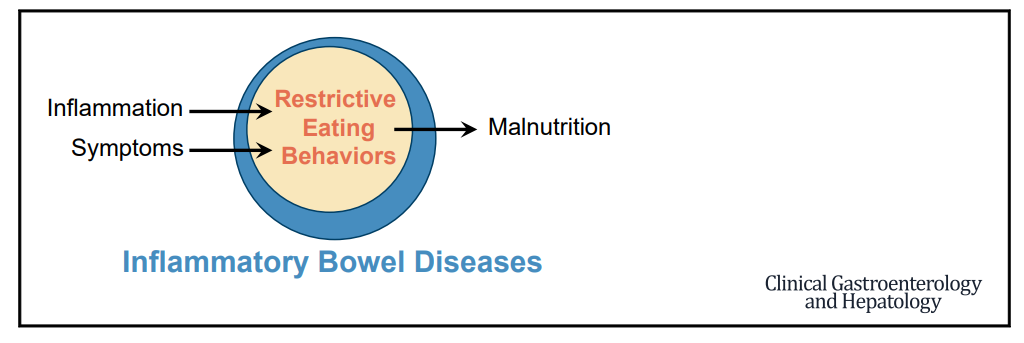
T Straatmijer et al. Clin Gastroenterol Hepatol 2022; Full text Pre-Proof PDF: Superior effectiveness of tofacitinib compared to vedolizumab in anti-TNF experienced ulcerative colitis patients: a nationwide Dutch Registry study. DOI:https://doi.org/10.1016/j.cgh.2022.04.038

Methods: Ulcerative colitis patients who failed anti-TNF treatment and initiated vedolizumab (n=83) or tofacitinib (n=65) treatment, were identified in the ICC Registry in the Netherlands.

Key findings:

  • Tofacitinib treated patients were more likely to achieve corticosteroid-free clinical remission and biochemical remission at week 12, 24 and 52 compared to vedolizumab treated patients (OR: 6.33, OR: 3.02, and OR 1.86 and OR: 3.27, OR: 1.87, and OR:1.81, respectively).
  • There was no difference in infection rate or severe adverse events.

My take: The response rates with tofacitinib were significantly better than vedolizumab at all time points; however, by 52 weeks, the differences were less pronounced. Nevertheless, the safety profile of vedolizumab is much more favorable than tofacitinib and this is a very important consideration.

Related blog posts -Tofacitinib:

Type 2 Diabetes in Children with Nonalcoholic Fatty Liver Disease

JB Schwimmer et al. Clin Gastroenterol Hepatol 2022; DOI:https://doi.org/10.1016/j.cgh.2022.05.028. Pre-proof full text PDF:Incidence of Type 2 Diabetes in Children with Nonalcoholic Fatty Liver Disease

Methods: Children with NAFLD (n=892) enrolled in the Nonalcoholic Steatohepatitis Clinical Research Network were followed longitudinally. These children had a mean age of 12.8 years followed for a mean of 3.8 years 

Key findings:

  • At baseline, 63 (of 892) children had T2D, and during follow-up, an additional 97 children developed incident T2D, resulting in a period prevalence of 16.8 %.
  • Incident T2D was significantly higher in females versus males (HR 1.8 [1.0-2.8]), associated with BMI z-score (HR 1.8), and more severe liver histology including steatosis grade (HR 1.3), and fibrosis stage (HR 1.3).

My take: Children/adolescents with NAFLD need to be monitored for the development of T2D.

Related blog posts:

Thanks to David for picture of Portland Head Lighthouse

Apple Adding Medication Tracker to iPhones

The Verge: Apple adds medication tracking feature to the Health app (6/6/22)

An excerpt:

Apple is adding a new tool to remind people to take medications to the iPhone health app, the company announced today…will let users add any drugs they take by either scanning a label on a medication bottle or searching through a list of medicines. People can create custom schedules for each drug they are taking and receive alerts to remind them when it’s time to take one.

In the United States, the app will also alert users if there are any dangerous interactions between the drugs that they take.

Related blog post: Presorted Pills -A Good Idea

Ahmyo Wine Garden, Santa Fe NM

GI Bleeding -Forrest Classification

My take: Good images on twitter for classification of ulcers/bleeding risk

Related blog posts:

Liver Update: Past Time to Split (2022) & Graft Fibrosis -Will the Liver Last?

In previous posts (see below), the benefits of split-liver transplantation has been discussed, chiefly reducing pediatric waitlist mortality. A recent study (MG Bowring et al. Liver Transplantation 2022; 28: 969-982. Survival Benefit of Split-Liver Transplantation for Pediatric and Adult Candidates) shows split livers improve survival for pediatric and adult recipients.

Methods:  The researchers sought to determine the survival benefit associated with accepting a splittable graft offer for SLT versus declining and waiting for a subsequent offer using 2010 to 2018 Scientific Registry of Transplant Recipients (SRTR) data on 928 pediatric and 1814 adult liver transplantation candidates who were ever offered a splittable graft

Key findings:

  • Among adult candidates, split liver offer acceptance was associated with a 43% reduction in mortality (aHR, 0.390.570.83 [P = 0.005]; 92.2% versus 84.4% 1-year survival after decision)
  • Among pediatric candidates ≤7 kg, split liver offer acceptance versus decline was associated with a 63% reduction in mortality (adjusted hazard ratio [aHR], 0.170.370.80 [P = 0.01]; 93.1% versus 84.0% 1-year survival after decision). Among pediatric candidates >7 kg, there was no significant difference associated with acceptance of a split liver offer (aHR, 0.631.071.82 [P = 0.81]; 91.7% versus 94.4% 1-year survival after decision)

My take: These findings should spur more efforts at incentivizing the use of split livers.

Unrelated article: ER Perito et al. Liver Transplantation 2022; 28: 1051-1062. Graft Fibrosis Over 10 to 15 Years in Pediatric Liver Transplant Recipients: Multicenter Study of Paired, Longitudinal Surveillance Biopsies

Key findings (n=78):

  • The first biopsy, at a median 8.2 years (interquartile range, 5.9-11.6 years) after transplantation, showed moderate (LAFSc 4-6) in 55%, and severe (LAFSc 7 or higher) in 3% of patients.
  • The second biopsy, at a median 4.7 years (IQR, 4.3-5.1 years) later, showed moderate (LAFSc 4-6) in 62%, and severe (LAFSc 7 or higher) in 5% of patients.. Thus, there was fibrosis progression (LAFSc increased by ≥3) in 10 (13%) and regression (LAFSc decreased by ≥3) in 4 (5%) patients.

Related blog posts:

Albuquerque, NM and a bridge over the Rio Grande

Targeted Therapy for Autoinflammatory Very Early Onset Inflammatory Bowel Disease

S Rudra et al. Clin Gastroenterol Hepatol 2022; 20: 1408-1410. Ruxolitinib: Targeted Approach for Treatment of Autoinflammatory Very Early Onset Inflammatory Bowel Disease

As we start to understand the genetic basis for some of the cases of very early onset inflammatory bowel disease (VEO-IBD), identifying effective targeted treatment is needed. For example, abatacept has been shown to be helpful for CTLA4 deficiency. The report cited above reports the experience of ruxolitinib for autoinflammatory phenotype (AIP) of VEO-IBD.

AIP was defined by persistent fevers, leukocytosis, elevation of at least 2 cytokines: sIL2R, IL8, IL6, CXCL9 or IFN-gamma.

Ruxolitinib is a selective JAK1/2 inhibitor which is approved for treatment of polycythemia vera, myelofibrosis, and graft-versus-host disease. As an aside, its retail cost (with 10 mg, #60) is ~$15,000 per month.

In this case report, 6 children with severe VEO-IBD were treated with average starting dose of 5.6 mg/m2/dose twice daily. Most were receiving dual therapy –3 patients were treated with IL1 blockade and 2 patinents with anti-TNF therapy.

Key findings:

  • Over 6-months, all patients had clinical response, especially with regard to fever and stool frequency
  • All patients had improvement in lab studies
  • Among the 3 with endoscopic followup, 1 had deep mucosal healing and 2 had endoscopic improvement
  • Three mild infections occurred while on treatment, but no bone marrow suppression was noted

My take: Patients with VEO-IBD represent a huge challenge. Trying to target specific therapies is difficult given that there are more than 70 monogenic defects that have been identified and many of the therapies are quite expensive (and difficult to get).

Related blog posts:

Near Santa Fe, NM

Wow, Your Liver Looks So Young!

I’ve had the good fortune to work with the same nurse, Bernadette, for 25 years. While I have joked with some patients, that in a few more years she will figure it all out, in fact, she has been terrific from day one. A few years ago, Bernadette enthusiastically told me that her physician had told her that she had the colon of a teenager; this sounds like a good thing.

I was thinking about this comment about younger body parts after reading a recent article from The Washington Post (6/6/22): Your liver is younger than you think

Key points/excerpts:

  • “Research in the journal Cell Systems reveals that humans’ livers are forever young, clocking in at less than three years old despite their hosts’ biological age…”
  • “Researchers studied the livers of 33 adults who were between ages 20 and 84 when they died…When the scientists dated the cells, they found an average age of about three years regardless of the age of the person who generated the cells. The hepatocytes “show continuous and lifelong turnover, allowing the liver to remain a young organ,” they write.”
  • “Ninety-five percent of the cells with two complete sets of chromosomes turned over within a year, but up to 12 percent of a cell subtype that have more than one pair of chromosomes can survive up to a decade.”
  • “Our bodies produce about 700 million hepatocytes each day — not bad for a three-pound organ.”

My take: The liver is amazing and can stay young even when in older bodies.

Related blog post: Why the Liver is the King of Internal Organs

Tirzepatide: Promotes Impressive Weight loss

Source Study: AM Jastreboff et al NEJM 2022; DOI: 10.1056/NEJMoa2206038. Tirzepatide Once Weekly for the Treatment of Obesity

USA Today (6/6/22): Diabetes drug helps patients lose never-before-seen amounts of weight, study shows

An excerpt:

The drug, called tirzepatide, works on two naturally occurring hormones that help control blood sugar and are involved in sending fullness signals from the gut to the brain...Those taking the highest of three studied doses lost as much as 21% of their body weight – 50-60 pounds in some cases…

Another obesity treatment approved last year called semaglutide, from Novo Nordisk, provides an average of up to about 15% weight loss. Previous generations of diet drugs cut only about 5% of weight and many carried prohibitive side effects…

About 15% of participants who received the active drug dropped out of the 72-week trial, about a third because of gastrointestinal side effects. Twenty-six percent of trial volunteers who received a placebo dropped out.

On May 13, the Food and Drug Administration approved tirzepatide, under the trade name Mounjaro, for the treatment of Type 2 diabetes…The new tirzepatide trial, called SURMOUNT-1, included more than 2,500 volunteers [without diabetes]…Nine out of 10 lost weight, and on the highest dose, 15 mg, they lost an average of 52 pounds each...

It’s too soon to know what price Lilly will set for tirzepatide. Mounjaro, the same drug used to treat diabetes at the same doses, retails for almost $1,000 a month…Semaglutide went on the market last year for weight loss and has been in short supply ever since, Rind said. It costs about $1,600 a month for the 2.4 mg weight loss dose, which is higher than the 1 or 2 mg doses used to treat diabetes. Like other weight loss drugs, semaglutide isn’t covered by many insurance plans. 

My take: This therapy, already approved for Type 2 Diabetes, appears promising for obesity but costly. More time will be needed to understand the safety profile with extended use.

Related blog post: Are We On the Verge of Pharmacologic Management of Obesity (Again)?

Atalaya Hike, Santa Fe, NM