How Long is Acetylcysteine Needed for Acetaminophen Overdose?

A recent open-label “NACSTOP trial” (A Wong et al. Hepatology 2019; 69: 774-84) examined a 12-hour regimen of acetylcysteine in patients at lower risk for severe hepatotoxicity from acetaminophen overdose.

Background/Methods: Intravenous acetylcysteine is generally delivered as 300 mg/kg over 20 hours in “nearly every patient deemed at any risk for hepatotoxicity following acetaminophen overdose.” Administration within 8 hours of an acute single acetaminophen overdose prevents hepatotoxicity in nearly all patients.

In this study, patients with normal serum alanine transaminase (ALT) and normal creatinine at presentation and at 12 hours along with acetaminophen level of <20 mg/L at 12 hours were assigned to either a 12 hour (250 mg/kg) or 20 hour (300 mg/kg) acetylcysteine (IV) infusion.

1411 Acetaminophen overdoses were identified; of these, 449 met criteria for study participation. 100 patients out of these 449 eligible were enrolled.

Key findings:

  • There was no difference in ALT or INR at 20 hours between the two groups.
  • No hepatotoxicity was evident in either group. 96 of 96 were well at 14-day telephone followup.

Discussion: “A normal ALT on  presentation has a high negative predictive values (100%) of individuals developing any serious liver injury (ALT >1000 IU/L) in those receiving acetylcysteine.” [Al-Hourani et al. QJM 2013; 1065: 541-6)

My take: This study shows that a shortened acetylcysteine infusion is likely safe in selected patients at low risk for hepatotoxicity.

Related blog posts:

Disclaimer: These blog posts are for educational purposes only. Specific dosing of medications/diets (along with potential adverse effects) should be confirmed by prescribing physician/nutritionist.  This content is not a substitute for medical advice, diagnosis or treatment provided by a qualified healthcare provider. Always seek the advice of your physician or other qualified health provider with any questions you may have regarding a condition

Joshua Tree National Park


Liver Shorts Feb 2019

ZM Younossi et al. Hepatology 2019; 69: 564-72. This study, using Markov models for nonalcoholic steatohepatitis (NASH), estimated that there are 6.65 million adults with NASH in the U.S. and that lifetime costs will be $.222.6 billion.

Y Chang et al. Hepatology 2019; 69: 64-75.  This study with 58,927 Koreans with non-alcoholic fatty liver disease (NAFLD), found that nonheavy alcohol consumption was “significantly and independently associated with worsening of noninvasive markers of fibrosis, indicating that even moderate alcohol consumption might be harmful.”

Related blog posts:

KA Forde et al. Hepatology 2019; 69: 270-81.  This study examined screening for hepatopulmonary syndrome (HPS) in patients (n=363) evaluated for liver transplantation (LT). It found that pulse oximetry had low sensitivity for detecting HPS. Overall, 21% of the cohort had HPS. “We found that pulse oximetry essentially performed no better than chance (i.e.. a ‘coin flip’) in the discrimination of patients with HPS from all-comers.” 18% of patients with an SpO2 of 96% or higher had HPS. Based on their findings, the authors recommend that routine screening of LT candidates include ABG and contrast-enhanced echocardiograpy.

From Joshua Tree National Park..Gorgeous views from Ryan Mountain

Teaching an Old Liver New Tricks

A recent retrospective study (JD de Boer et al. Liver Transplantation 2019; 25: 260-74) helps address the question of whether/when a geriatric liver is too old for donation.

The authors culled data from 2000-2015 from 17,811 first liver transplantations performed in the Eurotranplant region.

Key findings:

  • 2394 (13%) transplants were performed with livers ≥70 years old
  • Graft survival was reduced from donors with a history of diabetes (HR 1.3) and in recipients with hepatitis C virus (HCV) antibody (HR 1.5)
  • “Although donor age is associated with a linearly increasing risk of graft loss between 25 and 80 years old, no differences in graft survival could be observed when “preferred” recipients were transplanted” with older grafts (HR 1.1).
  • Preferred recipients: 1. HCV-Ab neg, 2. Recipient >45 years old, 3. BMI <35 kg/m2, 4. cold ischemia time < 8 hours. 26% of recipients were considered “preferred” recipients
  • Utilization of livers from donors ≥70 years old increased from 42% (2000-2003) to 76% (2013-2015).
  • The median donor age increased from 42 to 55 years old from 2000 to 2015.
  • The oldest transplanted liver was 98 years old!

The overall Kaplan-Meier survival curves are given in Figure 2 and there is a clear trend of better graft and patient survival with donors <70 years of age.  However, Figure 4 shows that graft survival with “preferred” recipients was essentially identical when comparing grafts from donors <70 compared to >70.  However, when comparing graft survival from donors <40 compared to donors >70, there appeared to be a small advantage for the younger organs, though this did not meet statistical significance. (HR 1.2 CI 0.96-1.37).

My take: Given the shortage of available livers, the use of older donor organs is a necessity and can be accomplished without significant loss of grafts in selected patients.

Related blog posts:

Joshua Tree National Park


Tackling High Drug Costs -Lessons from Australia and Brazil

In two related commentaries referenced below, the authors detail how Australia and Brazil managed to provide a blockbuster hepatitis C virus (HCV) medication without following the going-broke example of Blockbuster video stores.

  • Australia: S Moon et al. NEJM 2019; 380: 607-9
  • Brazil: EM da Fonseca et al. NEJM 2019; 605-6.

Australia provided a lump-sum payment of approximately 770 million dollars (in U.S.) over 5 years in exchange for an unlimited volume of direct-acting antivirals (DAAs). As a result of this approach, Australia managed to treat many more patients at a much lower cost.  “The government would have to spend …U.S. $4.92 billion more to treat the same number or it could treat 93,000 fewer patients with a fixed budget” of approximately U.S. $766 million.

With the Australian approach, the authors note that it is analogous to a patent buyout and works if the ongoing drug manufacturing cost is low and the manufacturer is able to meet growing volume demand.

Brazil’s approaches for DAAs relied on either threatening loss of patent protections and/or enabling local generic production of sofosbuvir.  This resulted in ~90% price discount. Patent protection in Brazil is granted only if a medication is approved by both INPI (Instituto Nacional da Propriedade Industrial) and ANVISA (Brazilian Health Regulatory Agency).

My take: Given the rising costs of medicines, examining how other countries surmount these financial barriers is important.  In my view, the often arbitrary and exorbitant pricing by pharmaceutical companies will erode the support of protective policies in the U.S. which thus far has helped produce many advances.

Skull Rock, Joshua Tree National Park


Why Fiber Matters?

A recent review article (J O’Grady et al. Aliment Phamacol Ther; 2019; 49: 506-15) highlights how fiber is important for health and its potential role in fostering a diverse microbiome. Some of the material has been covered before in a previous blog/presentation: It’s Alimentary!  “The Fiber Movement: Why Kids Need It and How to Get It” by Maria Oliva-Hemker .

In the introduction, the authors note that there had been a period of disappointment that fiber did not seem to help irritable bowel syndrome.  Though with expanding knowledge of the diet-, microbiome- host interactions, clinicians have started to appreciate the health impact of dietary fiber.

In subsequent sections, the authors detail the different types of fiber based on solubility, viscosity and fermentation.

Key actions of fiber:

  • Anti-inflammatory effects
  • Immune system modulation
  • Regulation of cell proliferation and differentiation
  • Richer microbiome diversity (may lower risk of C difficile)

The authors note that a low-fiber diet in germ-free mice can result in a reduced microbial diversity and interestingly, the “missing taxa is transmitted to subsequent generations” even if fiber is re-introduced.

Potential beneficial fiber effects beyond bulking up stools:

  • Reduced adiposity
  • Lower metabolic disease including lower cholesterol and better glucose metabolism
  • Lower incidence of chronic inflammatory diseases
  • “Potential for fiber to prevent… diverticular and neoplastic disorders”

Western Diet is Deficient in Fiber.

  • Recommendations for fiber intake of 14 g per 1000 kcal consumed, which equates to approximately 25 g for females and 38 g for males (depending on energy intake).
  • In underdeveloped countries and historically, intakes are more than 50 g (in Africa) and up to 100 g/day in ancestral humans
  • Actual intake in U.S. is only 12-18 g/day.

The authors recommend efforts to gradually titrate increased fiber in the diet as abrupt changes may be poorly tolerated due to gas and bloating.

My take: This article explains that the connection between fiber intake and a number of health outcomes is likely due, at least in part, to its modulation of the microbiome. Thus, fiber is important for much more than a good poop.

Related blog posts:

NY Times: Five Things I Wish I’d Known Before My Chronic Illness

A recent article describes some of the challenges of dealing with Crohn’s disease (thanks to Kayla Lewis for pointing out this reference).

NY Times: Five Things I Wish I’d Known Before My Chronic Illness

Key Points:

  • Your relationships change” “It’s hard to be a good employee when you need extended time off. It’s hard to be a good friend when you cancel plans last minute. It’s hard to be a good partner or parent when you barely have the energy to get out of bed. “
  • Everyone offers you advice” “So unless someone asks for your advice, don’t offer it. If you’re on the receiving end of misguided advice, say something like, “I appreciate that you’re trying to help, but my doctors and I think this treatment is best right now” or “There’s no known cure for my disease, but I’d love if you donated toward the research to find one!”
  • You have to educate yourself — and everyone else
  • Support is everything”  Online communities can be helpful. ” The Crohn’s and Colitis Foundation has resources to help you find one. For a sometimes embarrassing “bathroom disease” like IBD, this is especially vital.”

Joshua Tree National Park
Economic Costs of Gluten Free Diet

A recent study (AR Lee et al. Nutrients; 2019, 11, 399). Open access: Persistent Economic Burden of the Gluten Free Diet) quantifies the additional costs of a gluten free diet (GFD) in the U.S. Thanks to Kipp Ellsworth for this reference.

The authors conducted a “market basket” study to establish the cost of a GFD. “A market basket is a group of products that are purchased by consumers …for this study, the market basket was food that would necessitate a GF substitute, including staple foods, snack foods, and commonly used ready-made or convenience meals.”

Key findings:

  • GF products were more expensive, overall the increase was 183%.  This is an improvement from a 2006 study which found the increase overall at 240% (adjusted for inflation).
  • Mass-market products were 139%  more expensive than wheat-based versions

Discussion:

  • Cost is identified as a frequent reason for nonadherence with diet, cited by 33% in one study
  • Overall, the burden of GFD is more frequently related to the restrictive nature of the diet which leads to a negative impact on quality of life. According to the authors, in one study (Am J Gastroenterol 2014; 109: 1304-11), treatment burden for celiac was ranked higher than for diabetes hypertension, and congestive heart failure

My take: This study shows the significant economic burden of a GFD.  In Italy, the  “government offers celiac patients vouchers to buy gluten-free food — up to 140 euros per month.” (NPR: Italy, Land of Pizza and Pasta)

Related blog posts:


AAP -Behind the Scenes 2019

The Georgia Chapter of the American Academy of Pediatrics (AAP) had a recent Board of Directors meeting.  There is a core group of pediatricians and pediatric specialists who, in conjunction with the AAP staff, work to improve the health of children. This includes arranging conferences, working with legislators, identifying regulatory issues and promoting best practices.  The Board of Directors meeting helps guide the chapter’s work.  This year’s meeting covered a lot of ground.  Two of the presentations provided information from the composite medical board and ABP certification/MOC.

The first presentation discussed the following:

  • -How physicians get into trouble: not completing CME credits, drug use, inappropriate contact with patients.  A new issue is not registering for PDMP (prescription drug monitoring program).  If a physician is not in compliance, they will be fined $3000 and reported to national database.
  • -Issue of lack of physician access in rural areas.
  • -High debt of physicians completing medical school and loan repayment programs to encourage physicians to locate in underserved areas.

The second presentation by Anna Kuo and Brad Weselman focused on changes in ABP’s MOC process, including the introduction of MOCA-Peds.  The goal of the changes is to make MOC process more relevant in improving practice.

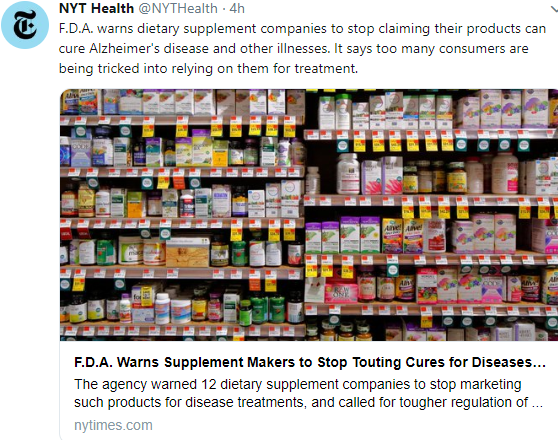
FDA’s Very Limited Ability to Regulate Dietary Supplements

NY Times: Supplement Makers Touting Cures for Alzheimer’s and Other Diseases Get F.D.A. Warning

An excerpt:

The Food and Drug Administration on Monday warned 12 sellers of dietary supplements to stop claiming their products can cure diseases ranging from Alzheimer’s to cancer to diabetes.

At the same time, Dr. Scott Gottlieb, the agency’s commissioner, suggested that Congress strengthen the F.D.A.’s authority over an estimated $40 billion industry, which sells as many as 80,000 kinds of powders and pills with little federal scrutiny…

The F.D.A.’s oversight is based on a 1994 federal law, which imposed minimal reporting and labeling requirements on the makers of vitamins, minerals and herbs — a fledgling industry at the time. To prevent a company from selling a product, the law requires the F.D.A. to prove that it is unsafe

There are now between 50,000 and 80,000 dietary supplements on the market, according to the F.D.A. The agency also says that three of every four American consumers now take a dietary supplement regularly.

Related blog posts: