One Bad Apple Spoils the Bunch

A recent NY Times article highlights the end of a renowned food-scientist Brian Wansink’s career at Cornell which “came to an unceremonious end. On Sept. 20. The university announced that a yearlong investigation had found that he committed “academic misconduct in his research and scholarship, including misreporting of research data,” and that he had tendered his resignation.”  This commentary highlights other problems with nutrition studies: More Evidence That Nutrition Studies Don’t Always Add Up

My take: Nutrition studies are difficult –having academic misconduct is going to further undermine the credibility of these studies.

IBD Shorts October 2018

C Ma et al. Clin Gastroenterol Hepaatol 2018; 16: 1407-19.  This study examined endpoints in randomized controlled trials (RCTs) of Crohn’s disease.  Key finding: Among 116 included RCTs (n=27,263 patients), there were 38 unique definitions of clinical response or remission and 32 definitions of loss of response. The most common endpoint was CD activity index.

RP Hirten et al. Clin Gastroenterol Hepatol 2018; 16: 1374-84. This review examines the topic of combining biologics in inflammatory bowel disease. Currently, there is little data in IBD.  From studies completed in rheumatology and dermatology, there are some safety concerns. One current study, the EXPLORER study, which is a phase 4 open label trial evaluating the use of vedolizumab in combination with adalimumab and methotrexate, will provide some useful information.  With regard to safety, gut-specific anti-integrin therapies are likely to be safer in combination than other biologic therapies.

RJ Colman et al. Inflamm Bowel Dis 2018; 24: 2135-41.  This systematic review and meta-analysis which included 14 eligible studies showed that the pooled clinical remission rate with methotrexate monotherapy for pediatric Crohn’s disease was 57.7% at 3-6 months and 37.1% at 1 year.

AA Wren et al. Inflamm Bowel Dis 2018; 24: 2093-2105. This study with 93,668 patients in a cohort from Truven MarketScan Database (2007-2015) identified a high rate of opioid therapy usage in U.S. adolescents and young adults (15-29 year olds).  Annual prevalence of chronic opioid use was 9.3% in 2007 and peaked at 12.2% in 2011. In 2015, the prevalence dropped to 10.8%.  Overall, 18.2% had received chronic opioid therapy.  Among the 2503 with chronic opioid usage who were followed longitudinally, 30.5% received opioids for 2 years and 5.3% for 4 years. The associated editorial (ME Kuenzig, EI Benchimol, pg 2140-5) note that these prevalence data may underestimate the true rate of opioid use due to the case definition of IBD used when analyzing the administrative data.

Lake Moraine, Banff

Losing the Obesity Battle Early in Life

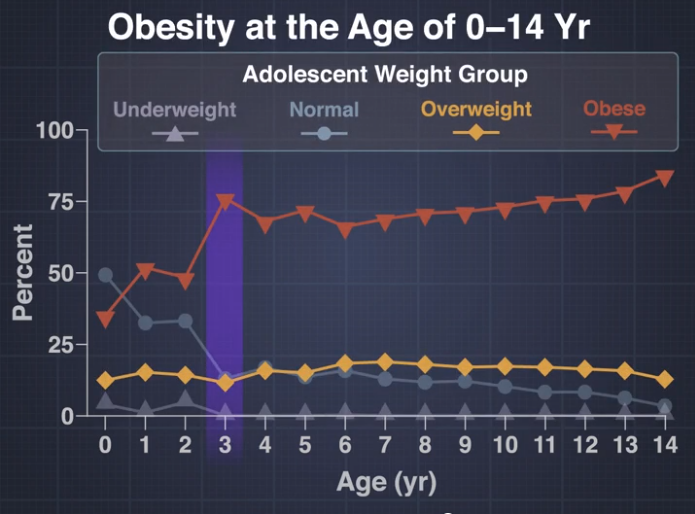
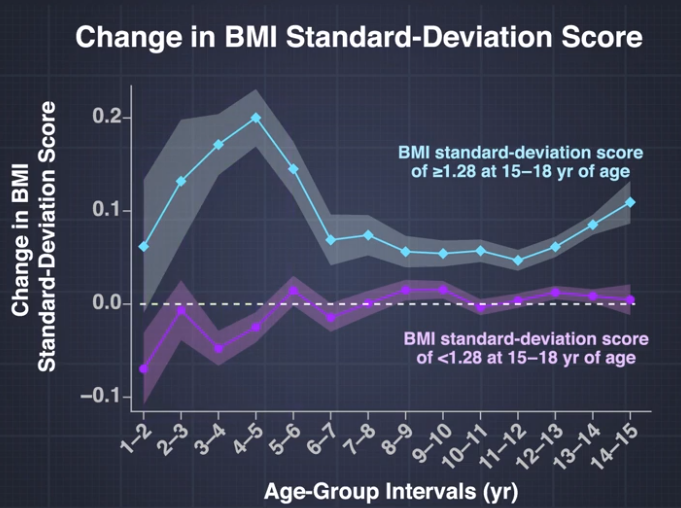
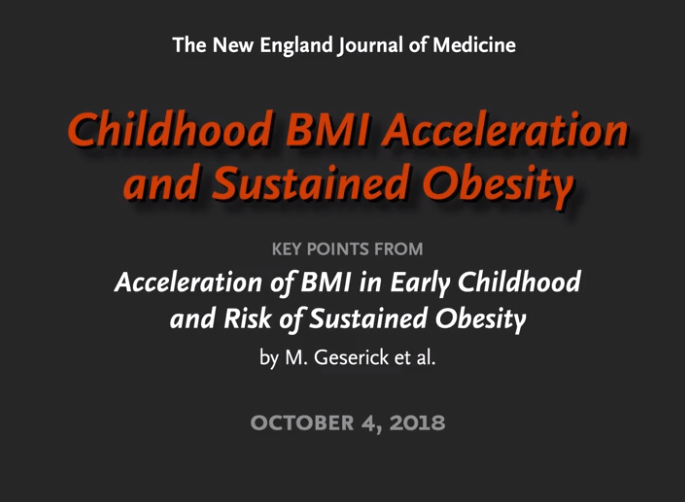
A recent study (M Geserick et al. NEJM 2018; 379: 1303-12) performed a prospective and retrospective analysis of a population-based sample of 51,505 German children to examine BMI in early childhood and risk of sustained obesity.

Key findings:

  • Most normal weight adolescents had a normal weight throughout childhood
  • Half (53%) of the obese adolescents had been overweight or obese from 5 years of age onward
  • Almost 90% of children who were obese at 3 years of age were overweight or obese in adolescence
  • Among obese adolescents, the most rapid weight gain had occurred between 2 and 6 years of age

My take: We are losing the childhood obesity battle at very young ages.

Abstract and Link to 1:32 Quick Summary: Acceleration of BMI in Early Childhood


Mental Health of Medical Students

It is well-recognized that there is a high rate of burnout and even suicides among physicians.  The concern regarding mental health extends to medical students.  According to a recent commentary (JF Karp, AS Levine. NEJM 2018; 1196-8), “despite entering medical school with relatively good mental health, medical students become depressed, burned out, and suicidal at alarming rates.”  This is thought to be due to “demanding schedules, cost, and stigma” to obtain mental health services.

The editorial advocates for medical students: “Working closely with the physician-services divisions of large hospital systems may help schools and hospitals leverage resources and provide shared opportunities to improve the care of students, trainees, and faculty and staff physicians.”

Related blog posts on burnout:

Frpm NEJM twitter feed

What to Do About Bile Reflux Gastritis?

A recent review (ME McCabe, CK Dilly. Clin Gastroenterol Hepatol 2018; 16: 1389-92) provides useful information on bile reflux gastritis.

The authors note that bile reflux gastritis is “increasingly found in individuals without prior gastric surgery, a problem termed ‘primary biliary reflux.'”

Key points:

  • Most often bile reflux gastritis occurs due to prior surgery affecting pylorus, dysmotility, after cholecystectomy (due to loss of bile reservoir), and after biliary sphincterotomy (due to increased biliary flow).
  • Suggested treatments (Figure 5) -are limited by lack of evidence but the following are recommended by the authors: remove offending medications (eg. agents that affect peristalsis) –>proton pump inhibitors –>ursodeoxycholic acid –>sucralfate –>combination therapy –>surgical diversion of bile (generally reserved in those with surgically-induced bile reflux)

Is it Helpful to Check Celiac Serology Titers After 3 Months of a Gluten Free Diet?

A recent prospective study (D Petroff et al. Clin Gastroenterol Hepatol 2018; 16: 1442-49) with 345 pediatric patients with biopsy-proven celiac disease (CD) examined serologic response to a gluten-free diet (GFD) between 2012-2015.

Key findings:

  • Mean TTG IgA concentration decreased 14-fold after 3 months of a GFD.  The study assay used kits from EUROIMMUN.
  • TTG IgA remained above 1-fold ULN in 83.8% and above 10-fold ULN in 26.6%.
  • Deamidated gliadin IgA (DGL IgA) decreased in the vast majority but did not distinguish response of GFD from random fluctuations.
  • The authors note that symptoms improved in most on GFD, but short-term response could reflect “regression to the mean…for a considerable share” as symptoms improved in the non-GFD group as well.

In their discussion, the authors reference a large study (n=487) which showed mean normalization of TTG IgA of ~400 days; longer times were noted in those with type 1 diabetes and higher baseline values.

My take: This study, while showing that TTG IgA levels improve after 3 months of a GFD, helps solidify my opinion that in those who are improving, followup serology could be obtained later.  My practice is to have followup serology after 6 months of a GFD in the majority of patients.

Related blog posts:

Lake Moraine, Banff

DILI, DILI -Two Studies on Drug-Induced Liver Injury

A Benesic et al. Clin Gastroenterol Hepatol 2018; 16: 1488-94. This prospective study found that monocyte-derived hepatocyte-like (MH) cells isolated from patients could be used to test and identify drugs that triggered acute liver injury.  Among 40 patients, 13 patients had 10 drugs identified which were toxic to MH cells.  Overall, they reported the MH test as having a 92% sensitivity and 100% specificity.

I Medina-Caliz et al. Clin Gastroenterol Hepatol 2018; 16: 1495-1502. Using the Spanish DILI registry (1994-2016), the authors identified 32 of 856 cases of DILI that were due to dietary supplements.  Patients were more often female (63%), and had a mean ALT level 37-fold above ULN.  3 patients (9.4%) progressed to acute liver failure. Many of these supplements were promoted as helpful for weight loss. The authors speculate that reported cases of DILI due to herbal supplements are ‘the tip of the iceberg’ due to under-reporting of cases.

Related blog posts:

Lake Moraine, Banff

Do Biologics Alter the Natural History of Crohn’s Disease in Children?

An important recent study (B Kerur et al. Clin Gastroenterol Hepatol 2018; 16: 1467-73 & editorial C Ballengee S Kugasthasan 1398-1400) examined the impact of biologic therapies on Crohn’s disease progression and need for surgery in 1442 children (age, ≤16 y) between 2002-14. This study examined data from the Pediatric Inflammatory Bowel Disease Collaborative Research Group registry.

Key findings:

  • Early use of biologics (n=145) was associated with slowing of disease progression (hazard ratio 0.85, CI 0.76-0.95).  Those who received anti-TNF therapy within three months of diagnosis were less likely to develop stricturing (B2) or penetrating (B3) disease.
  • Early anti-TNF therapy did not effect progression to surgery. Surgery rates were 4% at 1 year, 13% at 5 years, and 26% at 10 years.
  • Of those who needed surgery, ~15% already had their first bowel-related surgery in the first 90 days after diagnosis.
  • The study cohort at diagnosis included only 51 with B2 disease, 27 with B3, and 11 with both B2 & B3.  Thus, these three disease phenotypes represented ~6% of the entire cohort.

In the editorial, the authors state that this study “is a sobering reminder that we apparently have not changed the long-term course of CD for our pediatric patients.”  Though, at the same time, they explain how this study had some limitations which could have affected some of the conclusions.

  • In contrast to the RISK study, this study classified patients as B1 who progressed to B2 or B3 in the first 3 months of diagnosis.  Including these patients decreased the chance to show improvement with early biologic therapy.
  • Also, this cohort included a lower percentage of African American patients compared to the RISK study (8% vs 13%).  This also lowered the likelihood of identifying improvement;  these patients are more likely to develop penetrating disease which can be prevented with early biologic therapy (RISK study: Kugasthasan S et al. Lancet 2017; 389: 1710-8).

Also, one other finding of the study was that there was a paradoxical increase in the risk of surgery in the first 5 years in the early biologic group. “This suggests that our practicing pediatric gastroenterologists may have selected the sicker patients to start biologics.”

My take: I think biologics do influence the natural history of Crohn’s disease in children.  However, this study suggests that the magnitude of that alteration is suboptimal.

Related blog post: CCFA update 2017 -RISK study presentation