Unbound Bilirubin and Prematurity

A recent prospective study (SB Amin, H Wang. J Pediatr 2018; 192: 47-52) indicates that premature infants have lower bilirubin binding affinity which could place them at risk for neurological complications.

Background: Very high levels of unconjugated bilirubin can lead to bilirubin-induced neurotoxicity/kenricterus.  There is increased susceptibility in newborns, particularly premature infants.  Unbound bilirubin (not bound to protein) can cross blood-brain barrier.  However, unbound bilirubin, rather than total serum bilirubin, is a better predictor of abnormal neurological outcomes.

Key findings:

  • Among 166 infants, peak unbound bilirubin significant correlated with bilirubin-albumin binding affinity (Ka) (r=-0.44, P=.001)
  • Gestational age was a significant modifier for the association between Ka and peak unbound bilirubin.
  • Peak unbound bilirubin was primarily associated with a decrease in binding affinity in infants ≤30 weeks gestational age

Implications of study: “Phototherapy as a sole intervention may be insufficient in preventing or reducing bilirubin-induced neurotoxicity”

My take: If there is low bilirubin binding affinity, among premature infants ≤30 weeks gestational age, some neurologic toxicity could occur even with bilirubin levels that have been considered safe previously.

Related blog posts:

Bright Angel Trail, Grand Canyon

Legalized Cannabis Associated with Increased Vomiting and Dependency But What About Alcohol?

In politics, one hears a lot of “What about?”  If a problem is identified, many times a politician will try to divert the focus and/or justify a contentious issue to a related issue with a “what about” question. In medicine, when we see problems with marijuana, one could ask, ‘What about alcohol?’

A recent retrospective study (M Al-Shammari et al. Clin Gastroenterol Hepatol 2017; 15: 1876-81) found an increase in cannabis dependency unspecified (CDU) (ICD code) coinciding with the legalization of marijuana. Thanks to Seth Marcus for pointing out this study.

Key finding:

  • “We observed an increasing trend of CDU or an aggregate of CDU and persistent vomiting…the legalization of marijuana significantly increased the incidence rate during the legalization period (by 17.9%)…compared to the prelegalization period.

Related article: Aaron Carroll Alcohol or Marijuana? A Pediatrician Faces the Question

An excerpt:

The immediate answer, of course, is “neither.” …

The easy answer is to demonize marijuana. It’s illegal, after all. Moreover, its potential downsides are well known. Scans show that marijuana use is associated with potential changes in the brain. It’s associated with increases in the risk of psychosis. It may be associated with changes in lung function or long-term cancer risk, even though a growing body of evidence says that seems unlikely. It can harm memory, it’s associated with lower academic achievement, and its use is linked to less success later in life.

But these are all associations, not known causal pathways…

When I’m debating my answer, I think about health as well…Binge drinking accounted for about half of the more than 80,000 alcohol-related deaths in the United States in 2010, according to a 2012 report by the Centers for Disease Control and Prevention. The economic costs associated with excessive alcohol consumption in the United States were estimated to be about $225 billion. Binge drinking, defined as four or more drinks for women and five or more drinks for men on a single occasion, isn’t rare either. More than 17 percent of all people in the United States are binge drinkers, and more than 28 percent of people age 18 to 24…

Marijuana, on the other hand, kills almost no one…

I think about which is more dangerous when driving. A 2013 case-control study found that marijuana use increased the odds of being in a fatal crash by 83 percent. But adding alcohol to drug use increased the odds of a fatal crash by more than 2,200 percent. A more recent study found that, after controlling for various factors, a detectable amount of THC, the active ingredient in pot, in the blood did not increase the risk of accidents at all. Having a blood alcohol level of at least 0.05 percent, though, increased the odds of being in a crash by 575 percent…

 In 1995 alone, college students reported more than 460,000 alcohol-related incidents of violence in the United States… On the other hand, a 2014 study looking at marijuana use and intimate partner violence in the first nine years of marriage found that those who used marijuana had lower rates of such violence…

[Thus]  if I’m forced to make a choice, the answer is “marijuana.”

My take: While the cited study shows a correlation between cannaboid legalization with both CDU and increased vomiting, the commentary by Dr. Carroll helps provide context to the risks of marijuana use.  From a safety standpoint, the risks posed by alcohol appear much greater.

Related blog posts:

Bright Angel Trail, Grand Canyon

Medication Manager Apps

From Cincinnati Children’s Staff Bulletin: A review of medication manager apps

My take: I have not tried the apps below.  I do think ‘old school’ products like weekly pill boxes can be very useful.

An excerpt:

For some families, medication apps can help them establish a routine of taking medication at the same time each day. For others, the app acts as a reminder every once in a while when the family has a really busy day and may have forgotten otherwise.

Possible Features
MyMedScheduleMobile Mango Health Medication Manager
MedCoach Medication Reminder MediSafe Meds & Pill Reminder
Alerts you to take meds  X X X
Prescription refill reminders  X
Connect with pharmacy to refill prescriptions  X  X
Track progress  X  X
Create medication schedules  X  X
Create list of medications for doctor  X  X
Synchronizes with other family members  X
Drug interaction warnings  X
Gives points and rewards  X
FREE  X  X  X  X


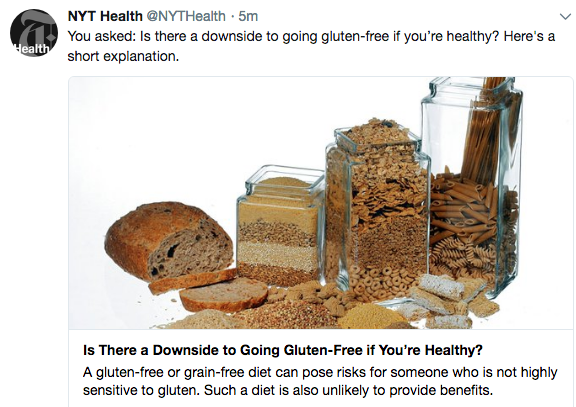
“Is There a Downside to Going Gluten-Free if You’re Healthy?” Yes

From NY Times: Is There a Downside to Going Gluten-Free if You’re Healthy?

Yes. This short commentary explains a lot of reasons why going gluten-free is not a great idea for healthy individuals.

  1. Often, a gluten-free diet incorporates more fat, more sugar, more salt and less fiber –all bad for your health.  A gluten-free diet can increase the risk of weight gain, type 2 diabetes, and cardiovascular disease.
  2. A gluten-free diet may make definitive testing for celiac disease inaccurate after more than a few weeks.
  3. “While much has been written in books and online sources about the purported benefits of avoiding gluten, such as weight loss, cognitive well-being and overall wellness, these claims are not supported by evidence….Though some patients with irritable bowel syndrome, or I.B.S., may see symptoms improve after cutting out gluten-containing foods, research suggests it’s likely to be a result of something other than gluten.”

My take (borrowed): “There’s no reason for someone who feels well to start a gluten-free diet to promote wellness,” said Dr. Benjamin Lebwohl, director of clinical research at the Celiac Disease Center at Columbia University. “It is not an intrinsically wellness-promoting diet.”

Related blog posts:


Overweight Children (like Adults) Are Prone to Underestimate Their Body Size

Reference: Steinsbekk Silje, Klöckner Christian A., Fildes Alison, Kristoffersen Pernille, Rognsås Stine L., and Wichstrøm Lars. Body Size Estimation from Early to Middle Childhood: Stability of Underestimation, BMI, and Gender Effects. Front. Psychol., 21 November 2017. DOI: 10.3389/fpsyg.2017.02038

This recent study examined how children perceive their own body size.  Given the prevalence of overweight/obesity, an accurate understanding of body size is needed if one is going to try to work on this issue.

An excerpt of a summary from Brinkwire: Overweight children more likely to underestimate their body size

The study is based on data from the Norwegian research project Tidlig Trygg i Trondheim, a longitudinal population-based study that looks at the risk and protective factors contributing to children’s psychological and social health…

The children were shown seven pictures of girls and boys with known body mass index and asked which picture looked the most like them. The researchers then calculated the difference in BMI between the figure identified by the children and the children’s own BMI based on measured height and weight…

Generally, the researchers found that children more often underestimated than overestimated the size of their body, although the majority made accurate estimates…

“We also found that the higher the children’s BMI, the more they underestimated their size over time,” Steinsbekk says.

The largest children thus underestimated their body size the most and showed an increased degree of underestimation over time (that is, from 6 to 8 and from 8 to 10 years old).

My take: Given the prevalence of overweight/obese children, this has skewed our perception of what a normal weight should be.

Related blog post: Can parents not know if their child is overweight?

Bright Angel Trail, Grand Canyon
Ketchup Packet Ingestion–Crohn’s Disease Mimic

In the category of –“I have not seen that before”…

Link: NY Daily News Women diagnosed with Crohn’s disease actually had ketchup packet in her intestines for six years (Thanks to my son for pointing out this story)

An excerpt:

A woman believed she was suffering from Crohn’s disease for six years until doctors performed surgery and discovered a ketchup packet in the lining of her intestine.

The 41-year-old patient had symptoms consistent with the serious bowel disease — including acute abdominal pain and bloating lasting up to three days — but she did not respond to the standard treatments.

Case study reference: Visagan R, et al. BMJ Case Rep 2013. doi:10.1136/bcr-2013-009603

Related blog post: Add it to the list


Why Fiber (Fruits and Veggies) is Good for You

A recent NY Times piece provides a summary of recent studies in mice which show that a low fiber diet promotes inflammation throughout the body and results in changes in the microbiome: Fiber is Good For You. Now Scientists May Know Why

An excerpt:

A diet of fiber-rich foods, such as fruits and vegetables, reduces the risk of developing diabetesheart disease and arthritis. Indeed, the evidence for fiber’s benefits extends beyond any particular ailment: Eating more fiber seems to lower people’s mortality rate, whatever the cause…

The ability of these bacteria to survive on fiber we can’t digest ourselves has led many experts to wonder if the microbes are somehow involved in the benefits of the fruits-and-vegetables diet. Two detailed studies published recently in the journal Cell Host and Microbe provide compelling evidence that the answer is yes.

In one experiment, Andrew T. Gewirtz of Georgia State University and his colleagues put mice on a low-fiber, high-fat diet… the scientists were able to estimate the size of the gut bacterial population in each mouse. On a low-fiber diet, they found, the population crashed, shrinking tenfold.

Dr. Bäckhed and his colleagues carried out a similar experiment, surveying the microbiome in mice as they were switched from fiber-rich food to a low-fiber diet…Along with changes to the microbiome, both teams also observed rapid changes to the mice themselves. Their intestines got smaller, and its mucus layer thinner. As a result, bacteria wound up much closer to the intestinal wall, and that encroachment triggered an immune reaction…

“It points to the boring thing that we all know but no one does,” Dr. Bäckhed said. “If you eat more green veggies and less fries and sweets, you’ll probably be better off in the long term.”

Related blog posts:

How Good Is Your ERCPist?

An interesting study and accompanying editorial (RN Keswani et al. Clin Gastroenterol Hepatol 2017; 15: 1866-75, & P Cotton Clin Gastroenterol Hepatol 2017; 15:1855-57) point out that ERCP is more successful in high volume centers and with high volume (HV) endoscopists.

The study was a systematic review and meta-analysis.  The threshold for low volume for endoscopist was < 27 case/year and for centers of <156 cases/year.  However, this data is not widely available.

  • In this study with 59,437 ERCPs, HV endoscopists had OR of 1.6 for success compared to LV endoscopist.
  • Similarly HV centers had OR of 2.0 for successful ERCP.
  • Post-ERCP adverse risks were lower for HV endoscopists with OR of 0.7

In addition, the level of complexity for the cases matters a lot. Dr. Cotton breaks down the complexity of procedures:

  • Standard complexity includes cannulation of bile duct, biliary stent removal/exchange, biliary stone removal <10 mm, treating bile leaks, treating benign and malignant strictures, and placing prophylactic stents..
  • Advanced procedure complexity includes any of the above procedures after Billroth II, minor papilla cannulaiton, removing biliary stents that have migrated internally, fine needle aspiration, treating pancreatic strictures, removing small (< 5 mm), mobile pancreatic stones, treating biliary strictures at hilum or more proximal
  • Highly technical complexity (“advanced tertiary”) includes removal of internally migrated pancreatic stents, intraductal image-guided therapy (eg. PDT EHL), pancreatic stones impacted or >5 mm, intrahepatic stones, pseudocyst drainage, ampullectomy, ERCP after Whipple or roux-en-Y bariatric surgery

My take: The ultimate goal is high success rates and lower complication rates.  Highly proficient endoscopists and high volume centers achieve these goals more consistently, particularly for more complicated ERCP procedures.

Grand Canyon near Phantom Ranch

Looking at the ‘Less is More’ Narrative

There is a widespread claim that up to 30% of health care dollars are wasted.  This claim is similar to other claims of fraud and abuse often extolled in political campaigns.  The questions, at least in medicine, is whether this claim is accurate and even if it is, is there a way to improve health care spending.

A recent commentary (L Rosenbaum. NEJM 2017; 377: 2392-7) tackles the “Less-Is-More-Crusade” in medicine.  Some of the key points:

  • The 30% waste figure is often attributed to Dartmouth investigators ((http://www.dartmouth.atlas.org/keyissues/issue.asp?con=1338)
  • This figure has many limitations including inadequate control for severity of illness, regional price differences, and the possibility that variation is due to underuse as well as overuse.
  • Confounders: difficulty controlling for sicker patients
  • “Other research suggests that higher spending is actually associated with better outcomes.”

Dr. Rosenbaum describes how MIT economists identified what worked out to be a randomization experiment of health care.  These economists examined hospital performance among patients transported by ambulance.  Since the ambulance companies had hospital preferences, the “patients [were] essentially randomly assigned to hospitals.”  Key finding: “hospitals that spend more during hospitalizations for various acute conditions have lower mortality rates at 1 year post-hospitalization than lower-spending-hospitals, a relationship driven largely by inpatient treatment intensity” (J Pol Econ 2015; 123: 170-214).

Another recent analysis found that Medicare beneficiaries discharged from EDs in “hospitals with the lowest admission rates were 3.4 times as likely to die within a week” as their counterparts at hospitals with the highest admission rates.  In addition, “low-admitting EDs tended to serve generally healthier populations.”

Dr. Rosenbaum points out that while many attribute physician greed as a driver of excess testing/overdiagnosis in a fee-for-service model, there are many other explanations.  Physician expertise and desire for more certainty are relevant factors.

My take: This commentary provides a lot of nuance.  Yes, there is certainly waste but there is a lot of underuse in medicine. Like in areas outside of medicine, “eliminating fraud and abuse” is an oversimplification and will be difficult to achieve.

Grand Canyon basin