NAFLD Guidance from American Association for the Study of Liver Diseases

Link: AASLD Guidance for the Diagnosis and Management of Nonalcoholic Fatty Liver Disease

This guidance provides a 2018 review of NAFLD and current diagnostic/management recommendations in both adults and children.  Some points from this practice guidance:

  • “Liver-related mortality is the second or third cause of death among patients with NAFLD.” Cardiovascular disease remains the number one and cancer-related mortality is in the top three.
  • “Routine screening for NAFLD in high-risk groups attending primary care, diabetes, or obesity clinics is not advised at this time because of uncertainties surrounding diagnostic tests and treatment options.” Likewise, screening of family members is not recommended.
  • In children: “Because of a paucity of evidence, a formal recommendation cannot be made with regard to screening for NAFLD in children with overweight and obesity.”
  • In patients undergoing evaluation with suspected NAFLD, the authors specifically recommend checking ferritin, iron saturation, and autoantibodies that could indicate autoimmune liver disease.
  • In patients with suspected NAFLD, the authors recommend evaluation for comorbities including dyslipidemia, diabetes, hypothyroidism, polycystic ovary syndrome, and sleep apnea.
  • “Liver biopsy should be considered in patients with NAFLD who are at increased risk of having…advanced fibrosis” and in “whom competing etiologies…cannot be excluded without a liver biopsy.”
  • Pharmacologic therapies are not recommended in those without biospy-proven NASH and fibrosis.  Specifically, the authors suggest consideration of pioglitazone and vitamin E and recommend against metformin, GLP-1 agonists, omega-3 fatty acids, and ursodeoxycholic acid.
  • “Weight loss (7%-10%) is needed to improve the majority of histopathological features of NASH.”
  • In patients with cirrhosis due to NASH, screening for varices is recommended and consideration of screening for HCC.

My take: This practice guidance is quite reasonable.  At this time, more focus on systemic measures to counter overweight and obesity is crucial.  Pharmacologic therapies for NAFLD will need to be effective for the cardiovascular, metabolic, and liver-related problems.

Related blog posts:

Bright Angel Trail, Grand Canyon
Crohn’s Disease Diagnosis Identified After Colectomy in Presumed Ulcerative Colitis

A recent retrospective single-center study (I Jones et al. JPGN 2018; 66: 69-72) identified a high rate of inflammatory bowel disease (IBD) reclassification.  From 2003-2014, 570 children were diagnosed with IBD, including 190 with ulcerative colitis.  29 of these patients underwent colectomy.  Among this select group, 24% (7/29) were subsequently reclassified as having Crohn’s disease, sometimes several years later.  Only two of the seven reclassified patients were younger than 10 years of age at the time of colectomy.

My take: This rate of Crohn’s disease following colectomy is higher than in previous reports (generally 5-10%).  The larger point is that the diagnosis of ulcerative colitis is more uncertain in the pediatric population, particularly in those in the first decade of life.

Related blog posts:

Near Bright Angel Trail, Grand Canyon
Pancreatitis -Feedings and Genetics

KM Ellery et al. J Pediatr 2017; 191: 164-9.  This prospective pediatric study examined 30 patients with mild acute pancreatitis in a “patient-directed nutrition” (PDN) pathway using a low fat diet and compared to a historical control of 92 patients in a “treatment team-directed nutrition” (TTDN) pathway. In the PDN group, patients were allowed a low-fat oral diet (<5 g fat per entrée, <1 g fat per snack, and only 1 entrée or snack at a time) at the time of admission.

Key findings:

  • PDN group had median length of stay of 48.5 hours compared with 93 hours for the TTDN group
  • PDN group was NPO for median of 14 hours compared to 34 hours for TTDN group
  • No patients in the PDN group had complications within 30 days of discharge

Y Xiao et al. J Pediatr 2017; 191: 158-63.  Among 55 pediatric patients with chronic pancreatitis and 14 with acute recurrent pancreatitis, there were 45 and 10 patients respectively who harbored 1 or more mutations in pancreatitis-associated genetic disorders: PRSS1, SPINK1, CFTR, CASR, CTSB, CTRC, KRT8

My take: These two studies indicate that oral feeding in mild acute pancreatitis leads to shorter hospital stays and that pediatric patients with chronic pancreatitis and acute recurrent pancreatitis frequently have predisposing genetic mutations.

Related blog posts:

Near Bright Angel Trail, Grand Canyon


The Half Empty Glass: Rumination Outcomes

Briefly noted:

A Alioto, C DiLorenzo. JPGN 2018; 66: 21-25.  In this study based on patient follow-up questionnaires, among 47 adolescents with rumination syndome who received inpatient treatment, Key findings:

  • ~20% reported complete cessation of rumination for at least 6 months; though, even in this group, 73% had at least some recurrent symptoms.
  • 40% reported a reduction in rumination intensity following discharge and ~80% reported having at least one day with no rumination.
  • Triggers for recurrence of rumination symptoms included stress (51.4%), illness (27%), menstruation (10.8%), and certain foods (18.9%).
  • Treatment of rumination syndrome helped eliminate the need for supplemental tube feedings in the “vast majority of patients.”

One important limitation of this study is the patient selection; this group of inpatients with rumination syndrome at a specialized center likely had more severe rumination syndrome.

My take: Like many GI conditions, the expectation for rumination syndrome should probably be improvement/management rather than resolution/cure.

Signage on Bright Angel Trail, Grand Canyon
NYT: Do You Trust the Medical Profession?

An interesting commentary from NY Times: Do You Trust the Medical Profession?

This article explains how lack of trust in medical leaders can effect response to epidemics (eg. ebola), participation in clinical trials, and influence acceptance of vaccines. In addition, on a personal level, individuals who trust their physician are more likely to continue treatment important for their health.

An excerpt:

Trust, in each other and in American institutions, is vital for our social and economic well-being: It allows us to work, buy, sell and vote with some reasonable expectation that our behavior will be met with fairness and good will.

But trust has been declining for decades, and the most tangible and immediate damage may be to public health and safety. Mistrust in the medical profession — particularly during emergencies like epidemics — can have deadly consequences…

Trust is the cornerstone of the doctor-patient relationship, and patients who trust their doctors are more likely to follow treatment plans…

Another study found that trust is one of the best predictors of whether patients follow a doctor’s advice about things like exercise, smoking cessation and condom use. Mistrust can lead people to skip the flu shot or forgo the measles vaccine for their children — with potentially serious consequences for individual patients and the broader population…

A degree of skepticism is inevitable and important. But when doubt becomes pervasive, it can erode the glue that binds society together, and the medicine that keeps us healthy.

Related blog posts:


Parental Fat Stigma

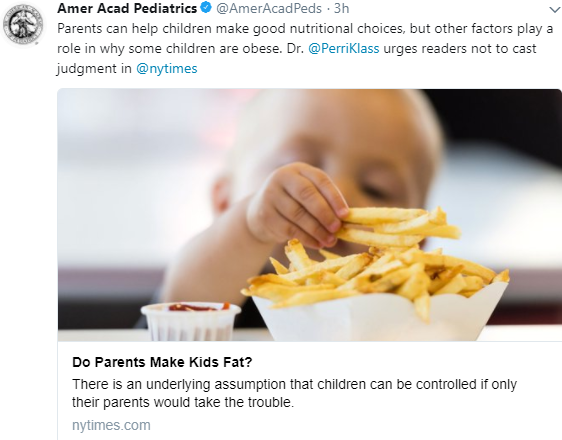
A recent NY Times article, Do Parents Make Kids Fat, explores the issues of parents being considered responsible for enabling their children to become fat.

Here’s an excerpt:

“When you are the parent of an obese child, there is tremendous stigma,” said Dr. Julie Lumeng, a professor of pediatrics at the University of Michigan. “Everyone looks at the parent and thinks: That parent is incompetent. They don’t care about their child. Why can’t they just make the child eat less and exercise?”

There’s an underlying assumption here about what adults can control, and about how children can be controlled, if only their parents would take the trouble, or make and enforce healthy rules for the whole family, or read the nutritional information on the back of the cereal box….

So yes, for all children, whatever their risk for obesity, good parental decisions about nutrition really matter: It’s important not to overfeed babies, to keep junk food and sugary drinks out of the house, to not let kids eat in front of the screen, and to encourage kids to “eat the rainbow” of fruits and vegetables. But those who rush to judgment should be aware that it is not at all simple to “say no” all the time to an extra-hungry child, or to “feed more vegetables” to the kid who refuses to eat anything green.

Most parents — really — are doing our best, in the complicated food environment in which our children are growing up, with the daily struggles of family life…

“The good parenting that a lot of families exercise when it comes to health,” said Dr. Lumeng, “that may be good enough for a lot of kids, but with some kids with a genetic makeup that predisposes them to obesity, it’s not enough.”

Related blog posts:


Budesonide Looks Better for Eosinophilic Esophagitis

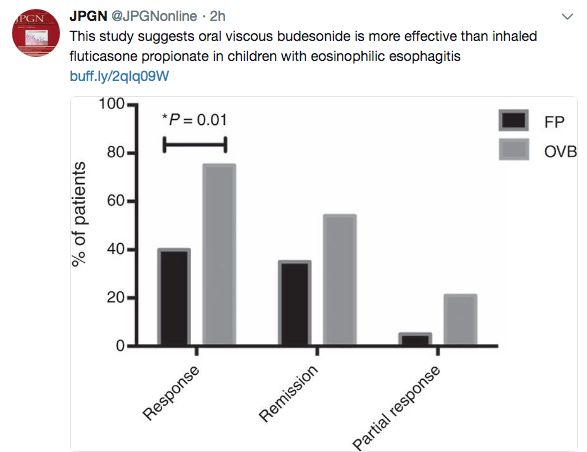
A recent retrospective study (JM Fable et al. JPGN 2018; 66: 26-32) found that patients with eosinophilic esophagitis (EoE) who were treated with oral viscous budesonide (OVB) had more favorable outcomes than those treated with fluticasone propionate (FP).  This single center study included 68 pediatric patients (mean age 10.6 years) with 20 receiving FP and 48 OVB.

Dosing in study:

  • FP 110 mcg/actuation 2 puffs twice a day if 1-10 years, and 220 mcg/actuation 2 puffs twice a day if >10 years
  • OVB: 0.5 mg twice a day if 1-10 years, and 1 mg twice a day if >10 years
  • The authors noted that Duocal (which contains cornstarch and coconut oil) was a suitable alternative to Splenda.  They note that Neocate Nutra is effective too (limited by cost/coverage) as is pasteurized honey and maple syrup.

Key findings:

  • Histologic response (<15 eos/hpf) was noted in 75% (36/48) of OVB group and 40% (8/20) of FP group
  • Mean post-treatment peak eos/hpf was 12 ± 16 in OVB group and 20 ± 29 in the FP group (P=0.002)
  • Histologic remission (<5 eos/hpf) was noted in 54% OVB group and 35% FP group
  • In OVB-treated patients, those without asthma were more likely to achieve a histologic response (P=0.031)

Since this is a retrospective study, there are several potential limitations, including possible selection bias.  In addition, higher doses of topical agents have been shown to have higher response rates.

My take: Budesonide is probably better than fluticasone for EoE and its high first-pass metabolism indicates that it is probably safer as well.

Related blog posts:

What Happens Four Years After Fecal Microbiota Transplantation?

A recent study (J Jalanka et al. AP&T 2018; 47: 371-9-thanks to Ben Gold for this reference) provide long-term data of fecal microbiota transplantation (FMT).

In this study of 84 adult patients who were treated for C difficile infection, 45 who had received FMT and 39 treated with antibiotics, the authors determined the frequency of adverse sequelae at 3.8 years using a retrospective questionnaire.

Key findings:

  • There were no difference in the development of severe diseases between FMT recipients and control patients (eg. IBD, cancer, autoimmune diseases, allergy, and neurological diseases)
  • There were no differences in weight gain
  • FMT patients reported faster improvements in bowel habits and reported that their mental health improved after treatment
  • FMT patients had fewer symptoms of functional gastrointestinal disorders than the control (antibiotic) patients

The authors note that FMT is frequently recommended based on three recurrences of C difficile infection and that their study would support using FMT earlier as a treatment option.

My take: Though a small study, these data suggest that FMT is effective and without long-term consequences.

High-resolution Esophageal Manometry for Rumination Syndrome.

Briefly noted: While in most cases, rumination syndrome does not require manometry for diagnosis, in cases of uncertainty, it can be helpful.  A recent retrospective study (FR Grunder, A Aspirot, C Faure. JPGN 2017; 65: 627-32) highlights the utility of high-resolution esophageal manometry (HREM) in the diagnosis of rumination syndrome using 15 patients with rumination and 15 control patients.

Background: The sensitivity of HREM can be lower in a clinical setting as many “subjects with rumination are often able to tolerate the test meal during the manometry study with minimal or no symptoms.”

HREM also helps determine whether rumination is primary, secondary or if there is supragastric belch-associated rumination.

  • Primary rumination indicates that abdominal pressure increases before the retrograde flow
  • Secondary rumination indicates that abdominal pressure increases after a reflux event
  • Supragastric belch-associated rumination indicates an association of air inflow (detected with combined impedance) in the esophagus immediately followed by a rumination event

Key finding from this study:

  • HREM had a sensitivity and specificity of 80% and 100% respectively to confirm the diagnosis of rumination.  “the association of a clinical rumination episode with a rise in gastric pressure >30 mmHg seems to be specific for the diagnosis of rumination syndrome in children.”

My take: Manometry is usually not needed for the diagnosis of rumination syndrome but does help explain the pathophysiology.

Bright Angel Trail, Grand Canyon



Increasing Cost/Use of Biologic Therapies for Inflammatory Bowel Disease

As noted in a previous blog post (Changes in the Use of IBD Biologic Therapy), there has been an increased use of biologic therapy early in the course of patient’s with inflammatory bowel disease (IBD). Another retrospective study (H Yu et al AP&T 2018; 47: 364-70 -thanks to Ben Gold for this reference) examines the market share and costs of biologic therapy for IBD using the Truven Marketscan Commercial Claims and Encounters database (2007-2015).  This database consists of out-patient and in-patient pharmaceutical claims of approximately 40-50 million privately insured patients each year from patients from all 50 states (U.S.).

Key findings:

  • Among 415,405 patients with IBD (188,842 with Crohn’s, 195,183 with ulcerative colitis, 31,380 with indeterminate IBD), the proportion using biologics increased over the 9-year period (2007-2015); overall, the market share increase was from 7.1% (2007) to 20.5% (2015).
  • There were 28,797 pediatric patients with IBD (17,296 with Crohn’s, 9368 with ulcerative colitis, and 2133 with indeterminate colitis). The overall market share in pediatric patients was the highest, increasing from 19.1% to 45.9%.
  • For all patients with Crohn’s disease (CD) the proportion receiving biologic therapy increased from 21.8% to 43.8%.  For patients with ulcerative colitis (UC), the proportion increased from 5.1% to 16.2%.
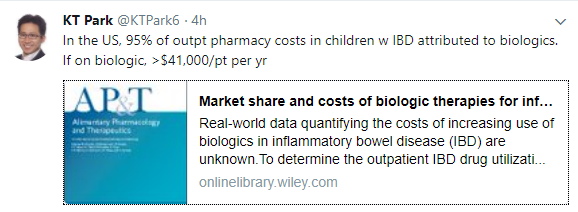
  • Per-member per-year (PMPY) costs increased. “The average biologic-taking patient accounted for $25,275 PMPY in 2007 and $36,051 PMPY in 2015.”  This was similar in the pediatric population, going from $23,616 PMPY in 2007 to $41,109 PMPY in 2015.
  • The share of costs of medicines: the costs of biologics as a share of the total increased from 72.9% in 2007 to 85.7% in 2015. 95% of the pharmacy costs in children with IBD are attributed to biologics.

My take: This trend of increasing use of biologics and their associated costs is going to continue due to their effectiveness. While there are direct costs related to these medications, the net cost is unclear as they can prevent hospitalizations and surgeries. In addition, by helping to spare corticosteroids and increasing response rates, biologic therapies improve quality of life, minimize opportunity loss, and optimize long-term health outcomes.

Bright Angel Trail, Grand Canyon