One of 340,000 Followers of NEJM

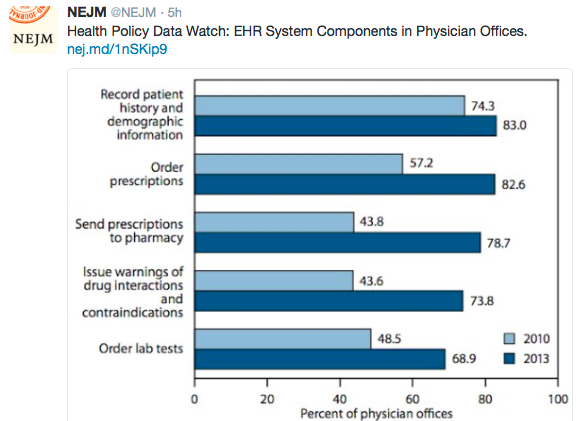
A recent editorial (EW Campion et al. NEJM 2016; 375: 993-4) made a few worthwhile points and shows how NEJM has been successful and innovative over 20 years of using the web and social media.

  • This has allowed more widespread access to its content, even by resource-poor countries.
  • The use of the web has facilitated quick distribution of multiple resources for outbreaks like  Ebola and Zika.
  • Currently, every article back to 1812 is available online (over 173,000 with more than 570,000 pages)
  • NEJM has 340,000 twitter followers and 1.3 million followers on facebook
  • Despite the importance of NEJM, as well as other healthcare media, important caution is needed.

“We do need to be wary of challenges and dangers that the new media have created.  On the Internet, speed and simplicity often displace depth and quality, especially on complex subjects.  Our privacy is increasingly vulnerable. Misinformation, misrepresentation, and piracy are common.  There are health scams and even sham medical conferences and fake medical journals.”

My take: Careful use of internet resources has been incredibly helpful.  But, beware of the inherent hazards that have accompanied these advances.

Related blog posts:

Balancing Rock, Bar Harbor

Balancing Rock, Bar Harbor


Antipsychotic Agent, Olanzapine, Helps in Reducing Chemotherapy-Induced Nausea/Vomiting

Briefly noted: RM Navari et al. NEJM 2016; 375: 134-42. Olanzapine (marketed as Zyprexa), compared with placebo, in combination with dexamethasone, aprepitant (or fosaprepitant) and a 5-hydroxytryptomaine type 3 antagonist (eg palonosetron, ondansetron, or granisetron) helped reduced nausea/vomiting.  Among a total of 380 patients, 74% in the olanzapine group had no nausea/vomiting compared with 45% in the placebo group in the first 24 hours.  In the 1st 120 hours, the rates of no nausea/vomiting were 37% vs. 22%.  A “complete response,” defined as no emesis episodes and no rescue medications, occurred in 64% vs 41% in the 1st 120 hours.  The most concerning side effect reported was severe sedation which was reported in 5%.

Arthur Ravenel Jr Bridge

Arthur Ravenel Jr Bridge

Increased Intestinal Blood Flow with Bolus Feedings in Very Low Birth Weight Infants

From Journal of Pediatrics:  V Bozzetti et al. DOI: http://dx.doi.org/10.1016/j.jpeds.2016.05.031

Abstract:

Objective

To detect changes in splanchnic perfusion and oxygenation induced by 2 different feeding regimens in infants with intrauterine growth restriction (IUGR) and those without IUGR.

Study design

This was a randomized trial in 40 very low birth weight infants. When an enteral intake of 100 mL/kg/day was achieved, patients with IUGR and those without IUGR were randomized into 2 groups. Group A (n = 20) received a feed by bolus (in 10 minutes), then, after at least 3 hours, received the same amount of formula by continuous nutrition over 3 hours. Group B (n = 20) received a feed administered continuously over 3 hours, followed by a bolus administration (in 10 minutes) of the same amount of formula after at least 3 hours. On the day of randomization, intestinal and cerebral regional oximetry was measured via near-infrared spectroscopy and Doppler ultrasound (US) of the superior mesenteric artery was performed. Examinations were performed before the feed and at 30 minutes after the feed by bolus and before the feed, at 30 minutes after the start of the feed, and at 30 minutes after the end of the feed for the 3-hour continuous feed.

Results

Superior mesenteric artery Doppler US showed significantly higher perfusion values after the bolus feeds than after the continuous feeds. Near-infrared spectroscopy values remained stable before and after feeds. Infants with IUGR and those without IUGR showed the same perfusion and oxygenation patterns.

Conclusion

According to our Doppler US results, bolus feeding is more effective than continuous feeding in increasing splanchnic perfusion.

Related blog posts:

Iceberg Lake, Glacier Natl Park

Iceberg Lake, Glacier Natl Park

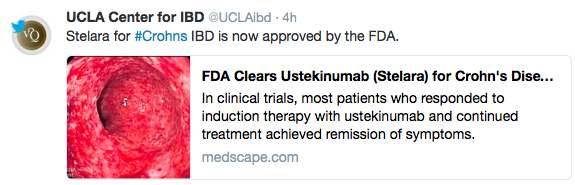
FDA Gives Ustekinumab (Stelara) Approval for Crohn’s

Here’s a link summarizing FDA approval: Medscape: FDA Clears Ustekinumab (Stelara) for Crohn’s Disease

An excerpt:

The US Food and Drug Administration (FDA) has approved ustekinumab (Stelara, Janssen Biotech, Inc) for the treatment of moderately to severely active Crohn’s disease in patients aged 18 years or older.

Specifically, the interleukin-12/23 inhibitor is indicated for Crohn’s patients who have failed or were intolerant to immunomodulator or corticosteroid therapy but who never failed treatment with a tumor necrosis factor (TNF) blocker or who failed or were intolerant to treatment with one or more TNF blockers, according to a company news release.

Ustekinumab is already approved in the United States for treatment of patients with plaque psoriasis and psoriatic arthritis…The clinical development program for ustekinumab for Crohn’s disease included more than 1300 patients across three pivotal phase 3 studies, which served as the primary basis for FDA approval.

In clinical studies of patients who were either new to, experienced with, or failed anti-TNF therapy, between 34% and 56% of patients experienced symptom relief in the 6 weeks after receiving a one-time intravenous induction dose of ustekinumab. “Noticeable improvement was observed as early as 3 weeks,” the company said.

Most patients who responded to induction dosing and who continued ustekinumab treatment with subcutaneous maintenance doses every 8 weeks were in remission at the end of 44 weeks (52 weeks from initiation of the induction dose), the company said.

Full prescribing information and a medication guide are available online.

screen-shot-2016-09-28-at-4-18-01-pm


The Indispensable Physician

A recent pair of commentaries (RM Wachter, L Goldman. NEJM 2016; 375: 1009-1011, R Gunderman. NEJM 2016; 375; 1011-13) provides some insight into what has been gained and what has been lost with the proliferation of hospitalist care in the past 20 years.

The growth of hospitalist care has developed due to numerous factors:

  • evidence of cost savings/better outcomes
  • need for rapid evaluation of acutely ill patients/repeated evaluations which would be disruptive to efficient outpatient physician practices

Decline of comprehensive care:

  • at times of extreme vulnerability when admitted to the hospital, patients have a physician assigned to them who they have probably never met.  This has led to a diminishment of the patient-physician relationship.
  • increasing number of physicians creates opportunities for miscommunication, particularly on admission and discharge, but also at every step of hospital care during “handoffs”

The second commentary, in particular, challenges the way medicine is evolving.  This article stresses the central role of the physician as opposed to the hospital filling that role.

“The reality is that medicine can be practiced without hospitals, but hospitals cannot function without physicians.”

The goal of developing personal relationships with our patients is often at odds with work-life balance.  Thus, having hospitalists and other ways of having cross-coverage, when we are unavailable, often conflict with being able to provide the best care.

My take (from 2nd commentary): “The true core of good medicine is not an institution but a relationship — a relationship between two human beings.”

Related blog posts:

Glacier Nat'l Park

Glacier Nat’l Park


Newborn Bilirubin Measurements To Identify Biliary Atresia

It is remarkable how tricky making a diagnosis of biliary atresia can be, even when one has seen the presentation many times.  For parents and many providers, one of the pitfalls includes the inability of recognizing acholic stools. To identify biliary atresia, promotion of stool color cards, over the last two decades, has not been very effective. To address this problem, a recent study (S Harpavat et al. JPGN 2016; 62: 799-803) describes the use of direct or conjugated bilirubin measurements in the newborn period. This study was conducted between 2009-2011.

As with previous studies, 35 infants with biliary atresia all had elevated direct bilirubin. In the non-biliary atresia group, 8936 of 9102 infants had direct bilirubin measurements within the laboratory’s reference range.  Thus, this study suggests that newborn direct bilirubin has a sensitivity 100% and specificity of 98.2%.

In a related publication, the same group published a letter to the editor (NEJM 2016; 2016; 375: 605-6) that describes a prospective two-stage screening of newborns for biliary atresia.  Of 11,636 infants included over a 15-month period, 121 were identified who had direct-bilirubin >95% reference interval in their laboratory.  At a median of 14 days, 11 remained abnormal: 2 had biliary atresia.  Overall, they state the net sensitivity was 100%, then net specificity of 99.9%, and the positive predictive value was 18.2%.

Related blog posts:

Sullivan's Island, SC

Sullivan’s Island, SC

Biotin Supplementation and Thyroid Laboratory Results

Biotin, which is a water-soluble vitamin, is given in several genetic conditions and often used as a supportive treatment in mitochondrial disorders.  A recent report (S Kummer et al. 2016; 375: 704-6 Letter to Editor) noted six children ages 1 mo-9 yrs with markedly abnormal thyroid studies who were receiving biotin.  The results mimicked Graves’ disease with high free thyroxine levels, low thyrotropin levels, and elevated anti-thyrotropin receptor antibodies.

After stopping biotin, these biochemical abnormalities resolved in 48 hrs for free T4/TSH and 7 days for anti-thyrotropin receptor antibodies.

My take: High-dose biotin can create concerning laboratory profile of Graves’ disease. Awareness of this phenomenon is important for endocrinologists and pediatric gastroenterologists as well.

Glacier Nat'l Park

Glacier Nat’l Park