Preliminary Work: A Vaccine to Prevent Colon Cancer and A Blood Test to Detect Colon Cancer

D’Alise, A.M., Willis, J., Duzagac, F. et al. Nat Med (2026). https://doi.org/10.1038/s41591-025-04182-9. Nous-209 neoantigen vaccine for cancer prevention in Lynch syndrome carriers: a phase 1b/2 trial. (Open Access!)

Background: “Lynch syndrome (LS) is a prevalent hereditary cancer syndrome affecting ~1 in 300 individuals, with an overall lifetime cancer risk as high as 80%. LS is caused by germline mutations in the DNA mismatch repair genes, leading to microsatellite instability (MSI) and accumulation of shared mutations. When these occur in coding regions, they generate frameshift peptides (FSPs). Nous-209 is a neoantigen-directed immunotherapy” against these FSPS. These are “the results from cohort 1 of a phase 1b/2 single-arm trial of Nous-209 for cancer interception in LS carriers (n = 45).”

Key findings:

  • Neoantigen-specific immune responses were observed after vaccination in 100% of evaluable participants (n = 37), with induction of potent T cell immunity
  • The immune response was durable and detectable at 1 year in 85% of participants
  • Both CD8+ and CD4+ T cells were induced, recognizing multiple FSPs
  • Peptide–human leukocyte antigen predictions allowed the identification of >100 immunogenic FSPs with demonstration of cytotoxic activity in vitro
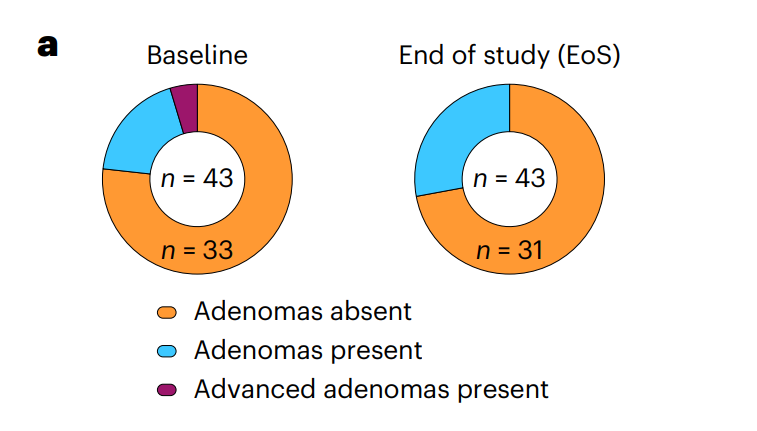
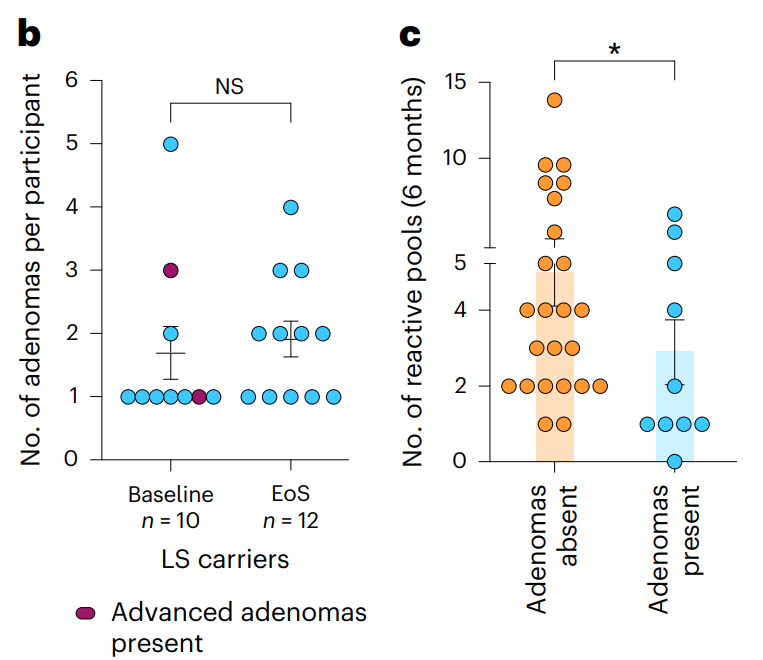
Colorectal neoplasia burden observed at end-of-study colonoscopy inversely correlates with breadth of immune response. a, Number of participants who underwent screening colonoscopy at baseline and end of study (EoS; n = 43) who had no adenomas (adenomas absent), at least one adenoma (adenomas present) and advanced adenomas (advanced adenomas present) detected.
b, Number of adenomas per trial participant at baseline and end of study; comparison of baseline versus EoS was performed using a two-tailed Mann–Whitney U-test; NS, not significant. c, Number of reactive pools measured at 6 months (n = 34 evaluable subjects) between the participants with and without adenomas. Data are shown as the mean ± s.e.m.

My take (borrowed in part from authors): “Overall, this clinical trial provides important proof-of-concept data of the safety and the robustness of induced immunogenicity of
Nous-209 in LS carriers…and supporting its clinical development as a valuable intervention for cancer immune interception.” Vaccines have a long history in reducing cancer (for Hepatitis B, Cervical Cancer (due to HPV), Anal Cancer, Leukemia (by boosting immunity) and Others). Until recently, this has been by preventing viral infections that increase the risk of cancer. This is a new approach.

Related article: Blood test for colorectal cancer: A Mannucci et al. Gastroenterol 2026; 170: 330-343. An Exosome-Based Liquid Biopsy for the Detection of Early-Onset Colorectal Cancer: The ENCODER Multicenter Study Methods: A panel of 6 cell-free and exosome-based circulating biomarkers were identified through small RNA sequencing from a biomarker discovery cohort (blood test). Key finding: “This study developed and independently tested a blood-based test with 97.3% sensitivity for screening-relevant CRC stages I–III and 61.5% for the noninvasive detection of high-grade dysplasia.”

Related blog posts:

“Are Marathons and Extreme Running Linked to Colon Cancer?”

NY Times 8/19/25: Are Marathons and Extreme Running Linked to Colon Cancer?

An excerpt:

A small, preliminary study found that marathoners were much more likely to have precancerous growths. Experts aren’t sure why…

Dr. Cannon, an oncologist with Inova Schar Cancer in Fairfax, Va., launched a study, recruiting 100 marathon and ultramarathon runners aged 35 to 50 to undergo a colonoscopy.

The results were staggering. Almost half the participants had polyps, and 15 percent had advanced adenomas likely to become cancerous. The rate of advanced adenomas was much higher than that seen among adults in their late 40s in the general population, which ranges from 4.5 percent to 6 percent, according to recent studies.

The research was presented at an American Society of Clinical Oncology conference but has not yet been published in a medical journal…

Dr. David Rubin, chief of gastroenterology and director of the Inflammatory Bowel Disease Center at the University of Chicago, said the study was important but limited. It lacked a control arm consisting of similar young adults who were not long-distance runners, he noted, and the family histories of colon cancer among the marathoners were not entirely known…

Runners often develop gastrointestinal symptoms that they dismiss as benign — so-called runner’s trots, for example. The symptoms can be caused by ischemic colitis, a condition that develops when blood flow to the colon is temporarily reduced as it is redirected to muscles in other parts of body (like a runner’s legs).

My take: While this is a small study, it indicates that extreme runners could have an increased risk of colonic polyps and cancer. If there are symptoms (especially rectal bleeding and weight loss), a low threshold for further evaluation is needed.

Related blog posts:

View of Statue of Liberty from Governor’s Island

45 Years –The New Recommendation for Colorectal Cancer Screening

Related blog posts:

Video for Patients: Benefits and Risks of IBD Treatment & Risks of Untreated IBD

A recent study (NE Newman, KL Williams, BJ Zikmunde-Fisher, J Adler. JPGN 2020;70: e33-36) highlights work to communicate the benefits and risks of the treatment for inflammatory bowel disease (IBD) along with the risks of untreated IBD.  “We developed a simple video aid to illustrate competing risks associated with medications and underling disease in context of inflammatory bowel disease…Those who viewed the video aid had more realistic perceptions than those who did not view it.”

Here is a link to the ~13 minute online video: IBD: Risk of Disease and Treatments

Overall, the presentation is very helpful and thoughtful.  I think this would be an excellent overview for families.  For practitioners, a few points that could benefit from some nuance are noted below some screenshots.  It is worth stating that the authors had started this project a few years ago and some of the points below are related to more information that has emerged.

In the section of treatment benefits (above), the presentation suggests that thiopurines (azathioprine, 6-mercaptopurine) and methotrexate both are effective in about 50%; this is probably an overestimate; in addition, methotrexate as monotherapy is definitely less effective (if effective at all) for ulcerative colitis .  Also, it would be worthwhile to indicate that anti-TNF monotherapy with therapeutic drug monitoring may help achieve similar benefits as dual therapy.

In the section of colon cancer, the authors provide useful data that current treatments lower this risk substantially.  It is notable that more recent reports suggest that there have been improvements in the rates of colon cancer associated with IBD.

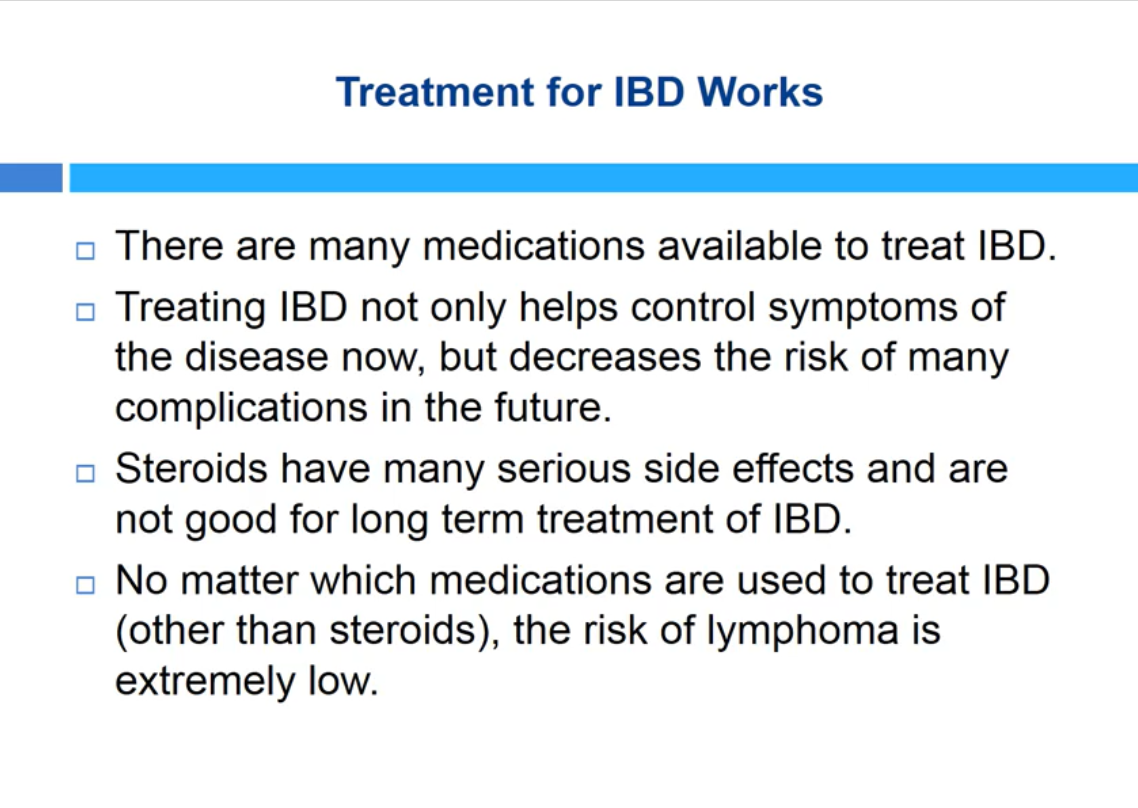
Overall, the section on lymphoma is very good.

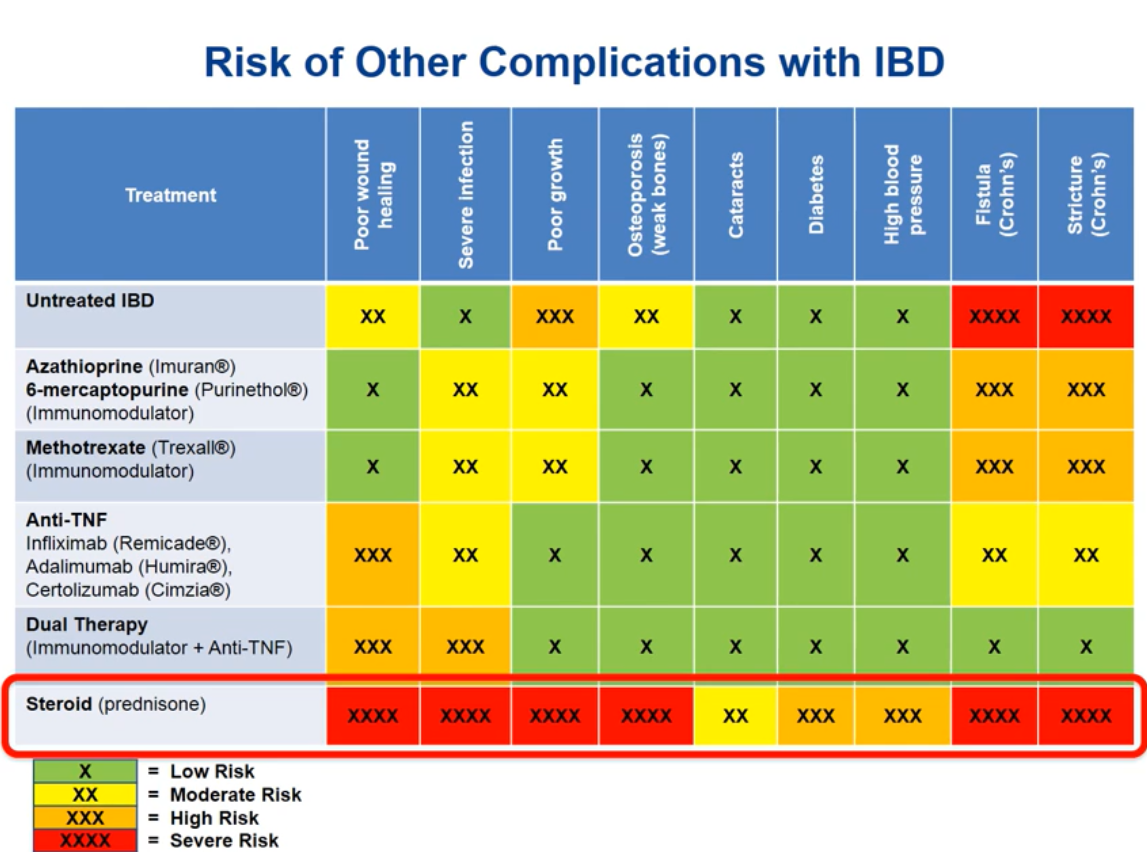
In the section on other complications, the presentation suggests that there may be impaired wound-healing with anti-TNFs.  I think this risk is overstated in this slide. Also, I think the risk of severe infection with thiopurines is a little bit higher than stated; though, this can be mitigated with careful monitoring.

I think this summary slide could be improved by noting that the overall risk of serious cancers is likely lowered by treating IBD.  Since colon cancer is a fairly common cancer and IBD treatment reduces the risk, this likely outweighs the increased risk of other cancers (eg. lymphoma) which are much less common.

Another link to video: https://tinyurl.com/IBDTreatments

Related posts:

Disclaimer: This blog, gutsandgrowth, assumes no responsibility for any use or operation of any method, product, instruction, concept or idea contained in the material herein or for any injury or damage to persons or property (whether products liability, negligence or otherwise) resulting from such use or operation. These blog posts are for educational purposes only. Specific dosing of medications (along with potential adverse effects) should be confirmed by prescribing physician.  Because of rapid advances in the medical sciences, the gutsandgrowth blog cautions that independent verification should be made of diagnosis and drug dosages. The reader is solely responsible for the conduct of any suggested test or procedure.  This content is not a substitute for medical advice, diagnosis or treatment provided by a qualified healthcare provider. Always seek the advice of your physician or other qualified health provider with any questions you may have regarding a condition.

Colon Cancer at Younger Ages

From USA Today: Colon and rectal cancers surge in millennials and GenX

An excerpt:

Someone born in 1990 has double the risk of early colon cancer and quadruple the risk of early rectal cancer as someone born in 1950…

Most of the nation’s 135,000 annual cases and 50,000 deaths related to colon and rectal cancer still occur among people over age 55. But the share of cases involving younger adults has risen to 29% for rectal cancer and 17% for colon cancer, the study showed. About 11,000 people in their 40s and 4,000 under 40 were diagnosed in 2013…

Known risk factors for colon and rectal cancer include obesity, inactivity and diets high in red and processed meat and low fruits, vegetables and whole grains.

screenshot-163

“The Couric Effect”

A recent commentary (Am J Gastroenterol advance online publication 29 March 2016; doi: 10.1038/ajg.2016.118) by Katie Couric provides a summary of her personal journey as an advocate for preventing colon cancer.

A good read: An Unexpected Turn: My Life as a Cancer Advocate

Here’s an excerpt:

“April is the cruelest month,” T.S. Eliot wrote in “The Waste Land,” and in 1997 it certainly was for my family. That’s when my husband Jay and I discovered he had stage IV colon cancer that had spread to his liver…and the beginning of a 9-month nightmare…

the University of Michigan found that my televised colonoscopy and educational outreach contributed to a sustained 19% increase in the number of colonoscopies performed nationwide. They called it “The Couric Effect”

Screen Shot 2016-03-29 at 4.59.42 PM

Polyps: Clinical Decision Tool

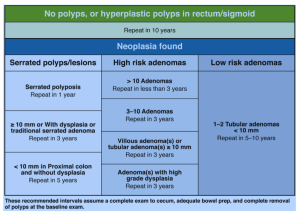
The best approach to polyps from the U.S. Multi-Society Task Force: Gastroenterology 2014; 146: 305-306.  This paper’s simple chart on page 306 could help reduce many follow-up colonoscopies that are performed at shorter than recommended intervals.

Polyp Guideline

Related blog post:  Consensus guidelines after polypectomy | gutsandgrowth)

Thiopurines associated with reduced risk of colon cancer

A recent study provides some good news for those using thiopurines (6-mercaptopurine and azathioprine) (Gastroenterol 2013; 145: 166-75).

Using the observational cohort enrolled in the French CESAME study (Cancers et Surrisque Associe aux Maladies Inflammatoires Intestinales En France), the authors followed 19,486 patients with IBD.  60.3% had Crohn’s disease, and 30.1% were receiving thiopurine therapy.  The study period was 2004-2007.  At the start of the study, 2841 patients (14.6%) had long-standing extensive colitis.

Among patients with long-standing extensive colitis, the hazard ratio for colrectal high grade dysplasia and cancer was 0.28 for those who received thiopurine therapy compared with those who never received thiopurine therapy.

Thus, this prospective study showed that while colorectal cancer (CRC) was increased in IBD patients with long-standing colitis, this risk was less among the subset who were treated with thiopurines.  Some previous studies have not found a reduction in CRC risk, though they may have been underpowered and biased as these studies came from referral centers.

The authors also cautioned that more than 1/3rd of CRC cases occurred in those without extensive colitis which may necessitate a lower threshold for screening colonoscopy.

Related blog posts:

Consensus guidelines after polypectomy

The US Multi-Society Task Force (MSTF) on colorectal cancer has updated their recommendations and provided an update on the literature as well (Gastroenterol 2012; 143: 844-57).

Their recommendations are summarized in Table 1 of this article.  In brief, repeat colonoscopy is recommended at the following interval:

  • 10 years –If no polyps or small (<10 mm) hyperplastic polyps in rectum/sigmoid
  • 5-10 years –if 1-2 small (<10 mm) tubular adenomas
  • 3 years –if 3-10 tubular adenomas or if adenoma with high-grade dysplasia
  • ❤ years –if >10 adenomas
  • 1 year  –if serrated polyposis syndrome

Other important points include the recommendation of adopting split-dose bowel preparations and avoiding interval fecal testing within 5 years after colonoscopy.  If the bowel preparation is poor, the MSTF recommends that in most cases colonoscopy should be repeated within 1 year.  Newer techniques like chromoendoscopy, narrow band imaging, and magnification endoscopy have not been adequately studied to recommend them as part of  a surveillance strategy.

Related blog entries:

Colonoscopy, Split-dosing bowel preps, and Ottawa scores

Aspirin prophylaxis for colorectal cancer?

Additional references:

  • -Gastroenterol 2010; 138: 73, 27 (ed). Overutilization of colon screening in low risk situations and underutilization in high risk situations in clinical practice.
  • -Clin Gastro & Hep 2010; 8: 795. Juvenile Polyps. Describes frequent rate of recurrence (3 of 18 among single polyps) & 45% overall. n=257. 39% with at least 2 polyps. Among those with multiple polyps, 7 had mutations in either SMAD4 (mothers against decpentaplegic drosophilia), BMPR1A (bone morphogenetic protein), or PTEN (phosphatase & tensin homolog). Their recs: recheck with scope in 1-3 years depending on polyp burden and presence of dysplasia.
  • -Clin Gastro & Hep 2009; 7: 1217. Fewer polyps detected as day progresses at a VA hospital n=477 pts. 27% decline in polyp detection.
  • -NEJM 2009; 361: 1179. Review of screening for colorectal cancer.
  • -Gastroenterol 2009; 137: 792. Use of CT colonography -current appraisal.
  • -Ann Intern Med 2009; 150: 1-8. Says endoscopists miss most cancers on right side & colonosopy reduces cancer by ~60% primarily due to left-sided cancers.  Most, 73%, of colonoscopies not done by GI/colorectal surgery.
  • -Gastroenterol 2008; 134: 1570. Update recommendations from ACS, ACR, US Multi-society task force.
  • -Clin Gastro & Hep 2005; 3: 633.  Inherited polyposis syndromes & genetic testing.
  • -Clin Perspectives in Gastro 2002; 5: 329.  Polyp techniques & complications. If entrapped snare, consider cutting off snare handle & pulling on 1 wire. Alternative us to use snare as guidewire & push scope beyond wire. For large stalks, consider using snare as tourniquet for 5 min. Consider pure (or blended) coagulation at settings 20-30W.
    Injection of fluid into the submucosa beneath the polyp increases the distance between the polyp and the deeper layers of the colon. Using a sclerotherapy needle normal saline is injected at the edge of the polyp raising a bleb. No specific volume of normal saline is used. The objective is to raise a large bleb with marked elevation of the polyp. The snare is then placed around the base of the polyp and it can be removed with electrocautery. If bleeding is a consideration then a solution of epinephrine can be used at a 1:10,000 concentration. The advantage of cautery is that residual tissue is usually destroyed although this is usually not a consideration when removing juvenile polyps.Hot biopsy forceps are usually used to ablate diminutive polyps (< 5 mm in diameter). The coagulation current applied should be low. 10-15 watts applied for 1-2 seconds. The technique is generally safe but serious complications including bleeding or perforation have been reported.The cold snare technique is safe in small polyps. (< 5 mm) The rationale is that the vessels feeding the polyp are small and the risk of bleeding is low. The advantage is that without cautery there is not deep tissue damage. Submucosal injection may make the procedure safer.