K El-Chammas et al. J Pediatr Gastroenterol Nutr. 2026; 83: 748-760. Dietary management and feeding considerations of pediatric aerodigestive and upper gastrointestinal motility disorders.
Oropharyngeal dysphagia (OPD):
- “Untreated OPD (either penetration and/or aspiration) is associated with persistent symptoms, recurrent respiratory infections, elevations in pulmonary inflammatory markers, and even bronchiectasis”
- “Because >80% of pediatric aspiration is silent, the presence of symptoms at the time of an aspiration event should not be the determining factor when considering thickening”
- “Most infants with OPD and aspiration experience improvements in swallow function over time, and thickeners/delivery vehicles can be weaned or changed as swallow function, palate, and caloric needs change. Antegrade aspiration is unlikely to be seen in neurodevelopmentally normal children older than 2 years of age exhibiting persistent lower respiratory tract infections”
- Table 2 lists common thickeners and key differences. In infants, cereals and gelmix (if >37 weeks gestational age) are recommended. In older age groups, xanthan gum (SimplyThick®), Corn starch (Thick-It®), Tapioca starch, and Tara gum (PuraThick®) are options.
- “Thickening gastrostomy tube feeds either with commercial thickeners or food improves GI and pulmonary outcomes and reduces the number of gastroesophageal reflux events without prolonging gastric emptying”
- Table 3 provides specific recommendations including the following: ‘The recommended thickener for formula-fed infants younger than 1 year of age is cereal or purées. Commercial thickeners may be an option for some expressed breast milk- or formula-fed infants under the age of 1 year without comorbidities, depending on institutional practices.”
Esophageal Dysmotility
This section reviews several disorders including achalasia, gastroesophageal reflux, and esophageal atresia.
- Reflux: In infants with reflux, “thickening of feeds can reduce overt symptoms such as vomiting but does not decrease reflux events.” Also, in this population, “a trial of maternal cows’ milk elimination, extensively hydrolyzed or amino-acid based formulas (in more severe cases with intractable symptoms) may be appropriate”
- Achalasia: “There are no clear guidelines on the management of feedings in pediatric or adult patients with achalasia…Patients should be encouraged to eat in an upright position and to minimize eating for several hours before bedtime. A liquid or purée may be required with the guidance of a dietitian to ensure adequate nutritional intake while waiting for the diagnosis and definitive management of achalasia”
- Esophageal atresia: “Only 28% of children with EA are consuming age‐appropriate food textures within the first 2 years of life, with that improving to 70% of children over 5 years of age…Many infants with EA require gastrostomy tube placement because they cannot safely tolerate oral feeding or meet caloric requirements”
- Table 4 summarizes recommendations for esophageal dysmotility, including “children with esophageal dysmotility should avoid foods with a high risk for esophageal obstruction/irritation, eat in an upright position, and avoid eating several hours before bedtime”
Gastric Dysmotility
- “Most pediatric cases are idiopathic or post-viral, with less common causes being drug-induced or post-surgical”
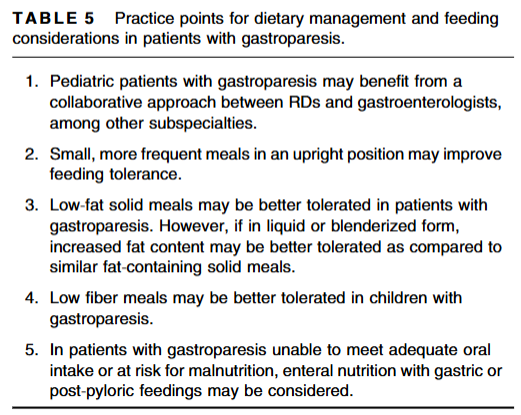
- “While dietary modification is often considered first-line therapy in patients with mild gastroparesis, it often results in suboptimal improvement in symptoms in clinical practice. Small, frequent meals and maintaining a post-prandial upright position may be better tolerated.74, 75 Liquids typically empty from the stomach faster than solids76; therefore, increasing liquid calories and switching from solid to liquid calories later in the day may help patients with their symptoms.”
- “Fatty, acidic, spicy, and high-fiber foods can exacerbate symptoms in patients with gastroparesis as they delay gastric emptying, exacerbate pain, and promote release of cholecystokinin”
- “Small-particle diets, consisting of puréed, blended, or finely ground foods, facilitate gastric emptying by reducing mechanical workload on the stomach”
- “Caution is advised when initiating enteral or parenteral nutrition in patients with gastroparesis given the significant overlap with functional dyspepsia and increased prevalence of feeding intolerance in adolescents with disorders of gut–brain interaction”
- “In aerodigestive patients with upper gut dysmotility and feeding intolerance, gastrostomy and/or post-pyloric tube placement may provide access to decompress as well as provide nutrition when oral feeding is inadequate to sustain appropriate growth and symptom control”
- “Blenderized tube feeds may be considered over commercial formulas to help with symptoms, decrease healthcare utilization, and improve quality of life…The American Society for Parenteral and Enteral Nutrition recently published detailed practice recommendations (L Epp et al. Nutr Clin Pract. 2023; 38(6): 1190-1219) providing guidance to medical providers and family pertaining to the use of BTFs regardless of their indication”
My take: This is a useful article regarding potential dietary interventions across a wide range of pediatric GI disorders. Just like medications, dietary interventions can result in complications. As such, the involvement of experienced dietitians and careful follow-up are needed.
Related blog posts:
Dysphagia:
- Rome V Pediatric Upper Gastrointestinal Disorders of Gut-Brain Interaction (Part 2)
- Sheila McBrayer: Swallow Dysfunction and Swallow Evaluation in Infants
- Briefly noted: Aerodigestive Medicine and Budesonide for Eosinophilic Esophagitis
- Promising Pilot Study Using Substance P to Screen for Pediatric Aspiration
Esophageal dysmotility:
- Incredible Review of GERD, BRUE, Aspiration, and Gastroparesis
- AI Diagnosis of Achalasia on Plain Chest X-ray
- Achalasia: Immune-Mediated Disease
- POEM vs Surgical Myotomy for Achalasia -Randomized Trial
- Selective Acid Suppression for Esophageal Atresia Patients
- Evidence-Based Algorithm for Surveillance in Esophageal Atresia Patients
- More Often Than Not Esophagitis in Children with Esophageal Atresia is NOT due to Reflux
- Understanding Heavy Metals in Baby Formula: Insights from Abbott
Blenderized Diets:
- Hard Data on Blenderized Diets
- Briefly Noted: Home Blenderized Tube Feedings
- Pediatric Nutritionist/Scott Pentiuk: Update on two topics: Blenderized diets and Eosinophilic Esophagitis
- Pediatric Nutritionist: Blenderized & Pureed Gtube Diets
- CHOA Pediatric Thickener Guide & High Rate of U.S. Gun Violence
Gastroparesis: