New Therapy for Celiac Disease: Larazotide Acetate

A recent randomized controlled trial study (Gastroenterol 2015; 148: 1311-9) examined the effectiveness of larazotide acetate in 342 adults with Celiac disease (CD) who had ongoing symptoms despite the use of a gluten-free diet for at least 12 months.

Larazotide acetate is a locally acting, nonsystemic 8-amino acid oral peptide which is a tight junction (TJ) regulator.  “Larazotide acetate appears to prevent opening of intestinal TJs by promoting TJ assembly and actin filament rearrangement, which prevents gluten from reaching the intestinal submucosas and triggering an inflammatory response.”
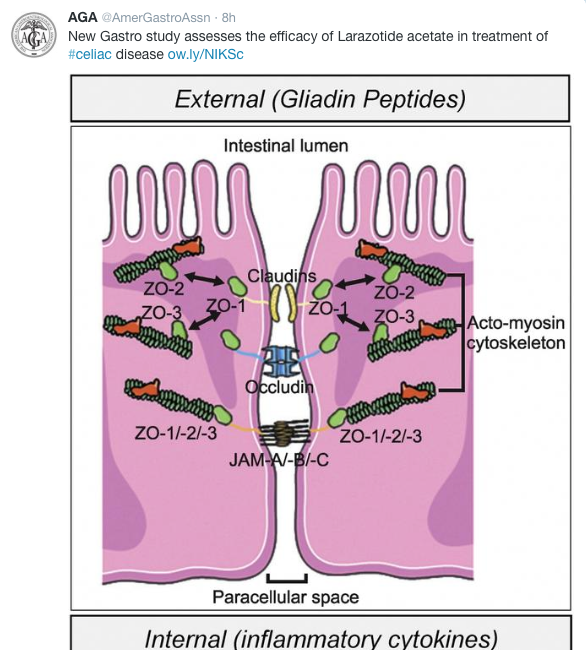
Screen Shot 2015-06-01 at 8.35.51 PM

Patients received either placebo, 0.5 mg, 1 mg, 2 mg three times daily. The majority of patients had normalized serology at the start of the study.  Key findings:

  • “The 0.5 mg dose showed a 26% decrease in celiac disease patient-reported outcome symptomatic days (P =.017), a 31% increase in improved symptom days (P =.034), a 50% or more reduction from baseline of the weekly average abdominal pain score for 6 or more of 12 weeks of treatment (P =0.022), and a decrease in the nongastrointestinal symptoms of headache and tiredness (P =0.010).”
  • The 1- and 2-mg doses were no different from placebo for any end point.
  • Safety was comparable to placebo.

The authors state that is unclear why the higher doses were not effective “but may involve peptide aggregation … reducing activity in vivo.”

Bottomline: There would be a benefit for an adjunct to a gluten-free diet due to the difficulty in adherence and due to ongoing symptoms in some despite the use of a GFD; in some cases, symptoms may be induced by inadvertent deviation from GFD.  More data is needed to determine if larazotide acetate will be useful in this role.

Related blog post: Good Educational Two Minute Celiac Video | gutsandgrowth

Data on Drug-Induced Liver Injury

Two recent studies provide complementary information regarding the causes and consequences of Drug-Induced Liver Injury (DILI).:

  • Chalasani N, et al. Gastroenterol 2015; 148: 1340-52.
  • Goldberg DS, et al. Gastroenterol 2015; 148: 1353-61.

The first study looked at 899 patients with DILI in the DILI Network which is a consortium of several academic institutions funded by the US National Institutes of Health.  Antimicrobials were the most commonly implicated agents (408 cases); however, dietary/herbal supplements were another common cause (145 cases).  Top 10 individual agents:

  • Amoxicillin-clavulanate (Augmentin) (n=91)
  • Isoniazid (n=48)
  • Nitrofurantoin (n=42)
  • Sulfamethoxazole/trimethoprim (n=31)
  • Minocycline (n=28)
  • Cefazolin (n=20)
  • Azithromycin (n=19)
  • Ciprofloxacin (n=16)
  • Levofloxacin (n=13)
  • Diclofenac (n=12)

Key findings:

  • Overall, 10% of patients with DILI died or required liver transplantation.
  • 18% developed chronic injury pattern; this was more common in patients with a cholestatic liver injury.
  • Mortality was high in patients with DILI and concomitant severe skin reactions.  Causative agents of DILI with either Stevens-Johnson Syndrome or Toxic epidermal necrolysis included azithromycin (n=2), lamotrigine (n=3); and one case for each of the following: moxifloxacin, diclofenac, carbamazepine, nitrofurantoin, and possible cephalexin (patient rec’d lamotrigine as well)
  • Preexisting liver disease increased the likelihood of mortality (16% versus 5%)

The second article, a retrospective cohort study using data from >5 million covered individuals over a 7-year span from Kaiser Permanente Northern California, identified 62 inpatients categorized as having definite or possible acute liver failure (ALF).  In this cohort, 32 (52%) had DILI.  Leading agents of DILI-ALF:

  • Acetaminophen n=18
  • Herbal/dietary supplement n=6. Chinese herbals (n=2), pine needle tea, saw palmetto, one unspecified herbal.
  • Antimicrobials n=2

Bottomline: Antibiotics and herbal supplements, both of which are often used without apparent benefit, can lead to liver failure

Related blog posts:

Soapes Creek, Atlanta

Soapes Creek, Atlanta

Would Medical Marijuana Meet the Threshold for FDA Approval?

For most conditions –the answer is no.  A recent study was reviewed by several media outlets including the LA Times.  Here is an excerpt:

A comprehensive review of dozens of clinical trials that have tested medical marijuana for 10 conditions finds that there’s very little reliable evidence to support the drug’s use. The review, by an international team of researchers, was published Tuesday in the Journal of the American Medical Assn.

Patients who use medical marijuana to treat chronic neuropathic pain or cancer pain would probably have the least to fear from an FDA review. The JAMA study considered 28 studies involving 2,454 patients and concluded that there was “moderate-quality evidence” from at least a dozen studies showing that cannabinoids – chemicals in marijuana that produce pharmacologic effects inside the body – reduced pain in such patients by modest amounts….

The other condition for which medical marijuana proved useful was muscle spasticity in people with multiple sclerosis. After assessing 14 studies with 2,280 patients, the JAMA authors determined there was “moderate-quality evidence” to support its use in these patients, although many of the studies reported improvements that weren’t quite big enough to qualify as statistically significant…

One of the things the studies showed most clearly is that people who use medical marijuana had a “much greater risk” of side effects, including serious problems like kidney, liver and psychiatric disorders. The most common adverse effects included dizziness, confusion and disorientation,  according to the JAMA report…

The authors, from the Yale University School of Medicine, lamented the fact that state approval of medical marijuana had been based on “low-quality scientific evidence, anecdotal reports, individual testimonials, legislative initiatives, and public opinion.”

Related blog posts:

Zoo Atlanta

Zoo Atlanta

What is an Entrustable Professional Activity?

It has been said that the difference between a haircut and a coiffure is about $30.

When I was reviewing an article (Rose S, et al. Gastroenterol 2014; 147: 233-42 -thanks to Ben Gold for this reference), the previous joke came to mind.  While I’m sure that there has been a lot of hard work to improve the effectiveness of gastroenterology fellowship training, I find the term “entrustable professional activity” (EPA) to be a strange term to define specific goals for educational assessment and competency.

Bottomline: For those in training and for those doing the training, entrustable professional activity is the new buzzword.

Briefly noted -unrelated studies:

Wang H et al. J Pediatr 2015; 166: 1404-9.  This study examined 4976 among the “Children of 1997,” a prospective population-representative Chinese birth cohort.  They “did not find adiposity [to] be a factor in the development of emotional/behavioral problems in early adolescence” (age 11 years).

Niemi AK, et al. J Pediatr 2015; 166: 1455-61. Treatment of methymalonic academia by liver or combined liver-kidney transplantation. This study identified fourteen transplant recipients; the 6 who had isolated liver transplant underwent transplantation much earlier at an average age of 17 months whereas the mean age for transplantation was 8.2 years.  The mean serum MMA dropped from 1648 μmol/L to 305 μmol/L (at four months post-Tx).  This level is still 1000-fold elevated but was low enough to eradicate episodes of hyperammonemia.  In addition, it was associated with stabilization of neurocognitive development.

The Connection Between Anxiety and Gastroesophageal Reflux Disease

Why is it that reflux is so much worse during periods of anxiety and depression?

A recent prospective study (Kessing BF et al. Clin Gastroenterol Hepatol 2015; 13: 1089-1095) of 225 consecutive patients with symptoms of gastroesophageal reflux disease (GERD) looks into this issue.  All patients underwent ambulatory 24-hour pH-impedance (pH-MII) monitoring and had assessment of anxiety/depression with the Hospital Anxiety and Depression Scale.

GERD was defined by having pathologic acid exposure time and/or positive temporal correlation between the occurrence of symptoms ad reflux episodes. Hypersensitivity to reflux was considered if there was physiologic acid exposure times while having temporal association between reflux episodes and symptoms.  Functional heartburn indicated the presence of symptoms with a normal pH-MII.

Key findings:

  • 147 patients had GERD and 78 had functional heartburn; 36 patients were considered hypersensitive to gastroesophageal reflux.
  • Among patients with GERD (including patients with hypersensitivity), increased anxiety/depression levels were associated with more severe retrosternal pain/burning. However, anxiety/depression were NOT associated with an increased number of reflux episodes or number of symptoms reported on pH-MII.
  • Patients with functional heartburn had higher levels of anxiety than patients with GERD.

Bottomline: Anxiety is associated with increased GERD symptoms.  In addition, anxiety is more prevalent in patients with functional heartburn.

Briefly noted: Review (Lipa S, et al. Clin Gastroenterol Hepatol 2015; 13: 1058-67) of 4 trials with 153 analyzed patients:  “Stretta [radiofrequency ablation] for patient with GERD does not produce significant changes, compared with sham therapy, in physiologic parameters, including time spent at pH less than 4, LESP, ability to stop PPIs, or HRQOL.”.

Related blog posts:

Cumberland Island

Cumberland Island

Complications with G-tube Placement

Two recent studies highlight the risks with gastrostomy tube (G-tube) placement.

  • McSweeney ME, et al. J Pediatr 2015; 166: 1514-9.
  • Jacob A, et al. J Pediatr 2015; 166: 1526-8.

The first study, a chart review of 591 patients, identified a 10.5% major complication rate and ~25% complication rate overall.  By far the most common complication for both major and minor complications was stoma infections.  In this study, the g-tube used was the Corflo PEG tubes using a pull-procedure.  Perioperative antibiotics (i.e. cefazolin for 24 hrs) were administered. Exchange of g-tubes (to a skin-level device) took place at 6 months in most patients.  Major complications were defined as an unplanned adverse event necessitating additional hospitalization, surgery or interventional procedure.

Key findings:

  • Cumulative incidence of major complications was 2.4% within 48 hours, 5.8% with 1 month, 9.2% within 6 months, and 14.7% at 12 months post-G-tube placement
  • Among the 62 patients experiencing major complications, 55 of the 72 were due to infections, 6 were dehiscence of PEG at exchange, 2 were due to granulation needing surgery, 2 were due to colon perforation, and 1 due to pneumoperitoneum.  Other major complications included: 1 aborted PEG procedure, 1 post-PEG cardiopulmonary arrest, 3 malfunctioning PEG tubes, and 1 failure to exchange PEG tube for a skin-level device.

Overall, this study shows a fairly high rate of significant complications and that their occurrence was usually not in the immediate post-operative period.

The second study was a prospective study of 183 children undergoing a one-step percutaneous G-tube using the MIC-KEY introducer kit.  This one-step button requires insertion of three gastropexy anchors, dilatation of gastrostomy tract, and button measurement.  The authors evaluated the safety technique and the learning curve.

Key Findings:

  • In the first 6-month period, the authors noted a 17% failure rate; this declined to 0-7% in the following 6-month study periods.
  • The time for placement improved from 21 minutes during the first 6-months to 12 minutes during the sixth 6-month study period
  • The authors highlighted several advantages: 1. lower peristomal infection rate (10.6% compared to their historical control of 29% with pull-PEG); the PEG avoids need to bypass the oropharynx. 2. One procedure/anesthetic for a skin-level device.
  • In the article, the results indicate that there are clearly tradeoffs for these advantages: after the initial learning curve, their remained complications in the majority (65%), mostly mild complications which included accidental button removal (35%), gastric heterotopy (24%), and peristomal leakage (15%).  Also, 35% of patients returned for a replacement tube before the planned date because of intragastric balloon deflation.
  • The cost savings with this one-step button were estimated to be 11% lower.

Bottomline: While g-tubes remain important in caring for children with feeding problems, there is not a magic bullet to eliminate complications.  Understanding the frequency of these problems and discussing them with families will help them be addressed promptly.

Related blog posts:

Resource:

www.feedingtubeawareness.com  This site contains a terrific PDF download which explains enteral tubes in an easy to understand style along with good graphics. “What You Need to Know Now, A Parent’s Introduction to Tube Feeding is the guidebook that every parent wished they had when they were first introduced to feeding tubes.”

How High Can You Go with Adalimumab?

A recent study (Inflamm Bowel Dis 2015; 21: 1047-53) explored the “Efficacy and Safety of Adalimumab 80 mg Weekly in Luminal Crohn’s Disease.”

Methods: Between 2011-2012, 42 adults with active Crohn’s disease, defined by CDAI > 150 and an objective marker of inflammation, had a dose escalation of adalimumab to 80 mg weekly in prospective multi center study.

  • Objective markers could include CRP >0.5 mg/dL, fecal calprotectin >300 mcg/g, radiologic evidence or endoscopic evidence
  • Only 4 patients were receiving concomitant immunomodulators (& none were started)
  • There were no reports of adalimumab drug levels

Findings: At 14 weeks, 33.3% achieved a clinical remission (CDAI <150) and 23 (54.8%) had a clinical response.  These patients had associated improvements in CRP.  The authors do not report on serious adverse events; all AEs “were consistent with previous experience with this drug.”

Take-home point: The authors do not recommend this approach in routine clinical practice at this time.  However, it would seem that some patients with low adalimumab trough levels (and no anti-drug antibodies) may benefit from high doses of adalimumab

Briefly noted:

Fumery M, et al. JPGN 2015; 60: 744-48.  This retrospective study identified 27 children who received adalimumab (ADA) after infliximab failure.  Though ADA was well-tolerated, 8 (30%) had primary nonresponse to ADA and an additional 5 (26%) had ADA failure by 1 year.

Huang EY, et al. Inflamm Bowel Dis 2015; 21: 963-72.  “Exposure to dexamethasone in mice led to substantial shifts in gut microbiota over a 4-week period.” Take-home point: Corticosteroids may have both direct and indirect impacts on the microbiome as one mechanism of influencing disease response

Related blog posts:

Zoo Atlanta

Zoo Atlanta

When Will MRI Obviate the Need for a Liver Biopsy in Pediatric NAFLD?

A recent study (JB Schwimmer et al. Hepatology 2015; 1887-95, editorial Vos MB, pages 1779-80) examines the accuracy of magnetic resonance imaging (MRI) compared with liver histology in children with nonalcoholic fatty liver disease.

This prospective validation study enrolled 174 children with a mean age of 14 years.  The MRI estimated the liver proton density fat fraction (PDFF).

Key findings:

  • Liver MRI-PDFF correlated with steatosis grade; the correlation was particularly strong at high and low end values.  Thus, a very low MRI-PDFF was highly likely to predict a steatosis grade 0 or 1 while a very high value corresponded to high steatosis levels.
  • Liver MRI-PDFF was weaker in children with stage 2-4 fibrosis than in children with no fibrosis

The editorial notes that this study “is one of hundreds now published in the literature on MRI and NAFLD…The superiority of MR-based methods…over ultrasound is clear.  The question is why are we still ordering abdominal ultrasounds to diagnose NAFLD in children?”  The barriers for usage of MRI include cost, potential sedation, and nonuniform methods for MRI usage.

The paper conclude that “MRI is not yet sufficient to replace liver biopsy in children.”  The editorial also indicates that the MRI era is fast approaching but not viable today.

Take-home point: Due to the huge numbers of patients with pediatric NAFLD, MRI remains a terrific area for research but remains problematic in clinical practice.  Given the expense of MRI, until its use can reduce liver biopsies or improve management, its role is likely to remain limited.

Turner Field

Turner Field


Genetically Modified Humans: Genome Editing 101

In a review at last year’s NASPGHAN meeting, John Barnard gave a basic science review (Basic Science Year in Review -#NASPGHAN 2014 | gutsandgrowth) that touched on CRISPR-Cas9 for genome engineering (Cell 2014; 157: 1262-78).  Reading through a recent editorial (Lander ES. NEJM 2015; 373: 5-7), it seems that the potential for genome editing is not that far from landing into clinical use.

His points:

Genome editing holds great therapeutic promise

  • “physicians might edit a patient’s immune cells to delete the CCR5 gene, conferring the resistance to HIV carried by the 1% of the U.S. population.”
  • “Editing blood stem cells might cure sickle cell anemia and hemophilia.”
  • Eliminate genes which increase the risk for Alzheimer’s, Huntingdon’s disease and heart attacks

Concerns:

  • “Genetically modified humans” and true “designer babies”
  • Technical issues to perform editing with precision.
  • Unanticipated effects with various edits. “We remain terrible at predicting the consequences of even simple genetic modification.”
  • Who decides?  Future generations cannot consent to their modification.
  • Is it morally right? “Would the ‘best’ genomes go to the most privileged?”

In the U.S., genome editing would not garner approval from FDA or NIH in the near future. But, given the advancing technical capabilities, it is not too early to begin the discussion about genome editing.  At the very least, this technology should spurn a couple great sci-fi movies.

Take-home point: “Authorizing scientists to make permanent changes to the DNA of our species is a decision that should require broad societal understanding and consent…We should exercise great caution before we rewrite” the human genome.

Zoo Atlanta (Kinda looks like a genetically-modified giraffe)

Zoo Atlanta (Kinda looks like a genetically-modified giraffe)

Not Thirsty for Water

As noted in several previous posts (see below), many kids (and adults) would likely benefit from increased water consumption.  The pervasiveness of this problem was recently discussed in a recent (June 11th) USA Today article (“Researchers to kids: drink more water”), though experts disagree on whether mild water deficits are detrimental.

Here’s an excerpt:

The study, published Thursday by the American Journal of Public Health, found 54.5% of children ages 6 to 19 inadequately hydrated, at least by the standard set in the study.

The findings, based on one-time urine samples from more than 4,000 children, do not mean most children are seriously dehydrated…

The researchers considered a child inadequately hydrated if the concentration reached a level other studies have linked to sluggish thinking and mood changes.

They found boys and black children were more likely than girls and children of other races to have highly concentrated urine…

But … some experts …say most people can judge their fluid needs by thirst alone – and that fluids can come from any drink and many foods…

The study showed 22% of children drank no water.


Not drinking enough water


Related blog posts: