Ledipasvir-Sofosbuvir for Children 6-11 years

Almost two years ago, the FDA approved Ledipasvir-Sofosbuvir (aka Harvoni) for pediatric patients 12-17 years of age with hepatitis C virus (HCV) infection.  Now, a recent study (KF Murray, WF Balistreri, S Bansal et al. Hepatology 2018; 68: 2158-66) is likely to expedite approval for children ages 6-11 years of age.

In this open-label study with 92 patients, 88 had genotype 1, 89 received treatment with ledipasvir-sofosbuvir without ribavirin for 12 weeks, 97% were perinatally-infected, and 78% were treatment naive.  The median age was 9 years. The dose (determined by intense pharmacokinetics) was 45 mg-200 mg (half the adult dosage). Two patients with genotype 3 HCV received ledipasvir-sofosbuvir for 24 weeks along with ribavirin.

Key findings:

  • SVR12 was 99% (91/91).  The single patient without SVR12 had relapsed 4 weeks after completing a 12 week treatment course.
  • Ledipasvir-sofosbuvir was well-tolerated; the common adverse events reported were headache and pyrexia.

The authors note that while most children are considered to have mild symptoms or are asymptomatic, some progress to have significant fibrosis or cirrhosis, a small minority develop hepatocellular carcinoma, and HCV infection can impact both cognitive development and overall health.

My take: This study confirms that effectiveness of DAA therapy with ledipasvir/sofosbuvir in children as young as 6 years of age.

Related study: F Tucci et al. Hepatology 2018; 68: 2434-37. The authors report the successful treatment with ledipasvir/sofosbuvir of an infant with both SCID and HCV infection.

Related blog posts:

Mesquite Flat Sand Dunes, Death Valley

Vedolizumab -Could it Work for Eosinophilic Gastroenteritis?

A recent study with only five patients (HP Kim et al. Clin Gastroenterol Hepatol 2018; 16: 1992-4) examined the use of vedolizumab for eosinophilic gastroenteritis.. The rationale was that α4β7 integrin may play an important role in eosinophilic localization in IBD and that blocking α4β7 may inhibit eosinophil recruitment to intestinal mucosa.  In addition, there are few proven therapies for EGE beyond steroids and dietary treatments.  The five patients in this study had been tried on numerous prior treatments and had a disease course of 6-17 years prior to vedolizumab.

Key findings:

  • Two of the five patients were able to wean/discontinue steroids, reported symptom improvement and had normal gastric and small bowel biopsies.  The median time to histologic followup was 2.2 months.
  • A third patient reported symptom improvement but declined a followup biopsy.

My take: A larger study of vedolizumab is needed for EGE.

Related blog posts:

Calgary

Is Deamidated Gliadin Serology a Useful Adjunct in Screening for Celiac Disease?

A recent multicenter retrospective study (MJ Gould et al. JPGN 2019; 68: 20-5) shows that deamidated gliadin peptide (DGP) is rarely helpful in screening for celiac disease when tissue transglutaminase IgA is negative. The study identified 40 patients who had a mean age of 6.5 years at time of intestinal biopsy.

Key findings:

  • Of the 40 patients with DGP (IgG) positivity, only 1 patient (2.5%) had celiac disease; this patient was IgA deficient.
  • Among the five IgA deficient patients, only 1 with DGP positivity had celiac disease.
  • The cohort included 6 patients with DGP levels >250 U/mL (refernece <12).
  • Only 5 patients in this DGP positive cohort were younger than 2 years.  None had celiac disease

My take: This retrospective study indicates that DGP is rarely helpful in patients with negative TTG IgA results. However, this study had too few patients who were  <2 years of age and/or IgA-deficient patients to determine its utility in these groups..

Related study: AK Verma et al. JPGN 2019; 68: 26-29. This study from Italy examined oral hygiene products and determined that 62 (94%) were gluten-free (gluten level <20 ppm). Among the 4 with detectable gluten, 3 were toothpastes and 1 lipstick with values between 20.7 adn 35 ppm. My take: Oral hygiene products have very low rates of gluten contamination.

Related blog posts:

Golden Gulch Trail, Death Valley

Reason for Optimism

While yesterday’s post (No exaggeration: too many children are dying in U.S.) highlighted the numerous unnecessary childhood deaths in this country and previous posts have discussed the drop in life expectancy in this country, there are still reasons for optimism.

It has been said that newspapers/news programs never report on the thousands of airplanes that don’t crash everyday.  Similarly, it is easy to think that with so many challenges that we face everyday that the world is falling apart.  A recent NY Times commentary by Nicholas Kristof points out that 2018 was in fact the best year ever.

Why 2018 Was the Best Year in Human History!

An excerpt:

[In 2018] Each day on average, about another 295,000 people around the world gained access to electricity for the first time, according to Max Roser of Oxford University and his Our World in Data website. Every day, another 305,000 were able to access clean drinking water for the first time. And each day an additional 620,000 people were able to get online for the first time.

Never before has such a large portion of humanity been literate, enjoyed a middle-class cushion, lived such long lives, had access to family planning or been confident that their children would survive…

Child deaths are becoming far less common. Only about 4 percent of children worldwide now die by the age of 5. That’s still horrifying, but it’s down from 19 percent in 1960 and 7 percent in 2003…

Until about the 1950s, a majority of humans had always lived in “extreme poverty,” defined as less than about $2 a person per day. When I was a university student in the early 1980s, 44 percent of the world’s population lived in extreme poverty. Now, fewer than 10 percent of the world’s population lives in extreme poverty, as adjusted for inflation.

My take: This commentary points out that worldwide people are living longer and living better.

From Golden Gulch Trail, Death Valley

No Exaggeration: Too Many Children Are Dying in the U.S.

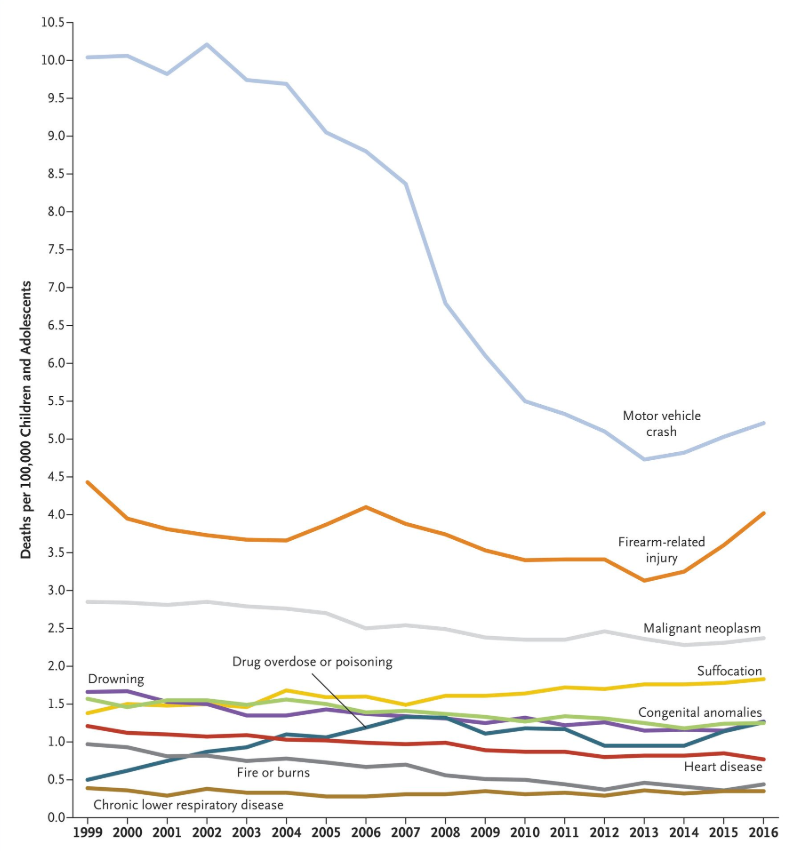
A recent report (RM Cunningham et al. NEJM 2018; 379: 2468-75; editorial 2466-7) highlights the poor outcomes for children in the U.S. based mainly on the CDC WONDER (Wide-ranging Online Data for Epidemiologic Research) database.

Key findings:

  • “The sad fact is that a child or adolescent in the United States is 57% more likely to die by the age of 19 years than those in other wealthy nations.”
  • Motor vehicle accidents (MVA) are the number one cause of deaths in children/adolescents, accounting for 20% of such deaths.  The U.S. rate of death from MVAs is “triple that in other developed countries.”  Overall, MVA deaths had dropped in half from 1999-2013 but have increased in last few years; this increase is thought to be related to distracted driving/walking due to cellphones.
  • Firearm-related deaths accounted for 15% of deaths in children/adolescents in U.S.  In U.S., children/adolescents are “36 times as likely to be killed by gunshots.”  Unlike adults in U.S., the majority of these gunshots are homicides (59%) rather than suicides (35%); unintentional firearm deaths accounted for 4% (2% undetermined firearm-related death).  Among U.S. adults, 62% of deaths from firearms were from suicide.
  • Malignant neoplasms were the third leading mortality cause in children/adolescents, 9%. This rate is similar to other countries.

The figures in the study are very helpful:

  • Figure 2: Deaths from MVAs for the U.S. pediatric population are more similar to low-to-middle income countries (Figure 2A) whereas firearm-related deaths are much greater than all of the countries shown in Figure 2B (including Sweden, England, Hungary, Australia, Austria, Thailand, Tajikistan, Romania, Mongolia).
  • Figure 3. Deaths in U.S. rural areas are roughly double from MVAs than from the average of urban/suburban areas.  Deaths from firearms are similar in all three areas.  There are several factors which could explain the high rate of fatal MVAs in rural areas: longer time to get medical attention, faster speeds in less populous areas, less seat belts, lower enforcement of traffic laws, and impaired driving.

My take: The increased risk of death from MVAs and firearms identified in this study should not be considered “accidents” but failures.  Is it too much to expect that a child born in the U.S. could have the same chance to reach adulthood as a child in Canada or a child in Europe?

Related blog posts:


Vonoprazan versus Lansoprazole for Initial Heartburn Relief

A recent study (T Oshima et al. Aliment Pharmacol Ther 2019; 49: 140-6) showed that a new potassium-competitive acid blocker (P-CAB) can more rapidly improve symptoms than lansoprazole. Thanks to Ben Gold for this reference.

This small study with 32 adult patients with endoscopically-confirmed erosive esophagitis with frequent heartburn were randomized in a double-blind study and received either lansoprazole 30 mg or vonoprazan 20 mg before breakfast.  The authors note that with PPIs, there is a slow onset of action, such that ‘half of all patients remain symptomatic even after 3 days of treatment.” In contrast, vonoprazan can increase intragastric pH to almost 7 within 4 hours.

Key finding:

  • Heartburn relief occurred quicker with vonoprazan.  Complete relief was noted in 31.3% at day 1 compared with only 12.5% in the lansoprazole group.

My take: Vonoprazan is currently approved in Japan.

Related article: Update on the Use of Vonoprazan DY Graham, MP Dore; Gastroenterol 2018; Volume 154, Issue 3, Pages 462–466

Mesquite Flat Sand Dunes, Death Valley

Vedolizumab Drug Levels –Are They Needed?

A recent retrospective study (E Dreesen et al Clin Gastroenterol Hepatol 2018; 16: 1937-46) with 179 consecutive patients (66 with ulcerative colitis, and 113 with Crohn’s disease) found that vedolizumab (VDZ) trough concentrations were correlated with response.

Key findings:

  • VDZ trough >30 mcg/mL at week 2, >24 mcg/mL at week 6, and >14 mcg/mL during maintenance were associated with effectiveness endpoints including endoscopic healing, physician global assessment and biochemical response (based on CRP).
  • Median VDZ trough levels during induction were 27.7 mcg/mL at week 2, 27.4 mcg/mL at week 6. With standard dosing, the maintenance VDZ trough was 13.5 mcg/mL at week 14
  • Higher BMI and more severe disease, based on CRP, albumin, and/or hemoglobin, were associated with lower VDZ trough levels and lower probability of mucosal healing (P<.05).

Interestingly, in the discussion the authors note that VDZ troughs above  3 mcg/mL completely saturate α4β7 intergrin.  This physiologic phenomenon is hard to reconcile with data showing better response with higher VDZ levels.  The authors note that “at present, there are not enough data in our study to support the role for TDM to guide clinical decision-making on dose escalation for vedolizumab.”

My take: This study implies that VDZ levels may help predict response but are not necessarily helpful in determining whether dose escalation is warranted.

Related blog posts:

Riverwalk, Chattanooga

Blood Test is Better Than a Liver Biopsy for Biliary Atresia

A recent study (L Yang et al. Hepatology 2018; 68: 2069-72) confirms the utility of Serum Matrix Metalloproteinase-7 (MMP-7) as a biomarker for biliary atresia (BA). The authors studied MMP-7 among healthy controls (n=72 with 54 <6 months) and among 135 with cholestasis (75 with BA, 60 with non-BA).  BA samples were taken at a median age of 54 days.

Key findings:

  • Median concentration for MMP-7 was 2.86 ng/mL in healthy controls, 11.47 ng/mL for non-BA cholestasis, and 121.1 ng/mL for BA.
  • Using a cutoff value of 52.85 ng/mL, the diagnostic sensitivity and specificity were 98.67% and 95.0% respectively.
  • The AUC for MMP-7 in BA was 0.99 compared for AUC for GGT of 0.72.  The sensitivity and specificity for GGT was much lower at 64% and 72% respectively with a cutoff of 314 U/L.
  • The predictive value for MMP-7 was particularly impressive, 74 of 75 BA  subjects were correctly identified as having BA.  Only 3 non-BA patients were incorrectly assigned a BA diagnosis based on MMP-7 values.
  • The authors noted that MMP-7 testing indicates that there are no substantial changes in its values for normal subjects extending to 54 years of age.
  • One limitation the authors note is the relatively small number of patients with non-BA syndromatic intrahepatic cholestasis which made up less than 30% of their non-BA cohort.  Thus, more testing in specific populations is needed.

My take: The diagnostic performance of MMP-7** appears to be superior to that of a liver biopsy (though this was not directly compared in this study) in predicting BA and could obviate the need for most liver biopsies in infants with cholestasis.  Those with high MMP-7 values would proceed directly to intraoperative cholangiogram with possible hepatoportojejunostomy. Those with non-BA MMP-7 values and persistent cholestasis could undergo additional investigation with genetic panels and/or other metabolic/infectious testing.

**This assay is likely to be commercially-available in the coming weeks according to a colleague at Cincnnati Children’s Hospital.  The expectation is an approximagely 2-day turnaround.

Related blog posts:

Moon over Zabriskie Point, Death Valley before Sunrise

Resolution: Eradication of Hepatitis C

Eradication of hepatitis C virus (HCV) is going to be difficult despite the huge improvements in treatment.  One obstacle that has been highlighted previously has been the increase in HCV transmission associated with the opioid epidemic.  Another basic problem is establishing a ‘cascade of care’ that makes sure that those with HCV receive appropriate treatment and followup.

In a recent study (RL Epstein et al. J Pediatr 2018; 203: 34-40, editoria by KB Schwarz, W Karnsakul 7-8) describe the deficiencies in the followup of women in an obstetric clinic serving women with substance use disorders. The authors reviewed electronic records of 879 women over a 10 year period.  Key findings:

  • 85% of women were screened for HCV.  Of the 68% who were seropositive, only 72% had HCV RNA testing and 71% were viremic.
  • There were 404 infants born to women who were HCVB seropositive.  Only 45% of these infants completed AAP-recommended perinatal HCV screening.

In the commentary, the authors point to the suboptimal rates of followup.  They note that there is a “huge gap between infected women and the linkage of their infected progency to care.” Furthermore, the AASLD has recommended that “all children with HCV infection in age groups for which direct-acting antiviral agents are approved should be treated.”

My take: this study identifies gaps in followup and treatment that need to be addressed systematically if we are to realize the goal of HCV eradication.

Related blog posts:

Screenshot (383)