Ozanimod for Ulcerative Colitis

The results of a phase 2 trial for Ozanimod have been published: WJ Sandborn et al. NEJM 2016; 374; 1754-62.

Ozanimod (RPC1063) is “an oral agonist of the sphingosine-1-phosphate receptor subtypes 1 and 5 that induces peripheral lymphocyte sequestration, potentially decreasing the number of activated lymphocytes circulating to the gastrointestinal tract.”

From the abstract:

METHODS

We conducted a double-blind, placebo-controlled phase 2 trial of ozanimod in 197 adults with moderate-to-severe ulcerative colitis. Patients were randomly assigned, in a 1:1:1 ratio, to receive ozanimod at a dose of 0.5 mg or 1 mg or placebo daily for up to 32 weeks. The Mayo Clinic score was used to measure disease activity on a scale from 0 to 12, with higher scores indicating more severe disease; subscores range from 0 to 3, with higher scores indicating more severe disease. The primary outcome was clinical remission (Mayo Clinic score ≤2, with no subscore >1) at 8 weeks.

RESULTS

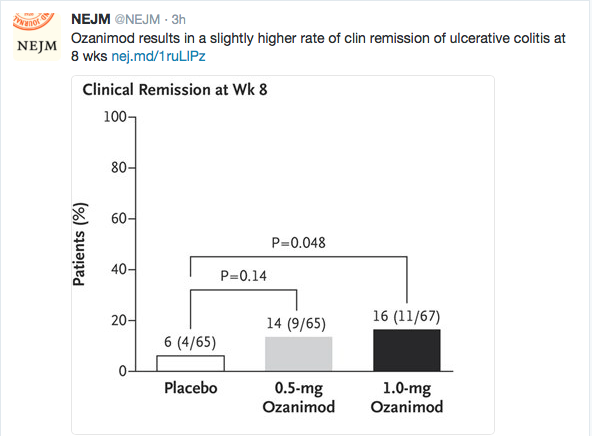
The primary outcome occurred in 16% of the patients who received 1 mg of ozanimod and in 14% of those who received 0.5 mg of ozanimod, as compared with 6% of those who received placebo (P=0.048 and P=0.14, respectively, for the comparison of the two doses of ozanimod with placebo). Differences in the primary outcome between the group that received 0.5 mg of ozanimod and the placebo group were not significant; therefore, the hierarchical testing plan deemed the analyses of secondary outcomes exploratory. Clinical response (decrease in Mayo Clinic score of ≥3 points and ≥30% and decrease in rectal-bleeding subscore of ≥1 point or a subscore ≤1) at 8 weeks occurred in 57% of those receiving 1 mg of ozanimod and 54% of those receiving 0.5 mg, as compared with 37% of those receiving placebo. At week 32, the rate of clinical remission was 21% in the group that received 1 mg of ozanimod, 26% in the group that received 0.5 mg of ozanimod, and 6% in the group that received placebo; the rate of clinical response was 51%, 35%, and 20%, respectively. At week 8, absolute lymphocyte counts declined 49% from baseline in the group that received 1 mg of ozanimod and 32% from baseline in the group that received 0.5 mg. The most common adverse events overall were anemia and headache.

CONCLUSIONS

In this preliminary trial, ozanimod at a daily dose of 1 mg resulted in a slightly higher rate of clinical remission of ulcerative colitis than placebo. The trial was not large enough or of sufficiently long duration to establish clinical efficacy or assess safety. (Funded by Receptos; TOUCHSTONE ClinicalTrials.gov number, NCT01647516.)
Ozanimod

Related blog post: CCFA Conference Notes 2016 (part 5) -Emerging Therapies …


Mirtazapine for Functional Dyspepsia

In a randomized, placebo-controlled pilot study (J Tack et al. Clin Gastroenterol Hepatol 2016; 385-92) with 34 patients (29 women, median age 35.9 years), the authors showed improved dyspepsia symptom scores at weeks 4 and 8 compared with baseline.

Background: Mirtazapine is an antidepressant which is associated with weight gain and improvement in nausea.

Methods: The treatment group received 15 mg each day.

Results:

  • Compared with the control group, these was improvement in early satiety, quality of life, GI-specific anxiety, nutrient tolerance, and weight loss.
  • Two patients in the treatment group dropped out due drowsiness.  Interestingly, the trend of improvement was greater at week 4 then for week 8.
  • The authors note that epigastric pain and burning did not improve.

Limitations: small number of patients, and tertiary care patient population

My take: more studies are needed for this vexing problem

Related blog posts:

Disclaimer: These blog posts are for educational purposes only. Specific dosing of medications/diets (along with potential adverse effects) should be confirmed by prescribing physician/nutritionist.  This content is not a substitute for medical advice, diagnosis or treatment provided by a qualified healthcare provider. Always seek the advice of your physician or other qualified health provider with any questions you may have regarding a condition.

Fountain at Gibbs Gardens

Fountain at Gibbs Gardens


Understanding the Risks of Propofol for Colonoscopy

A recent article & editorial (KJ Wernli et al. Gastroenterol 2016; 150: 888-94 & 801-2) shows that the use of propofol, delivered by an anesthetist, is associated with a small increase risk of adverse events.  This finding goes against assumptions that there would be reduced complications with an anesthesia expert in the room who could manage resuscitation and airway problems.

The study analyzed claims data from more than 3 million colonoscopies in the U.S between 2008-2011 in 40-64 year-olds.

Key findings:

  • Use of anesthesia was associated with a 13% increase in the risk of any complications within 30 days.
  • The increased risk included perforation (OR 1.07), hemorrhage (OR 1.28), and abdominal pain (OR 1.07).  Interestingly, the perforation risk was increased only in those undergoing polypectomy (OR 1.26) indicating that some confounders may have been difficult to eliminate.
  • Complications secondary to anesthesia were present as well (OR 1.15) and stroke (OR 1.04).

This is not the first study to associate anesthesia with increased risk of aspiration and mechanical complications (Cooper G et al. JAMA Intern Med 2013; 173: 551-6). It is certainly possible that the increased risk is due in part to patient selection, despite attempts to control for this.

It is also important to note that better sedation has not resulted in improved colonoscopy outcomes like increased polyp detection.

Will these results change anything? No.

The small increased safety risk (detectable only in studies of millions of patients), if accurate, is not going to stop the use of anesthesia services for two reasons.

  1. Patient satisfaction
  2. Financial incentives

Patient satisfaction.  Propofol results in excellent sedation, often with complete absence of pain combined with rapid recovery and an antiemetic effect.

Financial incentives.  Many endoscopists are able to employ an anesthetist and generate additional revenue by billing for sedation (in addition to the costs of the endoscopist), whereas this is not allowed with the combination of intravenous opioids/benzodiazepines used for ‘deep sedation.’  Even in the many who do not receive revenue for these services, the rapid recovery expedites patient care and room turnover.

My take: While propofol administered by anesthetists is a little less safe and more expensive, it is here to stay, at least until incentives are created to reconsider this approach.

Georgian Terrace

Georgian Terrace

Metronidazole –Associated Encephalopathy

An interesting image (D Farmakiotis, B Zeluff. NEJM 2016; 374: 1465) shows an unusual side effect from metronidazole. This individual who had cirrhosis presented with confusion after a fall.

The MRIs below show “a symmetric, enhanced fluid-attenuated inversion recovery (FLAIR) signal in the dentate nuclei of the cerebellum (Panel A, arrow), a finding consistent with encephalopathy associated with metronidazole use.” Panel B shows resolution one month later following metronidazole discontinuation.

Risk factors for metronidazole encephalopathy:

  • Liver dysfunction
  • Prolonged treatment with metronidazole (typical cumulative dose >20 g)

Flagyl Encephalopathy

Don’t Skip this Article -Rome IV Summary

When I visited MIT, one of the slogans I heard was “Getting an Education from MIT is like taking a drink from a Fire Hose.” While this is a ridiculous notion, it is also true that the amount of information to consume, not just at MIT, but in so many areas is tremendous in quantity.  As such, one has to figure out what to read and what to toss.  For GI physicians, a recent summary (DA Drossman. Gastroenterol 2016; 1262-80) is worth a read due to the ubiquitous nature of the problems discussed.

Here were some key points:

  • “The possibility that passions or emotions could lead to the development of medical disease was first proposed by the Greek physician Claudius Galen.”
  • “Rome IV is a compendium of knowledge accumulated since Rome III” –10 years ago.

Some of the Changes:

  • New diagnoses:  Narcotic bowel syndrome, opioid-induced constipation, cannabinoid hyperemesis syndrome
  • Removal of functional terminology when possible…functional abdominal pain syndrome has been changed to centrally mediated abdominal pain syndrome
  • Threshold changes for diagnostic criteria
  • Addition of reflux hypersensitivity diagnosis.
  • Revision of Sphincter of Oddi  dysfunction disorder…  “driven by evidence that debunks the value of sphincterotomy for type III SOD.”
  • Emphasis that functional disorders exist on a spectrum with linked pathogenesis, particularly with regard to irritable bowel syndrome (IBS) subtypes.
  • Removal of the term discomfort for IBS criteria and using pain as the key criterion.

Approach to Patients with Functional GI Disorders:

  • The author discusses ways to engage patient to create partner-like interaction.
  • “Determine the immediate reason for the patient’s visit (eg. What led you to see me at this time?)”  Potential reasons: exacerbating factors, concern for serious disease, stressors, emotional comorbidity, impairment in daily functioning or hidden agenda (eg. disability, narcotics, litigation)
  • “Determine what the patient understands of the illness…What do you think is causing your symptoms?”
  • Provide a thorough explanation of the disorder.  “For example: ‘I understand you believe you have an infection that has been missed; as we understand it, the infection is gone but your nerves have even affected by the infection to make you feel like it is still there, similar to phantom limb.”
  • “Identify and respond realistically to the patient’s expectations for improvement (e.g. How do you feel I can be helpful to you?)”
  • Explain ways that stress can be associated.  “I understand you do not see stress as causing your pain, but you have mentioned how severe and disabling your  pain is.  How much do you think that is causing you emotional distress?”
  • “Set consistent limits..narcotic medication is not indicated because it can be harmful.”
  • “Involve patient in treatment plan (e.g. Let me suggest some treatments for you to consider).”
  • With regard to use of TCAs, the author explains that antidepressants can be used “to turn down the pain, and pain benefit occurs in doses lower than that used for depression.”  “Tricyclic antidepressants or the serotonin-norepinephrine reuptake inhibitors help control pain via central analgesia as well as provide relief of associated depressive symptoms.  The selective serotonin reuptake inhibitors are less effective for pain but can help reduce anxiety and associated depression.”
  • Establish an ongoing relationship.  “Whatever the result of this treatment, I am prepared to consider other options, and I will continue to work with you through this.”

My take: This summary provides a succinct update on a 6-year effort of 117 investigators/clinicians from 23 countries.  After reading this article, you will probably want to glance at the other articles in the same issue.

Vik Muniz Collage

Vik Muniz Collage

A closer look at the front wheel

A closer look at the front wheel

538: Gut Science Week

While FiveThirtyEight garners a lot of attention for its political and sports forecasts, there are often health-related posts.  This week is devoted to Gut Science Week.

Here’s the link: Gut Science Week Introduction

Here’s an excerpt:

One of the major leaps forward in gut science began with an accidental shooting at a trading post on June 6, 1822. A fur trader named Alexis St. Martin took a bullet in the abdomen, leaving him with a hole ripped through his muscle, bone and internal organs…

His doctor, William Beaumont, could literally tie a bit of food on a string, shove it into St. Martin’s stomach through the hole, and pull it back out again. Using this one weird trick, Beaumont extracted samples of the man’s gastric juices. Over eight years and more than 200 awkwardly invasive experiments, St. Martin and Beaumont gave humanity its first real understanding of how digestion works.

Another post: Everybody is Constipated, Nobody is Constipated

Here’s an excerpt:

Doctors use diagnostic criteria for constipation, where patients have to experience two or more of six symptoms:

  1. Straining during at least 25 percent of defecations
  2. Lumpy or hard stools in at least 25 percent of defecations
  3. Sensation of incomplete evacuation in at least 25 percent of defecations
  4. Sense of obstruction in at least 25 percent of defecations
  5. Manual maneuvers needed to facilitate at least 25 percent of defecations
  6. Fewer than three defecations per week

And a video: What Your Poop Says About You — FiveThirtyEight

Gut Science Week --FiveThirtyEight

Gut Science Week –FiveThirtyEight

Colorectal Adenomas

A good review on colorectal adenomas: WB Strum. NEJM 2016; 374: 1065.

A couple of points from review:

  • There has been a wealth of new data in last 10 years.
  • In 2016, ~134,000 persons in U.S. will be found to have colorectal cancer & 49.000 will die from it.
  • Adenomas are present in 20-53% of the U.S. population older than 50 years of age.
  • Adults in the U.S. have a lifetime risk of ~5% of adenocarcinoma.
  • Two major pathways from adenomas to adenocarcinoma: chromosomal instability and micro satellite instability via predominantly ~25 genes.
  • Screening interval recommendations (Table 1): 10 years for no polyps or juvenile polyps in rectum/sigmoid.
  • Aspirin therapy may be beneficial but apply to persons who have no increased risk of bleeding and are willing to take low-dose aspirin (81 mg) daily.  The greatest benefit is expected in persons 50 to 59 years and a potential benefit in 60 to 69 years of age.
  • Diets that are low in fat, regular physical exercise, maintenance of an appropriate body-mass index, and avoidance of smoking are recommended to lower risk.

Related full text article: Aspirin Use for the Primary Prevention of Cardiovascular Disease and Colorectal Cancer: USPSTF Recommendations Excerpt:

The USPSTF recommends initiating low-dose aspirin use for the primary prevention of CVD and CRC in adults aged 50 to 59 years who have a 10% or greater 10-year CVD risk, are not at increased risk for bleeding, have a life expectancy of at least 10 years, and are willing to take low-dose aspirin daily for at least 10 years. (B recommendation)The decision to initiate low-dose aspirin use for the primary prevention of CVD and CRC in adults aged 60 to 69 years who have a 10% or greater 10-year CVD risk should be an individual one.”

Related blog posts:

Colonic adenoma

CCFA Conference Notes 2016 (part 4) –Pregnancy and IBD

Pregnancy and IBD –Dr. Doug Wolf

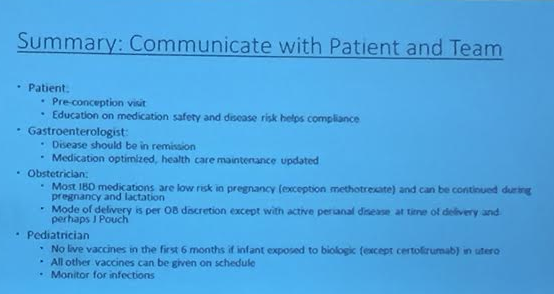
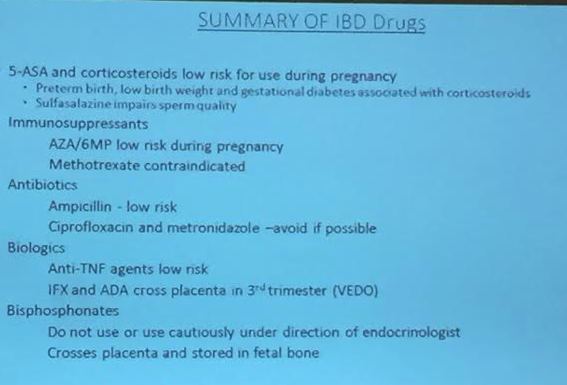
Dr. Wolf reviewed infertility, pregnancy issues, and PIANO registry. This topic has been covered elsewhere in this blog (IBD and Pregnancy | gutsandgrowth). Vedolizumab is a FDA category B; thus far, it is considered fairly safe. Thiopurines are category D but overall thought to be low risk.

This blog entry has abbreviated/summarized this terrific presentation. Though not intentional, some important material is likely to have been omitted; in addition, transcription errors are possible as well.

Screen Shot 2016-04-16 at 2.30.04 PM

Screen Shot 2016-04-16 at 2.28.45 PM

Screen Shot 2016-04-16 at 2.29.35 PM


“The Couric Effect”

A recent commentary (Am J Gastroenterol advance online publication 29 March 2016; doi: 10.1038/ajg.2016.118) by Katie Couric provides a summary of her personal journey as an advocate for preventing colon cancer.

A good read: An Unexpected Turn: My Life as a Cancer Advocate

Here’s an excerpt:

“April is the cruelest month,” T.S. Eliot wrote in “The Waste Land,” and in 1997 it certainly was for my family. That’s when my husband Jay and I discovered he had stage IV colon cancer that had spread to his liver…and the beginning of a 9-month nightmare…

the University of Michigan found that my televised colonoscopy and educational outreach contributed to a sustained 19% increase in the number of colonoscopies performed nationwide. They called it “The Couric Effect”

Screen Shot 2016-03-29 at 4.59.42 PM

Anti-TNF therapy and Pregnancy -More Data

G Broms et al (Clin Gastroenterol Hepatol 2016; 14: 234-41) provide more data on the ‘low risk of birth defects for infants whose mothers are treated with anti-tumor necrosis factor agents during pregnancy.”

From a Danish/Swedish cohort of 1,272,424 live births (2004-2012), the authors found the following (in comparison to healthy infants):

  • Birth defects were increased in chronic inflammatory bowel disease: 4.8% vs. 4.2%
  • 43 (6.3%) of the infants born to women with IBD who received anti-TNF therapy (683) had birth defects.  The OR for any defect was 1.32 (CI 0.93-1.82).  The types of defects were generally similar, including VSD, ASD, hypospadias, and hydronephrosis

Limitations:

  • In infants of mothers with chronic diseases, it is possible that more careful screening identified some less apparent defects.
  • Study did not examine rates of stillborn or abortions

My take: Overall there is a slightly but not significantly increased risk in birth defects based on the use of anti-TNF therapy.  Stopping anti-TNF therapy is likely to be more detrimental.

Briefly noted: P Wils et al. Clin Gastroenterol Hepatol 2016; 14: 242-50.  This retrospective study of 122 patients showed that 65% had a clinical benefit within 3 months of receiving ustekinumab for Crohn’s disease refractory to anti-TNF therapy.  Concomitant immunosuppressant therapy was associated with an increased likelihood of benefit (OR 5.43)

Related blog posts: