NY Times: Do DHA Supplements Make Babies Smarter?

Do DHA Supplements Make Babies Smarter?

Excerpt:

A systematic review of studies published this month by the Cochrane Collaboration concluded there was no clear evidence that formula supplementation with DHA, or docosahexaenoic acid, a nutrient found mainly in fish and fish oil, improves infant brain development. At the same time, it found no harm from adding the nutrient. The findings are consistent with a review of the effects of omega-3 supplements in pregnancy and infancy published by the Agency for Healthcare Research and Quality last fall that found little evidence of benefit.

Still, many experts believe there is value in including DHA in formula. “Even if you can’t easily prove it, because it’s hard to prove developmental outcomes, it makes sense to use it,” said Dr. Steven Abrams, a professor of pediatrics at Dell Medical School at the University of Texas at Austin. “It’s probably a good idea to keep it in there, and it’s certainly safe.”..

The review combined data from 15 randomized controlled trials into a meta-analysis including nearly 1,900 children, many tracked from infancy into mid-childhood. Some studies found small improvements in vision or cognition, but many did not, and when the results were pooled, there was no clear pattern of benefit from DHA added to formula…

 “If you don’t have a deficient population, then it probably doesn’t matter” if people take a supplement, said Dr. Susan Carlson, professor of nutrition at the University of Kansas Medical Center.

But in the United States, many women don’t seem to be getting enough DHA. Women of childbearing age consume an average of 60 milligrams of DHA per day, but many experts recommend at least 200 milligrams per day during pregnancy and breast-feeding.

Proof That Diet Changes Can Improve a Fatty Liver

A recent prospective study (M Markova, O Pivovarova, et al. Gastroenterol 2017; 152: 571-85) showed that among individuals with nonalcoholic fatty liver disease (NAFLD) and type 2 diabetes that a diet high in protein (animal or plant) reduced liver fat over a 6 week period.

Among 37 participants, body fat and intrahepatic fat were detected with MRI and spectroscopy, respectively. Protein was increased to 30% of the diet. Fat was reduced to 30% and carbohydrates to 40% of diet composition. .

Key findings:

  • With a high animal protein diet, liver fat was reduced by 36%.  In the high plant protein diet group, liver fat was reduced by 48%.
  • Theses changes were unrelated to change in body weight.  However, these changes were correlated with down-regulation of lipolysis and lipogenic indices.

Some of the findings may be limited to older patients as this cohort was older than 60 years of age.  In the pediatric population, the dietary factor that has been linked most closely to NAFLD has been fructose, mainly in sugar-sweetened beverages (R Patusco et al. Top Clin Nutr 2017; 32: 27-46 -thanks to Ben Gold for this reference).

My take: This study shows improvement in liver fat with increased protein/reduced dietary fat.  While this study indicates that dietary modification is important in treating NAFLD, the optimal dietary intervention (eg. higher protein, lower sugar, lower fat) remains uncertain.

Related posts:


What Happens When Patients With ‘Gluten Sensitivity’ Are Challenged with Gluten?

A recent review of double-blind, placebo-controlled trials (n=10) (J Molina-Infante, A Carroccio. Clin Gastroenterol Hepatol 2017; 15: 339-48) showed that most individuals who consider themselves to have nonceliac gluten sensitivity (NCGS) do not show gluten-specific symptoms.  Only 16% (38 of 231) showed symptoms specific to gluten ingestion.  In addition, the authors describe a 40% nocebo response (similar or increased symptoms in response to placebo).

My take: Due to the absence of a reliable test for NCGS, there are a lot of people who avoid gluten when gluten is not the main culprit for their symptoms.

On a related topic –NPR reports on colleges developing a New Niche -Gluten-free Dining Rooms.  An excerpt:

An estimated 5 to 10 percent of college students have celiac disease or other gluten-related disorders, according to Dr. Alessio Fasano, director of the Center for Celiac Research and Treatment in Boston…

There’s also a marketing angle in responding to the rising rate of gluten-related diagnoses. “Families tell us that Kent has become a top contender because this option exists

Also from NPR –For People With Celiac Disease -Could a Viral Infection Be a Trigger?

Related blog posts:


Why Do Canadians with Cystic Fibrosis Live Longer than Patients in U.S.?

NY Times Summarizes the reasons why Canadians with Cystic Fibrosis Live Longer: Link:  Canadians With Cystic Fibrosis Live 10 Years Longer Than Americans With the Disease

Cystic fibrosis is an inherited disease that causes recurrent lung infections and other problems. The average lifespan for an American with the illness is 37 years. In Canada, it is 49.

Researchers studied records of 5,941 Canadian and 45,448 American cystic fibrosis patients between 1990 and 2013. After controlling for severity of disease, age and other factors, they found that overall death rates were 34 percent lower in Canada than in the United States.

There was no difference in death rates between Canadians and Americans with private health insurance. But Canada provides universal health care coverage under a single-payer system, so every Canadian has some kind of health insurance. The Canadian death rate was 44 percent lower than that of Americans on Medicaid or Medicare, and 77 percent lower than Americans without insurance.

 AL Stephenson et al.  Ann Intern Med. 2017. DOI: 10.7326/M16-0858

Abstract

Background:In 2011, the median age of survival of patients with cystic fibrosis reported in the United States was 36.8 years, compared with 48.5 years in Canada. Direct comparison of survival estimates between national registries is challenging because of inherent differences in methodologies used, data processing techniques, and ascertainment bias.
Objective:To use a standardized approach to calculate cystic fibrosis survival estimates and to explore differences between Canada and the United States.
Design:Population-based study.
Setting:42 Canadian cystic fibrosis clinics and 110 U.S. cystic fibrosis care centers.
Patients:Patients followed in the Canadian Cystic Fibrosis Registry (CCFR) and U.S. Cystic Fibrosis Foundation Patient Registry (CFFPR) between 1990 and 2013.
Measurements:Cox proportional hazards models were used to compare survival between patients followed in the CCFR (n = 5941) and those in the CFFPR (n = 45 448). Multivariable models were used to adjust for factors known to be associated with survival.
Results:Median age of survival in patients with cystic fibrosis increased in both countries between 1990 and 2013; however, in 1995 and 2005, survival in Canada increased at a faster rate than in the United States (P < 0.001). On the basis of contemporary data from 2009 to 2013, the median age of survival in Canada was 10 years greater than in the United States (50.9 vs. 40.6 years, respectively). The adjusted risk for death was 34% lower in Canada than the United States (hazard ratio, 0.66 [95% CI, 0.54 to 0.81]). A greater proportion of patients in Canada received transplants (10.3% vs. 6.5%, respectively [standardized difference, 13.7]). Differences in survival between U.S. and Canadian patients varied according to U.S. patients’ insurance status.
Limitation:Ascertainment bias due to missing data or nonrandom loss to follow-up might affect the results.
Conclusion:Differences in cystic fibrosis survival between Canada and the United States persisted after adjustment for risk factors associated with survival, except for private-insurance status among U.S. patients. Differential access to transplantation, increased posttransplant survival, and differences in health care systems may, in part, explain the Canadian survival advantage.
Primary Funding Source:U.S. Cystic Fibrosis Foundation.

Sainte-Chapelle, Paris

Bone Health and Intestinal Failure

Link: Bone Health of Children with Intestinal Failure (Thanks to Kipp Ellsworth for this reference) E Neelis et al. DOI: http://dx.doi.org/10.1016/j.clnu.2017.02.014

From Abstract:

Methods

A retrospective study was performed including all children with IF between 2000 and 2015 who underwent a DXA measurement and/or a hand radiograph. Z-scores of BMD total body (BMD TB) and lumbar spine (BMD LS), bone mineral apparent density (BMAD) and bone health index (BHI) were collected. A low BMD and low BHI were defined as a Z-score ≤ -2. DXA and DXR results were compared for cases in which a DXA and hand radiograph were performed within a 6 months’ interval.

Results

Forty-six children were included. Overall, 24.3% of the children had a low BMD at the first DXA at a median age of 6 years; correction for growth failure (n=6)) reduced this to 16.2%. Fifty percent had a low BHI at the first hand radiograph. Median DXA and BHI Z-scores were significantly lower than reference scores. Age, duration of PN and surgical IF were related to lower Z-scores at the first DXA. Paired DXA and DXR results (n=18) were compared, resulting in a Cohen’s kappa of 0.746 (‘substantial’) for BMD TB. Spearman’s correlation coefficient for BHI and BMD TB Z-scores was 0.856 (p<0.001). Hand radiography had a sensitivity of 90% and specificity of 86% (BMD TB).

Conclusions

Up to 50% of the children had a low BMD. Children with IF have a significantly poorer bone health than the reference population, also after weaning off PN. Bone health assessment by DXA and DXR showed good agreement, especially for Z-scores ≤ -2. DXR assessment using BoneXpert software seems to be feasible for monitoring of bone health in children with IF.

screenshot-148

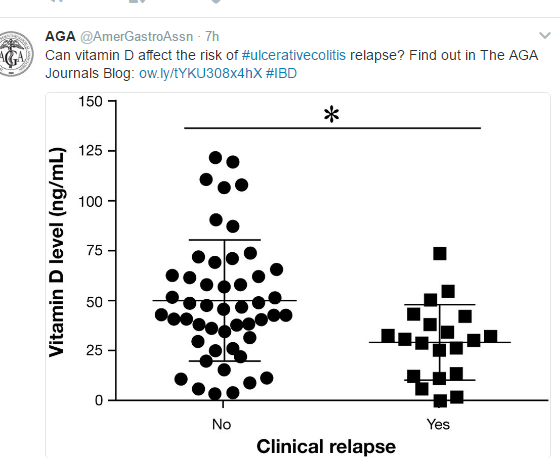
Vitamin D and Ulcerative Colitis Remission

A recent study (J Gubatan et al. Clin Gastroenterol Hepatol 2017; 15: 240-6) examined a prospective study of 70 patients with ulcerative colitis (UC).  These patients (average age 48.6 yrs) were initially in clinical remission.  Key findings:

  • Mean baseline vitamin D (25-OH) level was lower among patients with subsequent relapse (29.5 ng/mL) than those without relapse (50.3 ng/mL)
  • Over 12 months, a 25-OH D value <35, was associated with a small increased risk of relapse (odds ratio1.25). 20% of patients with a value <35 had clinical relapse compared with 9% (P= .003) who had values >35.

Because vitamin D levels are inversely related to UC disease activity, this study is particularly intriguing.  By enrolling patients prospectively while in remission, this study suggests that good vitamin D levels may directly have immunoprotective and anti-inflammatory properties.

The AGA Journals blog provides an excellent summary of this study: Can Vitamin D Affect Risk of Ulcerative Colitis Relapse?

“In an editorial that accompanies the article, Stephen Hanauer reminds readers that the mean vitamin D level in the entire cohort was 44 ng/mL, and 60% of the subjects were taking vitamin D supplements. A normal vitamin D level is considered to be 20–40 ng/mL in healthy individuals, and the 35 ng/mL cut-off level used in the study was within this range.

Hanauer also mentions that in assessing the confidence intervals for risk of relapse at lower or higher vitamin D levels, there does not appear to be a dose–response effect in the odds ratios according to levels. Based on these findings, Hanauer says it would be premature to target a level of 35 ng/mL. He states that the best predictors of clinical relapse are still endoscopic and histologic markers of inflammation.”

My take: At this time, trying to maintain a normal vitamin D level is likely to be worthwhile; though, values obtained during acute flares remain unreliable.

Related blog posts:

Disclaimer: These blog posts are for educational purposes only. Specific dosing of medications/diets (along with potential adverse effects) should be confirmed by prescribing physician/nutritionist.  This content is not a substitute for medical advice, diagnosis or treatment provided by a qualified healthcare provider. Always seek the advice of your physician or other qualified health provider with any questions you may have regarding a condition.

screenshot-99

Will Bariatric Surgery Become an Endoscopic Procedure?

A recent study (BK A Dayyeh et al. Clin Gastroenterol Hepatol 2017; 15: 37-43) provides evidence that endoscopic sleeve gastoplasty can be an effective treatment for obesity.

AGA Website Summary Endoscopic Sleeve Gastroplasty: A Promising New Weight Loss Procedure

An excerpt:

In the fight against obesity, bariatric surgery is currently the most effective treatment; however, only 1 to 2 percent of qualified patients receive this surgery due to limited access, patient choice, associated risks and the high costs. A novel treatment method — endoscopic sleeve gastroplasty — might offer a new solution for obese patients. Endoscopic sleeve gastroplasty is a minimally invasive, safe and cost-effective weight loss intervention, according to a study1 published online in Clinical Gastroenterology and Hepatology, the official clinical practice journal of the American Gastroenterological Association…

In this study of 25 patients with obesity who underwent the procedure at the Mayo Clinic in Rochester, MN, endoscopic sleeve gastroplasty reduced excess body weight by 54 percent at one year. Further, the procedure delayed solid food emptying from the stomach and created an earlier feeling of fullness during a meal, which resulted in a more significant and long-lasting weight loss.

Endoscopic sleeve gastroplasty was well tolerated as an outpatient treatment, requiring less than two hours of procedure time. Patients resumed their normal lifestyle within one to three days. The treatment was performed using standard “off-the-shelf” endoscopic tools as opposed to specific weight loss devices or platforms. The cost of endoscopic sleeve gastroplasty is roughly one-third that of bariatric surgery.

4 minute YouTube description from Johns Hopkins: What is Endoscopic Sleeve Gastroplasty and How Does it Work?

screenshot-73

screenshot-74 screenshot-75

PICC versus Broviac for TPN in Intestinal Failure

LinkA comparison of Broviac® and peripherally inserted central catheters in children with intestinal failure

Abstract:

Central venous catheters (CVCs) are a source of morbidity for children with intestinal failure (IF). Complications include infection, breakage, occlusion, and venous thrombosis. Broviacs® have traditionally been preferred, but peripherally inserted central catheters (PICCs) are gaining popularity. This study compares complications between Broviacs® and PICCs in children with IF.

Methods

After IRB approval, children with IF receiving parenteral nutrition (2012–2016) were reviewed. Complications were compared between Broviacs® and PICCs using the generalized estimation equation population-averaged Poisson regression model. P values <0.05 were considered significant.

Results

36 children (0.1–16 years) with IF were reviewed, accounting for 27,331 catheter days, 108 Broviacs® (3F–9F), and 54 PICCs (2-11F). Broviacs® had a significantly higher infection rate (4.2 vs. 2.6/1000 catheter days, p = 0.011), but PICCs were more likely to break (1.56 vs. 0.26/1000 catheter days, p = 0.002). When comparing same size catheters (3F), there were no significant differences in infection, breakage, or occlusion. Twelve children (33%) had central venous thrombosis, all after Broviac® placement. Three children (8%) had basilic vein thrombosis after PICC placement.

Conclusion

Although Broviacs® and PICCs had similar complication rates, there were fewer central venous thromboses associated with PICCs. This should be considered when choosing catheters for children with IF.

screenshot-113

My take: Despite some possible advantages of PICC in this study, a prospective randomized study is needed if one is to make a compelling argument regarding better outcomes.  Given the retrospective nature of this study, it could be that the sicker patients may have been more likely to receive a Broviac® and this could have skewed the results.

February Briefs

JM Powers et al. J Pediatr 2017; 180: 212-6. This retrospective study details a protocol for using intravenous ferric carboxymaltose (FCM) (Injectafer) in children.  This product has become available for adults in U.S. since June 2013; it had been available in Europe since 2009. In this retrospective study, 72 pediatric patients received FCM for iron deficiency anemia (off-label); there was a good safety profile and a good response with hemoglobin increasing from 9.1 to 12.3 (4-12 weeks post infusion).  FCM is a relatively costly IV iron formulation, but can be given over 15 minutes.

L Peyrin-Biroulet et al. Clin Gastroenterol Hepatol 2017; 15: 25-36.  This systemic review with more than 2800 patients showed that TNF antagonists were effective for extraintestinal manifestations of inflammatory bowel disease, including cutaneous disorders (eg.. pyoderma gangrenosum, erythema nodosum), hematologic problems (eg anemia), ocular disorders, and rheumatologic symptoms( eg. arthralgias/arthritis).

AE Mikolajczyk et alClin Gastroenterol Hepatol 2017; 15: 17-24. Useful review of the GI/Liver manifestations of autosomal-dominant polycystic kidney disease. “There is not a role for therapy [for the liver] in asymptomatic patients.” Other problems reviewed included pancreatic cysts, hernias, and diverticular disease. Related posts:

T Rajalahti et al. JPGN 2017; 64: e1-6.  Among 455 patients <18 with Celiac disease, anemia was noted in 18%. This resolved in 92% after one year of a gluten-free diet.  Anemia is associated with more severe histological and serological presentation. Related posts:

FL Cameron et al. JPGN 2017; 64: 47-55. This retrospective review of 93 children treated with infliximab and 28 children with adalimumab provides data on growth after anti-TNF therapy.  This study shows that anti-TNF therapy is more likely to be associated with growth improvement when used at earlier stages of puberty.

Related blog posts:

Chattahoochee River

Chattahoochee River

Briefly Noted: Crash Test Dummies

screenshot-96

Here’s the link: Crash Test Dummies Fatter too!

Related blog posts: