Popular Posts 2015

Today and tomorrow I am posting the most popular posts and my personal favorite posts from 2015.  I am labeling the most popular posts as those posts that had the highest number of visits in the past year.

Most popular posts:

Shem Creek, SC

Shem Creek, SC

Should Teenagers with Severe NAFLD Undergo Bariatric Surgery?

A recent commentary (Stavra A. Xanthakos and Jeffrey B. Schwimmer. Nat Rev Gastroenterol Hepatol. 2015 Jun; 12(6): 316–318.) discusses the role of bariatric surgery for teenagers with severe nonalcoholic fatty liver disease (NAFLD).  Full text Link: On a knife-edge—weight-loss surgery for NAFLD in adolescents.

Here’s an excerpt:

Abstract: A new position statement from Europe endorses expert-based recommendations to consider bariatric surgery as a treatment for severe NAFLD in severely obese adolescents. This article discusses the problem of severe paediatric obesity, its relationship with NAFLD, and the knowledge and needs regarding bariatric surgery in adolescents… it is critical that adolescents with NAFLD undergoing bariatric surgery be evaluated and managed in bariatric surgery centres with appropriate paediatric multidisciplinary expertise and a commitment to rigorously phenotype NAFLD histology at baseline and to follow outcomes prospectively as long as possible. These procedures can be particularly challenging in adolescents, who are prone to relocate in adulthood and thus might not return for follow-up. High quality prospective multicentre studies with low attrition rates, such as the Teen Longitudinal Assessment of Bariatric Surgery (USA) and the Adolescent Morbid Obesity Study (Sweden) have begun to provide short to intermediate term (1–2 year) outcomes after adolescent bariatric surgery, but do not include prospectively collected data on histological liver outcomes to support evidence-based recommendations regarding NASH as a specific indication for bariatric surgery. However, given the benefits that are emerging for type 2 diabetes and sleep apnoea, (which are comorbid conditions often associated with NASH), we concur with previously published expert guidelines that conclude that bariatric surgery is not contraindicated in a non-cirrhotic patient with NAFLD who otherwise meets appropriate medical and psychosocial criteria for bariatric surgery.2 The adolescent and family should, however, be counselled that a positive outcome with respect to NAFLD is, as yet, not a foregone conclusion.

Related blog posts:

Screen Shot 2015-12-15 at 7.37.51 PM

Tipping Point for Obesity?

A bit of encouraging news from California where investigators showed a small drop in the prevalence of childhood obesity from 2008 to 2013 (C Koebnick et al. J Pediatr 2015; 167: 1264-71).  Using a population-based cohort of ~1.3 million patients, the authors found the following:

  • Obesity prevalence decreased from 19.1% (2008) to 17.5% (2013).  This was observed across all ages, sexes, races, and socioeconomic groups but with variability.
  • Younger children had a greater decline in obesity prevalence compared with adolescents: ages 2-5 years:  -15.4% decline, ages 6-11 years: -11,8% decline and in 12-19 years: -4.5%.

My take: This is a good indication that increased awareness of the obesity epidemic may be leading to some improvement.

Related blog posts:

Lights at Life University

Lights at Life University

Antibiotics and Growth in India

A recent study (Rogawski ET, et al. J Pediatr 2015; 167: 1096-102) examined a prospective observational cohort of 497 children in India (from “semi-urban slums”).  The authors found that early exposure to antibiotics were not associated with increased or decreased growth.

“There are several potential explanations for the lack of a growth-promoting effect.  Most of the previous studies showing increased weight gain or risk of obesity associated with antibiotics were conducted in high-income countries with Western diets.”

My take: This was a negative study on antibiotics and obesity.  This suggests that the effects of antibiotics with regard to weight gain may be limited and/or modified by diet.

Also noted: Wakamoto H, et al. J Pediatr 2015; 167: 1136-42.  This study showed that Krebs von den Lungen-6 (KL-6) which is abundant on type II alveolar pneumoctyes and respiratory epithelial cells is a fairly good serum biomarker for chronic aspiration in this study of children with severe motor and intellectual disabilities.  Figure 1 shows the distribution of KL-6 among the 37 with aspiration and the 29 without aspiration.  The median in the former was 344 vs 207 in the later, though there was overlapping results.

Related blog posts:

Sandy Springs

Sandy Springs

Dietary Diversity in Infants

A recent study (Woo JG et al. J Pediatr 2015; 167: 969-74) indicates that breastfed infants in a US cohort had lower dietary diversity at 6-12 months of age than a cohort from Shanghai and Mexico City.

The diversity of consumed foods helps ensure intake of all necessary macro- and micronutrients.  One indicator, the “minimum dietary diversity” (MDD) developed by the World Health Organization has been used.  Infants meeting MDD standards between 6-23 months are less likely to experience stunting.

Key findings:

  • “Only 28% of Cincinnati [US cohort] infants fed >50% human milk achieved MDD between 6 and 12 months.”
  • Across all cohorts, dietary diversity increased from 31% at 6 months of age to 92% at 12 months of age.
  • Shanghai infants had the highest diversification, “largely accounted for by significant consumption of eggs”

This study shows that some of previous recommendations, prior to 2008, to avoid foods like eggs and peanuts to lessen atopic disease/food allergies may have affected introduction of a more diverse diet.  Newer data has shown that earlier introduction of foods lessens the likelihood of food allergies.

The associated editorial (pg 952-53) notes that despite the ‘breast is best’ philosophy, that “if this principle is taken to extreme and introduction of nutrient dense complementary foods is delayed well past 6 months of age, the extensively breastfed older infant is at risk for suboptimal intakes of multiple micronutrients, anemia, growth faltering, and other poor health outcomes.”

From recent painting class (it's an improvement from stick figure drawing)

From recent painting class (it’s an improvement from stick figure drawing)

Improving Outlook in Neonatal Nutrition (Part 2)

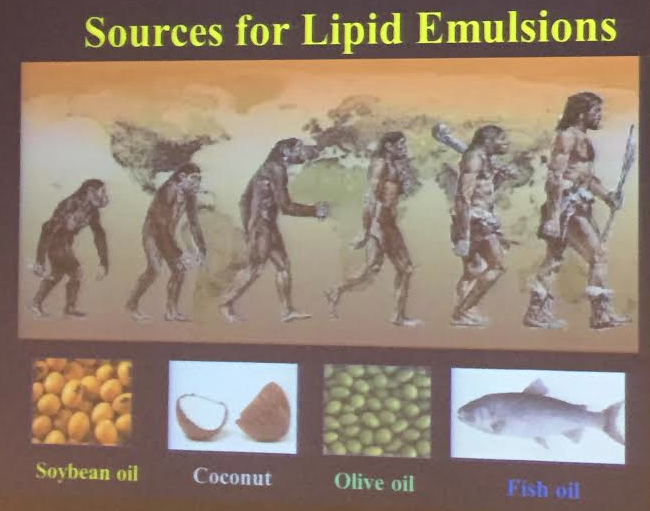
Besides arguing for more aggressive and earlier use of intravenous protein, Dr. Adamkin noted that newer lipid emulsions (eg. SMOFlipid) are likely to be helpful due to the concentrations of docosahexaenoic acid (DHA) and arachidonic acid (ARA).  DHA and AA are the two main long chain polyunsaturated fatty acids (LCPUFAs) and are integral to the structural membranes of cells in the central nervous system and retina.

Slow Evolution of Lipid Emulsions

Slow Evolution of Lipid Emulsions

Decreasing Incidence of Growth Failure with More Aggressive Nutrtion

Decreasing Incidence of Growth Failure with More Aggressive Nutrition –average daily protein intake in most recent cohort during 1st 5 days is 3 g/kg/day (much higher than in previous years

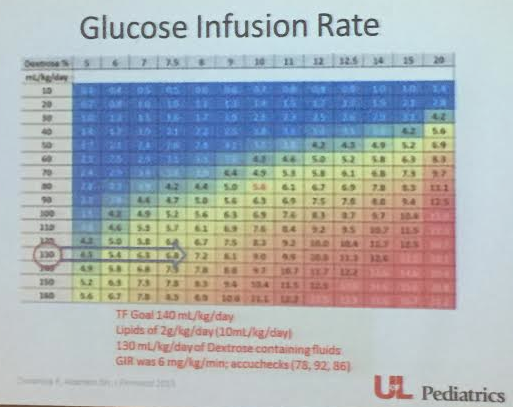
At U of L, they have developed a quick card to calculate glucose infusion rate based on dextrose and fluid volume (mL/kg/day)

At U of L, they have developed a quick card to calculate glucose infusion rate based on dextrose and fluid volume (mL/kg/day)

Other points:

  • SGA infants have low lioprotein lipase –>higher triglycerides
  • Slow lipid infusion associated with better tolerance
  • Insulin may be needed if not able to provide a glucose infusion rate of at least 4 mg/kg/min; otherwise, he recommends avoiding insulin.
  • Dr. Adamkin recommended adding carnitine after 4 weeks of TPN
  • During transition to enteral feeding, in order to continue with 3.5-4 g/kg/day of amino acids, many infants will need a stock solution of IVFs with supplemental amino acids to supplement enteral feeds

Related blog posts:

Improving Outlook in Neonatal Nutrition (Part 1)

I recently had the opportunity to hear a terrific lecture by David Adamkin (University of Louisville) on neonatal nutrition.  Unlike previous lectures that I’ve highlighted on this blog (Neonatal Nutrition Lecture -What We Know Right Now …) which focused on enteral nutrition and breastmilk.  This lecture focused on providing early parenteral nutrition to prevent postnatal growth failure.

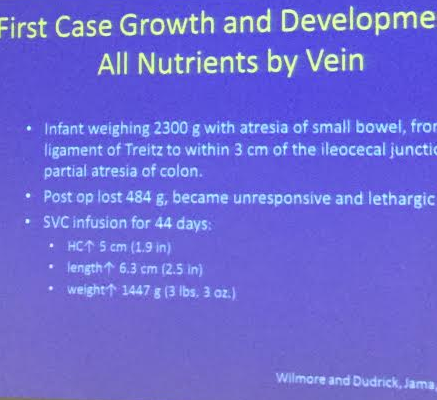
"Father" of TPN was Stanley Dudrick (1968)

“Father” of TPN was Stanley Dudrick (1968)

Introduction of TPN dramatically improved survival for many infants.  In disorders like gastroschisis, TPN increased survival from ~10% to 90%.

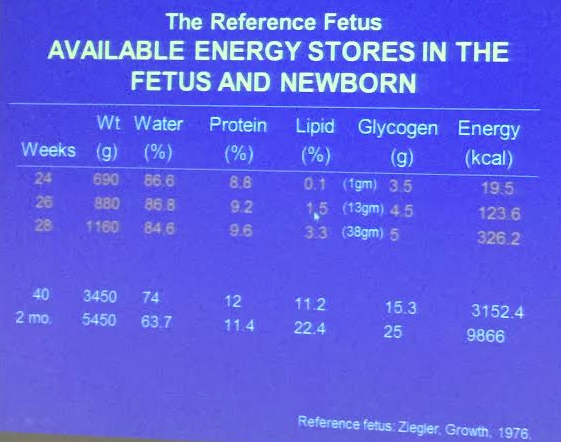
Extreme premature infants have minimal energy reserves

Extreme premature infants have minimal energy reserves

At 24-28 weeks gestational age, fetuses are ‘bathed in amino acids’ and extreme premature infants need early amino acids.  At University of Louisville, the neonatologists try to deliver ~3 gm/kg/day of amino acids in 1st 1-2 days in order to match intrauterine growth and prevent growth failure. Half of postnatal weight loss is water; other half is related to proteolysis.  To facilitate TPN at all hours, they use a stock solution (4% amino acids at 60 mL/kg/day delivers 2.4 mg/kg/day of protein; 80 mL/kg/day delivers 3.2 mg/kg/day of protein.

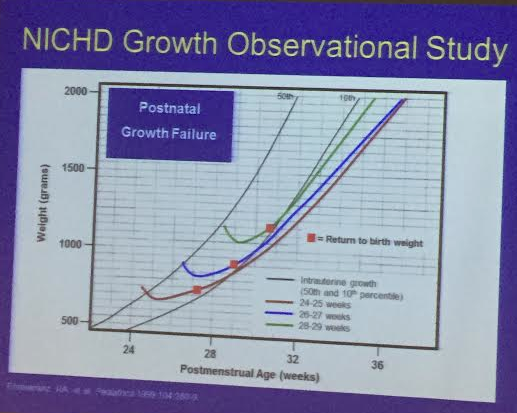
Return to Birth Weight Time is Correlated with Growth Failure

Return to Birth Weight Time is Correlated with Growth Failure.  Extreme prematurity has been correlated with slower return to birth weight

Screen Shot 2015-11-11 at 10.59.04 PM

Lack of correlation between BUN and Protein Intake

Lack of correlation between BUN and Protein Intake

BUN increases with any protein intake but not affected by protein intake -issue has to do renal fxn, comorbidity.  Smaller & sicker have higher BUN.

Key points:

  • The more premature, then the longer it takes to return birth weight and more growth failure
  • Poor growth related to neurodevelopment outcomes
  • With higher protein intake, there is better glucose tolerance; protein intake helps with glucose tolerance & lowers chance of hyperkalemia

More tomorrow…

Milder Celiac Disease Being Diagnosed Now

A study (Kivela L et al. J Pediatr 2015; 167: 1109-15) over a period of 48 years from Finland provides some hard data regarding the changing presentation of celiac disease.

Here are the key points;

  • Age at diagnosis has increased from a median of 4.3 years before 1980 to 7.6 years and 9.0 years in later periods.
  • Poor growth has decreased.  Among the 46 children diagnosed prior to 1980, poor growth occurred in 66% whereas 2010-2013: 23% had poor growth (had 14% were overweight or obese)
  • Severity of small-bowel mucosal damage was milder (Figure 1 D).  Among those with gastrointestinal presentation, total villous atrophy also declined from “61-62% to 18-22% (P=.001).”

Why is the presentation changing? There are increased “proportions of screen-detected and asymptomatic children…[this has] increased over 6-fold and simultaneously gastrointestinal symptoms …decreased.”  While there are improved diagnostic methods and increased knowledge, there has also been a “well-defined increase in the true prevalence of celiac disease.”

Related blog posts:

Overlooking Obesity in Hospitalized Children

A recent study (MA King et al. J Pediatr 2015; 167: 816-20) shows that physicians and physician trainees rarely addressed overweight/obesity in hospitalized children at a Utah pediatric hospital.

Using a chart review and an administrative database, the authors note that overweight/obesity was identified in 8.3% (n=25) and addressed in 4% (n=12) of 300 hospitalized children with overweight/obesity.  They conclude that “this represents a missed opportunity for both patient care and physician trainee education.”

My take: In many cases, addressing overweight/obesity at a stressful time like a hospitalization may be unwelcome. In children who are not very sick, offering nutritional counseling would be worthwhile.  For others, I think encouraging outpatient followup would be reasonable.

Also noted: “High Prevalence of Nonalcoholic Fatty Liver Disease in Adolescents Undergoing Bariatric Surgery” SA Xanthakos et al. Gastroenterol 2015; 149: 623-34. In this cohort of 242 adolescents, 59% had NAFLD.  None had cirrhosis; stage 3 fibrosis was identified in 0.7%. Comment: I’m surprised that only 59% had NAFLD.

white flower

So, What Could Go Wrong with Unregulated Dietary Supplements?

As noted before on this blog (see below), dietary supplements, marketed as health aids, can be quite dangerous.  More data on the complications has been published (AI Geller et. NEJM 2015; 373:1531-1540).

Here is an excerpt of a summary from the NY Times: Dietary Supplements Lead to 20,000 E.R. Visits Yearly, Study Finds

A large new study by the federal government found that injuries caused by dietary supplements lead to more than 20,000 emergency room visits a year, many involving young adults with cardiovascular problems after taking supplements marketed for weight loss and energy enhancement.

The study is the first to document the extent of severe injuries and hospitalizations tied to dietary supplements, a rapidly growing $32 billion a year industry that has attracted increased scrutiny in the past year and prompted calls for tougher regulation of herbal products….

Among the injuries cited were severe allergic reactions, heart trouble, nausea and vomiting, which were tied to a broad variety of supplements including herbal pills, amino acids, vitamins and minerals. Roughly 10 percent, or about 2,150 cases yearly, were serious enough to require hospitalization, the researchers found…

More than a quarter of the emergency room visits occurred among people ages 20 to 34, and half of these cases were caused by a supplement that was marketed for weight loss or energy enhancement…

Medical experts say that these products can be particularly hazardous because they have potent effects on the body and are frequently adulterated with toxic chemicals. The new study found that cardiovascular problems were even more commonly associated with weight loss and energy supplements than prescription stimulants like amphetamine and Adderall, which by law must carry warnings about their potential to cause cardiac side effects…

Under a 1994 federal law that has been widely criticized by health authorities, supplements are considered safe until proved otherwise.

Other points from the study:

  • “Child-resistant packaging is not required for dietary supplements other than those containing iron”
  • While these supplements result in <5% of the numbers for hospitalizations and admissions for pharmaceutical products, “dietary supplements are not regulated and marketed under the presumption of safety.”

Related blog posts: