GI Care for Kids physician, Jeff Lewis, helped bring fecal microbiota transplant (FMT) to Georgia. Here’s a success story from Fox5 Atlanta from August 31, 2015. Here’s the link:
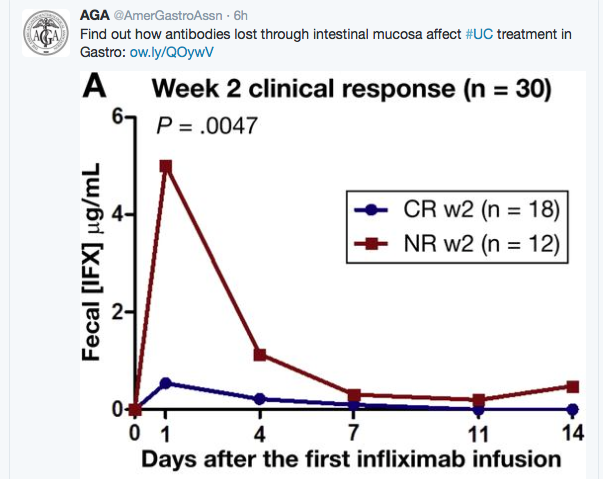
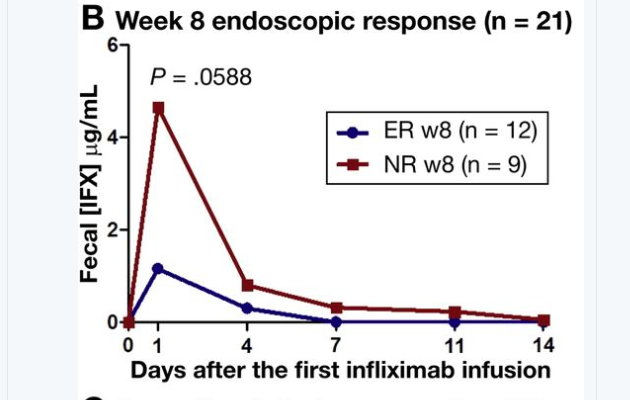
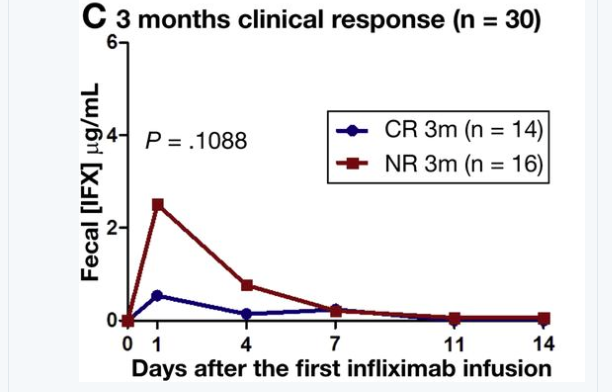
In this study, the authors obtained fecal samples from 30 consecutive patients with moderate to severe UC during the 1st 2 weeks of therapy. In addition, they obtained serum infliximab levels as well as assessed clinical and endoscopic response at 2 weeks, 8 weeks, and 3 months after treatment began.
Key findings:
Fecal infliximab was detected in 129 of 195 (66%) samples. The greatest loss was observed approximately 2 days after infusion. Low serum albumin was associated with greater infliximab levels in the stool.
Clinical nonresponders at week 2 had significantly higher fecal infliximab
The authors did not observe a correlation between fecal and serum infliximab concentrations. However, it is possible that stool losses could indicate lower mucosal concentrations of infliximab.
From AGA twitter account
From AGA twitter account
From AGA twitter feed
Bottomline: It is not clear whether stool losses of infliximab directly contribute to drug failure or whether the loss is another biomarker of disease activity/high-risk patients.
The study authors note that “intestinal loss of IFX in moderate to severely active UC is associated with a diminished response to this treatment. Patients with severe disease can, therefore, benefit from more intensive dosing regiments. This strategy warrants a prospective clinical trial.”
The best data to date: D Lee et al. Inflamm Bowel Dis 2015; 21: 1786-93. In this prospective study, the authors studied treatment initiation in children (N=90), comparing partial enteral nutrition (PEN, n=16), exclusive enteral nutrition (EEN, n=22), and anti-TNF therapy (n=52).
Results:
Clinical response, defined by PCDAI reduction ≤15 or final PCDAI ≤10, was achieved by 64% PEN, 88% EEN, and 84% anti-TNF.
Fecal calprotectin ≤250 noted in 14% PEN, 45% EEN, and 62% anti-TNF
Because of the discrepancy between EEN and PEN, the authors speculate that the “efficacy of EEN may be a consequence of elimination of table food rather than providing a uniquely therapeutic method of delivering nutrients.” They note that “choice of formula has not impacted the efficacy of enteral nutrition.”
More extensive information on this subject: D Lee et al. Gastroenterol 2015; 148: 1087-1106.
Bottomline: Anti-TNF therapy was as effective or more effective than EEN. And, “for patients who prefer treatment with a nutrition-based therapy, EEN seems superior to PEN.”
A recent study indicates that a fairly high number of adults with appendicitis could avoid surgery (JAMA 2015 June 15 [doi:10.1001/jama.2015.6154]).
In this study, patients with CT-confirmed acute uncomplicated appendicitis were randomly assigned to either immediate surgery (n=273) or a 1-day of IV ertapenem followed by 7 days of levofloxacin and metronidazole.
The primary endpoint for the antibiotic group – resolution of acute appendicitis with no recurrences for a full year – occurred in 73%. The remaining 27% of patients in this group underwent appendectomy during follow-up, at a median of 102 days after initial presentation. None of these patients developed abscesses or serious infections, “suggesting that the decision to delay appendectomy … can be made with a low likelihood of major complications,” the investigators said
And commentary from Edward Livingston, M.D., is deputy editor of JAMA. Corrine Vons, M.D., Ph.D., is in the digestive surgery department at Jean-Verdier Hospital, Bondy, France. :
The study findings dispel the notion that appendectomy is always an emergency and suggest instead that, given our current precise diagnostic capabilities and effective wide-spectrum antibiotics, a trial of antibiotic therapy is reasonable. However, it’s important to note that children, adolescents, pregnant women, and patients with complications were excluded from this trial so the findings do not apply to those patient groups.
Dr. Livingston and Dr. Vons made these remarks in an editorial accompanying Dr. Salminen’s report (JAMA 2015;313:2327-8).
My Take: This study indicates, at least in adults with uncomplicated appendicitis, that antibiotic treatment is an option. I think resolving the problem definitively would be my preference. If you had appendicitis, which therapy would you choose? Take the poll.
They used another virus called MS2 that’s similar to norovirus, that doesn’t make people sick and that’s easy to grow in the lab.,,
“We think that there’s a at least a million particles released in a vomiting event and maybe more.”
Not all of it goes into the air. In fact, very little did in their experiments. But it was enough. They estimate that as many as 13,000 virus particles can be released into the air with a single retch. They made a video that shows how it works.
“There was evidence of aerosolized MS2 after every simulated vomiting episode,” they wrote in their report, published in the Public Library of Science journal PLoS ONE.
People can be infected with as few as 20 to 1,300 microscopic viral particles, so their study shows that vomiting could indeed spread the infection through the air….
“WHEN ONE PERSON VOMITS, THE AEROSOLIZED VIRUS PARTICLES CAN GET INTO ANOTHER PERSON’S MOUTH AND, IF SWALLOWED, CAN LEAD TO INFECTION.”
“There are 21 million cases of human norovirus infection in the U.S. each year, and this virus genus is now recognized as the leading cause of outbreaks of acute gastroenteritis,” the researchers wrote.
It kills up to 800 people a year in the U.S. alone and puts 70,000 into the hospital, so understanding how it spread sand finding ways to stop it could prevent many illnesses, the researchers said.
This past week I’ve been on call and had not finished a few articles. One article that was on the to do list: A Lang et al. Clinical Gastroenter Hepatol 2015; 13: 1444-9.
I’ve read it now. However, even before finishing the article, I read a few good summaries of this article, including one from my colleague Stan Cohen/Nutrition4Kids: Curcumin Helps (A Lot) in Ulcerative Colitis
Here’s an excerpt:
The cover of a prestigious medical journal shows a pile of curcumin and over it, the announcement reads: Curcumin Helps Induce Remission in Mild-to-Moderate Ulcerative Colitis. That’s big news for a lot of reasons: first, this Indian spice (derived from tumeric) is inexpensive and well-tolerated; second, in a well-designed scientific study, curcumin showed that it was more effective than some medicines; and third, it showed, again, that careful trials of long-used herbs can be done with important results being shown. Again, because an earlier study (H Hanai, Clinical Gastroenterology 2006, pages 1502-6) had previously shown that curcumin can help keep ulcerative colitis (UC) patients from flaring for up to 12 months.
This new study (A Lang, Clinical Gastroenterology 2015, pages 1444-9) compared curcumin to a placebo in patients who were not doing well on the standard therapy (mesalamine) for mild to moderate UC. With a single daily dose of 3 grams of curcumin in capsule form, 65% responded (compared to 12% with a placebo) and 54% actually went into remission, having essentially no symptoms. Perhaps even, more importantly, 38% of those taking the curcumin showed improvement in the intestinal tissue when a colonoscopy was performed. That’s comparable or better than some of the medications that are being used.
A few other details: The researchers used a product called Cur-Cure from Bara Herbs Inc (Yokneam, Israel). Also, the associated commentary in the same journal by CN Bernstein (pages 1450-52) suggests that the study may have targeted mild ulcerative colitis (rather than moderate ulcerative colitis). He comments that the increasing rates of ulcerative colitis among Indian immigrants could be related to including less curcumin in their now more westernized diets. He also notes, as did Dr. Cohen, that there were previous promising studies dating back to 2006. Why has it taken nine years for this report?
My Take: This is probably an article worth reading. Although curcumin appears promising, I worry that a lack of financial incentive may hamper research efforts to better define its place as an agent for treatment of ulcerative colitis.
Several thought leaders, including Francis Collins, have heralded the age of “precision medicine.” A recent commentary provides compelling arguments why “enthusiasm is premature.”
The greatest problems we face in improving health care do not require precision medicine.
“In 2013, the National Research Council (NRC) and the Institute of Medicine (IOM) issued a bleak report on life expectancy and well-being in the United States. Shorter Lives, Poorer Health documented the extent to which Americans were at a disadvantage at every stage of life compared with their counterparts in peer countries.” Americans fared worse in all of the following:
Birth outcomes
Heart disease
Motor vehicle accidents
Violence
Sexually transmitted disease
Chronic lung disease
The NRC notes that “health is determined by far more than health care.”
“Precision medicine itself may ultimately make critical contributions to a narrow set of conditions, but the challenge we face…entails…willingness to address certain persistent social realities”
“Our public investments in broad, cross-sectional efforts to minimize…foundational drivers of poor health as poverty…are pitifully few in comparison with those of other countries.”
Take-home message from authors: “We worry that an unstinting focus on precision medicine by trusted spokespeople for health is a mistake — and a distraction from the goal of producing a healthier population.”
My view: The challenges posed by the authors do seem monumentally greater than those facing the development of precision medicine.
“Issue-attention cycle” problem. “This pattern occurs when initial public alarm over the discovery of a problem and optimism about its quick resolution are replaced by the realization that solving the problem will require some public sacrifice and will displace powerful societal interests.”from Weight of the Nation | gutsandgrowth
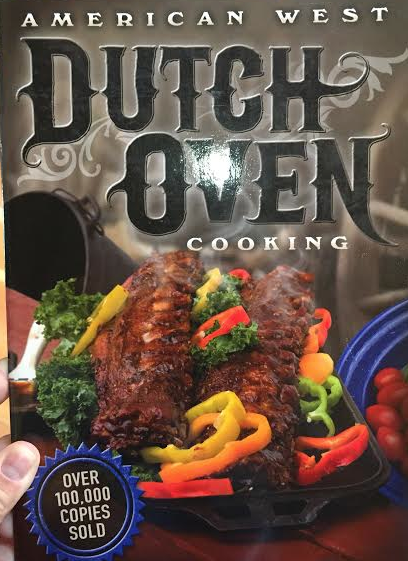
Here’s a Book Where the Title May Be Misinterpreted
A previous study has indicated that maternal probiotic administration was associated with a lower rate of atopic dermatitis. The overall quality of evidence supporting this association is considered low.
A recent study (CK Dotterud et al. JPGN 2015; 61: 200-7) examined the effect on the intestinal microbiota in both mother and child following maternal perinatal probiotic supplementation. This randomized, double-blind trial examined the effect of probiotic administration (or placebo) from 36 weeks of gestation up to 3 months postnatally while breastfeeding. Stool microbiome was examined in both mother and child.
Key findings:
The changes in the infants microbiome were quite limited. “Only the Lactobacillus rhamnosus GG bacteria colonized the children at 10 days and at 3 months of age. There were no significant differences in the abundance of administered probiotic bacteria between the groups at 1 and 2 years of age.”
My take: We know very little about probiotics and their effects on the GI tract. We often do not even the basics: which strains? which dosage? optimal timing/when to use? Given the lack of persistent change in the infant’s microbiome, does administration to pregnant mothers really make any sense (outside of research endeavors)?
Question for pediatric gastroenterologists (first poll I’ve placed in this blog): Do you think disaccharidases are needed routinely for patients with abdominal pain in the absence of bloating, or diarrhea?
A recent report indicated a high rate of disaccharidase deficiencies among children with recurrent abdominal pain. Here’s the abstract link: Disaccharidase Deficiencies in Children With Chronic Abdominal Pain (K El-Chammas, SE Williams, A Miranda. Published online before print July 9, 2015, doi: 10.1177/0148607115594675JPEN J Parenter Enteral Nutr July 9, 2015 0148607115594675). Thanks to Kipp Ellsworth for this reference.
Here’s an excerpt:
Data on disaccharidase activity and histology of endoscopic biopsies were collected retrospectively. Only patients with normal histology were included in the study.
Results: A total of 203 pediatric patients with CAP were included. The mean (SD) age was 11.5 (3.1) years, and 32.5% were male. The percentages of abnormally low disaccharidase levels using the standard laboratory cutoffs were lactase, 37%; sucrase, 21%; glucoamylase, 25%; and palatinase, 8%. Thirty-nine percent of the patients with low lactase also had low sucrase, and 67% of the patients with low sucrase had low lactase…Also, no association was found between stool consistency, stool frequency, or location of pain and low disaccharidase activity.
My take: I am highly skeptical regarding these findings–see Twyman’s Law | gutsandgrowth. For sucrase deficiency, for example, this report represents an extraordinarily high rate of deficiency compared with previous reports. In addition, there are numerous errors which can occur in the handling of tissue specimens. With regard to lactase deficiency, of course, this is common but having lactose intolerance does not prove causality with regard to abdominal pain. Many physicians encourage families to see if there is a link between milk ingestion and GI symptoms to help determine if lactose intolerance is a likely contributor to stomach pain (before endoscopy). Stomach pain in the absence of milk ingestion is not due to lactose intolerance.
Before accepting these high rates, improved methodology (eg. control group and duplicating results) would be helpful.
A recent study (FA Khan et al. J Pediatr 2015; 167: 29-34 -thanks to Mike Hart for forwarding this reference) provides data from a multicenter retrospective cohort of 272 infants. These infants had of IF were defined by requiring >60 days of PN; they were enrolled in the Pediatric Intestinal Failure Consortium. The median followup was 33.5 months. The most common etiologies of IF were necrotizing enterocolitis (NEC), gastroschisis, small bowel atresia, and volvulus. Key findings:
43% achieved enteral autonomy (EA), defined as freedom from PN for >3 months, 13% remained dependent on PN, and 43% had died, undergone intestinal transplantation, or both.
Infants with EA were more likely to have had NEC, preserved ileocecal valve, longer preserved small bowel length, and care at a non-transplant center (with retrospective study, high likelihood of a selection bias).
The associated editorial by Valeria Cohran (pages 6-8) notes that pediatric intestinal transplants peaked in frequency in 2007, but in 2014 there only 56 performed. She also notes that the care of these children with short bowel syndrome in the first year of life is approximately $500,000 ± $250,000! The improved survival is attributed to minimizing cholestasis with new lipid strategies, minimizing blood stream infections with better care and ethanol locks, and the use of autologous bowel reconstruction surgery. Bottomline: This study and several others show that meticulous care and advances in the treatment of intestinal failure improve the likelihood of survival without the need for intestinal transplantation. FULL CITATION: Khan FA et al. Predictors of enteral autonomy in children with intestinal failure: A multicenter cohort study. J Pediatr 2015 Jul; 167:29-34. [Free full-text J Pediatr article PDF | PubMed® abstract] Related blog posts: