Preclinical Disease Detection of Inflammatory Bowel Disease

Recent articles indicate the possibility of preclinical disease detection of inflammatory bowel disease; perhaps this is analagous to the “precrime’ detection in The Minority Report which allowed the police to arrest people before they committed their crime.

D Bergemalm et al. Gastroenterol 2021; 161: 1526-1539. Open Access: Systemic Inflammation in Preclinical Ulcerative Colitis

In this study from Sweden, the authors used biobanked plasma samples from 72 individuals with ulcerative colitis (UC) and matched healthy controls (n=140). Then the findings were validated in an inception cohort (n=101 with UC and 50 healthy controls. In addition, a cohort of heathy twin siblings of patients with UC (n=41) were matched with healthy controls (n=37).

Key findings:

  • Six proteins (MMP10, CXCL9, CCL11, SLAMF1, CXCL11 and MCP-1) were up-regulated (P < .05) in preclinical ulcerative colitis compared with controls
  • MMP10, CXCL9, CXCL11, and MCP1, but not CCL11 and SLAMF1, were significantly up-regulated among the healthy twin siblings. This up-regulation is triggered by exposure to genetic and early environmental factors.

The discussion elaborates on the role of these proteins.

  • MMP10 is classified as a stromelysin. Upregulated levels of stromelysin have been detected in inflamed segments of the colon from patients with ulcerative colitis….The observed preclinical upregulation of MMP10 [thought to promote wound healing] in plasma might indicate that endogenous pathways for wound healing are up-regulated several years before clinically overt ulcerative colitis to counteract disease progression and maintain mucosal homeostasis”
  • “Eotaxin (CCL11) is a potent chemoattractant of monocytes…eosinophilic-driven inflammation represents an early element in the pathogenesis of ulcerative colitis”
  • CXCL9 and CXCL11 has been observed previously in inflamed colonic tissue specimens and blood from patients with ulcerative colitis… Both chemokines are regulated by IFN-gamma and attract CXCR3-positive CD4þ T cells and natural killer cells to the inflammatory site”

My take: This study shows up-regulation of 6 plasma proteins indicating activation of both pro-inflammatory and tissue-repairing pathways several years before clinically overt UC. It offers hope of intervention to prevent the development of UC.

Related study: S-H Lee et al. Gastroenterol 2021; 161: 1540-1551. Open Access: Anti-Microbial Antibody Response is Associated With Future Onset of Crohn’s Disease Independent of Biomarkers of Altered Gut Barrier Function, Subclinical Inflammation, and Genetic Risk

In this study, the authors measured host serum antibody response to 6 microbial antigens at enrollment (Prometheus enzyme-linked immunosorbent assay test: anti-Saccharomyces cerevisiae antibodies immunoglobulin A/immunoglobulin G, anti-OmpC, anti-A4-Fla2, anti-FlaX, anti-CBir1) and derived the sum of positive antibodies (AS).

Key finding:

“High baseline AS (≥2) (43% of cases, 11% of controls) was associated with higher risk of developing CD (adjusted odds ratio, 6.5; 95% confidence interval, 3.4–12.7; P < .001). Importantly, this association remained significant when adjusted for markers of gut barrier function, fecal calprotectin, C-reactive protein, and CD-polygenic risk score, and in subjects recruited more than 3 years before diagnosis. Causal mediation analysis showed that the effect of high AS on future CD development is partially mediated (42%) via preclinical gut inflammation.

The Really Simplified Endoscopy Scoring

A recent article on simplifying the “simple” endoscopic assessment for Crohn’s disease reminded me of a scene from “There’s Something About Mary” (see below) where one of the characters plans to market a 7 minute abs video to replace the 8 minute abs video craze.

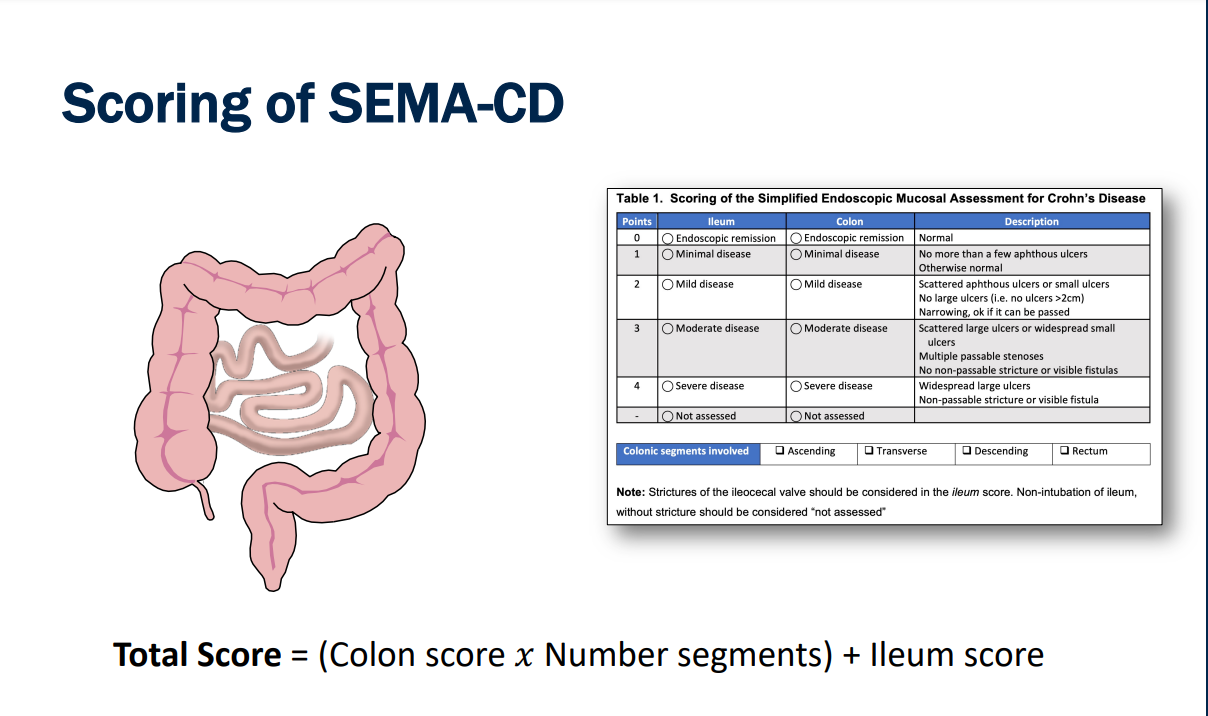
The article describes replacing the current “SES-CD” (or Simple Endoscopic Score for Crohn’s disease) with SEMA-CD (or Simplified Endoscopic Mucosal Assessment for Crohn’s disease).

YouTube: 7-minute abs Scene (from There’s Something About Mary)

J Adler et al. Inflamm Bowel Dis 2021; 27: 1585-1592. Development and Testing of a New Simplified Endoscopic Mucosal Assessment for Crohn’s Disease: The SEMA-CD

The SEMA-CD was scored by assigning a numerical value ranging from 0 (remission) to 4 (severe disease) for each bowel region (ileum and colon). The colon score was multiplied by the number of involved colonic segments and then added to the ileum score. “For example, if overall the colon was felt to have moderate involvement, and only the ascending and transverse colon had mucosal abnormalities, then a score of 3 for moderate disease would be multiplied by a total of 2 segments for a total [colon] score of 6.”

Key finding:

  • While there was excellent correlation between SES-CD and SEMA-CD, SEMA-CD was much easier as it required one scoring for the entire colon rather than evaluation of each segment

The authors note that clinical assessment is inadequate to monitor CD. CDAI (PCDAI) are poor surrogates for mucosal improvement…”30-68% of patients in clinical remission have evidence of mucosal inflammation on colonoscopy….Patients whose disease is managed based on clinical information alone are more likely to have disease complications, need more surgeries, or lose response to medications.”

My take: The SEMA-CD appears to be much easier than the SES-CD and thus more likely to be useful in clinical practice (& research), especially as it becomes incorporated into routine endoscopy software. If the SEMA-CD is widely adopted, we will need to be on the lookout for the ‘6 minute ab’ version.

Related blog post: Pediatric Adoption of ‘Treat to Target’ & Difficulty ‘Unlearning’

Thanks to Jeremy Adler for sharing this figure

Infection or Flareup in IBD: GI PCR Panel Helps

S Hong et al. Inflamm Bowel Dis 2021; 27: 1634-1640. Comparative Evaluation of Conventional Stool Testing and Multiplex Molecular Panel in Outpatients With Relapse of Inflammatory Bowel Disease

In this retrospective cohort study with 268 adult patients with inflammatory bowel disease, the authors compared the use of a GI PCR panel with 22 analytes (BioFire) and C diff testing to ‘conventional’ stool testing (culture, O&P and C diff). Key findings:

  • Pathogens were more frequently identified on GI PCR (26 vs 5%; P < 0.01)
  • GI PCR was associated with less escalation in IBD therapy (16 vs 29%; P < 0.01) and fewer posttest endoscopies (10% vs 18%; P = 0.04), with no differences in IBD outcomes
  • Those with recent travel had a higher pathogen detection rate: 38% vs 14%; P<0.01
  • In the GI PCR group, the most common pathogens were E coli species 22 (including 12 Enteropathogenic E coli), Campylobacter 10, Multiple pathogens 7, Norovirus 6, Yersinia 3, C diff 3,

The authors note that the group who underwent GI PCR panel testing were more likely to present with severe symptoms (eg. fever, rectal bleeding) as well as a history of recent travel. Even when controlling for symptoms and biomarkers of inflammation, GI PCR testing was still associated with lower likelihood of escalating IBD therapies.

My take: This study indicates that identification of an infectious pathogen which is more likely with a GI PCR panel helps avoid escalation of IBD therapy and need for endoscopy in the outpatient setting.

Related blog post: Molecular Panels for Identifying Etiology with Acute GI Symptoms

Ustekinumab in Pediatric Patients and More on VTE Prophylaxis

FS Kim et al. JPGN 2021; 73: 610-614. Open Access (PDF): Experience Using Ustekinumab in Pediatric Patients With Medically Refractory Crohn Disease

In this retrospective study with 38 pediatric patients with Crohn’s disease, 34% had stricturing or penetrating disease. Key findings:

  • At time of last follow-up, 84.2% of patients remained on UST for a median duration on UST of 62.1 weeks, and 60.5% achieved clinical remission
  • 89.5% of patients had no significant adverse events
  • Sixteen (of 38, 42.1%) patients required dose escalation, to every 4 weeks (n= 15 of these 16, 93.8%) or every 6 weeks (Nn=1 of 16, 6.3%)

My take: Ustekinumab had good efficacy in this group of refractory pediatric patients.

Related blog posts:

E Story et al. JPGN 2021; 73: 604-609. Safety of Venous Thromboprophylaxis With Low-molecular-weight Heparin in Children With Ulcerative Colitis

In this retrospective study with 218 inpatient pediatric patients with active ulcerative colitis, the key findings:

  • Use of enoxaparin did not result in a greater fall in hemoglobin among those with acute severe colitis (initial PUCAI ≥65) during the week following admission and there was not an increased risk of needing a transfusion
  • VTE occurred in 2 of 130 in control group and 1 of 88 in enoxaparin group (enoxaparin group was sicker)

My take: The absolute risk of VTE is low in the pediatric population. This study shows that enoxaparin prophylaxis is NOT associated with increased issues with blood loss. In those with active disease, the presence of CVC and use of steroids are known risk factors and require consideration of, at minimum, nonpharmacologic interventions.

Related blog posts:

Billy Goat Trail, Chesapeake and Ohio Canal National Park

Dietary Therapy for Adults with Crohn’s Disease

H Yanai et al. The Lancet 2021; The Crohn’s disease exclusion diet for induction and maintenance of remission in adults with mild-to-moderate Crohn’s disease (CDED-AD): an open-label, pilot, randomised trial https://doi.org/10.1016/S2468-1253(21)00299-5

In this open-label trial of adults with mild-to-moderate biologic naive Crohn’s disease, key findings:

  • At week 6, 13 (68%) of 19 patients in the CDED plus partial enteral nutrition group and 12 (57%) of 21 patients in the CDED group had achieved clinical remission (p=0·4618)
  • Among the 25 patients in remission at week 6, 20 (80%) were in sustained remission at week 24 (12 patients in the CDED plus partial enteral nutrition group and eight in the CDED alone group)
  • 14 (35%) of 40 patients were in endoscopic remission at week 24 (eight patients in the CDED plus partial enteral nutrition group and six in the CDED alone group)

My take: Dietary therapy may be effective option for motivated adult patients with Crohn’s disease.

Related blog posts:

Correlating Calprotectin with Disease Severity in Pediatric IBD

E Crawford et al. JPGN Reports 2021; 22 – Issue 4 – p e129. Open Access: Association of Fecal Calprotectin With Endoscopic and Histologic Activity in Pediatric Inflammatory Bowel Disease

This retrospective study used data from 331 patients (n=107 with IBD). Fecal calprotectin (FC) was done between 30 days and 1 day before colonoscopy.

Key findings:

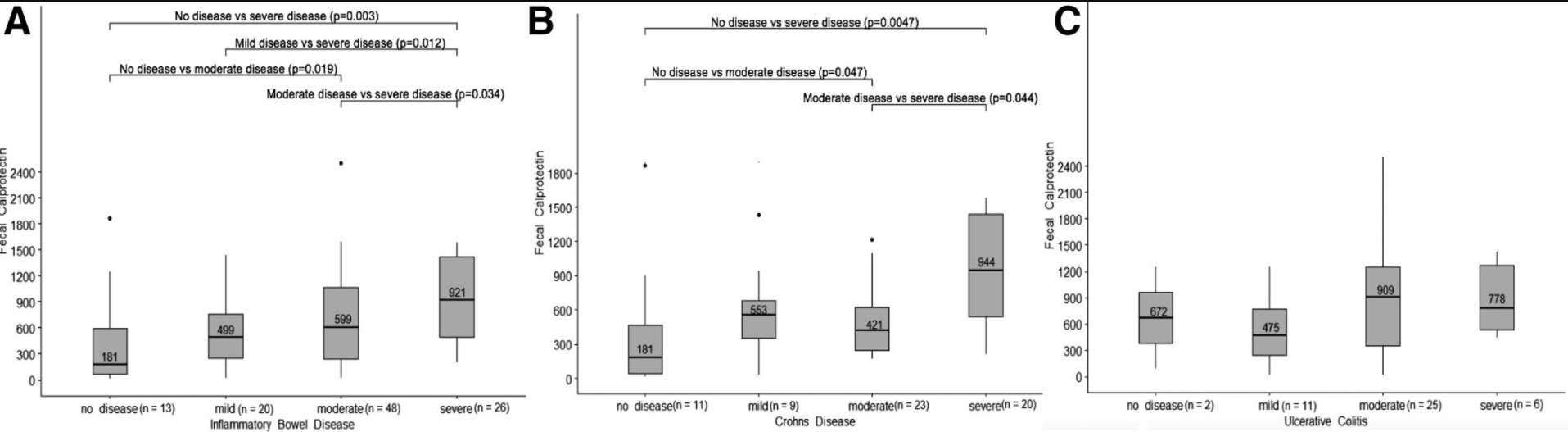
  • Correlation with endoscopy: median FC was lowest for all IBD patients with no active disease (181 μg/g) and highest in severe disease (921 μg/g), with significant difference between no disease and moderate and severe disease (P = 0.019, 0.003), and between mild and severe disease (P = 0.012)
  • Correlation with histology: median FC was lowest with no active disease (328 μg/g) and highest in severe disease (895 μg/g), with significant difference between no disease and moderate and severe disease (P = 0.021, 0.018)
  • The control population had median FC of 35.5 compared to 181 μg/g for the IBD population in endoscopic remission (P = 0.018).

My take: Calprotectin levels are particularly helpful as a screen for IBD (probably using threshold of at least 120) and its use to monitor clinical response. This study shows it has some utility in predicting disease severity.

Figure 1: Fecal calprotectin association with endoscopic disease severity of IBD
(A), Crohn’s disease (B) and ulcerative colitis (C). IBD = inflammatory bowel disease.

Latest on VTE in Pediatric IBD

MA Aardoom et al. JCC 2021; https://doi.org/10.1093/ecco-jcc/jjab171 The incidence and characteristics of venous thromboembolisms in paediatric-onset inflammatory bowel disease; a prospective international cohort study based on the PIBD-SETQuality Safety Registry

Design: 2016-2020: paediatric gastroenterologists prospectively replied to the international Safety Registry, monthly indicating whether they had observed a VTE case in a patient <19 years with IBD. n=24,802 PIBD patients

Key findings:

  • Twenty cases of VTE were identified (30% Crohn’s disease)
  • The VTE incidence was 3.72 [95%CI 2.27 – 5.74] per 10,000 person-years, 14-fold higher than in the general pediatric population (0.27 [95%CI 0.18-0.38], p<0.001)
  • All but one patient had active IBD, 45% were using steroids and 45% hospitalized.
  • Cerebral sinus venous thrombosis was most frequently reported (50%) VTE

My take: The absolute risk of VTE is low in the pediatric population. In those with active disease, the presence of CVC and use of steroids are known risk factors and require consideration of, at minimum, nonpharmacologic interventions.

Related blog posts:

Biologic Treatment Effectiveness for Esophageal Crohn’s Disease

J Lui et al. Inflamm Bowel Dis 2021; 27: 1544-1547. The Use of Biologics for the Treatment of Esophageal Crohn Disease

In this retrospective review (1998-2018), the authors identified 39 patients with esophageal Crohn disease (ECD) who met inclusion criteria.

Key findings:

  • 35 (92%) had a clinical response to treatment and 21 (55%) went into clinical remission
  • ECD seems to be associated with more disabling intestinal CD phenotypes. Of the 39 patients, 10 (26%) had stricturing phenotype and 21 (54%) had penetrating phenotype; 19 (49%) had perianal disease
  • “Initial treatment after diagnosis with anti-TNFalpha agents compared to other biologics was associated with greater improvement in clinical (97% vs 71%; P=0.02) and endoscopic response (95% vs. 40%; P<0.01) and in clinical remission (64.5% vs. 14.2%; P=0.01).”
  • Initial treatment with an anti-TNFalpha agent was initial treatment in 18 patients with ECD; 14 had an inflammatory, 3 had a stricturing, and 1 had a fistulizing phenotype.

While this study showed better response to anti-TNFalpha agents compared to other biologics (eg. anti-IL-12/IL-23 agents), this may be due to a selection bias as other biologics are often used as a second-line treatment and are selected more often in refractory disease.

My take: Esophageal Crohn’s disease is a rare diagnosis and appears associated with more severe disease.

Chesapeake and Ohio Canal National Historic Park (near Washington D.C.)

Better Levels –>Better Outcomes with Adalimumab

More data is accumulating that show that higher levels of adalimumab are associated with better outcomes: F Rinawi et al. Inflamm Bowel Dis 2021; 27 1079-1087. Association of Early Postinduction Adalimumab Exposure With Subsequent Clinical and Biomarker Remission in Children with Crohn’s Disease. This pediatric study included 65 patients with Crohn’s disease; the author’s note that children weighing less than 40 kg frequently received higher dosing than on-label ADA dosing.

Key findings:

  • Adalimumab trough levels (TLs) at both weeks 4 and 8 were significantly higher in remitters vs nonremitters at week 24 (P < 0.001 and P = 0.002, respectively)
  • The best ADA TL cutoffs at weeks 4 and 8 for predicting clinical/biomarker remission at week 24 were 22.5 µg/mL (80% sensitivity, 90% specificity) and 12.5 µg/mL (94% sensitivity, 60% specificity) respectively

My take (borrowed from authors): Greater early ADA exposure is associated with superior clinical/biomarker outcomes at week 24. ADA pediatric dosing is looking a lot like infliximab dosing in which nearly 75% would be underdosed if using on-label dosing.

Related blog post:

From Illuminarium Show Wild

Anti-TNF Therapy and Lower Rates of Colon Cancer & Financial Hardship Due to IBD

M Aklkhayyat et al. Inflamm Bowel Dis 2021; 27: 1052-1060. Lower Rates of Colorectal Cancer in Patients With Inflammatory Bowel Disease Using Anti-TNF Therapy

Using a selected sample from a database with >62 million patients, this retrospective cohort study determined the rates of colorectal cancer among patients with IBD. Key finding:

Among the IBD cohort, patients treated with anti-TNF agents were less likely to develop CRC; patients with Crohn’s disease: odds ratio, 0.69; 95% confidence interval, 0.66-0.73; P < 0.0001 vs patients with ulcerative colitis: odds ratio, 0.78; 95% confidence interval, 0.73-0.83; P < 0.0001.

My take: This study found an association between anti-TNF therapy and a reduced risk of CRC in patients with IBD.

Related blog posts:

NH Nguyen et al. Inflamm Bowel Dis 1068-1078. National Estimates of Financial Hardship From Medical Bills and Cost-related Medication Nonadherence in Patients With Inflammatory Bowel Diseases in the United States

Using the National Health Interview survey (2015), the authors identified individuals with self-reported IBD and assessed national estimates of financial toxicity. Key findings:

  • 23% reported financial hardships due to medical bills, 16% of patients reported cost-related medication nonadherence, and 31% reported cost-reducing behaviors
  • Approximately 62% of patients reported personal and/or health-related financial distress, and 10% of patients deemed health care unaffordable
  • Inflammatory bowel disease was associated with 1.6 to 2.6 times higher odds of financial toxicity across domains compared with patients without IBD

My take: In addition to the physical and emotional toll of having IBD, there is also significant financial hardships for many.