Patterns and Puzzles with Very Early Onset Inflammatory Bowel Disease

A recent review (S Chandrakasan, S Venkateswaran, S Kugathasan [corrresponding author]. Pediatr Clin N Am 2017; 64: 139-160) provides a surprisingly easy read on very early onset (VEO) inflammatory bowel disease (IBD) (Thanks to Kathleen McNamara for sharing).  Because of the myriad of genetic defects (>50 monogenetic defects), the topic of VEO-IBD can be quite confusing.  The authors of this summary make a number of key points.

  • VEO-IBD is increasing in incidence
  • Many patients with VEO-IBD have an underlying primary immune defect.  Identification of these underlying disorders may allow targeted therapy.
  • In some patients, hematopoietic stem cell transplantation could result in definitive cure
  • VEO features: more often involves colon and often severe course with poor response to conventional immunosuppressives

Besides idiopathic IBD, the differential can be subdivided into subgroups:

  • T-cell defects (IPEX and IPEX-like) (gene defects: FOXP3, LRBA CTLA4, STAT1, STAT3, STAT5B, CD25, CTLA4, )
  • Defects in IL-10 signaling (IL10RA, IL10RB, IL-10)
  • Hyperinflammtory/autoinflammatory disorders (XIAP/SAP (BIRC4), Mevalonate kinase deficiency (MVK), PLCG2, Familial Mediterranean Fever, Familial HLH Type 5: STXBP2, Hermansky-Pudlak: HPS1, HPS4, HPS6)
  • Defects in neutrophil function/phagoycte function (chronic granulomatous disease (CGD) genes: CYBB, CYBA, NCF1, NCF2, NCF4,, Leukocyte Adhesion Defect (LAD) ITGB2, GSD type 1bSLC37A4, congenital neutropenia G6PC3)
  • Epithelial barrier defect (X-linked ectodermal dysplasia and immunodeficiency (NEMO), TTC7A, ADAM17, dystrophic epidermolysis bullosa (COL7a1), Kindler syndrome (FERMT1), mutations in guanylate cyclase c, telomere biology defects like  DKC and RTEL1 )
  • T/B cell defects (X-linked agammaglobulin (BTK), SCID/Omenn (RAG1, RAG2, IL-7Ra, IL-2RG), CVID, IL21, Wiskott-Aldrich (WAS) HIES, HIMS)

The authors provide some vignettes of a typical presentation of each subset along with some commentary.  For example, with T-cell defects: “mutations in FOXP3 result in either absent or decreased Treg cell numbers or a qualitative defect…results in broader immune dysregulation, resulting in multisystem autoimmunity with autoimmune endocrinopathy, autoimmune cytopenia, autoimmune hepatitis, and severe eczema.”  Other IPEX-like mutations include gain of function in STAT-1/STAT-3, LRBA deficiency, and CTLA-4 haploinsufficiency.

The authors recommend an initial immune evaluation in VEO-IBD:

  • CBC
  • peripheral smear evaluation
  • immunoglobulin levels, lymphocyte subsets with T-cell
  • B-cell, and NK-cell enumeration
  • CD45RA/RO enumeration and B-cell panel for class-switched memory B cells
  • neutrophil oxidative burst
  • T regulatory cell (CD4+CD25+FOXP3+) cell enumeration.

Due to the increasing complexity of the immune evaluation, the necessity of a pediatric immunologist is apparent.  In addition, the role of genetic panels that test for all of these disorders simultaneously is becoming routine.  Genetic testing can help improve diagnosis and allow for early targeted intervention.  With the emergence of new defects, selecting the right lab with an up-to-date panel is another caveat.

Examples of targeted therapies include the potential role of anakinra for CGD, abatacept for LRBA deficiency, toclizumab (IL-6 receptor blocking antibody) for STAT3 gain-of-function mutation, and sirolimus for Treg disorders.  Hematopoietic stem cell transplantation is an established therapy for IL-10 signaling defects.

My take: Collaboration with immunology is an important consideration in young children with IBD.

Related blog posts:

Disclaimer: These blog posts are for educational purposes only. Specific dosing of medications (along with potential adverse effects) should be confirmed by prescribing physician.  This content is not a substitute for medical advice, diagnosis or treatment provided by a qualified healthcare provider. Always seek the advice of your physician or other qualified health provider with any questions you may have regarding a condition.

I liked this t-shirt
I liked this t-shirt

Nutrition Week (Day 7) Connecting Epidemiology and Diet in Inflammatory Bowel Disease

A supplement in Gastroenterology (2017; 152: 309-462) provides a great update on a lot of topics.  These include pathophysiology articles (eg. role of Paneth cell, role of microbiome), treatment/development of fibrosis, management advances in endoscopy and biomarkers, newest treatments and emerging treatments, complementary medicine approaches, pain/psychology issues, medications in pregnancy, and detecting dysplasia.

For me, the update on epidemiology and its relationship to diet (pgs 313-321) as well as the review on diet as a trigger or therapy for inflammatory bowel disease (398-414) were most interesting.  Though, I will keep the update on complementary and alternative medicines article at my desk in case questions come about this topic

GG Kaplan, SC Ng. “Understanding and Preventing the Global Increase of Inflammatory Bowel Disease”  Gastroenterology 2017; 152: 313-321

Epidemiology:

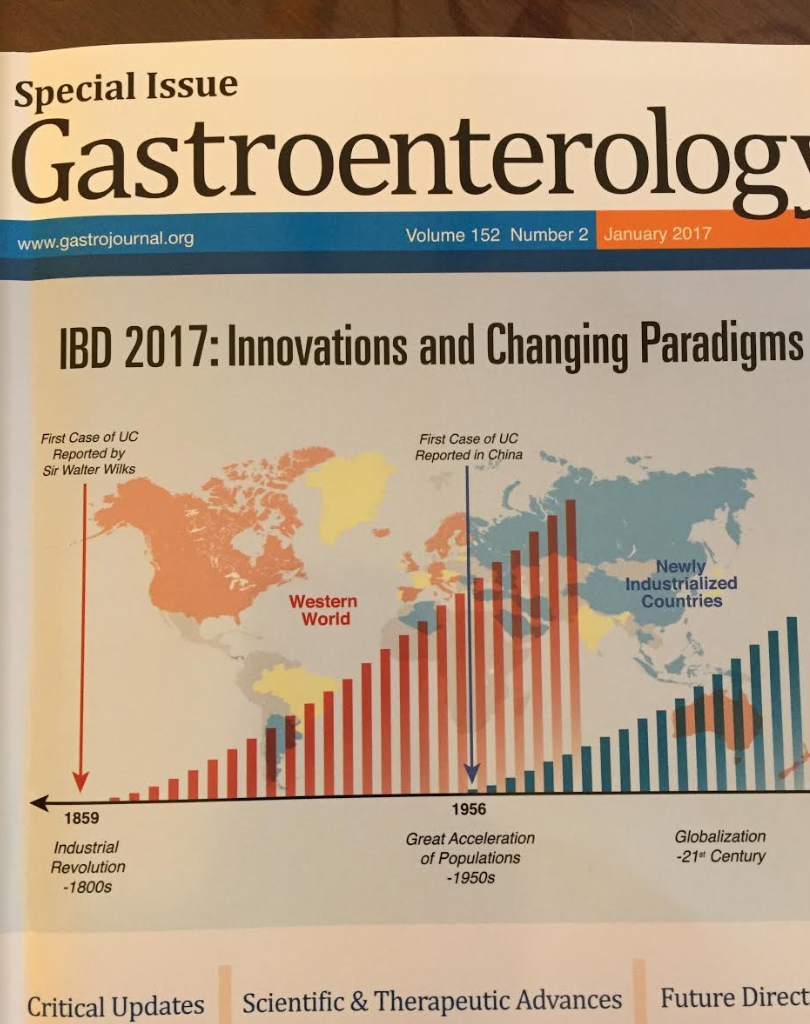
1st case of ulcerative colitis was reported in 1859.  !st cases of Crohn’s disease reported in 1932 (BB Crohn et al. JAMA 1932; 99: 1323-29).

Olmstead County, Minnesota –cases per 100,000:

  • 1965: 28
  • 1980: 90.5
  • 1991: 132.7
  • 2001: 213.9
  • 2011: 246.7

While rates of IBD have “shown signs of stabilization…pediatric-onset IBD continues to increase steadily in incidence.”

IBD Around the World –cases per 100,000:

  • 2005 Japan: 76
  • 2005 S Korea: 42
  • 2013 India: 9.3
  • 2013 China: 3.3.  The greatest incidence is noted in areas of increased urbanization and economic advancement.
  • 2005: Brazil: 9.7

Environmental factors/associations:

  • Cigarette smoking –increases risk of Crohn’s disease in Western countries, and has protective effect against Ulcerative colitis
  • Antibiotic use –increases risk of IBD in Western countries, but may be protective in developing countries.  “Antibiotic-induced dysbiosis may not develop as easily in developing countries, owing to ubiquitous exposure to a diverse range of microbiota that rapidly repopulate the intestinal tract.”
  • Breastfeeding –protects against developing IBD
  • Vitamin D –low levels increase risk of IBD in Caucasians.
  • Fiber –a “diet high in fiber protects against Crohn’s disease.”

screenshot-111

JD Lewis, MT Abreu.”Diet as a Trigger or Therapy for Inflammatory Bowel Disease”  Gastroenterology 2017; 152: 398-414.

“The most common question asked by patient is …’Doctor, what should I eat?'”

Key points:

  • Data from studies of immigrants to higher-IBD prevalence countries show an increasing incidence of IBD, leading to the hypothesis that environmental factors such as diet affect risk of IBD.
  • In early life, breast milk, in some but not all studies, has been associated with a lower risk of childhood-onset IBD.
  • Before development of IBD, studies have shown lower risk of IBD “among people who consume more fruits and vegetables, and a higher risk in people who consume less of these and more animal fats and sugar.”
  • “There is little information about which foods induce flares.” However, for UC, “a high intake of meat, especially red and processed meat, protein, alcoholic beverages, sulfur, and sulfate increased the likelihood of a flare” based on food questionnaires.  In patients with CD, diet with higher “total fat, saturated fat, monounsaturated fatty acids, and a higher ratio of omega-6:omega-3 PUFAs was associated with disease relapses.”
  • “Only approximately half of patients have ever received advice from a dietitian.”
  • Oral iron may trigger flares in a small percentage of patients with IBD.  The authors note that adherent E coli express genes for iron acquisition and require iron for growth.

Specific Diets/Additives:  Most of these diets have been discussed in previous posts, including:

Exclusive (and Partial) Enteral Nutrition:

  • “The most widely studied dietary intervention.” It has been shown to be effective for CD.  More elemental formulas have NOT been shown to be more effective.  “EEN and PEN therapy is less likely to normalize fecal levels of calprotectin in children.”
  • “Dietary therapy reduced inflammation and led to changes in the microbiome within 1 week. Unlike TNF antagonists, however, the changes to the microbiome induced by EEN did not lead to a microbiome resembling that of healthy individuals.”

Specific Carbohydrate Diet (SCD):

  • This diet has been studied in small populations.  Suskind et al reported SCD effectiveness “in 7 children with CD…showed that fecal calprotectin level decreased from a mean of 685 mcg/g to 213 mcg/g at 2-6 after starting the diet.”  “Cohen et al used video capsule endoscopy…in 10 children with CD…Four of 10 children achieved complete mucosal healing (Lewis score <135) and 6 of 10 children achieved clinical remission.”

Low FODMAP diet:

  • While the diet may induce symptom improvement, there is no “evidence that a low FODMAP diet reduces inflammation.”

Vitamin D supplementation:

  • “Vitamin D has multiple potential beneficial effects on intestinal inflammation.” The authors review studies that report lower risk of CD in patients with higher vitamin D levels and on the reduction in relapse in a study of CD patients who were in remission and  treated with Vitamin D (1200 IU daily)

Curcumin supplementation:

  • The authors review two small studies which suggested that curcumin for patients with ulcerative colitis increased clinical remission (when used with mesalamine)

The overall advice the authors give is that patients “should be advised to eat a well-balanced diet, such as the Mediterranean-style diet, avoiding processed foods or foods that they self-identify as worsening their symptoms.  Patients who are committed to attempting to manage their disease predominantly through dietary modification should be counseled about the importance of assessing for resolution of inflammation in addition to symptoms.”

Other Related blog posts:

Disclaimer: These blog posts are for educational purposes only. Specific dosing of medications/diets (along with potential adverse effects) should be confirmed by prescribing physician/nutritionist.  This content is not a substitute for medical advice, diagnosis or treatment provided by a qualified healthcare provider. Always seek the advice of your physician or other qualified health provider with any questions you may have regarding a condition.

Support for Step-Up Therapy and Thiopurines

A retrospective study (H Bar-Yoseph et al. Clin Gastroenterol Hepatol 2017; 15: 69-75) indicated that thiopurine use before infliximab (IFX) was associated with the prevention of antidrug antibody formation in patients with Crohn’s disease.

The authors had 207 eligible patients which included 93 who received IFX monotherapy, 52 who received combination therapy after response to thiopurine, 34 who received IFX after lack of response to thiopurines (but continued with combination treatment), and 28 who received de novo combination therapy.  The total number of patients followed in these centers is much higher, but they excluded those with episodic infusions and for other reasons that could affect their conclusions.

Key findings:

  • Prior thiopurine therapy was associated with lower antidrug antibodies (ADA). At 1 year, past thiopurine responders had 19.3% ADA, past thiopurine failures had 16.1% ADA; both were much lower that the monotherapy rate of 46.6%  The de novo combination group had a rate of 21.9% which did not reach significance.
  • Interestingly, after the first 5 months, the de novo combination group did not develop further ADA but during the first 5 months the rate of ADA was quite similar to the monotherapy rate. This could be related to the notion that thiopurines may take 3-6 months to achieve full effect.
  • Combination therapy (compiled)  was associated with higher rates of clinical remission (58.8% vs 40.9%) and lower rates of active disease (8.8% vs. 21.5%).

Overall, this study showed high rates of ADA compared to many studies but the conclusions are similar to other published studies.  It could be that many of those with positive ADA were lower antibody levels and that many of these levels may not be clinically significant. The study has limitations mainly related to being a retrospective study.

My take: This study supports the following:

  1. Combination therapy is more effective than monotherapy
  2. Using an immunomodulator before starting infliximab may reduce ADA formation more effectively than starting combination therapy de novo.

Related blog posts:

Disclaimer: These blog posts are for educational purposes only. Specific dosing/usage of medications (along with potential adverse effects) should be confirmed by prescribing physician.  This content is not a substitute for medical advice, diagnosis or treatment provided by a qualified healthcare provider. Always seek the advice of your physician or other qualified health provider with any questions you may have regarding a condition.

screenshot-72

Nutrition in Immune Balance -New Website for Inflammatory Bowel Disease

Dr. David Suskind and colleagues have developed a website which provides a great deal of information regarding nutritional therapy, particularly the Specific Carbohydrate Diet (SCD), and inflammatory bowel disease.  The website also facilitates contributions to Seattle Children’s Hospital and buying a book on the SCD.

Here’s a link to website: NIMBAL.org

Related blog posts:

Near Shem Creek, SC

Near Shem Creek, SC

Vedolizumab: summary of latest data

BG Feagan et al. Clin Gastroenterol Hepatol 2017; 15: 229-39.

From Clin Gastroenterol Hepatol, Feb 2017 Issue Highlights Link from AGA twitter feed:Vedolizumab in Anti-Tumor Necrosis Factor Naïve or Previously Exposed Ulcerative Colitis Patients

“Feagan et al present data comparing patients based on past exposure to anti-TNF agents. This post-hoc analysis compared 464 patients who received vedolizumab or placebo who were naïve to TNF antagonists to 367 patients who had been exposed but had an inadequate response, loss of response, or intolerance to TNF antagonists…

The investigators describe greater differences in efficacy for vedolizumab (versus placebo) in patients who were naïve to TNF inhibitors than for patients with prior exposure to anti-TNF agents.

Week 6 reponse rates to vedolizumab or placebo were 53% vs 26% amongst patients naïve to TNF antagonists (absolute difference 26%) compared to 39% vs 21% in patients with prior anti-TNF exposure (absolute difference 18%).

Week 52 remission rates with vedolizumab and placebo were 47% and 19%, respectively, for patients naïve to TNF antagonists (absolute difference 28%) compared with 36% and 5%, respectively, in patients with prior exposure to TNF biologics (absolute difference 29.5%).

Thus, while vedolizumab demonstrated significantly greater efficacy as induction and maintenance therapy for UC patients whether or not they had previously received therapy with anti-TNF agents, there were numerically greater treatment benefit at week 6 among patients who had never received prior biologic therapy.

My take: Given the higher response in anti-TNF naive patients along with the favorable safety profile, vedolizumab could be considered as a first-line therapy.

Related Blog Posts:

Induction endpoints in TNF-failure patients by type of failure. Forest plots show difference from placebo and 95% CIs for percentages of patients with (A) clinical response, (B) clinical remission, and (C) mucosal healing at Week 6. Patients with more than one type of TNF antagonist failure were evaluated by each type of failure; thus the number of patients in the subgroups may total more than the number of enrolled patients.

Induction endpoints in TNF-failure patients by type of failure. Forest plots show difference from placebo and 95% CIs for percentages of patients with (A) clinical response, (B) clinical remission, and (C) mucosal healing at Week 6. Patients with more than one type of TNF antagonist failure were evaluated by each type of failure; thus the number of patients in the subgroups may total more than the number of enrolled patients.

Closer Look at Ustekinumab Data

At a recent dinner, we had the opportunity to hear a review of some of the recent data on ustekinumab.  These notes may include some errors in transcription and errors of omission.  Most of this data is derived from a recent publication that has been summarized in this blog: Landmark Publication for Ustekinumab (Stelara) | gutsandgrowth

Some key points:

  • In numerous studies of biologic agents, longer duration of disease is associated with a much lower response to therapy.  For the UNITI-1/UNTI-2 studies, the patients enrolled had long duration of disease (~10 years in UNIT1-1, ~8 years in UNITI-2)
  • Recent data indicate that vedolizumab is effective for Crohn’s disease, but works slowly. It likely takes ~6 months to determine if it is working.
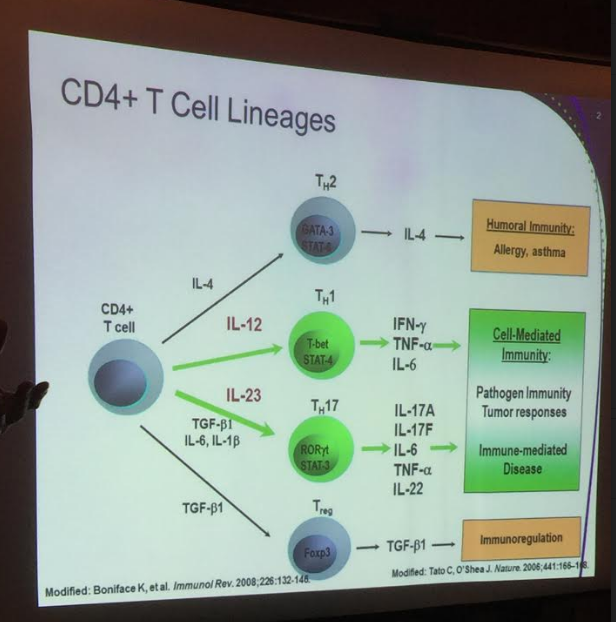
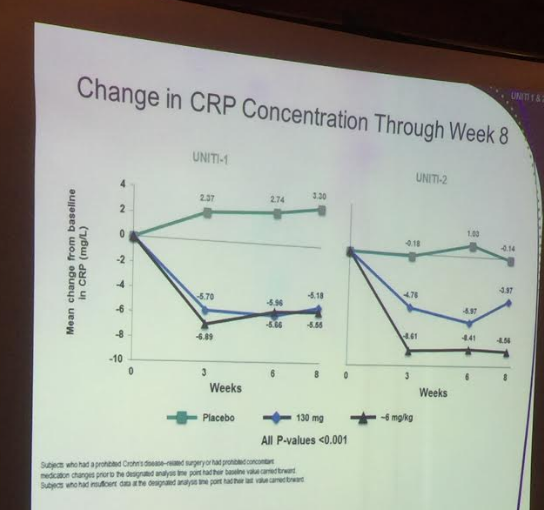
  • With ustekinumab, most patients respond within 3 weeks of the induction dose; however, among nonresponders, many responded after the first maintenance dose.  Thus, probably need to give at least the induction dose and the first maintenance dose for determining whether ustekinumab is effective.
  • Overall safety profile looks very good for ustekinumab.  More than 4000 patients in a psoriasis registry showed no serious safety signals (though psoriasis patients receive a lower dose).
  • Overall, the 6 mg/kg induction dose outperformed the 130 mg dose with regard to objective measures.
  • High placebo rate in the IM-UNITI study likely is due to some residual response to the initial induction dose.
  • Every 8 week dosing for ustekinumab was more effective than every 12 week dosing in these studies, though, there are likely patients who need more frequent and some who could benefit from less frequent dosing.
  • 2.3% of patients in IBD studies had detectable antibody to ustekinumab but this did not preclude efficacy.
  • ~20% of IBD patients do not develop increased CRP
  • Pediatric studies of ustekinumab are ongoing testing different dosing regimens.
  • One other anecdote in regards to magical thinking about which premedications are most effective:  A man with a ridiculous hat was approached as he walked in an Atlanta.suburb.  A lady asked him why he wore such an unusual hat. He replied that “the hat keeps elephants far away.”  The lady said, “there are no elephants around here.” He said, “See it is working.”

screenshot-86 screenshot-87 screenshot-88 screenshot-89 screenshot-90 screenshot-91 screenshot-92 screenshot-93

Cost Effectiveness & Underpowered Studies

A recent study (ALT Ma et al. J Pediatr 2016; 179: 216-8) reaches a conclusion that questions the cost-effectiveness of pretreatment TPMT activity in pediatric patients. In my opinion, this retrospective study is ridiculous. Here’s why:

The authors examined thiopurine transmethyltransferase (TPMT level) in 228 children before starting a thiopurine. They found the following:

  • Only 2 patients experienced mild neutropenia
  • 12% of their cohort had intermediate activity and 88% normal TPMT activity

I agree with their conclusion that routine blood tests are needed following institution of thiopurines, I think stating that “from an economic point of view –the cost for testing TPMT enzyme activity was high without major clinical benefit” cannot be made with such a small study.  Deficient TPMT activity occurs in about 1 in 300.  If a single patient develops bone marrow suppression due to a thiopurine medication, this can lead to a horrific and prolonged hospitalization.  The cost of such a hospitalization, both economically and emotionally, is enormous.

My take: If I were taking a thiopurine, I would want to know if I metabolized this medication at a slower rate and was at increased risk for bone marrow suppression.  My hunch is the authors would not forgo checking a TPMT level on themselves despite their study’s conclusion, particularly if they have ever witnessed a patient with thiopurine-induced bone marrow suppression.

Related blog posts:

Grand Prismatic Spriing, Yellowstone

Grand Prismatic Spriing, Yellowstone

Role of Biosimilars in Inflammatory Bowel Disease

A cautionary note on biosimilars has been discussed in a recent review (DT Rubin et al. Gastroenterol & Hepatol 2016; 12: 741-51)

In the recently completed NOR-SWITCH study presented at the United European Gastroenterology Week 2016 meeting, “a total of 481 patients were recruited across 40 centers: all patients had been on stable treatment with the originator infliximab for at least 6 months…When looking specifically at IBD patients, disease worsening was noted in 21.2% of originator infliximab-treated patients and 36.5% of CT-P13-treated Crohn’s disease patients (n=155).”  The 15% difference did not reach statistical significance, but is concerning.  The authors state that “subtle postranslational modifications unique to the biosimilars may be sufficient to lead to antidrug antibody formation with associated loss of response.  Also, it is noted that this study did not include endoscopic evaluation.

The authors note that therapeutic monitoring worked with biosimilar product using available infliximab assays.

My take: We still have a lot to learn.  The preliminary message, until more studies are available, indicate that switching stable patients could increase risk of losing response.

Related blog posts:

Puerto Rico

Puerto Rico

Standardizing the Care of Children Receiving Chronic Glucocorticoid Therapy

A recent study (ML Basiaga et al. J Pediatr 2016; 179: 226-32) highlights the large variation in care for 701 children receiving  steroids (for at least 15 days) at a leading children’s hospital (CHOP).  I think, given the fact that this is a retrospective study and the huge variation in steroid exposure, the message regarding variation should not be taken that seriously.  But, the article does suggest that in children with chronic glucocorticoid therapy, several measures should be considered:

  • Bone health -particularly Vitamin D (25-OH) levels
  • Immunity -particularly assuring pneumococcal and influenza vaccines
  • Lipid screening
  • Stress steroid plan.  The authors indicate that the endocrinology society recommendations have included instructing parents in intramuscular hydrocortisone in case of vomiting or severe stress.

My take: Having a standard approach to an at-risk group makes sense, however, “whether implementation of preventive care guidelines improves outcomes in children” is not known.

screenshot-63