Oral Cancer and Inflammatory Bowel Disease

A recent study (KH Katsanos et al. Clin Gastroenterol Hepatol 2016; 14: 413-20) shows an increased risk of oral cancers in patients with inflammatory bowel disease (IBD). Because these cancers are infrequent, the absolute risk remains low.  However, this study provides some further insight into why other cancers may occur more often in IBD as well.

This retrospective study collated data on 7294 patients with IBD seen at a single New York center (2000-2011).  Key findings:

  • 11 patients (7 male) developed biopsy-proven oral cancer, most commonly of the tongue (n=6).  The overall oral cancer age-adjusted standardized incidence ration (SIR) was 9.77 and the SIR for tongue was 18.91.  These numbers could be influenced by a referral bias.
  • The average age for oral cancer in this study was 44 years.
  • Prior treatment for IBD had occurred in 7 patients, including 4 with a thiopurine, 1 with infliximab, and 3 with combination therapy.
  • One patient died.

Discussion:

  • Traditional risk factors for oral cancer: tobacco exposure (smoking, oral tobacco) and alcohol consumption.
  • The authors speculate that in their population that acquiring oncogenic HPV virus may have contributed to increased risk.  This is clearly a risk with cervical cancer which has been reported as increased in IBD populations as well.

Related blog postCancers Complicating Inflammatory Bowel Disease | gutsandgrowth

Gibbs Gardens

Gibbs Gardens

Varicella and Zoster Infections in Children with Inflammatory Bowel Disease

A recent study (DJ Adams, CM Nylund. J Pediatr 2016; 171: 140-5) looked at a large database (1997-2012) with nearly 9 million admissions.  In this retrospective cohort, there were 4434 admissions related to varicella and 4488 due to herpes zoster.

  • Children with Crohn’s disease had a greater increased risk: Varicella OR 12.75, and Zoster OR 7.9 compared to the general population.
  • Children with ulcerative colitis had increased risk compared to general population but less compared to children with Crohn’s disease: Varicella OR 4.25, and Zoster OR 3.9
  • Overall, the risk of these infections improved among all groups over the 15 year study period

One significant limitation of this study is that children with IBD may have been hospitalized more readily out of concern for their vulnerability.  It is noted that there were no deaths due to these infections in the children with IBD.

My take (from the authors):  the increased risk of Varicella and Zoster “were comparable with that observed in children with HIV, malignancy, and primary immune deficiency.”  Given the difficulty of immunizing children on immunosuppressive treatments, at the very least, immunizing household contacts needs to take place.

Related blog posts:

Fox Theatre on a Tuesday

Fox Theatre (Atlanta) on a Tuesday

Vitamin D and IBD, More Data

Another large study (Kabbani TA, et al. Am J Gastroenterol. 2016;doi:10.1038/ajg.2016.53) links low vitamin D status with worse outcomes in IBD.

An excerpt from summary from HealioGastro: (Low vitamin D linked to higher morbidity, disease severity in IBD)

Binion and colleagues identified 965 IBD patients (61.9% Crohn’s disease; 38.1% ulcerative colitis; 52.3% women; mean age, 44 years) with up to 5 years of follow-up data in University of Pittsburgh Medical Center’s longitudinal IBD natural history registry…

At enrollment, 8.9% of patients were vitamin D deficient and 33.1% had vitamin D insufficiency vs. 4.9% and 23.6%, respectively, at the conclusion of the study period. Among patients who received vitamin D supplements, 67.9% achieved normal levels by the end of the study…

Overall, patients with low vitamin D levels required significantly more steroids, biologics, narcotics, computed tomography scans, emergency department visits, hospital admissions and surgeries compared with those who had normal mean vitamin D levels (P < .05). They also had worse pain, disease activity scores and quality of life (P < .05).

“More importantly, correction of vitamin D deficiency was associated with overall improvement in clinical status,” Binion said.

My take: Vitamin D levels are often low when patients are acutely ill and can improve without supplements in many; this accounts for some of the association with worsened outcomes.  True vitamin D deficiency and insufficiency does have negative physiologic effects and should be treated.

Related blog posts:

Gibbs Gardens

Gibbs Gardens


What happens when anti-TNF therapy is stopped

Another study (NA Kennedy et al. Aliment Pharmacol Ther 2016; 43: 910-23) has examined the issue of outcomes after anti-TNF therapy withdrawal among patients with inflammatory bowel disease.

This study included 166 UK patient cohort (117 with Crohn’s disease [median 31 yrs], 19 with ulcerative colitis [median 40 years]) as part of a retrospective observational study and a meta-analysis incorporating 11 further cohorts totalling 746 patients (624 with Crohn’s dissease, 122 with ulcerative colitis).

Key findings:

  • In the UK cohort, relapse rates were 36% at year and 56% at 2 years for Crohn’s disease
  • In the UK cohort, relapse rates were 42% at year and 47% at 2 years for ulcerative colitis
  • Increased relapse rates were noted for those with a diagnosis prior to age 22 years (hazard ratio (HR) 2.78), calprotectin >50 mcg/g (HR 2.95).
  • In meta-analysis, 1-year relapse rates were 39% for CD and 35% for UC/IBDU patients
  • Retreatment with anti-TNF was successful in 88% for CD and 76% of UC/IBDU patients

To understand this study, it is important to note some of the study criteria.  In the UK cohort, inclusion criteria required the patient to have had at least 12 months of ant-TNF therapy and be in corticosteroid-remission for at least 6 months.  In addition, the relapse rate is likely to be underestimated due to using a definition of relapse that required either commencement of steroids, immunomodulator or anti-TNF therapy.  The meta-anlaysis cohort studies also used clinical relapse rather than endoscopic or other objective markers.

My take: Relapse of clinical symptoms occur in about 40% after withdrawal in highly-selected groups who were doing well prior.  Significantly higher rates of endoscopic relapse are likely.  This study provides strong reasons for not interrupting therapy when it is working.

Related blog posts:

Cures Tshirt


Should Medical Marijuana Get a Free Pass?

In many states, including Georgia, medical marijuana has bypassed the rigorous Food and Drug Administration (FDA) approval process via state laws permitting its usage.  A recent editorial (J Koliani-Pace, CA Siegel. Am J Gastroenterol 2016; 111: 161-62 -thx to Ben Gold for this reference) highlights the dilemma facing physicians with medical marijuana with regard to providing advice/approval for this treatment.

Key points:

  • 12% of people aged 12 years or older report using cannabis in the past year.
  • For gastrointestinal illnesses, there is scant evidence effectiveness.  There is some data indicating that it makes you feel better, but no data proving that there is objective improvement in conditions like Crohn’s disease.
  • Adverse effects require more research.  “Approximately 9% of people who experiment with marijuana will become addicted.”  Other concerns: increased car accidents, altered memory/judgment, hyperemesis syndrome, and respiratory effects.  With increasing availability and increasing THC concentrations, there have been in an increase in emergency department visits related to usage.
  • Lack of quality control: various concentrations of THC and cannabinoids, different administration routes, contaminants.

My take: At least with GI illnesses, more studies are needed to determine whether medical marijuana should be recommended.

Related blog posts:

Gibbs Gardens

Gibbs Gardens

Here’s Why Biologic Therapy for Crohn’s Helps Adolescents Grow

It is well-recognized that Crohn’s disease is associated with delays in the onset and progression of puberty with the potential for stunted growth, impaired bone accrual, and diminished quality of life.

Now, a study (MD DeBoer et al. J Pediatr 2016; 171: 146-52) shows that initiation of anti-tumor necrosis factor α (anti-TNFα) treatment results in a rapid increase in sex hormone and gonadotropin levels.

In 72 adolescents, this observational study followed levels of sex hormones, gonadotropin levels, dual-energy x-ray absorptiometry, along with cytokine/inflammatory markers at initiation of anti-TNFα therapy, at 10 weeks and at 12 months.

Key findings:

  • By week 10 , testosterone z scores in males increased from a median of -0.36 to 0.40 (P<0.05)
  • By week 10 , estradiol z scores in females increased from a median of -0.35 to -0.02 (P<0.01)

My take (from the authors): This study suggests that “systemic inflammation suppresses gonadotropin-stimulated production of sex hormones” and that treatment of this inflammation with anti-TNFα agents allows rapid resumption normal production.

Related blog posts:

Law Quad, Univeristy of Michigan

Law Quad, Univeristy of Michigan

CCFA Conference Notes 2016 (part 5) -Emerging Therapies

This blog entry has abbreviated/summarized this terrific presentation; most of the material has been covered in this blog in prior entries (can use search function to find additional relevant material) but still this was a useful review. Though not intentional, some important material is likely to have been omitted; in addition, transcription errors are possible as well.

Emerging Therapies in IBD –Dr. Gary Lichtenstein

Background: This lecture started with a review of current therapies. We have learned how to use our current therapies better. There still remain a large number of patients that face surgery with IBD; though there has been improvement (?50% reduction).

Issues with thiopurines were reviewed. May take 2-6 months to take effect, though monotherapy with thiopurines are fairly ineffective for Crohn’s disease as initial therapy.

Leukocyte Trafficking Agents:

  • Natalizumab
  • Vedolizumab
  • AJM300 –oral agent. Initial safety data were fine.
  • AMG 181
  • Etrolizumab (Vermeire S Lancet 2014) –low rates of endoscopic healing, but better than placebo

Screen Shot 2016-04-17 at 12.15.26 PM

PF-00547,659

Screen Shot 2016-04-17 at 12.15.52 PM

S1P Modulators:

Fingolimod

Screen Shot 2016-04-17 at 12.16.26 PM

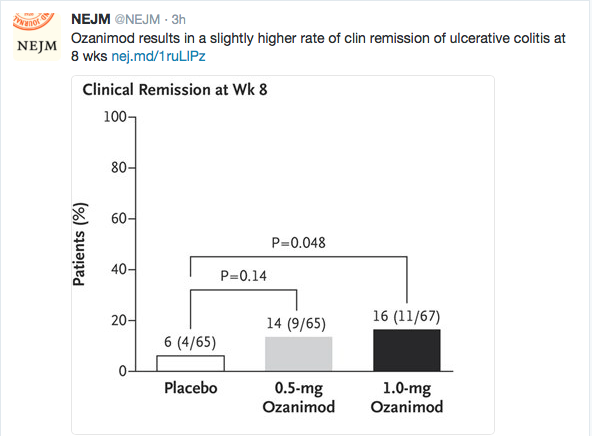
Ozanimod (RPC1063) (oral agent, fairly rapid onset) causes S1P-r on lymphocytes to be internalized –more selective than Fingolimod. Good safety has been noted thus far.  No notable cardiac problems. Infrequent elevations of transaminases; this issue will need to be followed.

Screen Shot 2016-04-17 at 12.16.38 PM

Tofacitinib oral Janus Kinus (JAK) Inhibitor (Sanborn WJ et al. NEJM 2012; 367: 616-24). Dr. Lichtenstein thinks 10 mg will be recommended dose. Follow lipids. For UC

Screen Shot 2016-04-17 at 12.17.11 PM

Mongerson related post: Mongerson -Phase II Data Available in NEJM | gutsandgrowth


Ustekinumab

Screen Shot 2016-04-17 at 12.18.05 PM

Related article from GI & Hep News: Ustekinumab for complex Crohn’s from ECCO conference/UNITI-1 Study (n=741)

FMT.  Further studies are needed

Screen Shot 2016-04-17 at 12.18.17 PM

CCFA Conference Notes 2016 (part 3) -Malignancy and IBD

This blog entry has abbreviated/summarized this terrific presentation; most of the material has been covered in this blog in prior entries but still this was a useful review. Though not intentional, some important material is likely to have been omitted; in addition, transcription errors are possible as well.

3rd Lecture: Prevention and management of malignancy in IBD –Dr. Thomas Ullman

Malignancy risk (colorectal cancer [CRC]) is present with prolonged ulcerative colitis, though more recent studies have shown lower risk than in the past –not much higher than the general population.

Screen Shot 2016-04-17 at 12.02.04 PM

  • CRC surveillance–colonoscopy monitoring after 8-10 years. Typically colonoscopy every other year for most patients, every year in higher risk patients (eg. PSC).

Screen Shot 2016-04-17 at 12.01.37 PM

  • Unclear if chemoprevention is effective (5-ASA, thiopurines, others).
  • Chromoendoscopy “has not been consensus on its use in our field (yet).” It is time consuming and expensive and unclear if it will improve outcome.

Does medical therapy for IBD predispose to developing cancer?

  • Thiopurines increase the risk of malignancy. (Pasternak et al) though the risk returns to near baseline when stopped according to study below.

Screen Shot 2016-04-17 at 12.03.27 PM

  • No overall increased risk with anti-TNF agents with RCTs (may not follow patients long enough) but also not seen in Danish registry either (JAMA study)
With Anti-TNFs

No increased risk of malignancy in this study with Anti-TNFs

  • Lymphoma risks: age, immunodeficiency, EBV
  • EBV negative are at risk for HLH with thiopurines
  • HTSCL ~200, >90% men and >90% <35 years. NOT EBV-related. Has not been identified in anti-TNF monotherapy.

Screen Shot 2016-04-17 at 12.02.55 PM

  • Skin cancer –main concern is in non-melanoma skin cancer (possibly melanoma too). Skin cancer increase has not been noted with methotrexate. Prevention: Skin care, and annual dermatology visits.
  • Cervical cancer—likely increased risk in IBD, probably due to thiopurine exposure and reduced immune surveillance. Prevention: HPV vaccination, Pap testing.
  • Urinary Tract cancers –especially in those >65 years with thiopurine exposure


CCFA Conference Notes (Part 1): Preemptive Therapeutic Drug Monitoring Not That Helpful

This blog entry has abbreviated/summarized this terrific presentation; most of the material has been covered in this blog in prior entries but still this was a useful review. Though not intentional, some important material is likely to have been omitted; in addition, transcription errors are possible as well.

Optimizing Therapeutic Drug Monitoring –Dr. Hans Herfarth

  • Trough levels have been recognized to correlate with remission rates. Good data from SONIC (2010) for infliximab. Ultra2 trial (2013) showed similar data for adalimumab.

Screen Shot 2016-04-17 at 11.19.23 AM

  • Low albumin predicts higher rates of failure, possibly due to loss of infliximab in stool.

Screen Shot 2016-04-17 at 11.20.14 AM


  • Reviewed algorithm for loss of response to infliximab based on trough levels. If low infliximab and no antibodies, increase dosing of infliximab has high likelihood of clinical response.
  • If high infliximab and not responding, evaluate for other reasons including irritable bowel, and strictures.

Scenarios that create confusion with therapeutic drug monitoring:

  • If clinically-well patient has antibodies and adequate drug level, could observe or possibly add immunosuppressive agent. ~3% of patients have simultaneous ATI and IFX detection.
  • If clinically-well with low infliximab level, could increase dose or observe.

Screen Shot 2016-04-17 at 11.23.19 AM

Screen Shot 2016-04-17 at 11.24.10 AM

  • In TAXIT study, however, lowering dose (panel B above) to get in target range was associated with a lower rate of response. No clear difference between clinically-based changes compared with proactive monitoring. Proactive adaption of trough levels may help prevent relapse in ~10% but not shown to alter long-term outcomes

Screen Shot 2016-04-17 at 11.25.43 AM

  • TAILORIX study looked at tailoring dose at week 14. ‘Week 14 adaption did not make a significant difference at 1 year.’  Limitation: 122 patients.

Screen Shot 2016-04-17 at 11.26.29 AM

Hard to see Group C (clinically-based group) in this slide

Hard to see Group C (clinically-based group) in this slide

Drug monitoring has become popular but its importance as a preemptive measure is unclear.  Dr. Herfarth’s practice is to monitor when loss of response but not to monitor if doing well. His view: if someone is doing well, therapeutic drug monitoring can be confusing. It is not proven that optimizing drug levels will improve long-term outcomes. (In children, especially due to growth, drug monitoring may be more important.)

Screen Shot 2016-04-17 at 11.30.13 AM

Screen Shot 2016-04-17 at 11.39.09 AM

One other recommendation from Dr. Herfarth: he recommends combination therapy in his patients are started on a 2nd anti-TNFs.

Anti-TNF therapy and Pregnancy -More Data

G Broms et al (Clin Gastroenterol Hepatol 2016; 14: 234-41) provide more data on the ‘low risk of birth defects for infants whose mothers are treated with anti-tumor necrosis factor agents during pregnancy.”

From a Danish/Swedish cohort of 1,272,424 live births (2004-2012), the authors found the following (in comparison to healthy infants):

  • Birth defects were increased in chronic inflammatory bowel disease: 4.8% vs. 4.2%
  • 43 (6.3%) of the infants born to women with IBD who received anti-TNF therapy (683) had birth defects.  The OR for any defect was 1.32 (CI 0.93-1.82).  The types of defects were generally similar, including VSD, ASD, hypospadias, and hydronephrosis

Limitations:

  • In infants of mothers with chronic diseases, it is possible that more careful screening identified some less apparent defects.
  • Study did not examine rates of stillborn or abortions

My take: Overall there is a slightly but not significantly increased risk in birth defects based on the use of anti-TNF therapy.  Stopping anti-TNF therapy is likely to be more detrimental.

Briefly noted: P Wils et al. Clin Gastroenterol Hepatol 2016; 14: 242-50.  This retrospective study of 122 patients showed that 65% had a clinical benefit within 3 months of receiving ustekinumab for Crohn’s disease refractory to anti-TNF therapy.  Concomitant immunosuppressant therapy was associated with an increased likelihood of benefit (OR 5.43)

Related blog posts: