“AGA suggests against re-instituting routine pre-procedure testing prior to elective endoscopy. The downsides (delays in patient care, burden, inaccurate results) outweigh potential benefits. Infection and transmission of SARS-CoV2 from asymptomatic individuals is rare especially among vaccinated health care workers using personal protective equipment (PPE), even with the emergence of the Delta variant.”
“If PPE is available, AGA recommends using N95 masks” for both upper endoscopy and colonoscopy”
In this study with 109 adults who were newly diagnosed with eosinophilic esophagitis (EoE), the authors consecutively performed high-resolution manometry (HRM). Key findings:
68 (62%) had normal findings from HRM
8 (7.3%) had achalasia (1 with type 1, 4 with type 2, and 3 with type 3)
9 (8.3%) had major motor disorders of esophagus (& not achalasia) and 24 (15.6%) had minor motor disorders
These findings are important because the diagnosis of EoE could result in a diagnostic delay of concurring achalasia and because the presence of esophageal eosinophilia could perhaps play a role in the pathogenesis of achalasia (or vice versa). The finding of achalasia in 7.3% of this population is exponentially higher than the estimated prevalence of achalasia in the general population (10-16 cases per 100,000).
My take: In patients with EoE, further diagnostic workup is indicated if there are persistent symptoms.
Recently, several news reports highlighted a study which among other things claimed that each hot dog one ingests could costs a person 36 minutes off their lifespan.
Olivier Jolliet, one of the lead researchers on the study, published in thejournal Nature Food, told USA TODAY that 5,800 foods were evaluated and then ranked based on their nutritional disease burden as well as their impact on the environment. Hot dogs were considered the most unhealthy...
The study found that substituting 10% of daily caloric intake from beef and processed meats for a mix of fruits, vegetables, nuts, legumes and select seafood could reduce your dietary carbon footprint by one-third and allow people to gain 48 minutes of healthy life per day...
Regardless of moderation, hot dogs are not exactly healthy. The World Health Organization’s International Agency for Cancer Research (IARC) reported ham, hot dogs and other processed meats may contribute to colorectal cancer. Hot dogs also are high in saturated fat and sodium. Just one hot dog can contain over a quarter of your day’s sodium allowance and over 14 grams of fat...while processed meats like hot dogs can inherently be unhealthy, it’s wrong to zero in on just hot dogs as the study does in highlighting the food.
Researchers classified foods into three color zones: green, yellow and red, based on their combined nutritional and environmental performances, much like a traffic light. The green zone represents foods that are recommended to increase in one’s diet and contains foods that are both nutritionally beneficial and have low environmental impacts. Foods in this zone are predominantly nuts, fruits, field-grown vegetables, legumes, whole grains and some seafood.
Based on their findings, the researchers suggest:
Decreasing foods with the most negative health and environmental impacts including high processed meat, beef, shrimp, followed by pork, lamb and greenhouse-grown vegetables.
Increasing the most nutritionally beneficial foods, including field-grown fruits and vegetables, legumes, nuts and low-environmental impact seafood.
Due to case series which have reported increased mucocutaneous bleeding and macrothrombocytopenia, the authors prospectively evaluated children (n=29) with 22q11 deletion syndrome (22q11DS) for bleeding disorders. Key findings:
In total, 17 of 29 subjects had a positive bleeding score on ISTH-BAT (International Society on Thrombosis and Hemostasis Bleeding Assessment Tool) compared with 1 of 29 control patients (P < .0001).
The most frequent bleeding symptoms reported in subjects with 22q11DS were epistaxis (69%) and bruising (52%).
Eighteen subjects had been surgically challenged, and 6 were noted to have increased perioperative hemorrhage.
My take: While this bleeding was mainly mucocutaneous, I agree with the authors that children with 22q11DS should be screened with a validated bleeding assessment tool before surgical interventions.
In the study by Wightman et al, the researchers performed a retrospective cohort analysis of children receiving a first kidney, liver, or heart-alone transplant in the United Network for Organ Sharing dataset from 2008 to 2017. Key findings:
Definite intellectual disability accounted for 594 of 6747 (9%) first pediatric kidney-alone, 318 of 4566 (7%) first pediatric liver-alone, and 324 of 3722 (9%) first pediatric heart-alone transplant recipients.
Children with intellectual disability account for 7%-9% of pediatric transplant recipients with comparable long-term outcomes to other pediatric recipients.
The article had a number of limitations including a lack of a standardized assessment of cognitive development.
In the editorial, the author “opposes the absolute exclusion of patients with intellectual disability and end-stage organ disease from transplantation waitlists provided that the candidates are expected to gain a predefined minimum benefit threshold of life-years and quality-adjusted-life years. Intellectual disability is one of many factors that should be considered in determining transplant eligibility and each candidate should have an individualized interdisciplinary assessment.”
In this commentary, it is noted that “the vast majority (85%) of individuals classified as having intellectual disability are able to live independently with minimum levels of support.” While the author would exclude those in a persistent vegetative state and those who were minimally conscious, otherwise he advocates “the candidate with intellectual disability should be given equal priority for organ transplantation.”
My view: The suitability for transplantation of individuals with intellectual disability centers on the issue of personhood; those who meet the threshold of personhood should be eligible to receive organ transplants without discrimination. Wikipedia-Personhood: “Defining personhood is a controversial topic in philosophy and law and is closely tied with legal and political concepts of citizenship, equality, and liberty.”
This useful review explains the techniques/technologies/limitations of transient elastography and provides pediatric values which correlate with liver fibrosis. Confounding factors, however, may affect elastography measurements, such as obesity, severe inflammation, nonfasting state, and hepatic congestion.
From Table 2 for Elastography (FibroScan technology) Cut-Off Values and Correlation with Outcomes :
Biliary Atresia: >15.5 kPa distinguishes METAVIR F4 fibrosis and >12.7 kPa predicts development of varices
Any Chronic Liver disease: >10.6 kPa distinguishes METAVIR F2 fibrosis
My take: Elastography is most useful when values are at the very low and very high end. Low values provide a lot of reassurance against significant fibrosis and high values indicate a high likelihood of significant liver fibrosis.
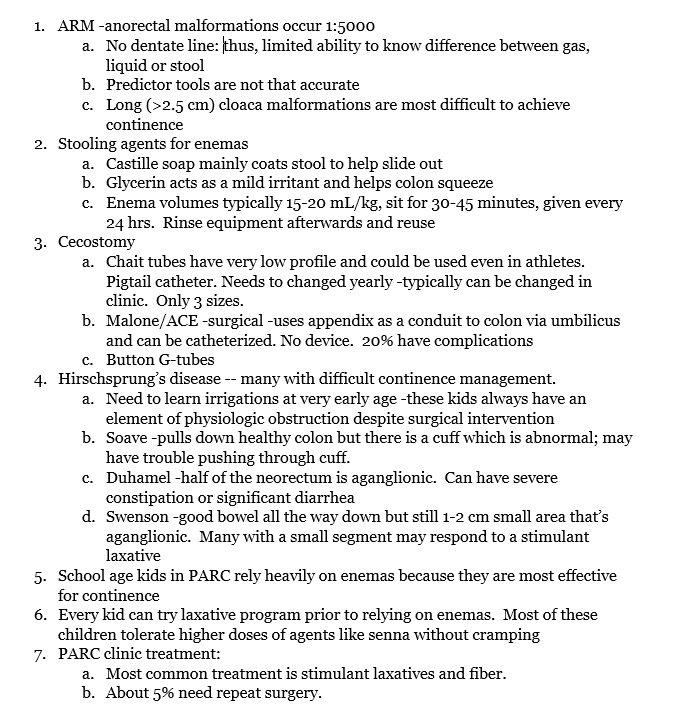
I recently had the opportunity to hear a terrific lecture by Kathleen Hoff regarding efforts to achieve continence for children, especially those with anorectal malformations. This blog entry has abbreviated/summarized the presentation. Though not intentional, some important material is likely to have been omitted; in addition, transcription errors are possible as well.
Key points (my notes followed by screenshots of some of the slides):
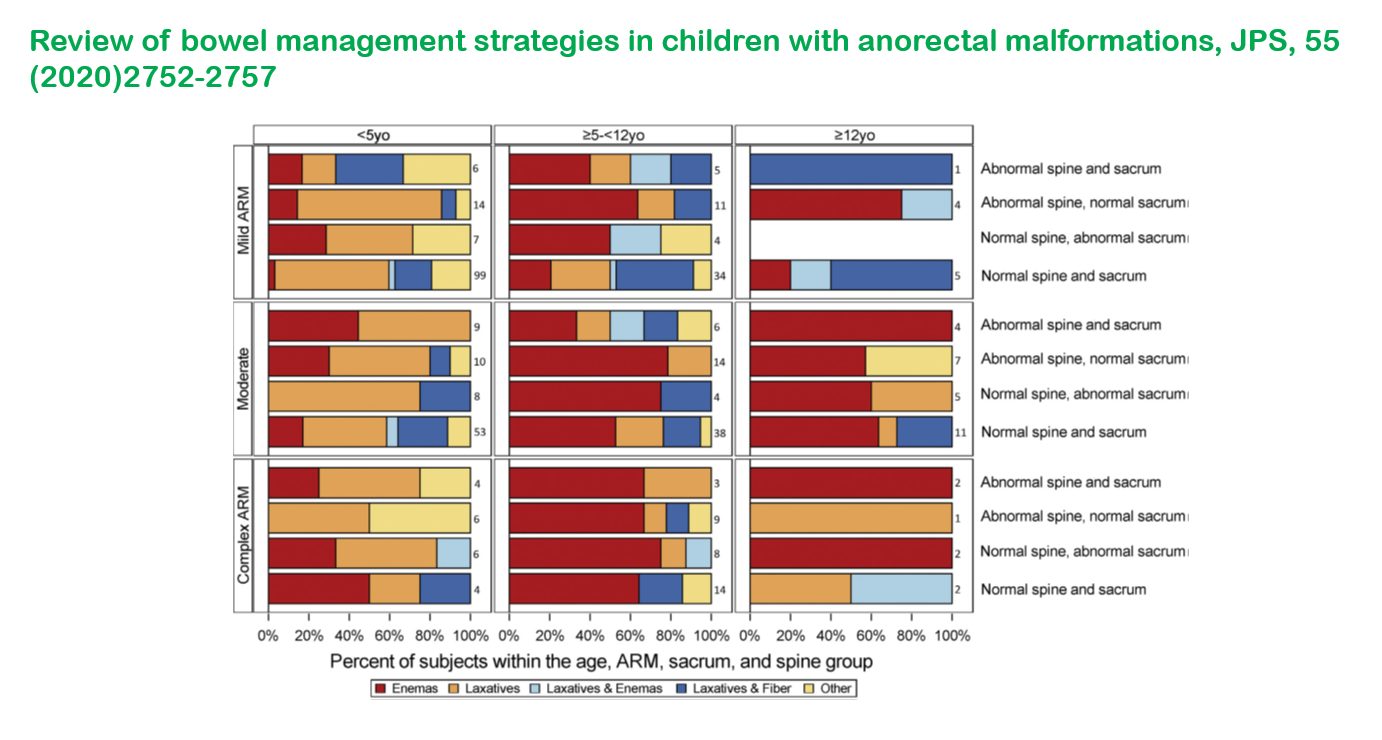
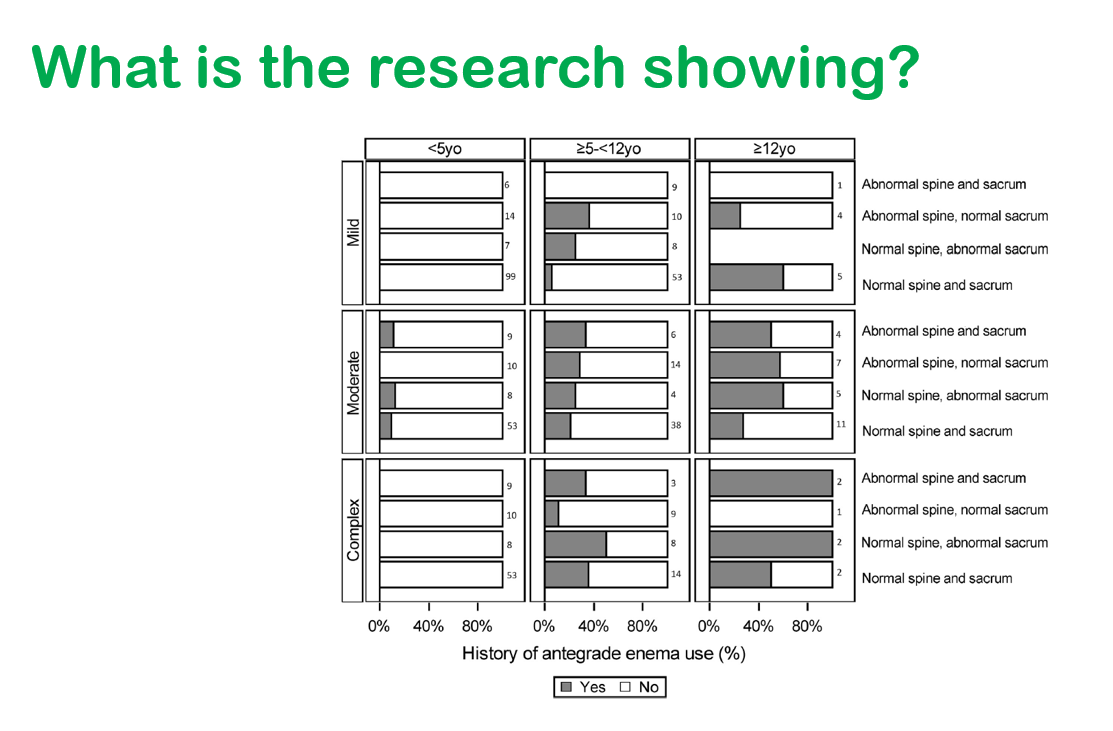
Data from PARC: Red color indicates use of enemas, light brown indicates use of laxativesProducts for enemasData showing increasing use of antegrade enemas in older children and those with moderate and complex malformations
A recent clinical problem-solving case (TW Fredrick et al. NEJM 2021; 385; 549-554. Turning Purple with Pain) is a good review on episodic pain and acute intermittent porphyria (AIP).
The case presentation regarded a 32 yo with episodic severe pain for 10 years (associated with constipation) that required morphine. Episodes occurred every month or two and lasted for several days. Some clues in this case included the development of hyponatremia, purple urine, and an episode in which she was “out of it.” This episode was attributed to opioid use and providers were concerned about opioid-seeking behavior and a conversion disorder.
She had extensive evaluations including imaging, panendoscopy, and labs. Atypical labs included serum tryptase, cortisol, and C1 esterase inhibitor level. Ultimately, her constellation of findings led to a urine porphyrin levels which disclosed elevated porphobilinogen (PBG) and delta-aminolevulinic acid. The diagnosis of AIP was confirmed with genetic testing.
Key points:
AIP results from mutations in HMBS, the gene encoding hydroxymethylbilane synthase which plays an integral role in heme synthesis
AIP is rare, affecting about 5 people per million; age of onset is typically 18-45 years of age
In a case series, 18% of patients with AIP reported nearly constant abdominal pain symptoms, 73% had nausea/vomiting, 60% have constipation, and 55% had anxiety/depression.
Flares of AIP may be triggered by alcohol, infections, low caloric intake, and medications (especially seizure medications and hormonal contraceptives)
The urine can appear red or brown and darkens on exposure to oxygen, light or heat. Purple urine reflects very high urinary PBG levels
My take: This article provides a useful overview. AIP needs to be considered in adolescents with severe abdominal pain that results in hospitalization (especially if episodic).
Factoring in new infections in unvaccinated people, we can conservatively expect more than 15 million cases of long Covid resulting from this pandemic. And though data are still emerging, the average age of patients with long Covid is about 40, which means that the majority are in their prime working years.
Long Covid is not a condition for which there are currently accepted objective diagnostic tests or biomarkers…The health care community, the media, and most people with long Covid have treated this syndrome as an unexpected new phenomenon. But given the long arc and enigmatic history of “new” postinfection syndromes, the emergence of long Covid should not be surprising.
Equally unsurprising has been the medical community’s ambivalence about recognizing long Covid as a legitimate disease or syndrome…If the past is any guide, they will be disbelieved, marginalized, and shunned by many members of the medical community…Some of the disregard can be attributed to the fact that long Covid has disproportionately affected women.
The ultimate success of the research-and-development and clinical management agendas in ameliorating the impending catastrophe is critically dependent on health care providers’ believing and providing supportive care to their patients. These beleaguered patients deserve to be afforded legitimacy, clinical scrutiny, and empathy.
My take: It is unfortunate that many cases of long-haul Covid that will develop could be prevented with vaccination
Causeway Trail in Burlington VT (adjacent to Lake Champlain)




















 gutsandgrowth
