Must-Read: How to Handle Post-Procedure Fevers

A recent study (JM Boster, M Iwanowski, RE Kramer. JPGN 2021; 72: 250-254. Management of Pediatric Postendoscopy Fever: Reducing Unnecessary Health Care Utilization With a Clinical Care Guideline) provides clear guidance for how to handle post-procedure fevers.

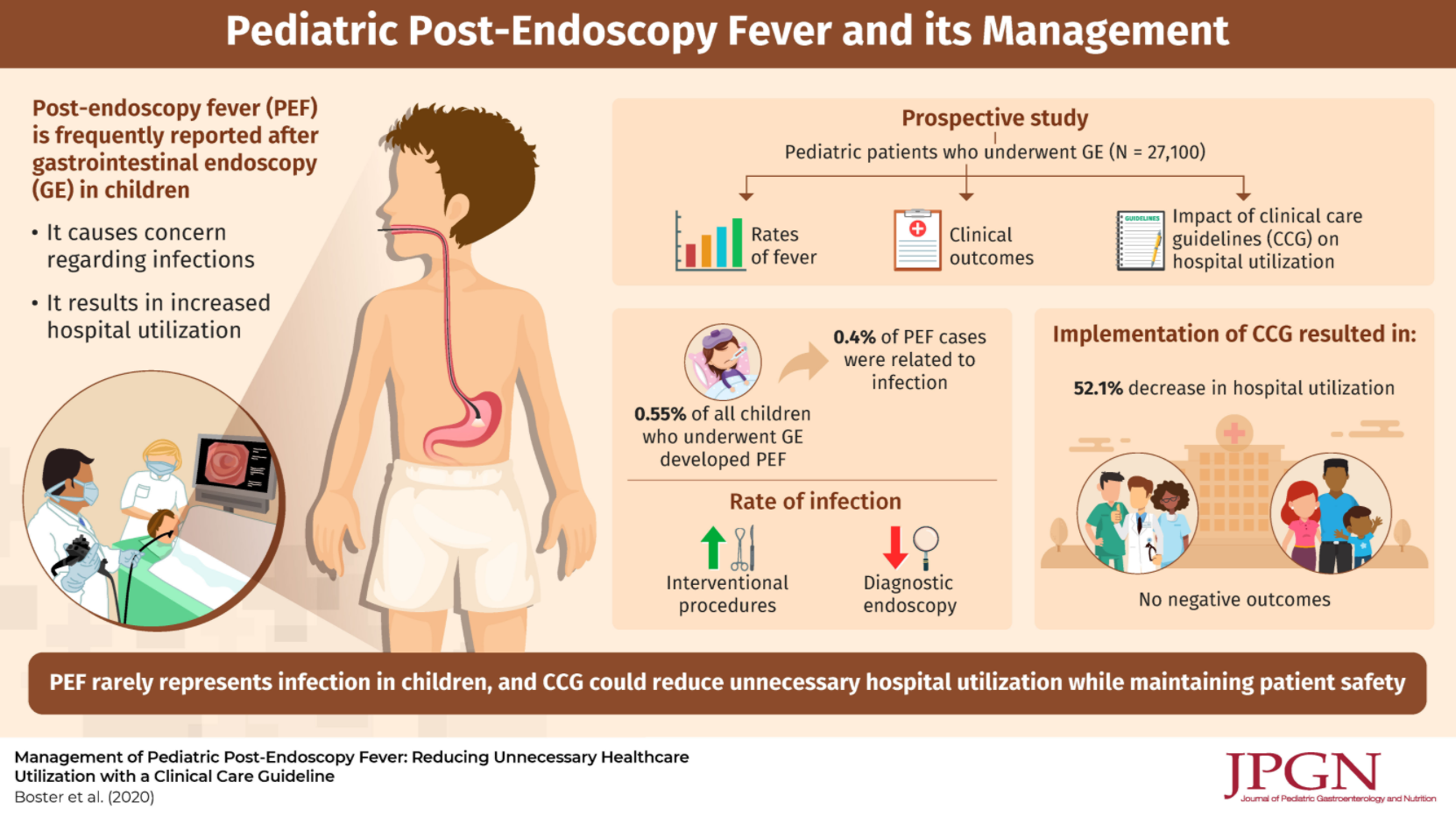
Using a prospective database with 27,100 endoscopies, the authors evaluated a clinical care guideline to reduce unnecessary medical care following endoscopy.

Key findings:

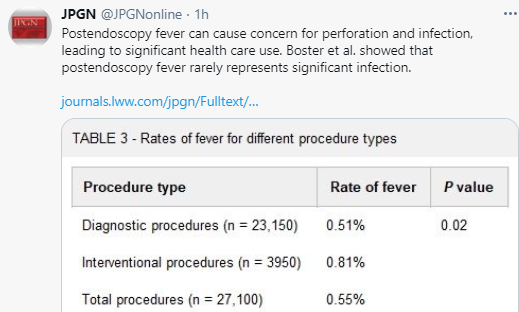
  • Post-endoscopy fever (PEF) occurred in 0.55% (n=150)
  • ONLY 6 of these 150 PEFs (0.4%) were attributed to a procedure complication: 3 had perforations (all with abdominal pain), 2 had aspiration (both had emesis at time of endoscopy) and 1 had a positive blood culture (though had undergone a liver biopsy as well as endoscopy)
  • The authors published their care guideline (Figure 1) which stratifies risk based on whether the procedure was an interventional (high risk) vs diagnostic (low risk), ASA class, duration of fever, concomitant immunosuppression (eg. steroids), and associated symptoms including vomiting, diarrhea, bleeding, new abdominal pain, impact on activities of daily living, and hydration
  • Interestingly, the authors note that their cohort had a total of 23 perforations, but only 3 presented with fever
  • Using the care guideline resulted in a “significant shift in the prevalence of Grade 2 and above (requiring hospital use) to Grade 1 (clinical observation and reassurance) adverse events, dropping ED visits and admissions by 43.6% and 76.4% respectively for the post-endoscopy fever patients.” This shift was not associated with any observed negative patient outcomes or missed diagnoses.

My take: The authors note that fever is often related to release of inflammatory cytokines which can occur with endoscopy in the absence of complications. The authors methodical guideline to post-procedure fever provides a logical approach to this common problem.
Related blog posts:

Disclaimer: This blog, gutsandgrowth, assumes no responsibility for any use or operation of any method, product, instruction, concept or idea contained in the material herein or for any injury or damage to persons or property (whether products liability, negligence or otherwise) resulting from such use or operation. These blog posts are for educational purposes only. Specific dosing of medications (along with potential adverse effects) should be confirmed by prescribing physician.  Because of rapid advances in the medical sciences, the gutsandgrowth blog cautions that independent verification should be made of diagnosis and drug dosages. The reader is solely responsible for the conduct of any suggested test or procedure.  This content is not a substitute for medical advice, diagnosis or treatment provided by a qualified healthcare provider. Always seek the advice of your physician or other qualified health provider with any questions you may have regarding a condition.

Short Bowel Syndrome -YouTube Information

Some good patient educational videos for short bowel syndrome:

Related article: AE Wiskin et al. Clin Nutrition 2021; https://doi.org/10.1016/j.clnesp.2020.12.029. Prevalence of Home Parenteral Nutrition in children Key finding: In 2019, 389 children received HPN (home parenteral nutrition) in the UK; this is nearly double the number last reported in 2012 and is a prevalence of 30 per million children (Thanks to Kipp Ellsworth for this reference)

Other resources:

Related blog posts for Short Bowel Syndrome:

Should We Worry About Osteopenia in Children with Crohn’s Disease?

A recent retrospective study (N Ronel, et al. JPGN 2021; 72: 270-275. Clinical Criteria Can Identify Children With Osteopenia in Newly Diagnosed Crohn Disease) included 116 children (mean age 13 years)

Key finding:

  • In total, 59% of children with BMI z-score <−0.5 had moderate-severe osteopenia and only 18% of those with higher z-scores. 
  • Osteopenia was associated with lower BMI z-score (−0.8 ± 1.2 vs −1.8 ± 1.1, P < 0.001) and higher PCDAI  (33.7 ± 15.2 vs 25.7 ± 16.5; P = 0.009)
  • None of the higher risk patients were receiving long-term corticosteroids 
  • Limitations: retrospective study with relatively small sample size, pubertal stage not recorded, variability in DXA studies, and lack of followup information

My take: The authors have NOT shown that identification of osteopenia at the time of diagnosis improves outcome of Crohn’s disease or bone disease. This is why I disagree with their recommendation to routinely screen children with BMI z-score <−0.5. In those in which finding osteopenia may influence treatment, then a DXA study would be worthwhile.

Related blog posts:

Chicago 2021

Seronegative Villous Atrophy

A recent large retrospective study (R Mandile et al. JPGN 2021; 72: 282-287. Seronegative Villous Atrophy in Children: Clinical and Immunohistochemical Features) provides information about conditions, besides celiac disease (CD) which present with villous atrophy. 64 of 1282 pediatric patients were seronegative with villous atrophy; seronegative was defined as testing negative twice for serology (TTG IgA/EMA or if IgA-deficient, IgG antibody serology).

Key findings:

  • Diagnoses were: inflammatory bowel diseases (IBD) (21/64), food allergy (8/64), infections (7/64, of which 3 HIV infections), immune deficiency (3/64), short bowel syndrome (3/64), congenital diarrhea (2/64), other/inconclusive diagnosis (8/64). In addition, there were 12 with Gastro-Esophageal Reflux Disease (GERD) & the authors speculate that perhaps hyperacidity could play a role in some of these cases.
  • Only one quarter of the seronegative patients had an increased number of intraepithelial lymphocytosis (IELs)
  • Among those with villous atrophy attributed to IBD, this was nearly equally-split between Crohn’s disease and ulcerative colitis, 10 and 11 patients respectively (according to Table 1)
  • The authors note that the ~5% of patients with seronegative villous atrophy with alternative diagnosis than Celiac disease may be an overestimation as more individuals are being diagnosed without biopsy based on serology
  • Despite the large cohort, there are still other rare conditions that were not identified in this study (eg. autoimmune enteropathy, CTLA4B deficiency,drug-induced enteropathy, and tropical sprue)

My take: This article provides a good starting point for patients with villous atrophy and negative serology.

Related article: J Devara et al. JPGN 2021; 72: 288-293. The Significance and Clinical Outcome of Lymphocytic Duodenosis in Children: Mayo Clinic Experience and Systematic Review Background: Lymphocytic duodenosis (LD) defined as increased intraepithelial lymphocytes >25 intraepithelial lymphocytes (IELs) per 100 epithelial cells with normal villous architecture is associated with many gastrointestinal (GI) disorders.

Key findings:

  • During the study period 12,744 children underwent an EGD with biopsies. Of those, we identified 426 children with LD (3%).
  • Among the LD (compared to control group), 5% had celiac disease (vs 0%, P < 0.001), 9% had Crohn disease (3%, P = 0.003) and 3% had Helicobacter pylori gastritis (1%, P = 0.021).

Related blog post: @AmyOxentenkoMD: Celiac Disease and Mimics

Is A Sphincterotomy a Good Idea for Pediatric Pancreas Divisum?

A recent retrospective single-center study (TK Lin et al. JPGN 2021; 72: 300-305. Clinical Outcomes Following Therapeutic Endoscopic Retrograde Cholangiopancreatography in Children With Pancreas Divisum) indicated that a minor papilla endoscopic sphicterotomy (mPES) may be beneficial for children with pancreas divisum and pancreatitis. The study included 27 children who had a total of 58 ERCPs.

Key findings:

  • After a median follow-up of ~32 months, 13 of 20 responders (65%) reported clinical improvement from endotherapy/mPES.
  • A genetic variant was identified in 19/26 (73%) tested patients
  • Post-ERCP pancreatitis (PEP) was the only observed adverse event; 21% (12/58)

Discussion:

The authors note that the beneficial finding of improvement after mPES in children is contrary to findings in adults. In addition, there is an active sham-controlled randomized clinical trial ongoing in adults (NCT03609944). They speculate that this could be related to longer disease burden in adults. In addition, they note that their findings had limitations:

  • this was a retrospective study with a small sample size
  • the results were based on a subjective non-validated questionnaire with concerns for recall bias

My take: I am not convinced that sphincterotomy is beneficial in most children with pancreatitis and pancreas divisum –the majority of whom have an underlying genetic variant which likely triggers pancreatitis. The only way to answer this question definitely is to perform a randomized clinical trial similar to the sham-controlled study in adults.

Related blog posts:

Sunrise in Sandy Springs (no filter)

Disclaimer: This blog, gutsandgrowth, assumes no responsibility for any use or operation of any method, product, instruction, concept or idea contained in the material herein or for any injury or damage to persons or property (whether products liability, negligence or otherwise) resulting from such use or operation. These blog posts are for educational purposes only. Specific dosing of medications (along with potential adverse effects) should be confirmed by prescribing physician.  Because of rapid advances in the medical sciences, the gutsandgrowth blog cautions that independent verification should be made of diagnosis and drug dosages. The reader is solely responsible for the conduct of any suggested test or procedure.  This content is not a substitute for medical advice, diagnosis or treatment provided by a qualified healthcare provider. Always seek the advice of your physician or other qualified health provider with any questions you may have regarding a condition.

Liver Shorts -March 2021. Neonatal liver disease, Hepatitis-Associated Aplastic Anemia & Two

S Kemme et al. JPGN 2021; 72: 194-201. Outcomes of Severe Seronegative Hepatitis-associated Aplastic Anemia: A Pediatric Case Series This small case series (n=4) with HAAA found that this condition was poorly responsive to steroids, azathioprine and tacrolimus; however, Anti-Thymocyte Globulin (ATG) was associated with sustained biochemical remission of the hepatitis. Two patients underwent hematopoietic stem cell transplantation. All patients had extensive investigations. All had evidence of systemic hyperinflammation (with markedly-elevated ferritin and soluble IL-2 R levels) and CD8+ T cell predominant liver tissue infiltration.

C Potter. JPGN Reports 2021; 1: e031. doi: 10.1097/PG9.0000000000000031. Full text: The Role of a NICU Hepatology Consult Service in Assessing Liver Dysfunction in the Premature Infant This was a retrospective observational study of 157 consecutive babies were evaluated by a single hepatologist. The approach outlined by this study:

  1. Workup: In the well and stable premature with elevated DB, “aminotransferases, AP, GGT, glucose, T4, TSH, UC, urine CMV PCR, and US with Doppler evaluation should be obtained…Coagulation studies in well babies with other evidence of good synthetic function are not necessary.” Empiric ursodeoxycholic acid may be given with weekly evaluation.
  2. Genetic testing: “Genetic panels are indicated in babies with no obvious risk factors after the first tier of studies…In critically ill babies with multisystem disease, critical whole exome sequencing (WES) is faster and provides broader results.”
  3. Sepsis: Babies with sudden increase in DB and ALT should be evaluated for sepsis (including urosepsis) and CMV.
  4. Nutritional support: Infants should be “supported with MCT and vitamin supplementation.”
  5. Severe liver disease: “Babies with coagulopathy and marked elevation of aminotransferases who have multiorgan failure in the first few days of life need to be evaluated for perinatal complications, severe metabolic disease, and gestational alloimmune liver disease (GALD). In this period, ischemic shock or infectious disease is much more common than primary liver disease, but the presentations can overlap.”
  6. Liver biopsy: “Liver biopsy should be pursued in babies whose cholestasis is not improving and the diagnosis is unclear.”
  7. Etiology: Infection, genetic disease, cardiac dysfunction, large heme loads, and hypothyroidism are common causes of liver dysfunction in the NICU. Common findings included trisomy 21-associated liver dysfunction (n=12), and thyroid disease. 6 patients had type 2 Abenathy shunts -only one required closure. Two patients had biliary atresia. Other liver diseases identified included GALD (n=2), PFIC2, Alagille, Alpha-one-antitrypsin, Cystic Fibrosis, and Niemann-Pick.

Related blog posts:

Wahid N et al. AASLD 2020, Abstract 153. Summary from GI & Hepatology News: Liver-related deaths decline after Medicaid-expansion under ACA. “Beginning around 2015, liver-related deaths began to decline in expansion states by a mean of –0.6%, while they continued on an upward trajectory in the nonexpansion states…“It’s a no-brainer that the lack of insurance accessibility for the most vulnerable people in the United States meant that they were dying of cirrhosis instead of being transplanted,” said Elliot Benjamin Tapper, MD, of the University of Michigan, Ann Arbor.”

W-M Choi et al. Clin Gastroenterol Hepatol 2021; 19: 246-258. Effects of Tenofovir vs Entecavir on Risk of Hepatocellular Carcinoma in Patients With Chronic HBV Infection: A Systematic Review and Meta-analysis “In a meta-analysis of studies of patients with chronic HBV infection, we found that TDF treatment was associated with a significantly lower (20%) risk of HCC than entecavir treatment. Randomized trials are needed to support this finding.” This analysis comprised 15 studies (61,787 patients; 16,101 patients given TDF and 45,686 given entecavir).

Related blog posts:

Disclaimer: This blog, gutsandgrowth, assumes no responsibility for any use or operation of any method, product, instruction, concept or idea contained in the material herein or for any injury or damage to persons or property (whether products liability, negligence or otherwise) resulting from such use or operation. These blog posts are for educational purposes only. Specific dosing of medications (along with potential adverse effects) should be confirmed by prescribing physician.  Because of rapid advances in the medical sciences, the gutsandgrowth blog cautions that independent verification should be made of diagnosis and drug dosages. The reader is solely responsible for the conduct of any suggested test or procedure.  This content is not a substitute for medical advice, diagnosis or treatment provided by a qualified healthcare provider. Always seek the advice of your physician or other qualified health provider with any questions you may have regarding a condition.

Worldwide Burden of Functional Disorders

AD Sperber et al. Gastroenterology 2021;160:99–114. Full text PDF. Worldwide Prevalence and Burden of Functional Gastrointestinal Disorders, Results of Rome Foundation Global Study

A global epidemiological study of functional GI disorders
• 73,076 adults surveyed (33 countries, 6 continents)
• Data collection: By Internet (24 countries), by household interview (7 countries), or both methods (China and Turkey, green).

Key findings:

  • Diagnostic criteria were met for at least 1 FGID by 40.3% persons who completed
    the Internet surveys and 20.7% of persons who completed the household surveys
  • FGIDs were associated with lower quality of life and more frequent doctor visits

My take: In industrialized countries, about 40% have functional GI disorders.

Related article: C Ma et al. Gastroenterol 2021; 160: 88-98. Full text: Epidemiologic Burden and Treatment of Chronic Symptomatic Functional Bowel Disorders in the United States: A Nationwide Analysis

From 2007–2015, approximately 36.9 million (95% CI, 31.4–42.4) weighted visits in patients of non-federally employed physicians for chronic symptomatic FBDs were sampled. There was an annual weighted average of 2.7 million (95% CI, 2.3–3.2) visits for symptomatic irritable bowel syndrome/chronic abdominal pain, 1.0 million (95% CI, 0.8–1.2) visits for chronic constipation, and 0.7 million (95% CI, 0.5–0.8) visits for chronic diarrhea. Pharmacologic therapies were prescribed in 49.7% (95% CI, 44.7–54.8) of visits compared to nonpharmacologic interventions in 19.8% (95% CI, 16.0–24.2) of visits (P < .001). Combination treatment strategies were more likely to be implemented by primary care physicians and in patients with depression or obesity. The direct annual cost of ambulatory clinic visits alone for chronic symptomatic FBDs is approximately US$358 million 

Related blog posts:

Success of Isolated Heart Transplantation in the Setting of Fontan-Associated Liver Disease & How COVID Vaccines Work

A small retrospective analysis by my Emory colleagues (DS Rodriguez et al [Senior author R Romero]. J Pediatr 2021; 229: 78-85. Pretransplantation and Post-Transplantation Liver Disease Assessment in Adolescents Undergoing Isolated Heart Transplantation for Fontan Failure) examines outcomes of 9 patients with Fontan-associated liver disease (FALD) who underwent liver transplantation.

All of these patients underwent extensive evaluations. Key findings:

  • Central venous pressures and VAST scores decreased significantly post-transplantation
  • Fontan liver MRI score maximum was 10 pretransplantation and decreased significantly post-transplantation
  • Pretransplantation and post-transplantation liver biopsy scores did not differ in 4 paired biopsy specimens
  • Patients with FALD and MELD <15, MELD-XI <16 (MELD XI excludes INR), Fontan liver MRI score <10, and VAST (varices, ascites, splenomegaly, thrombocytopenia) score ≤2 can have successful short-term isolated heart transplantation outcomes

My take: This study provides reassurance that heart transplantation can proceed in patients with FALD, which is helpful as hepatic fibrosis is nearly universal in this population. After transplantation, surveillance is still needed for hepatic complications including hepatocellular carcinoma.

Related blog posts:

From Eric Topol’s Twitter Feed

Predicting Outcomes in Childhood Autoimmune Hepatitis

G Porta et al. J Pediatr 2021; 229: 95-101. Autoimmune Hepatitis: Predictors of Native Liver Survival in Children and Adolescents

This retrospective study enrolled a total of 819 patients, 89.6% with AIH-1 and 10.4% with AIH-2

Key findings:

  • The overall survival was 93.0%, with a native liver survival (NLS) of 89.9%; 4.6% underwent liver transplantation
  • The risk of death or liver transplantation during follow-up was 3.2 times greater in patients with AIH-1 ( P = .024). 
  • Normal C3 levels was associated with longer NLS ( P = .017). The chance of death or liver transplantation during follow-up was 3.4 times greater in patients with C3 level below normal
  • Death or liver transplantation during follow-up was 2.8 times greater in patients with associated sclerosing cholangitis ( P = .046).

My take: This large cohort from Brazil shows that a significant portion of children with AIH do NOT do well, especially if they have associated sclerosing cholangitis.

Related blog posts: