Histologic Healing and IBD Outcomes

Several recent studies recently evaluated outcomes based on histologic healing compared to endoscopic remission.

RK Pai et al. Clin Gastroenterol Hepatol 2020; 18: 2510-2517. Full text link: Complete Resolution of Mucosal Neutrophils Associates With Improved Long-Term Clinical Outcomes of Patients With Ulcerative Colitis n=281.Key findings:

  • “We found histologic evidence of UC activity (Geboes score ≥ 2B.1) in biopsies from 182 patients (65%) and endoscopic evidence of UC activity in 149 patients (53%) (substantial agreement, κ = 0.60).”
  • “Histologic features of UC activity were associated with increased rates of systemic corticosteroid use, colectomy, and hospitalization in the entire cohort (P < .05 for all) and associated with increased rates of systemic corticosteroid use in an analysis limited to patients in endoscopic remission (P < .001).”

B Christensen et al. Clin Gastroenterol Hepatol 2020; 18: 2518-2525. Full text link: Histologic Healing Is More Strongly Associated with Clinical Outcomes in Ileal Crohn’s Disease than Endoscopic Healing This was a a retrospective study of 101 patients with CD (52% male) isolated to the terminal ileum. Key findings:

  • At ileo-colonoscopy, 63% of patients had endoscopic healing and 55% had histologic evidence of healing. The level of agreement between endoscopic and histologic activity was fair (62%, K = 0.2250, P = .0064)
  • On multivariate analysis, only histologic healing was associated with decreased risk of clinical relapse (hazard ratio [HR], 2.05; 95% CI, 1.07–3.94; P = .031), medication escalation (HR, 2.17; 95% CI, 1.2–3.96; P = .011), and corticosteroid use (HR, 2.44; 95% CI, 1.17–5.09; P = .018).
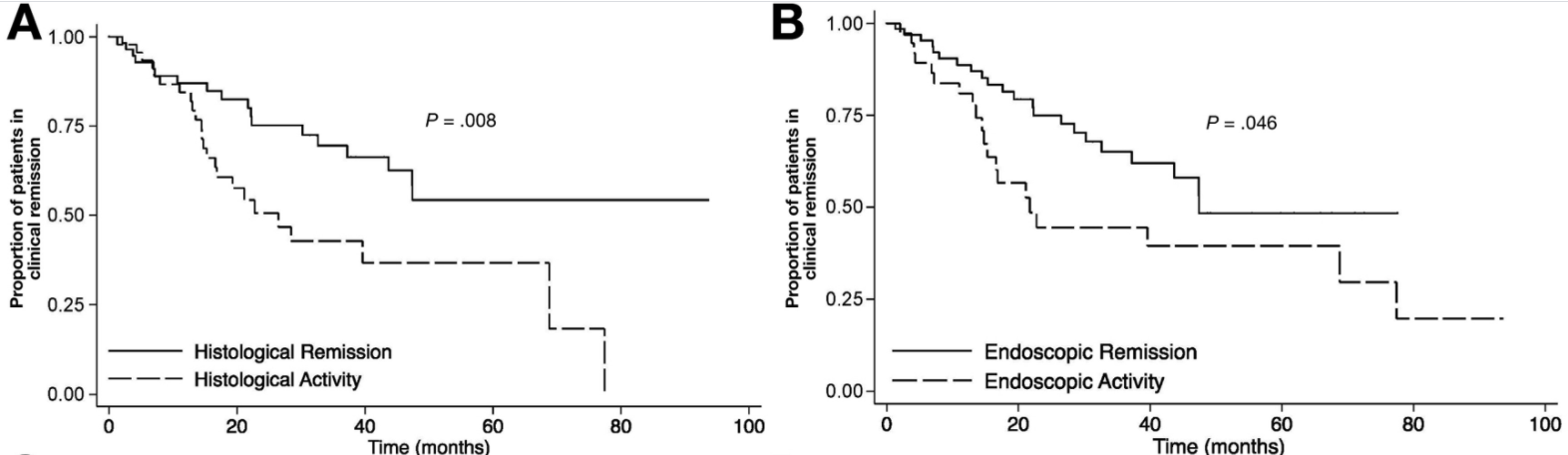
Kaplan-Meier analysis of effect of endoscopic and histologic activity on (A) clinical relapse-free survival versus histologic healing, (B) clinical relapse-free survival versus endoscopic healing

D Kevans et al. Inflamm Bowel Dis 2020; 26: 1722-1729. Histological Markers of Clinical Relapse in Endoscopically Quiescent Ulcerative Colitis Key finding: In endoscopically quiescent UC (n=76), active histological inflammation …[is] adjunctive histological marker associated with increased likelihood of disease relapse. The associated editorial (1730-32 by Asher Kornbluth) quotes Voltaire: “A wise Italian says that the best is the enemy of the good.” He notes that there is “a very real risk of abandoning an effective drug while chasing the goal of some yet to be universally defined histologic remission.” Currently organizational guidelines (ACG, AGA, ECCO, IOIBD) do NOT suggest the use of histologic normalization as an endpoint at this point.

My take: These studies show that histologic healing in ileal Crohn’s disease and in ulcerative colitis are associated with better outcomes that endoscopic appearance. However, there are a lot questions because many patients, possibly a majority, will not achieve histologic healing despite aggressive treatment. Related technical issues include how many biopsies are needed to assess histology and having a validated histologic assessment.

Related blog posts:

Disclaimer: This blog, gutsandgrowth, assumes no responsibility for any use or operation of any method, product, instruction, concept or idea contained in the material herein or for any injury or damage to persons or property (whether products liability, negligence or otherwise) resulting from such use or operation. These blog posts are for educational purposes only. Specific dosing of medications (along with potential adverse effects) should be confirmed by prescribing physician.  Because of rapid advances in the medical sciences, the gutsandgrowth blog cautions that independent verification should be made of diagnosis and drug dosages. The reader is solely responsible for the conduct of any suggested test or procedure.  This content is not a substitute for medical advice, diagnosis or treatment provided by a qualified healthcare provider. Always seek the advice of your physician or other qualified health provider with any questions you may have regarding a condition.


New Treatment for Eosinophilic Gastritis and Duodenitis

ES Dellon et al. NEJM 2020; 383: 1624-1634. Anti–Siglec-8 Antibody for Eosinophilic Gastritis and Duodenitis

Background: AK002 (lirentelimab) is an anti-Siglec-8 antibody that depletes eosinophils and inhibits mast cells.

Methods: In this phase 2 trial, the authors randomly assigned adults (n=65) who had symptomatic eosinophilic gastritis, eosinophilic duodenitis, or both conditions in a 1:1:1 ratio to receive four monthly infusions of low-dose AK002, high-dose AK002, or placebo

Key findings:

  • The mean percentage change in gastrointestinal eosinophil count was −86% in the combined AK002 group, as compared with 9% in the placebo group
  • Treatment response  (>30% reduction in total symptom score and >75% reduction in gastrointestinal eosinophil count) occurred in 63% of the patients who received AK002 and in 5% of the patients who received placebo
  • The authors note that AK002 “also resulted in alleviation of dysphagia in patients with a history of concomitant eosinophilic esophagitis.”
  • Limitations: Small study and 10% developed antibodies to drug

My take: Larger phase 3 studies with AK002 are underway (NCT04322604 & NCT04322708). AK002 looks promising for eosinophilic gastrointestinal diseases.

Change in total symptom score over 14 weeks. “Shown is the least-squares mean percentage change from baseline in total symptom score over time.” The total symptom score ranges from 0 to 80, with higher scores indicating greater symptom severity. Each of eight symptoms are given a score of 0 to 10: abdominal pain, nausea, vomiting, early satiety, loss of appetite, abdominal cramping, bloating and diarrhea.

Related blog posts:

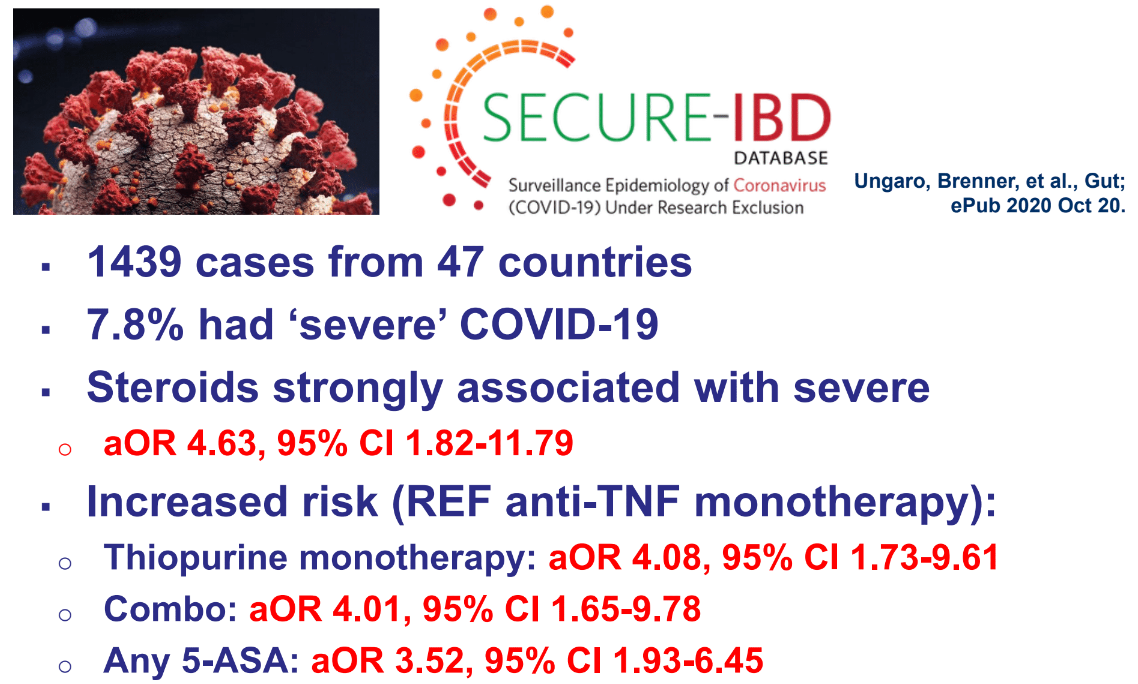
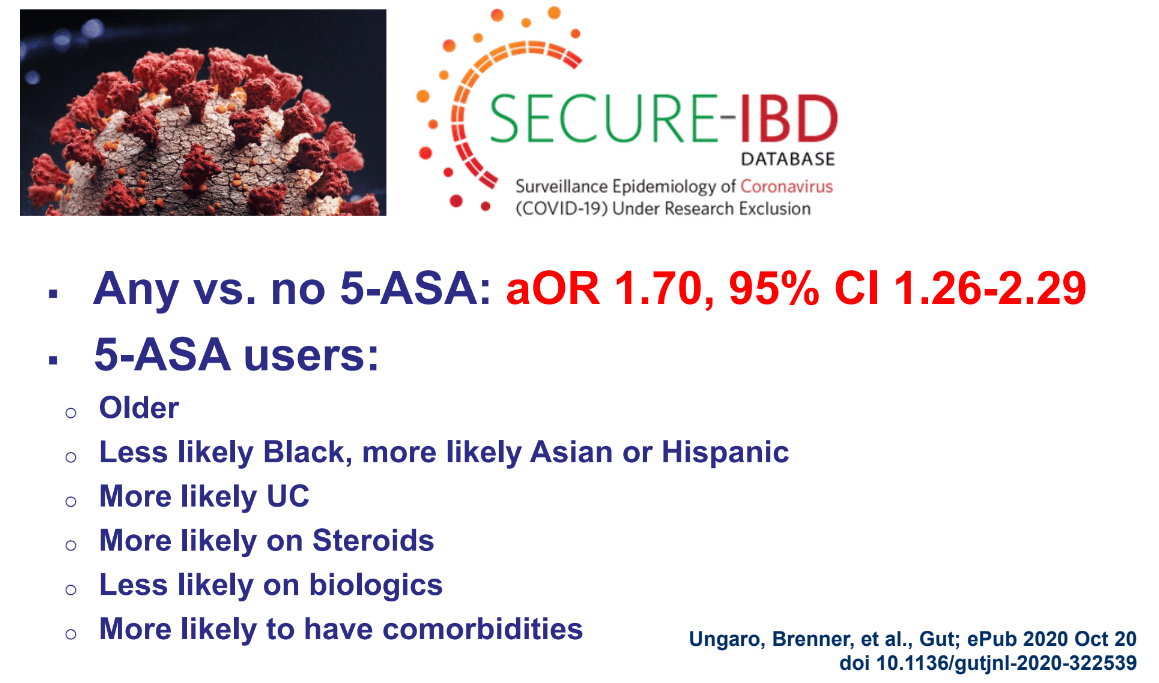
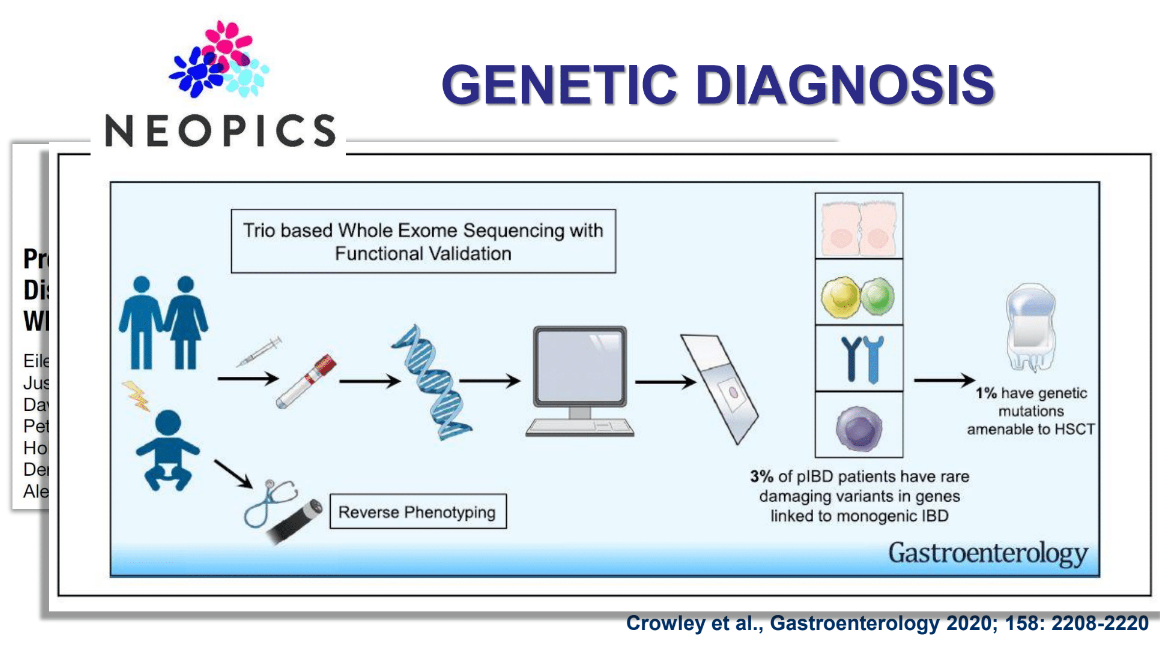
In Case You Missed It: IBD Year in Review (Eric Benchimol)

I did not have the opportunity to hear this #NASPGHAN20 lecture but Dr. Benchimol has shared his slides. Link to Dropbox Slides: IBD Clinical Science: Year in Review

Some of the key points on slides (links to articles below):

Some screenshots:

Links to many of the referenced papers:


Related links:

“Leave Overweight Kids Alone”

Aubrey Gordon provides personal insight into the issue of weight stigma in her opinion piece: NY Times Leave Overweight Kids Alone

Here a few excepts:

The war on childhood obesity reached its zenith with the 2010 introduction of the national “Let’s Move!” campaign, “dedicated to solving the problem of obesity within a generation.” It was a campaign against “childhood obesity” — not specific health conditions or the behaviors that may contribute to those health conditions. It wasn’t a campaign against foods with little nutritional value, or against the unchecked poverty that called for such low-cost, shelf-stable foods. It was a campaign against a body type — specifically, children’s body types.

In 2012, Georgia began its Strong4Life campaign aimed at reducing children’s weight and lowering the state’s national ranking: second in childhood obesity. Run by the pediatric hospital Children’s Healthcare of Atlanta, it was inspired in part by a previous anti-meth campaign. Now, instead of targeting addiction in adults, the billboards targeted fatness in children…The billboards purported to warn parents of the danger of childhood fatness, but to many they appeared to be public ridicule of fat kids…

Despite ample federal and state funding, multiple national public health campaigns and a slew of television shows, the war on obesity does not appear to be lowering Americans’ B.M.I.s. According to the Centers for Disease Control and Prevention, since 1999 there has been a 39 percent increase in adult obesity and a 33.1 percent increase in obesity among children.

Weight stigma kick-starts what for many will become lifelong cycles of shame..Yet, despite its demonstrated ineffectiveness, the so-called war on childhood obesity rages on. This holiday season, for the sake of children who are told You’re not beautiful. You’re indulging too much. Your body is wrong. You must have done it, I hope some parents will declare a cease-fire.

Related blog posts:

Isle of Palms, SC

45 Years –The New Recommendation for Colorectal Cancer Screening

Related blog posts:

Update on Upper GI Bleeding Recommendations

DK Mullady et al. Gastroenterol 2020; 159: 1120-1128. AGA Clinical Practice Update on Endoscopic Therapies for Non-Variceal Upper Gastrointestinal Bleeding: Expert Review

Listed below are the 10 ‘Best Practice Advice’ recommendations. I think the acknowledgement that “hemostatic powder should be preferentially used as a rescue therapy and not for primary hemostasis, except in cases of malignant bleeding or massive bleeding with inability to perform thermal therapy or hemoclip placement” (#7) is very useful.

“Best Practice Advice:”
  • Endoscopic therapy should achieve hemostasis in the majority of patients with NVUGIB.
    • This may include clips, thermal (heater probes, bipolar/multipolar catheters, hemostatic forceps), diluted epinephrine injection, and hemostatic spray
  • Initial management of the patient with NVUGIB should focus on resuscitation, triage, and preparation for upper endoscopy. After stabilization, patients with NVUGIB should undergo endoscopy with endoscopic treatment of sites with active bleeding or high-risk stigmata for rebleeding.
  • Endoscopists should be familiar with the indications, efficacy, and limitations of currently available tools and techniques for endoscopic hemostasis, and be comfortable applying conventional thermal therapy and placing hemoclips.
  • Monopolar hemostatic forceps with low-voltage coagulation can be an effective alternative to other mechanical and thermal treatments for NVUGIB, particularly for ulcers in difficult locations or those with a rigid and fibrotic base.
  • Hemostasis using an over-the-scope clip should be considered in select patients with NVUGIB, in whom conventional electrosurgical coagulation and hemostatic clips are unsuccessful or predicted to be ineffective.
  • Hemostatic powders are a noncontact endoscopic option that may be considered in cases of massive bleeding with poor visualization, for salvage therapy, and for diffuse bleeding from malignancy.
  • Hemostatic powder should be preferentially used as a rescue therapy and not for primary hemostasis, except in cases of malignant bleeding or massive bleeding with inability to perform thermal therapy or hemoclip placement.
  • Endoscopists should understand the risk of bleeding from therapeutic endoscopic interventions (eg, endoluminal resection and endoscopic sphincterotomy) and be familiar with the endoscopic tools and techniques to treat intraprocedural bleeding and minimize the risk of delayed bleeding.
  • In patients with endoscopically refractory NVUGIB, the etiology of bleeding (peptic ulcer disease, unknown source, post surgical); patient factors (hemodynamic instability, coagulopathy, multi-organ failure, surgical history); risk of rebleeding; and potential adverse events should be taken into consideration when deciding on a case-by-case basis between transcatheter arterial embolization and surgery.
  • Prophylactic transcatheter arterial embolization of high-risk ulcers after successful endoscopic therapy is not encouraged.

Related blog posts:

Operation Warp Speed Strategy

M Slaoui, M Hepburn. NEJM 2020; 383: 1701-1703. Full text: Developing Safe and Effective Covid Vaccines — Operation Warp Speed’s Strategy and Approach

As an aside, I have always thought that the name, “Operation Warp Speed,” sounded like a line from the movie Spaceballs.

This article provides insight into the strategy for “Operation Warp Speed” (OWS). An excerpt:

OWS’s strategy relies on a few key principles. First, we sought to build a diverse project portfolio that includes two vaccine candidates based on each of the four platform technologies…In addition, advancing eight vaccines in parallel will increase the chances of delivering 300 million doses in the first half of 2021…

Of the eight vaccines in OWS’s portfolio, six have been announced and partnerships executed with the companies: Moderna and Pfizer/BioNTech (both mRNA), AstraZeneca and Janssen (both replication-defective live-vector), and Novavax and Sanofi/GSK (both recombinant-subunit-adjuvanted protein). These candidates cover three of the four platform technologies and are currently in clinical trials. The remaining two candidates will enter trials soon...

No scientific enterprise could guarantee success by January 2021, but the strategic decisions and choices we’ve made, the support the government has provided, and the accomplishments to date make us optimistic that we will succeed in this unprecedented endeavor.

Related article:

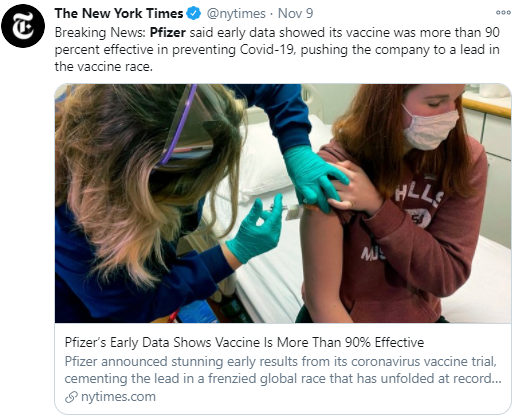
NY Times (11/9/20): Pfizer’s Early Data Shows Vaccine Is More Than 90% Effective

Small Study: Kiwi For Constipation

Healio Gastroenterology: Kiwi fruit effective, well tolerated in treating chronic constipation

From a randomized (Virtual) ACG 2020 study from Samuel W. Chey and colleagues (University of Michigan), n=79 adults:

  • “All three treatments improved complete spontaneous bowel movement (P .003). Prunes demonstrated the largest magnitude of response at 67% vs. 64% for psyllium vs. 45% for Kiwi fruit”
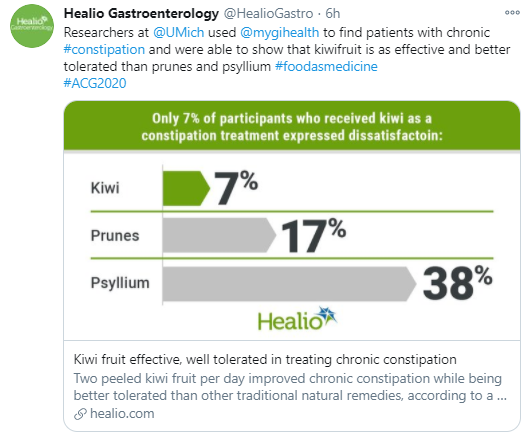
  • “The highest proportion of participants – 68% – reported treatment satisfaction with kiwifruit while similar proportions of those receiving prunes and psyllium – 48% – reported satisfaction”
  • “The kiwi group had the lowest proportion of participants reporting treatment dissatisfaction at 7%….Participants receiving prunes and psyllium were more likely to report abdominal pain and bloating than those receiving kiwi”