IBD Update -September 2020

Briefly noted:

Safety of Thiopurine Use in Paediatric Gastrointestinal Disease. E Miele et al. JPGN 2020; 71: 156-62. Useful review of thiopurines for IBD and for autoimmune hepatitis

The Effect of Adalimumab Treatment on Linear Growth in Children With Crohn Disease: A Post-hoc Analysis of the PAILOT Randomized Control Trial. M Matar et al. JPGN 2020; 71: 237-42. This study showed that 66 (of 78) who completed 72 weeks of treatment had improved (but not normalized) linear growth (height z-score at baseline improved from -0.62 to -0.33 (P=0.005) and normalization of weight and BMI. The presence of perianal disease was associated with diminished growth velocity.  Overall, this study adds to the literature that anti-TNF agents can reverse growth failure associated with Crohn’s disease.

Full text: Deep Remission at 1 Year Prevents Progression of Early Crohn’s Disease  RC Ungaro et al. Gastroenterol 2020; DOI: https://doi.org/10.1053/j.gastro.2020.03.039 Key finding: When we adjusted for potential confounders, deep remission (adjusted hazard ratio, 0.19; 95% confidence interval, 0.07–0.31) was significantly associated with a lower risk of major adverse outcome.  This study is reinforced by recent data published at DDW 2020 -Abstract 401: N Plevris et al. “Early Mucosal Healing Key to Long-Term Success.”  This was highlighted by Miguel Regueiro in Gastroendonews.com.  Among 375 patients, those who achieved a fecal calprotectin (FC) <250 mcg/g within one year of diagnosis, the disease progression was 65% slower than those with FC values that did not normalize within a year.  Initiation of a biologic within 3 months of diagnosis, more than quadrupled the likelihood of FC normalization within one year.


Weak Support For Probiotics in Acute Gastroenteritis

Two recent well-controlled studies (D Schnadower et al.N Engl J Med 2018; 379:2002-2014, SB Freedman et al. N Engl J Med 2018; 379:2015-2026) showed that probiotic-treated children with acute gastroenteritis (AGE) did not have better outcomes than placebo-treated children. In addition, a recent AGA practice guideline recommended against the use of probiotics for most GI conditions, including in AGE.

However, a new report (H Szajewska et al. JPGN 2020; 71; 261-69) from an ESPGHAN  working group recommends that probiotics should have a role for AGE.  Several points about this report:

  1. Their recommendations are very qualified: “weak recommendation” with “low to very low certainty of evidence” for the following in descending order: S boulardiii, L rhamnosis GG, L reuteri DSM 17938, and L rhamnosus 19070 & L reuteri DSM 12246
  2. It is noted that this report has a disclaimer from ESPGHAN: “it does not represent ESPGHAN policy and is not endorsed by ESPGHAN”
  3. The authors have extensive disclosures
  4. The report notes that “despite large number of identified trials, we could not identify 2 randomized controlled trials of high quality for any strain that provided benefit when used for treating acute gastroenteritis”

Of note, the associated editorial (pg 146-47) also favors probiotics in the setting of AGE.  “These recommendations…have clarified that there is a role for probiotics in treating” AGE.

Related article (just published): F Mourney et al. The Pediatric Infectious Disease JournalAugust 7, 2020 – Volume Online First – Issue –doi: 10.1097/INF.0000000000002849 A Multicenter, Randomized, Double-Blind, Placebo-Controlled Trial of Saccharomyces boulardii in Infants and Children With Acute Diarrhea (n=100) Key findings: The time of recovery from diarrhea was significantly shorter in the probiotic group compared with the placebo group (65.8 ± 12 hours vs. 95.3 ± 17.6 hours, P = 0.0001).

My take: Overall, probiotic effectiveness is overstated; though, some strains may be helpful for AGE.  Still, there are concerns about variation in production and quality standards even in these strains.

Related blog posts:

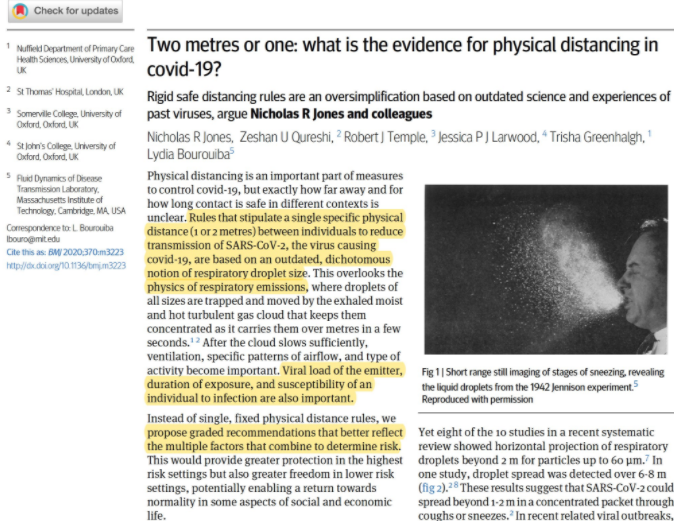
For SARS-CoV-2–Is 2 Meters Enough?

NR Jones et al. BMJ 2020;370:m3223. Full Text: Two metres or one: what is the evidence for physical distancing in covid-19?

Key messages from article:

  • Current rules on safe physical distancing are based on outdated science
  • Distribution of viral particles is affected by numerous factors, including air flow
  • Evidence suggests SARS-CoV-2 may travel more than 2 m through activities such as coughing and shouting
  • Rules on distancing should reflect the multiple factors that affect risk, including ventilation, occupancy, and exposure time

Highlighted article from Eric Topol’s Twitter Feed

A more nuanced approach is recommended by authors -color-coded Figure 3 above –caption: “Risk of SARS-CoV-2 transmission from asymptomatic people in different settings and for different occupation times, venting, and crowding levels (ignoring variation in susceptibility and viral shedding rates). Face covering refers to those for the general population and not high grade respirators. The grades are indicative of qualitative relative risk and do not represent a quantitative measure. Other factors not presented in these tables may also need to be taken into account when considering transmission risk, including viral load of an infected person and people’s susceptibility to infection. Coughing or sneezing, even if these are due to irritation or allergies while asymptomatic, would exacerbate risk of exposure across an indoor space, regardless of ventilation.”

Doing “LESS” is Beneficial -Combining ERCP and Cholecystectomy

A recent retrospective study (DS Fishman et al. JPGN 2020; 71: 203-207) identified 25 patients who underwent combined Laparascopic cholecystectomy/ERCP in Same Session (=LESS) to more conventional ERCP followed by laparoscopic cholecystectomy (n=42).  The center utilized prospectively-collected data from 13 centers and 67 consecutive ERCPs.

Key findings:

  • Median hospital stay was shorter for LESS patients, 3 days vs. 4 days (P=.32)
  • Total procedure time was similar, though a decrease in total anesthesia time was reported for LESS patients: mean 177 minutes compared to 205 minutes (P=.04)
  • No significant adverse events were reported in either group, though both groups had two patients who required repeat care due to suspected retained stones
  • The authors note that concerns about gaseous distention following ERCP “is likely unfounded as all cholecystectomies were completed.”
  • No local or systemic infections were reported.  The authors recommend antibiotic prophylaxis with the LESS approach

My take: Given the recommendation that cholecystectomy should take place during the same hospitalization for patients with choledocholithiasis, this combined approach makes a lot sense and is supported by this study.

Related posts:

Isle of Palms, SC

Liver Shorts -August 2020

V Cardenas et al. JPGN 2020; 71: 197-202.  Incidence and Sequelae of Liver Injury Among Children Treated for Solid Tumors: Analysis of a Large Single-Center Prospective Cohort

  • Of 1136 solid tumor patients, 160 (14%) experienced liver injury, and the overall frequency of DILI was 4%.
  • DILI was the leading identified cause of liver injury (31%), followed by infection (17%), metastatic/malignant biliary disease (13%), and perioperative liver injury (13%).
  • Most DILI cases (>90%) were mild acute hepatocellular injury episodes that did not result in modification to the chemotherapy plan, and all DILI eventually resolved.

N Kapila et al. Hepatology 2020; 72: 32-41. Full Text Link: Hepatitis C Virus NAT‐Positive Solid Organ Allografts Transplanted Into Hepatitis C Virus–Negative Recipients: A Real‐World Experience

Background: As of April 1, 2019, an estimated 103,000 kidney, 13,500 liver, and 3,800 heart transplant (HT) candidates are awaiting transplantation

Key findings:

  • Seventy‐seven patients who were HCV negative underwent solid organ transplantation from a donor who was HCV viremic. Only one has been a HCV-treatment nonresponder (though several have not completed SVR12).
  • “Our study is the largest to describe a real‐world experience of the transplantation of HCV‐viremic organs into recipients who are aviremic. In carefully selected patients, the use of HCV‐viremic grafts in the DAA era appears to be efficacious and well tolerated.”

M Martinello et al. Hepatology 2020; 72: 7-18Short‐Duration Pan‐Genotypic Therapy With Glecaprevir/Pibrentasvir for 6 Weeks Among People With Recent Hepatitis C Viral Infection

  • This was an  open‐label, single‐arm, multicenter, international pilot study; adults with recent HCV (duration of infection < 12 months) received glecaprevir/pibrentasvir 300/120 mg daily for 6 weeks.
  • At baseline, median estimated duration of infection was 29 weeks (range 13, 52) and median HCV RNA was 6.2 log10 IU/mL (range 0.9, 7.7). SVR12 in the intention‐to‐treat and per‐protocol populations was achieved in 90% (27/30) and 96% (27/28), respectively.

H Verkade et al. JPGN 2020; 71: 176-83. Systematic Review and Meta-analysis: Partial External Biliary Diversion in Progressive Familial Intrahepatic Cholestasis

  • With regard to  pruritus improvement, 104/155 (67%) were responders, 14/155 (9%) had partial response, and 37/155 (24%) were nonresponders.

K Patel et al. Hepatology 2020; 72: 58-71. Cilofexor, a Nonsteroidal FXR Agonist, in Patients With Noncirrhotic NASH: A Phase 2 Randomized Controlled Trial

  • “Cilofexor for 24 weeks was well‐tolerated and provided significant reductions in hepatic steatosis, liver biochemistry, and serum bile acids in patients with NASH.”

Building a Bigger (Better?) Brain in Premature Infants

A recent retrospective study (PE van Beek et al. J Pediatr 2020; 223: 57-63. Increase in Brain Volumes after Implementation of a Nutrition Regimen in Infants Born Extremely Preterm) with 178 infants (median gestational age 26.6 weeks) found that a modification in the nutritional regimen resulted in improved brain volumes.

Key findings:

  • In cohort B (new regimen), mean protein and caloric intake were 3.4 g/kg/d & 109 kcal/kg/day which were significantly  increased compared to Cohort A: 2.7 g/kg/d and 104 kcal/kg/d for first 28 days of life.
  • At 30 weeks gestational age, 22 brain regions were significantly large in cohort B compared with cohort A, though at term age equivalence, only the caudate nucleus remained significantly larger.
  • key limitation: brain MRI can only be performed in relatively stable neonates; thus, sicker infants may be underrepresented.

My view: Optimizing nutrition as early as possible is likely to help improve cognitive outcomes.

Related blog posts:

Other nutrition-related articles in this issue:

DL Harris et al. J Pediatr 2020; 223: 34-41. Glucose Profiles in Healthy Term Infants in the First 5 Days: The Glucose in Well Babies (GLOW) Study

  • In term infants, plasma glucose concentrations of 47 mg/dL (2.6 mmol/L) approximated the 10th percentile in the first 48 hours, and 39% of infants had ≥1 episode below this threshold.
  •  The mean glucose concentrations increased over the first 18 hours, remained stable to 48 hours (59 ± 11 mg/dL; 3.3 ± 0.6 mmol/L)] before increasing to a new plateau by the fourth day (89 ± 13 mg/dL; 4.6 ± 0.7 mmol/L).

WG Sharp et al. J Pediatr 2020; 223: 73-80. Intensive Multidisciplinary Intervention for Young Children with Feeding Tube Dependence and Chronic Food Refusal: An Electronic Health Record Review  Congratulations to my colleagues at the Marcus Center for this work, particularly Valerie Volkert who has worked with so many of our kids and Barbara McElhanon who has been so helpful.  83 patients with complex medical-behavioral-developmental problems met study criteria.  Key finding:  58 patients (72%) weaned from tube feeding at follow-up.

From Pitt Street Bridge Park, Mount Pleasant, SC


Briefly Noted: How to Approach Crohn’s Disease Complicated by an Intra-abdominal Abscess

A recent review (T Qazi, M Regueiro. Practical Gastroenterology 2020: June Issue, 10-18. Full PDF Link: Crohn’s Disease Complicated by an Intra-abdominal Abscess: Poke, Prod, or Cut?)

The article is a good review & the algorithm below provides some good guidance -if difficult to visualize, then it may be worthwhile to look at source article.

The authors propose initial management with antibiotics, minimization of steroids, nutritional support and drainage.

Medical treatment is favored after initial management:

  • Newly diagnosed Crohn’s disease
  • Extensive disease
  • No fibrostenoting disease
  • Active perianal disease

Surgical treatment is favored after initial management:

  • Long-standing disease
  • Stricture with dilatation
  • Abscess >6 cm in size
  • Prior surgical intervention

The authors note that “recent studies have suggested that roughly 30% of patients
treated with PD are able to avoid future surgical resection.”

Related blog posts:


AASLD: Advice for Patients with Liver Diseases and Liver Transplants During COVID-19

AASLD: OK Fix et al. Hepatology 2020; 72: 287-304. Full Article Link: Clinical Best Practice Advice for Hepatology and Liver Transplant Providers During the COVID‐19 Pandemic: AASLD Expert Panel Consensus Statement

This is a lengthy article with extensive recommendations –here are a few:

  • Consider etiologies unrelated to COVID‐19, including other viruses such as hepatitis A, B and C, when assessing patients with COVID‐19 and elevated liver biochemistries.
  • Consider other causes of elevated liver biochemistries, including myositis (particularly when AST>ALT), cardiac injury, ischemia, and cytokine release syndrome.
  • Generally, this article supports continuation of ongoing treatments in those with liver disease who are without active infection.  “Do not reduce immunosuppression or stop mycophenolate for asymptomatic posttransplant patients without known COVID‐19”
  •  “As we learn more about how the COVID‐19 pandemic impacts the care of patients with liver disease, we will update the online document available at https://www.aasld.org/about-aasld/covid-19-and-liver.”