Low-Value Care: IBD Serologies for Diagnosis of IBD

A recent high-value care series (MD Long, BE Sands. Clin Gastroenterol Hepatol 2018; 16: 618-20) explains why “clinicians should not use IBD serologies as a test to diagnose inflammatory bowel disease.”

Here are the key points:

  • “Benoir et demonstrated that a 7-marker serology panel had a lower predictive value than routine laboratory tests in diagnosis of IBD among symptomatic pediatric patients.”
  • “Studies on the accuracy of these serologies for diagnosis included populations with a high prevalence of IBD (42%-62%), rather than the low-prevalence populations in primary care settings” (or even in for routine GI office visits)…”When the disease is rare, a greater proportion of the positive tests represent false positives and the PPV [positive predictive value] is low.”
  • The authors also recommend against using serologies to predict a more aggressive course because “no data exist that modifications based on these serologies improve outcomes.”

My take: When I highlight this article, there is an element of confirmational bias as I have held a dim view of their value for a long time. While there is some academic interest in IBD serology results, to me, it is a disturbing trend to see patients with nonspecific abdominal pain referred who have already had these serological markers.
Increased Organ Availability for Transplantation Related to Opioid Epidemic

A letter to the editor (MR Mehra et al. NEJM 2018; 378: 20: 1943-45) provides a perspective on the increasing availability of organs for transplantation from drug overdoses/opioid epidemic from 2000 to 2016.

Key findings:

  • “The drug-abuse epidemic has been associated with a sharp increase in the recovery of organs from brain-dead donors in the United States but not in Europe. “
  • “The U.S. data indicate that survival among recipients from donors who died from drug intoxication is similar to survival among recipients from donors who died from other causes.”

My take: Opioid use is more likely to place one at risk for needing a liver transplantation due to increase acquistion of hepatitis C infection and is more likely to make a donor available due to drug overdoses.

Related blog posts:

More on Time to Split (2018)

As noted in a blog last year (More on its Past Time to Split), increased use of split livers can reduce liver transplantation waitlist mortality in children.  Further justification for this approach is evident from a new study (DB Mogul et al. J Pediatr 2018; 196: 148-53, editorial pg 12) indicated that outcomes following split liver organs are equivalent to whole organ liver organs.

The authors examined two time periods: 2002-2009 and 2010-2015 using the Scientific Registry of Transplant Recipients. n=5715

Key findings:

  • 1-year survival from split liver transplant (SLT) improved during the later period compared to the initial period: 95% versus 89%. n=1626 (28.5% of all transplants)
  • 1-year survival from living donor liver transplant (LDLT) improved during the later period compared to the initial period: 98% versus 93%. n=661 (11.6% of all transplants)
  • 1-year survival from whole liver transplant (WLT) was essentially unchanged during the later period compared to the initial period: 95% versus 94%. n=3428 (60% of all transplants)

These data show that survival after transplant is no longer worsened by SLT and may be higher for LDLT than WLT.

The editorial by Dr. Bae Kim and Dr. Vakili note that there have been several proposals to encourage more use of SLTs.  One that was developed “would prioritize children <2 years old before local/regional adults except for those who were status 1 or who had a MELD score above 30.”  At this point, these efforts to favor SLT allocation have not been adopted by UNOS Board of Directors.

My take (borrowed from editorial): “The question should no longer be ‘To split or not to split?’ but rather ‘Why should we let children die when we can now split livers safely?'”

Related blog posts:

Chattahoochee River


Canakinumab for Recurrent Fever Syndromes

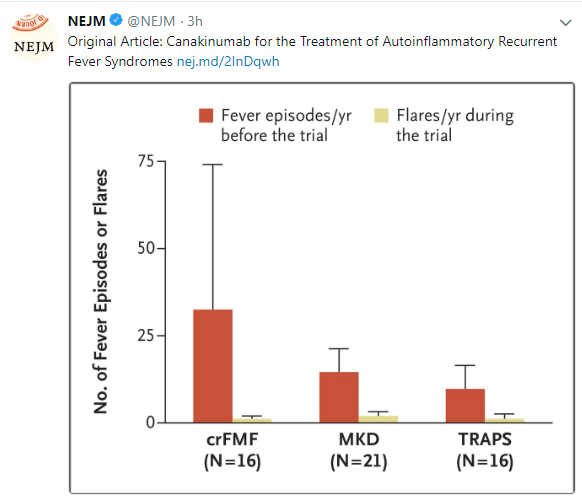
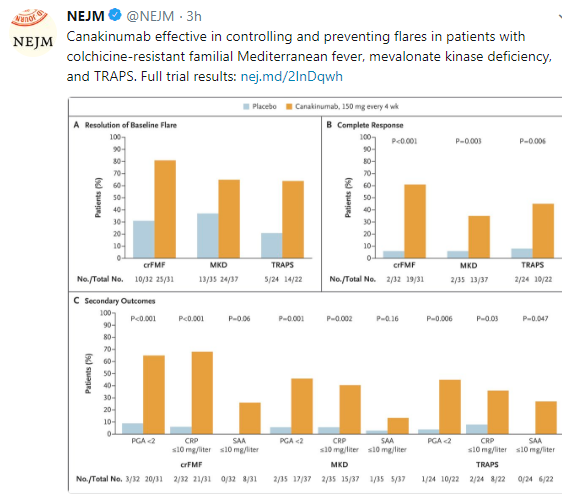
A recent study (F de Benedetti et al. NEJM 2018; 378: 1908-19) presents data on canakinumab, an anti-interleukin-1β monoclonal antibody, for three hereditary periodic fever syndromes in the so-called “CLUSTER” trial.  Canakimumab is administered as a subcutaneous injection. The three periodic fevers were the following:

  • Familial Mediterranean Fever (colchicine-resistant)
  • Mevalonate kinase
  • Tumor necrosis factor-receptor-associated periodic syndrome (TRAPS)

Are Long-Term Liver Transplant Survivors Destined to Have Low Bone Density? (No)

Briefly noted: A recent study (L Ee et al. JPGN 2018; 66: 797-801) provides some good news for children who have had liver transplantation (LTx).

Among 42 patients (64% with biliary atresia) who had undergone LTx at a median age of 2.2 years and were long-term survivors (median time since LTx 10.1 yrs), mean bone mineral density (BMD) were normal.  Lumbar BMD z-score -0.15 and total body BMD -0.76.  Pathologic fractures were noted in 2 patients; these occurred within 18 months of transplantation.

My take: this study indicates that over time, most patients are not likely to have very low bone density.

Low Fiber Diet During Bowel Prep

A recent prospective, randomized trial (A Mytyk et al. JPGN 2018; 66: 720-24) compared a low fiber diet with a clear liquid diet during a polyethyylene glycol prep prior to colonoscopy. N=184, Median age 15 yrs (range 6-18 yrs).

Low fiber diet included milk, dairy products, some soups, bread and rolls, sandwiches, meat, fish, eggs, pasta, and honey.

Children in both groups were asked to fast for a minimum of 6 hours prior to colonoscopy and their bowel prep was assessed with the Boston Bowel Preparation Scale (BBPS). Bowel prep consisted of PEG 4000 with electrolytes dosed at 66 mL/kg to max of 4 liters.

Key findings:

  • There was no significant difference in BBPS between the two groups
  • Overall, 95.4% of patients had good bowel cleanness (BBPS ≥5)

My take: This study indicates that with a good volume of bowel prep, a less-rigorous diet change may be effective for a cleanout.

Disclaimer: These blog posts are for educational purposes only. Specific dosing of medications/diets (along with potential adverse effects) should be confirmed by prescribing physician/nutritionist.  This content is not a substitute for medical advice, diagnosis or treatment provided by a qualified healthcare provider. Always seek the advice of your physician or other qualified health provider with any questions you may have regarding a condition.

Related blog posts:

Big Creek Greenway -not far from McFarland


ADMIRE Study: Use of Stem Cell Therapy for Complex Perianal Fistulas in Crohn’s Disease

A recent phase 3 randomized, double-blind, placebo-controlled study (J Panes et al. Gastroenterol 2018; 154: 1334-42) examined the use of stem cell therapy for the treatment of complex perianal fistulas in Crohn’s disease (CD).

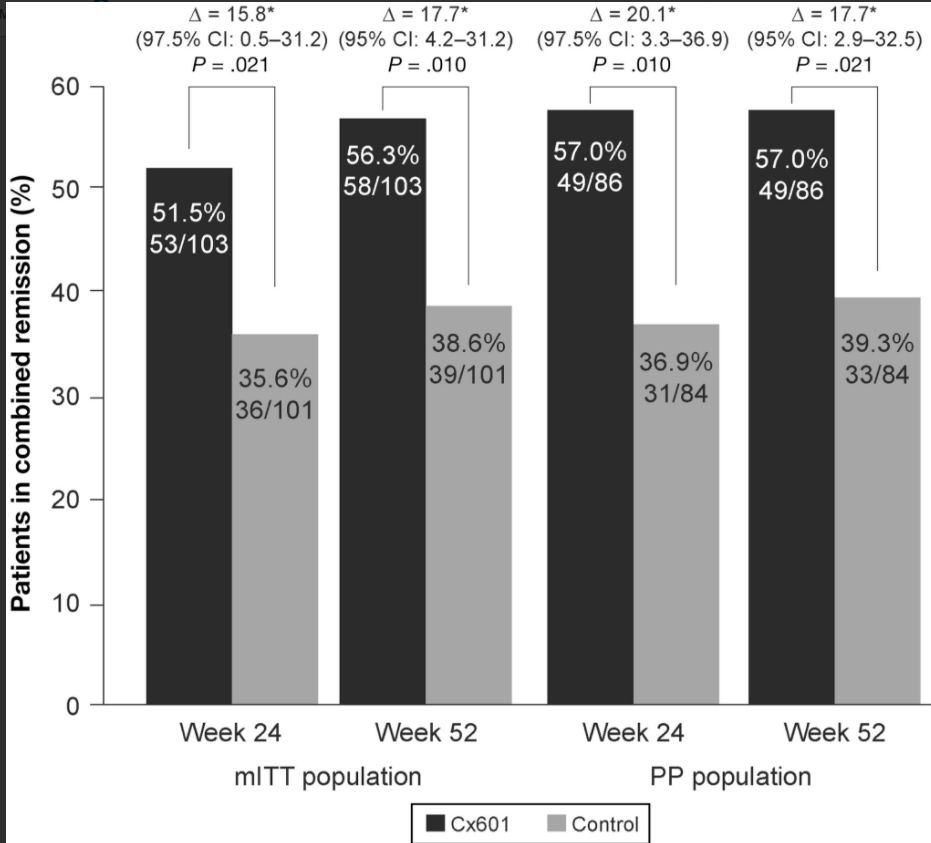
They used a single local injection of 120 million Cx601, a suspension of allogeneic expanded adipose-derived stem cells, and compared to a placebo injection.  This study comprised 212 patients from 49 centers. The primary endpoint, labelled “combined remission,” was based on absence of draining fistulas and MRI findings.

Key Findings:

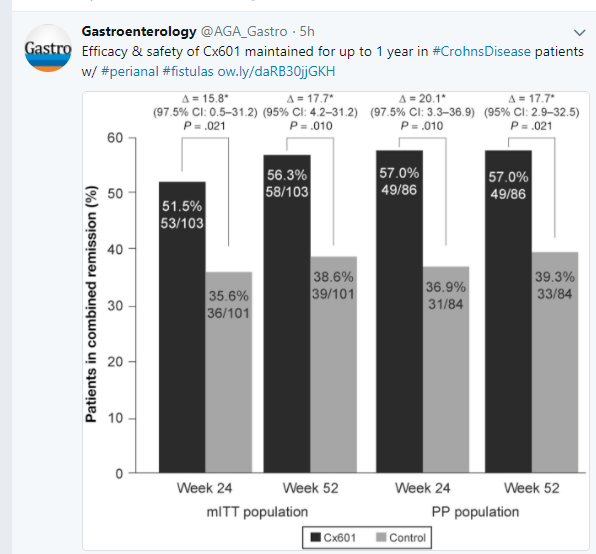
  • As noted in Figure 1 (below), combined remission occurred in 51.5% of Cx601-Rx patients compared with 35.6% for placebo at week 24; at week 52, combined remission occurred in 56.3% of Cx601-Rx patients compared with 38.6%

My take: This local therapy improved outcomes for 1 year after a single injection and appears promising for refractory perianal fistulas.  It may help avoid surgery or systemic immunosuppression.


Closer Look at Data Then Image Below

Expert Actuary is Overcharged by the Hospital in ‘Collusion’ with the Insurance Company– Guess Who Wins

From NPR Why Your Health Insurer Doesn’t Care About Your Big Bills

This is a terrific article that explains a lot about what is wrong with our health system’s economics.  This article details how an expert actuary is overcharged by Aetna and NYU Langone for a partial hip replacement and how insurance companies are NOT good financial representatives for patients.

Some excerpts:

Widely perceived as fierce guardians of health care dollars, insurers, in many cases, aren’t. In fact, they often agree to pay high prices, then, one way or another, pass those high prices on to patients — all while raking in healthy profits…

Before Frank’s hip operation, he asked NYU Langone for an estimate. It told him to call Aetna, which referred him back to the hospital. He never did get a price…

For one item in his bill the implant, Aetna said NYU Langone paid a “member rate” of $26,068 for “supply/implants.” But., the maker of his implant, … told him the hospital would have paid about $1,500…

Turns out, insurers don’t have to decrease spending to make money. They just have to accurately predict how much the people they insure will cost. That way they can set premiums to cover those costs — adding about 20 percent for their administration and profit

It’s as if a mom told her son he could have 3 percent of a bowl of ice cream. A clever child would say, “Make it a bigger bowl.”

Wonks call this a “perverse incentive.”…

After the hearing, Nugent said a technicality might have doomed their case. New York defendants routinely lose in court if they have not contested a bill in writing within 30 days, he said. Frank had contested the bill over the phone with NYU Langone and in writing within 30 days with Aetna. But he did not dispute it in writing to the hospital within 30 days.

My take: While I’m no expert, I have had a similar experience where I was convinced that my insurance company would want to look into their agreement with a local hospital (Northside Hospital) because I was charged exorbitantly for the processing of a pathology specimen.  Further aggravating the situation was that I had no idea that this specimen, obtained from an outpatient visit, would be sent to a hospital system, rather than an outpatient pathology group.  It turns out that the insurance company had no interest in looking into this matter, even though the cumulative effect of these types of pathology charges were enormous.

Related blog posts:


Laying to Rest a Breast-Feeding Myth

A recent study (VJ Flaherman et al. J Pediatr 2018; 196: 84-90) examines whether early limited formula feeding undermines breastfeeding.

Background: The authors note that women have been discouraged from using formulas for newborns during the birth hospitalization due to concerns that this will diminish the frequency/success of breastfeeding.

Besides the concern that supplemental formula could increase the risk of breastfeeding cessation, some have expressed concern that supplemental formula could undermine benefits of breastmilk on the intestinal microbiome.  In addition, some have worried that if mothers perceived formula-feeding to be easier, that this could lower satisfaction with breastfeeding.

Yet, on the other side of the ledger, there are “about 80,000 newborns who require readmission after discharge” with the majority related to dehydration and hyperbilirubinemia.  Both of these conditions could be ameliorated by formula supplementation.  Thus, to address whether supplemental formula may be of benefit, the authors devised an “early limited formula” (ELF) trial.  The authors only enrolled infants >2500 gm and who had a weight loss >75th percentile on The Newborn Weight Tool (www.newbornweight.org). The authors excluded those with >10% of their birth weight due to routine practice of supplementation.

Methods: 163 mother-infant pairs were randomly assigned to either ELF along with breastfeeding or breastfeeding exclusively.  ELF involved giving infants 10 mL of a hydrolysate formula with a feeding syringe after each breastfeeding until the onset of copious breast milk

Key findings:

  • Mothers using ELF averaged 5.4 times/day for a median of 2 days.
  • Breastfeeding rates at one month of age: 86.5% of ELF group and 89.7% of controls; 54.6% of ELF and 65.8% of controls were breastfeeding exclusively at 1 month of age.
  • Readmission occurred in 4 (4.8%) of control infants and none of the infants in the ELF cohort (P=.06)
  • Using a subset of 15 (8 with ELF), the authors did not identify significant changes in microbiome of ELF group compared with the exclusively fed group when examined at 1 week and 1 month (as well as baseline)

Limitations of this study include the relatively small number of participants.  Furthermore, some populations that are at increased risk for breastfeeding cessation, namely mothers <25 years and African-American mothers were underrepresented.

My take: This study indicates that ELF is safe and does not appear to significantly increase breastfeeding cessation.

Related blog posts: