“Data-free Zone” and mHealth

A recent study (J Kamgno et al. NEJM 2017; 377: 2044-52) used an innovative cell-phone-based device (the LoaScope) to improve treatment of onchocerciasis (river blindness).

Background (summarized in editorial: pg 2088-90): Ivermectin has been distributed in Africa since 1988 to treat onchocerciasis; in fact, the 2015, Nobel Prize in Medicine was shared by the discoverers of ivermectin.  However, in 1996, it was recognized that central nervous system adverse events were occurring in ivermectin-treated patients with coexistent Loa loa infection.

Kamgno et al show that not treating patients with L loa counts >20,000 microfilariae per mL helps target ivermectin to those who will benefit.  The LoaScope identified 340 persons who were at high risk for serious adverse events; the authors estimate that 62 serious central nervous system complications and 8 deaths were avoided with this approach.

Despite the apparent success of this mobile Health (mHealth) application, a separate editorial cautions that most mHealth has little data to support its use (A Roess.  NEJM 2017; 377: 2010-11). Key points:

  • To date, more than 1200 mHealth tools or apps have been catalogued
  • Determining which are effective is difficult  With breastfeeding, there are >340 apps, yet only “15 had any evidence supporting their use, and that was from pilot evaluations.:
  • Most apps involve data collection and delivering health education messages.  The latter are usually one-way messages. “The evidence to support their rapid and widespread use is limited.”
  • mHealth in remote areas may enhance collaboration; though, practical infrastructure problems like poor wireless networks and unreliable electricity hamper their utility.
  • mHealth could improve point-of-care diagnostics. Current products include blood-glucose monitors, blood-pressure monitors, and electrocardiography
  • While many have suggested these apps will be cost-effective, these analyses typically do not evaluate the costs of misinformation and the diverse workforce requirements needed for implementation

My take (with help from editorial): mHealth tools are here and increasing.  Advances like the LoaScope for treating river blindness has been shown to improve outcomes.  Before recommending other mHealth tools, we need to insist on adequate evaluation or we will “arrive in an increasingly fragmented mHealth landscaped littered with poor-quality, unproven apps.”

Related blog posts:

Sunrise at the Grand Canyon’s South Rim

Will We Still Need Liver Biopsies to Diagnose Biliary Atresia in a Few Years?

A recent study (C Lertudomphonwanit, R Moura, L Fei, Y Zhang, S Gutta, L Yang, KE Bove, P Shivakumar, JA Bezerra. Sci Transl Med. 2017; 9: eaan8462) may change how we diagnose biliary atresia (BA) and provides an insight into potential pathogenesis. Link to studyLarge-scale proteomics identifies MMP-7 as a sentinel of epithelial injury and of biliary atresia

Using large-scale proteomics, the authors screened 1129 proteins in a discovery cohort (n=70) of patients with BA.  They identified several proteins that were increased with BA. Matrix metalloproteinase-7 (MMP-7) was the lead biomarker.  Subsequently, they used two additional validation cohorts.  Human subjects were infants in enrolled in the Prospective Database of Infants with Cholestasis (PROBE) which is part of the NIDDK-funded ChiLDRen (www.childrennetwork.org).

Key findings:

  • 76 proteins were significantly overexpressed or underexpressed in BA compared with children with intrahepatic cholestasis (IHC).
  • MMP-7 was more accurate than gamma glutamyltranspeptidase (GGT).  The combination of MMP-7 and GGT had a AUROC of 0.94 in validation cohorts.
  • The authors further studied the role of MMP-7 by immunostaining and found it primarily was detected in cholangiocytes of intrahepatic bile ducts in infants with BA.  It was also identified in a few hematopoietic cells.
  • MMP-7 expression in the liver did not correlate with fibrosis.
  • MMP-7 serum levels increased in neonatal mice after bile duct epithelial injury induced by intraperitoneal rotavirus administration.
  • Using a mice model, they found that a MMP-7 inhibitor (batimastat) could block the development of BA in a mouse model (in 86% of cases) compared with 0% in control mice.
  • Overall, the authors note that coupled with GGT, MMP-7 serum levels result in “sensitivity and specificity of 97 and 94% respectively, at optimal cutoff, which provided positive and negative predictive values of 85 and 99% respectively, if one considers the prevalence of BA of 25.9% among infants with conjugated hyperbilirubinemia.”

My take: More work is needed.  However, these values suggest that MMP-7 and GGT combined may be more accurate than a liver biopsy in the diagnosis of BA.

Related blog posts:

South Kaibab Trail, Grand Canyon

More on PPIs and Kidney Disease & Brain Disease

The most recent information and perspective on proton pump inhibitors and kidney disease:

From AGA: More Data on PPI Use and Kidney Disease

An excerpt:

The most recent study related to PPIs and CKD was a meta-analysis by Wijarnpreecha et al. presented at the American Society of Nephrology annual meeting and published in Digestive Diseases and Sciences. They found that any use of PPIs was associated with a 33 percent relative increase in risk for CKD/ESRD whereas no such risk was seen with H2RAs.

Talking to Your Patients
  1. Inform patients that, while this study does raise some concern about long-term PPI use and the potential contributions to kidney disease, the study does not show that PPI use causes kidney disease. No decisions should be made in haste as a reaction to this study. A brief explanation of the meta-analysis may also be helpful. 
  2. Reassure patients that the benefits of using PPIs often outweigh the possible risks. Let them know that you prescribed a PPI for a clear-cut indication, in the lowest possible dose, and for an appropriate period of time (lowest dose, shortest time). 

From the published abstract:

Results: five studies (three cohort studies and two case-control studies) with 536,902 participants met the eligibility criteria and were included in the meta-analysis. We found that individuals with PPIs use had significantly increased the risk of CKD or ESRD when compared with non-PPIs users (pooled RR of 1.33, 95% CI, 1.18-1.51). There was no publication bias of overall included studies assessed by the funnel plots.

My take: (borrowed from the AGA) This is an association, not proof of a causal relationship. Patients who use PPIs differ at baseline than those who do not. For example, patients who use PPIs are more likely to have diabetes or hypertension than patients who do not use PPIs, and are more likely to use additional nephrotoxic medications. Large retrospective studies are unable to completely adjust for these baseline differences. These differences, rather than PPIs themselves, may explain the observed association.

Related study: DCF Klatte et al. Gastroenterol 2017; 153: 702-10.  In this retrospective analysis with more than 100,000 new PPI users (Swedish cohort), PPI users (compared to H2 blocker users) had an increased risk for doubled levels of creatinine with a HR of 1.26, and an increased risk of end-stage renal disease with HR of 2.40. The risk of chronic kidney disease was increased with higher cumulative PPI exposures.

Related study: Effects of PPI on dementia –recent large study shows no association: H Taipale et al. The American Journal of Gastroenterology(2017) 112, 1802–1808 (2017) doi:10.1038/ajg.2017.196.  (Thanks to Ben Gold for this reference. This study examined more than 70,000 Finnish patients with Alzheimer’s disease (AD) (2005-2011) and 280,000 controls.  Results: PPI use was not associated with risk of AD with 3-year lag window applied between exposure and outcome (adjusted odds ratio (OR) 1.03, 95% confidence interval (CI) 1.00–1.05). Similarly, longer duration of use was not associated with risk of AD (1–3 years of use, adjusted OR 1.01 (95% CI 0.97–1.06); ≥3 years of use adjusted OR 0.99 (95% CI 0.94–1.04)). Higher dose use was not associated with an increased risk (≥1.5 defined daily doses per day, adjusted OR 1.03 (95% CI 0.92–1.14)).

Sunrise over the South Rim at the Grand Canyon

Understanding the New Therapies for Spinal Muscular Atrophy

Pediatric gastroenterologists follow children with spinal muscular atrophy type 1 (Wernig-Hoffman disease) mainly due to feeding problems associated with the profound weakness. Two recent studies show promise for spinal muscular atrophy and are summarized in a “quick take” video: Quick Take NEJM video on SMA type 1

While these new therapies have improved the outcomes, long term data are needed.  With the adenovirus vector gene therapy, if the expression of the gene therapy declines, it may not be possible to do further infusions due to antibody development against the adeonviral vector.

With nusinersen, which has been approved for clinical use, the anticipated cost of $750,000 for the first year of therapy alone and ongoing need for intrathecal administration are problematic.

Incidental Brain Imaging Findings

A recent study (PR Jansen et al. NEJM 2017; 377: 1593-5) provides some useful insight into the issue of incidental findings with pediatric brain MRIs.  Between 2013-2015, the authors examined 3966 children (mean age 10.1 years) prospectively in an effort to identify influences on development. Key findings:

  • At least one incidental finding was present in 25.6%
  • Most commonly: Pineal gland cysts 16.8% of cohort, Arachnoid cysts 2.17%, Venous anomalies 1.59%, Chiari I malformations 0.63%, subependymal heterotopia 0.48%, partial agenesis of the corpus callosum 0.05%
  • 7 children (0.18%) has suspected primary brain tumors; 2 had neurosurgical treatment
  • Imaging findings requiring clinical followup was only 0.43%

A study CT scans in asymptomatic adults, mean age 63 years, (NEJM 2007; 357: 1821) also found a high incidence of abnormalities, including 7.2% with asymptomatic infarcts, 1.8% with aneurysm, and 1.6% with benign tumors.

My take: The frequency of these incidental findings in the pediatric population is surprising to me.  Having anything reported as abnormal on an MRI is likely very unsettling for parents and often for providers due to uncertainty regarding the significance.

Grand Canyon Sunrise and  then to the South Kaibab Trail (below)

Advice on Arsenic in Baby Foods

The issue of arsenic, mainly in rice cereal, has been discussed on this blog: Arsenic in Rice –New Recommendations

Renewed widespread publicity on this is likely following a recent NY Times Article: Should You Be Worried About the Arsenic in Your Baby Food?

Here’s an excerpt:

Rice cereal is often a baby’s first solid food, but it contains relatively high amounts of arsenic, a source of growing concern…rice cereals still contain six times more inorganic arsenic, on average, than infant cereals made with other grains like barley or oatmeal.

The new report comes from Healthy Babies Bright Futures, an alliance of scientists, nonprofit groups and private donors that aims to reduce children’s exposures to chemicals that may harm developing brains. One step parents can take immediately to reduce children’s exposure to arsenic is to feed infants cereals made with other grains, the group suggests…

For years, pediatricians have encouraged parents to introduce babies to a wide variety of grains in order to minimize exposure to arsenic…

The Healthy Babies Bright Futures alliance … found that over all, oatmeal, barley, buckwheat, organic quinoa, wheat and rice-free multigrain baby cereals contained much lower amounts of inorganic arsenic than rice cereals..

The average level of arsenic in the rice cereals tested recently was 85 parts per billion, down from an average level of 103 parts per billion found by the F.D.A. when it tested baby cereals in 2013 and 2014…

To reduce your family’s exposure to arsenic, the report suggests choosing a variety of grains including those low in arsenic.

My take: While the levels of arsenic are low, for the infants who are likely more vulnerable, it makes sense to recommend oatmeal cereal rather than rice cereal when introducing solid foods.


CFTR Modulators for Cystic Fibrosis

Two more studies have shown the effectiveness of CFTR modulators for subsets of patients with cystic fibrosis.

  • JL Taylor-Cousar et al. NEJM 2017; 377: 2013-23
  • SM Rowe et al. NEJM 2017; 377: 2024-35.

In the Taylor-Cousar study, the authors treated patients with homozygous Phe508del cystic fibrosis with either combination tezacaftor-ivacaftor or placebo for 24 weeks. Combination therapy resulted in FEV1 that was 4% higher along with a 35% lower rate of pulmonary exacerbations than placebo.

In the Rowe study which examined patients some retained CFTR function (which occurs ~5% of CF patients), a prospective trial of tezacaftor-ivacaftor had a greater effect on increasing FEV1 than ivacaftor alone.  Ivacaftor monotherapy and tezacaftor-ivacaftor combination therapy were both more effective than placebo.

A related editorial (H Grasemann. pgs: 2085-8) helps provide context to help understand the importance of these studies.  His key point:

“Although CFTR modulator therapies have measurable beneficial effects on some aspects of the disease, there is still an unmet need for truly effective new therapies to be developed for all persons with cystic fibrosis.  The clinical efficacy of the current combination therapies for patients with cystic fibrosis who have the most common CFTR genotype (Phe508del/Phe508del) is suboptimal and falls within the range of established symptomatic therapies, such as nebulized inhaled hypertonic saline or recombinant human DNAse.”

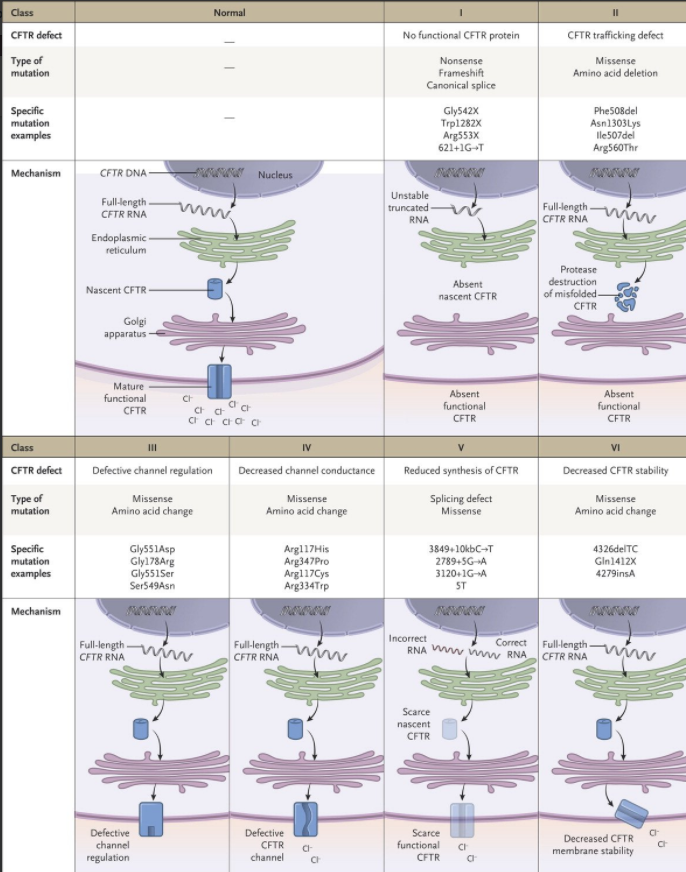
This figure depicts the types of molecular defects: No functional CFTR with framshifts for deletions or insertions (class 1), CFTR trafficking defect due to misfolded protein (class II), defective channel regulation (class III), reduced cholirde conductance (class IV) , reduced synthessis (class V) or decreased CFTR stability (class VI)

Projected Obesity Rates: Majority of Today’s Children Will Be Obese in U.S.

A recent study (ZJ Ward et al. NEJM 2017; 377: 2145-53) pooled observations from 41,567 children and adults.  They extrapolated this data to created 1000 virtual  populations of 1 million children through the age of 19 years.  They performed simulations to predict future obesity levels.

Key findings:

  • Given current levels of childhood obesity the authors predict 57.3% of today’s children will be obese at the age of 35 years.  They defined obesity for adults as BMI ≥35 and for children as 120% or more of the 95th percentile.
  • For children with severe obesity at age 2 years, approximately 80% will be obese at 35 years; whereas approximately 95% of severely obese 19 year olds will be obese at 35 years of age.
  • About half of the total prevalence of obesity at age 35 years begins in childhood in these models.

Because these are simulations, these projections could be influenced by changing circumstances.  Though, the authors note that these projections have corresponded well to measurable trends thus far in NHANES data.

My take: The increasing rates of obesity projected in these models will have profound effects for health but has implications for a wide range of issues: transportation, housing, social, etc.

South Kaibab Trail, Grand Canyon

Nonalcoholic Steatohepatitis Review

A concise and useful review of nonalcoholic steatohepatitis (NASH): AM Diehl, C Day. NEJM 2017; 377: 2063-72

A couple points:

  • About 25% of adults have fatty livers in the absence of excessive alcohol consumption
  • NASH is strongly associated with obesity/overweight which occur in  >80% of patients
  • NASH comorbidities in adults: 72% with dyslipidemia, 44% with type 2 diabetes mellitus
  • In a typical patient with NASH, liver fibrosis progresses “at a rate of approximately one stage per decade, suggesting that F2 fibrosis will progress to cirrhosis within 20 years.” However, there is considerable variability.
  • It is expected that NASH will be the leading reason for liver transplantation by 2020.
  • Cirrhosis related to NASH increases the risk of hepatocellular carcinoma with this occuring in 1-2% per year of patients with cirrhosis.
  • NASH is estimated to cost >$100 billion currently in annual direct medical costs
  • Staging of NASH and differentiation from isoloated steatosis identifies those at high risk for sequelae.
  • In Table 2, the authors list more than 10 pharmacologic agents in phase 2/3 studies

Current lifestyle treatment recommendations (for adults):

  • Lose 7% of body weight if overweight or obese
  • Limit consumption of fructose-enriched beverages
  • Limit consumption of alcohol (no more than 1 drink/day for women and 2 drinks/day for men)
  • Drink two or more cups of caffeinated coffee daily

Related blog entries:


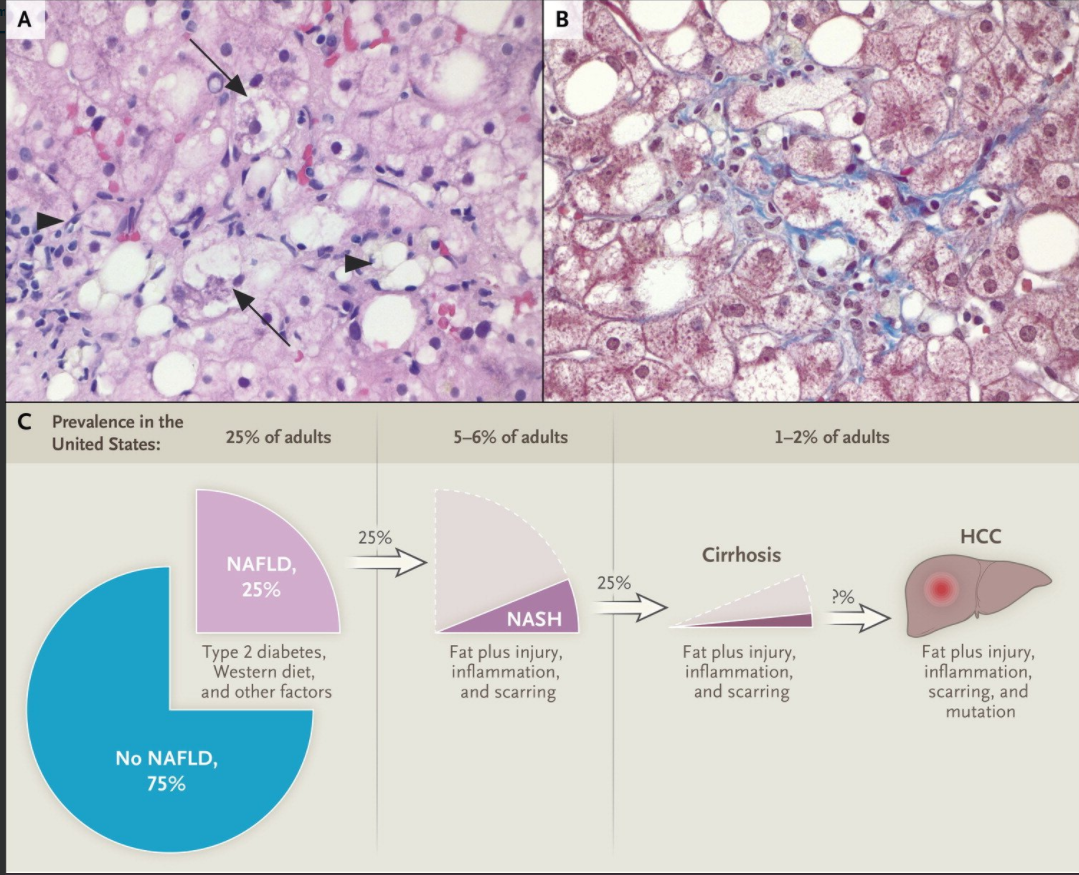
Panels A & B show typical histologic findings: ballooned hepatocytes (arrows), inflammatory infiltrates (arrowheads), and fibrosis Panel C shows the relative distribution of NASH, cirrhosis, and hepatocellular carcinoma in U.S. Adults.

Research for Fatty Liver Disease

Recently the AASLD Postgraduate Course discussed emerging treatments for nonalcoholic fatty liver disease/nonalchoholic steatohepatitis. From AASLD News: Emerging Treatments for NASH 

Key point:

  • Quentin Anstee: “It is important to remember that our patients with fatty liver disease will most likely die of cardiovascular disease, not liver disease.”

Four principles in treating nonalcoholic fatty liver disease (NAFLD) to address both cardiovascular and liver risks.

  • Target obesity with lifestyle changes and, possibly, bariatric surgery.
  • Target metabolic syndrome to reduce cardiovascular disease risk using medications with additional liver-directed benefits.
  • Target liver disease to prevent progression of steatohepatitis to fibrosis and cirrhosis.
  • Minimize downstream complications such as hepatocellular carcinoma.

More than 60 phase 3 trials are underway –Primary Therapeutic Targets:

  • PPAR signaling (insulin signaling, glucose and lipid metabolism, energy homeostasis, inflammation)
  • FXR signaling (insulin sensitivity, glucogenesis, lipogenesis)
  • ASK1 signaling (apoptosis)
  • CCR2/CCR5 signaling (inflammation and fibrogenesis).