“You Still Going to be Doing This?”

EJ Shapiro. NEJM 2025; 393: 1360-1361. “You Still Going to be Doing This?”

This commentary mirrored a lot of my recent experience. The author is startled at how patients are asking if he will still be taking care of patients in a few years and how he has enjoyed being a clinician.

Here is an excerpt:

At first, I was startled — I’d never seriously considered the timeline of my own career…Whether it was thanks to luck, sound reasoning, some resolution of my cognitive dissonance, or (least likely) an easy disposition, I mostly enjoyed the ride. Medical school flew by…every rotation opening a new world…As a resident, then a fellow, I learned the delicate balance between personal responsibility and teamwork required in caring for patients facing the range of problems…

Then…I …realized that my opinion — no discussion with the team, no attending cosignature, just mine alone — would guide this patient’s care… So many lives shared, some with laughter, less often with tears. Many of them I helped, and some I probably didn’t…

I realize the time has come to try to figure out the answer to, “Are you still going to be doing this?” But the decision doesn’t come easily. On a day-to-day basis, I love what I do, mostly because of the connections with those patients, and the nurses, techs, secretaries, medical assistants, and my partners (some of whom are now in my children’s age group). Also because medicine always changes and always fascinates.

Of course, prior authorizations, electronic medical record snafus, obtuse hospital administrators, and sometimes the clinical demands can feel oppressive… But… when I go into the exam room, close the door, greet the patient, and begin our visit, none of those structural irritants matter. We explore their situation and try to figure out how to move forward. The challenge and respect of that task never really pale…

Still, all the other passions, affections and hobbies, grandchildren, books, and mountains call out…And… I’d rather go when the reaction from the people left behind will be regret rather than relief…

I still have some things to consider before I put that full stop on my medical career, but maybe at some point the choice will become clear — like the one that long ago began it. Everything has its season.

My take: Though I am not ready to retire, I am getting the question from families about when I might and have started to think about the next season.

Related blog posts:

“Self-Portrait with Straw Hat” at the Metropolitan Museum of Art

Dr. Jim Squires: Practical Approach to Pediatric PSC and Pointers on Unconjugated Hyperbilirubinemia (Part 2)

Recently Dr. Squires gave our group an excellent lecture. I have taken some notes and shared some slides. There may be inadvertent omissions and mistakes in my notes.

  • Bilirubin is derived from the breakdown of red blood cells.
  • Each red blood cell contains approximately 250-300 million molecules of hemoglobin. Each molecule of hemoglobin can transport four oxygen molecule; thus a single RBC can carry one billion oxygen molecules
  • Unconjugated bilirubin binds to albumin and is taken into cell by OAT1B1 membrane transporter. Conjugation occurs in the endoplasmic reticulum.
  • Three main causes of indirect hyperbilirubinemia: defective bilirubin uptake, defective bilirubin conjugation, and hemolysis. In older patients, medications are another reason for indirect hyperbilirubinemia
  • Evaluation for hemolysis can include CBC, LDH, Haptoglobin, and retic count
  • Breastmilk jaundice (aka Lucey-Driscoll syndrome) is a different entity than “suboptimal intake jaundice” (aka breastfeeding jaundice). Suboptimal intake jaundice occurs in the fist week of life. Due to less intake, there are increased delays in meconium passage and increased reabsorption of bilirubin. Breastmilk jaundice which is much less common can result in very elevated indirect bilirubin levels.
  • With Gilbert, the molecular defect affects the promoter region of the UGT1A1 gene. Defects here are less critical than with Crigler-Najjar. For Gilbert’s, it is like there are fewer exits to reduce bilirubin. Whereas with severe forms of Crigler-Najjar, it is like all of the exits are blocked
  • Especially in the newborn period, very elevated unconjugated hyperbilirubinemia can result in kernicterus/severe neurologic sequelae. This can occur at older ages as well. The risk is related to the bilirubin to albumin ratio
  • For Crigler-Najjar, phototherapy is less effective with age and is associated with a reduction in the ratio of body surface area to plasma volume

Conclusions:

Related blog posts:

Dr. Jim Squires: Practical Approach to Pediatric PSC and Pointers on Unconjugated Hyperbilirubinemia (Part 1)

Recently Dr. Squires gave our group a terrific lecture. I have taken some notes and shared some slides. There may be inadvertent omissions and mistakes in my notes.

Key points:

  • 2023 AASLD Practice Guidance is very helpful and Dr. Squires considers its advice akin to a ‘North Star’
  • There are several etiologies for the sclerosing cholangitis phenotype – including primary disorders and secondary causes.
  • Pancolitis is most common presentation of IBD with PSC, often with rectal sparing and backwash ileitis
  • PSC often has subclinical inflammation and poor growth. PUCAI scores typically underestimate IBD activity
  • Diagnosis can be challenging – but often “I know it when I see it”
  • MMP-7 is still being studied as a biomarker. Thus far, it appears a little better than GGT and Alk phos as a marker for biliary injury
  • ERCP should be avoided as part of diagnostic workup but is important for therapeutic intervention

Deneau et al (Hepatology 2017; 66: 518) study wit 781 children has a wealth of information on natural history. In children, 38% developed portal HTN and 25% developed biliary complications over 10 years. However, once these complications developed, the need for transplantation develops more quickly. Median survival with native liver after the development of portal HTN was 2.8 yrs and it was 3.5 yrs after development of biliary strictures

  • Cholangiocarcinoma is rare in pediatrics ~1%
  • ASC (overlap of AIH and PSC) is fairly common in children and often a manifestation of early PSC. Many evolve to PSC without overlap features. Dr. Squires counsels families that most patients will need multiple biopsies to help determine need for ongoing immunosuppression
  • In patients with IBD, some liver test abnormalities and autoimmune features may be transient. Some watchful waiting may be beneficial prior to extensive evaluation
  • Multiple factors can predispose to PSC, including EBV infection which is associated with OR 12. Genetics, environment, immune dysregulation, toxic bile acids, microbiome, leaky gut/inflammation are additional factors
  • SCOPE is very useful prognostic tool
  • Ursodeoxycholic acid (UDCA) is a first line therapy. However, if no response to treatment, it is likely not beneficial
  • Oral vancomycin has not been proven to improve liver outcomes in PSC thus far (not recommended by AASLD 2023 Practice Guidance). However, further studies are ongoing and it has been associated with improvement in IBD activity

Related blog posts:

H Pylori Study Methods

In response to this morning’s post, 5 Rights and H pylori Treatment, one reader commented: “How often does the susceptibility test come back without a result? Unable to grow out pathogen?”

From the study senior author, Dr. Bonilla: “We ultimately partnered with a specialty lab, Mayo Laboratories, for our H pylori susceptibility testing.  Another important point is establishing clear communication with the lab. We now integrate results directly into EPIC so physicians see when a culture is positive and susceptibilities are pending. Final susceptibility reports often take 5–7 business days. In my experience, when we take the time to explain this to families, they are comfortable waiting in order to receive the most effective antibiotics. In the meantime, patients can start a PPI if needed for symptomatic relief.

At present, our culture growth rate is approximately 90%. For the remaining 10% without susceptibility results, we are working to implement a reflex molecular pathway using PCR for detection and, when positive, next-generation sequencing for susceptibilities on FFPE samples. We are also exploring the use of stool samples for the same molecular testing. Our goal is to ensure that all patients receive targeted, effective therapy even when culture is unsuccessful. Broader adoption of molecular techniques will be an important part of the future of pediatric H. pylori care. We are actively generating data to support clinical usefulness, expand access, and hopefully facilitate insurance coverage.”

Related blog post: How To Achieve Helicobacter Pylori Cure Rates of >95% (lists labs that run susceptibility testing)

Cherokee Trail, Stone Mountain Park, Stone Mountain, GA

5 Rights and H pylori Treatment

For medication administration, there are five “rights” that are needed for optimal results:

  • Right drug
  • Right dose
  • Right route (e.g., oral, intravenous, topical)
  • Right patient
  • Right time 

The recent article below highlights the fact that the “right drug” for H pylori can be dependent on resistance patterns. Previous articles (see below) have shown that the right dose is equally-important to improve cure rates.

C Chan et al. J Pediatr Gastroenterol Nutr. 2025;81:1133–1141. Antimicrobial susceptibility-guided treatment is superior to empiric therapy for Helicobacter pylori infection in children

Methods: Retrospective study with 218 children who had histologically-proven H pylori infection.  Susceptibility-guided treatment (SGT) was given to 123 and empiric therapy (ET) to 95. Testing for susceptibility was via a send-out assay to an outside specialty laboratory (Mayo Clinic Laboratories).

Key findings:

  • Eradication success was significantly higher in the SGT group (89.4%,110/121) compared to the ET group (70.2%, 66/94) (p < 0.001).
  •  Amoxicillin resistance was strongly associated with failure (27.3% vs. 0.9%, p = 0.002), as was dual clarithromycin-metronidazole resistance (36.4% vs. 8.2%, p = 0.018).

My take: This study shows the huge improvement when therapy is adjusted based on known susceptibility.

Related blog posts:

Amicalola Falls State Park

Also, more on changes to CDC website:

Benjamin Mazer, The Atlantic; 11/21/25: Open Access! Do Childhood Vaccines Cause Tornadoes? It hasn’t been ruled out (Related blog post: CDC Website Changed to Include False Claims About Autism and Vaccines)

Worrisome Report: PPI Use and Early Onset Colorectal Cancer

C Strong, ACG 10/28/25: Long-Term PPI Treatment Linked to Higher Risk for Early-Onset CRC Before Age 50

An excerpt:

“Long-term treatment with proton pump inhibitors (PPIs) is independently associated with an increased risk for early-onset colorectal cancer (EOCRC) among individuals aged younger than 50 years, according to study results presented at the American College of Gastroenterology (ACG) 2025 conference…”

“Researchers reviewed data from the National Inpatient Sample from 2016 to 2020. Individuals were aged 18 to 49 years and had a main diagnosis of colorectal cancer (CRC)…Investigators identified PPI exposure through diagnostic codes indicating long-term use (Z79.891) or adverse effects (T45.4X5A/D)….

“Of the 7140 hospitalizations for patients with EOCRC aged younger than 50 years, 1056 (14.8%) reported long-term PPI treatment. After multivariable adjustment, PPI users had a 41% increased risk for EOCRC vs individuals without PPI use (adjusted odds ratio [aOR], 1.41…”

My take: More studies will be needed to determine if this link between PPI use and early onset CRC is truly significant. Many prior associations between PPI and other health conditions on observational studies have not held up with well-controlled studies. There was no increased risk of cancer in a previous randomized control trial (see below).

Related blog posts:

Amicalola Falls State Park

CDC Website Changed to Include False Claims About Autism and Vaccines

11/20/25 AAP: AAP: ‘Stop wasting government resources to amplify false claims’ about vaccines, autism

An excerpt:


The AAP and more than 40 other medical, health and patient advocacy groups also issued a joint statement condemning the change and called on the CDC to “return to its long history of promoting evidence-based information.”

Potential links between vaccines and autism have been studied for decades. More than 40 high-quality studies in seven countries involving over 5.6 million people have found no connection.

“The conclusion is clear and unambiguous: There’s no link between vaccines and autism,” Dr. Kressly said. “Anyone repeating this harmful myth is misinformed or intentionally trying to mislead parents.”

Scientists believe there is no single root cause of autism. Interactions between genetic changes and environmental influences likely play a role, according to an AAP Fact Checked article. Improved awareness and screening and updated diagnostic criteria have contributed to increases in autism prevalence.

“At this point, it’s not about doing more studies. It’s about being willing to accept what the existing studies clearly show,” said Alison Singer, M.B.A., co-founder and president of the Autism Science Foundation.

She said spending more money on settled science takes funding away from research on genetics and services for autistic people. False claims further stigmatize autistic people and their families…

Sean T. O’Leary, M.D., M.P.H., FAAP, chair of the AAP Committee on Infectious Diseases, called the latest move to put misinformation on the trusted CDC website “madness” and “a tragic moment for this country” and said he does not blame the career CDC scientists.

“For many decades, we (could) rely on CDC to provide the American public with the best available science,” Dr. O’Leary said. “Now our government is using it as an apparatus to spread falsehoods and lies.”

Here is a screenshot on media coverage of this story:

Related blog posts:

Primary Sclerosing Cholangitis (PSC) – Medical Treatment, Therapeutic Window and Relationship to Colitis

A recent Hepatology issue with reviews on cholestatic diseases featured three articles focused on Primary Sclerosing Cholangitis (PSC). These in-depth reviews spanned ~60 pages with more than 500 references.

TH Karlsen et al. Hepatology 2025; 82: 927-948. Open Access! Medical treatment of primary sclerosing cholangitis: What have we learned and where are we going?

As an aside, all of the articles include a short AI-generated plain language summary. I am a little surprised that the journal put in a disclaimer for them: “Text is machine generated and may contain inaccuracies.” The authors and editors have the expertise to assure accuracy of the summary of their published article. (I am the one who needs a disclaimer.)

A Few Points:

  • “It has proven difficult to establish robust evidence for significant clinical benefits of medical treatment in primary sclerosing cholangitis (PSC). For ursodeoxycholic acid, clinical practice guidelines only offer vague recommendations”
  • “Norucholic acid (previously denominated nor-UDCA) is a side chain–shortened homologue of UDCA that has shown superior anticholestatic, anti-inflammatory, and antifibrotic properties compared to UDCA in animal models.9  In PSC, norucholic acid was compared to placebo in a randomized multicenter phase II trial that evaluated the safety and efficacy of 12 weeks of treatment with oral norucholic acid (500, 1000, or 1500 mg/d) compared with placebo.10 … Norucholic acid significantly reduced ALP values in all treatment arms compared to placebo, and the safety profile was comparable across groups…An ongoing phase III placebo-controlled study compares oral treatment with 1500 mg/d norucholic acid with placebo on PSC disease progression assessed by a decrease in ALP and liver histology as a combined primary endpoint (NCT03872921)”
  • Other therapies are reviewed in depth
  • LJ Horst et al. Hepatology 2025; 82: 960-984. Open Access! PSC and colitis: A complex relationship “The clinical phenotype, genetic, and intestinal microbiota associations strongly argue for PSC-IBD being a distinct form of IBD, existing alongside ulcerative colitis and Crohn’s disease. In fact, the liver itself could contribute to intestinal pathology, clinically overt in 60%–80% of patients. Recent studies suggested that on a molecular level, almost all people with PSC have underlying colitis…complex pathophysiological relationships, where factors such as genetic predisposition, changes in the intestinal microbiota, altered bile acid metabolism, and immune cell migration are among the suspected contributors.”

My take: These are good reviews that highlight how much we have learned about PSC but also details the challenges ahead.

Related blog posts:

Disclaimer: This blog, gutsandgrowth, assumes no responsibility for any use or operation of any method, product, instruction, concept or idea contained in the material herein or for any injury or damage to persons or property (whether products liability, negligence or otherwise) resulting from such use or operation. These blog posts are for educational purposes only. Specific dosing of medications (along with potential adverse effects) should be confirmed by prescribing physician.  Because of rapid advances in the medical sciences, the gutsandgrowth blog cautions that independent verification should be made of diagnosis and drug dosages. The reader is solely responsible for the conduct of any suggested test or procedure.  This content is not a substitute for medical advice, diagnosis or treatment provided by a qualified healthcare provider. Always seek the advice of your physician or other qualified health provider with any questions you may have regarding a condition.

Living-Donor Transplant Availability Lifts All Boats

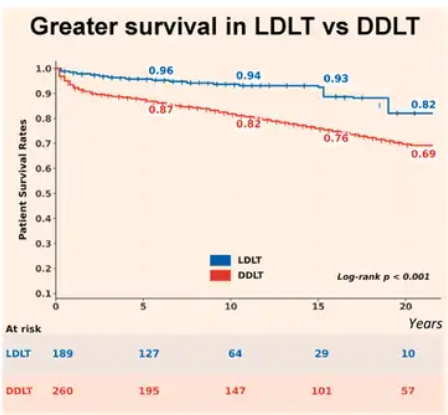
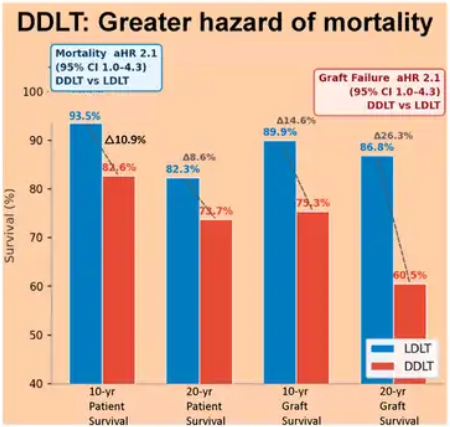
“A rising tide lifts all boats” has been used to express the sentiment that a good economy is beneficial to all. However, this has been criticized as not all boats are lifted equally and some boats are a lot nicer than others. I was thinking about this expression with these recent publications. The articles indicate that the availability of living donor liver transplant (LDLT) is clearly beneficial to the recipients but also is helpful, in a lesser way, to others on the transplant list as well.

Researchers analyzed data from 474 pediatric candidates listed for liver transplants at a single center from 2001 to 2023 (Toronto).

Key findings:

  • The pLDLT group had a higher likelihood of receiving a liver transplantation (adjusted HR: 1.38)  a lower risk of dying without a transplant (adjusted HR: 0.11)
  • Survival rates from the time of listing were significantly better in the pLDLT group compared to the pDDLT (on live donor) at 1—(98.6% vs. 87.6%), 5—(96.6% vs. 84.4%), and 10—(96.6% vs. 83.1%) years
  • Having a potential live donor was linked to a 72% reduction in mortality risk (adjusted HR: 0.28)
  • The waiting time for deceased donation shortened. This correlated with increased LDLT utilization, suggesting LDLT not only improved outcomes but also shortened wait times even for pDDLT patients

From the associated editorial:

  • “LDLT continues to be underutilized in the United States with only 15% of all pediatric LTs being LDLTs.1… In 2024, only 6 pediatric centers across the United States performed 5 or more LDLTs.6…”
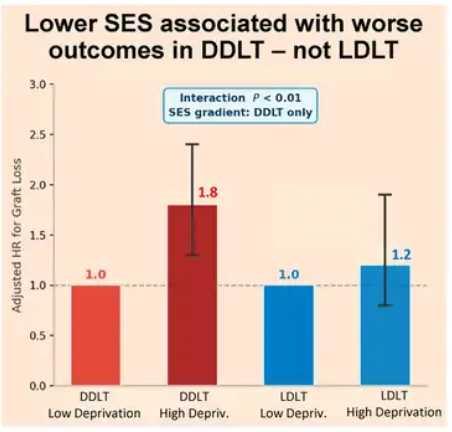
  • “Black and African-American and Hispanic candidates and those with public insurance are half as likely to undergo LDLT compared with Caucasian candidates and those with private insurance.7,8
  • “In a survey of over 200 parents of pediatric candidates and recipients of LT, only 72% reported knowing the steps to gain access to LDLT, and only 69% knew that donor costs were covered by the recipient’s insurance.7
  • The authors recommend collaboration between centers offering LDLT and those that don’t so that more patients could benefit

My take: More use of LDLT will result in better outcomes.

Related blog posts:

New Study: Mediterranean Diet for IBS

JO Bamidele et al. Annals Int Med 2025; https://doi.org/10.7326/ANNALS-25-015. The Mediterranean Diet for Irritable Bowel Syndrome: A Randomized Clinical Trial

Methods: Randomized noninferiority clinical trial (n=139 Adults from UK) — 6 weeks of the MD (Mediterranean diet) (n = 68) versus TDA (traditional diet advice) (n = 71).  Primary end point was the proportion achieving clinical response, defined as 50-point or greater reduction in IBS Symptom Severity Scale (IBS-SSS).

Traditional dietary advice’s main elements are to “adopt sensible eating habits
and avoid excess fatty foods, spicy foods, processed foods, caffeine, fizzy drinks, and alcohol. The principal components of the MD are a diet rich in fruit, vegetables,
pulses (aka legumes), whole grains, nuts, fish, and olive oil.”

Key findings:

  • The primary end point was met by 62% following a MD versus 42% following TDA (P = 0.017)
  • There was a greater reduction in the mean IBS-SSS after a MD than TDA (−101.2 vs. −64.5)

My take: I agree with the authors: The Mediterranean diet “represents a viable first-line dietary intervention for IBS.”

Related blog posts: