Pouchitis -Not So Rare in Patients with FAP

In their introduction (KP Quinn et al. Clin Gastroenterol Hepatol 2016; 14: 1296-1301), the authors state the following:  “Despite the widely held notion that pouchitis is a rare complication in FAP following IPAA, clinical experience at our institution suggests [it]…is underestimated.”

Methods: retrospective cohort study of all FAP patients who underwent IPAA (ileal ouch-anal anastomosis) from 1992-2015 at their institution (Mayo clinic), n=113.

Key findings:

  • 25 (22.1%) developed pouchitis with a mean time to pouchitis of 4.1 years.
  • Of the 25 who developed pouchitis, 72% had an acute course and 28% had a chronic course.

My take: While pouchitis does occur more commonly in IBD following IPAA, it does occur with FAP more frequently than previously described.

Related blog post:

funnycity-name

First-Hand Account: Living-Donor Liver Transplantation

From NY Times: Donating an Organ to My Son

An excerpt:

It has been a year and half since the surgery. Sammy looks great and is on minimal medication. He goes to school full time, and most people have no idea what he went through. The scar on his abdomen has mostly faded, and we aren’t sure if he even has any memories of this experience.

My liver has grown to full size and my scars are nearly invisible. But that doesn’t mean I am entirely recovered. There are moments, and they are less frequent and further between, that I get spontaneously choked up. This experience was both frightening and inspiring. I had to briefly give up being both doctor and a mother to become a patient. It was as a living donor that I was able to help my son the most.

Another comic account of living liver donation:

Chattahoochee River

Chattahoochee River

AAP Recommendations on Preventing Obesity and Eating Disorders

From AAP Committee on Nutrition, Pediatrics, August 2016Full text: Preventing Obesity and Eating Disorders in Adolescents

  1. Discourage dieting, skipping of meals, or the use of diet pills; instead, encourage and support the implementation of healthy eating and physical activity behaviors that can be maintained on an ongoing basis. The focus should be on healthy living and healthy habits rather than on weight.
  2. Promote a positive body image among adolescents. Do not encourage body dissatisfaction or focus on body dissatisfaction as a reason for dieting.
  3. Encourage more frequent family meals.
  4. Encourage families not to talk about weight but rather to talk about healthy eating and being active to stay healthy. Do more at home to facilitate healthy eating and physical activity.
  5. Inquire about a history of mistreatment or bullying in overweight and obese teenagers and address this issue with patients and their families.
  6. Carefully monitor weight loss in an adolescent who needs to lose weight to ensure the adolescent does not develop the medical complications of semistarvation.
Gardens at University of Virginia

Gardens at University of Virginia

Nonsteroidal Analgesics and Risk of Empyema

A recent study (M Le Bourgeois et al. J Pediatr 2016; 175: 47-53) from 15 medical centers in France showed an association between nonsteroidal anti-inflammatory drugs (NSAIDs) and the development of empyema.

Methods: a case-control design with 83 cases of children with empyema and recent acute viral infection (w/in 15 days) and 83 controls who had recent acute viral infection but no emyema. Age range: 3 months-15 years.  To ascertain the underlying initial viral etiology, the investigators utilized molecular techniques and identified respiratory viruses in about half of both groups of children.

Key finding: Exposure to NSAIDs was associated with a modest increase in the rate of empyema (aOR 2.79).  The risk of empyema associated with NSAIDs was diminished if the  child had been prescribed an antibiotic.

My take: This study, by minimizing confounding factors, suggests that the casual use of NSAIDs during acute viral illnesses increases the chance of developing empyema.


Grinnell Glacier, Glacier Nat'l Park

Grinnell Glacier, Glacier Nat’l Park


Magnetically Controlled Capsule Endoscopy

I’m not sure this will take off, but a recent study (Z Liao et al. Clin Gastroenterol Hepatol 2016; 14: 1266-73) showed the feasibility and accuracy of using a magnetically controlled capsule endoscopy (MCE) to detect diseases in the stomach with a high rate of accuracy.

This was a multicenter blinded study comparing MCE with conventional gastroscopy in 350 patients (mean age 46.6 years).  Technique: MCE system relied on a guidance robot with a C-arm.  The capsule could also be manipulated manually with a joystick.  Examinations took no longer than 30 minutes and required no sedation.  To improve visualization, a defoaming agent and pronase granules (to remove mucus) were given.  Also, if visualization was not adequate, the patient was instructed to infest water.

Key findings:

  • MCE detected lesions in the stomach with 90.4% sensitivity and 94.7% specificity.  The negative predictive values was 95.9%.
  • 110 (31.4%) patients who had MCE required endoscopic biopsies.

In patients capable of swallowing the capsule, MCE could allow very good inspection of the stomach without sedation and at much lower cost.  In adults, nearly a third would still need conventional gastroscopy to obtain biopsies and MCE would not be ideal for detecting duodenal diseases like celiac disease.

My take: I doubt MCE will be used much in this country anytime soon.

this is art?

this is art?

World Congress 2016 Postgraduate Course

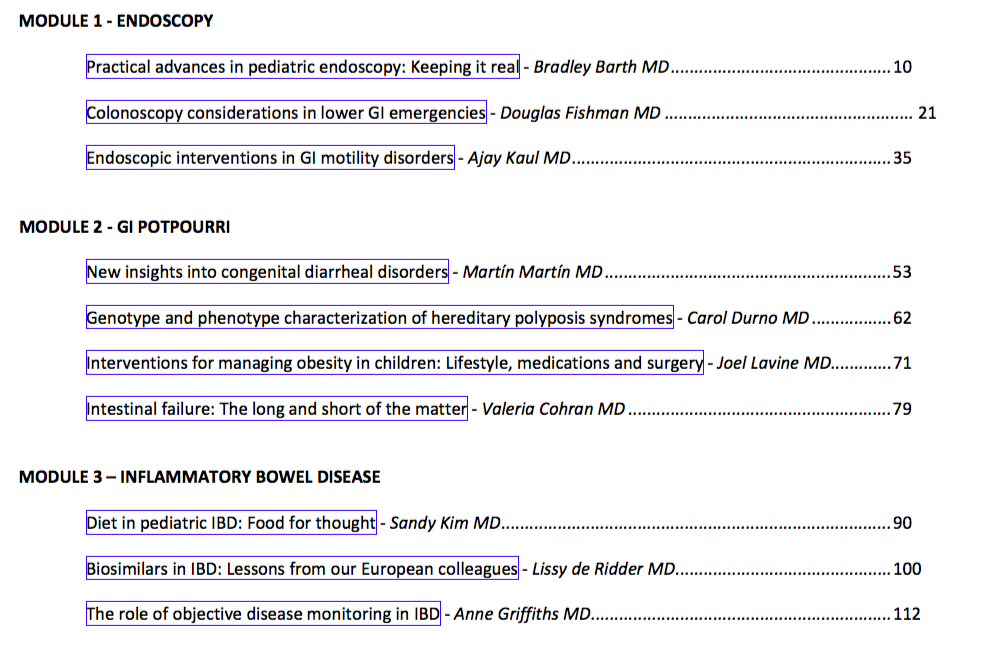
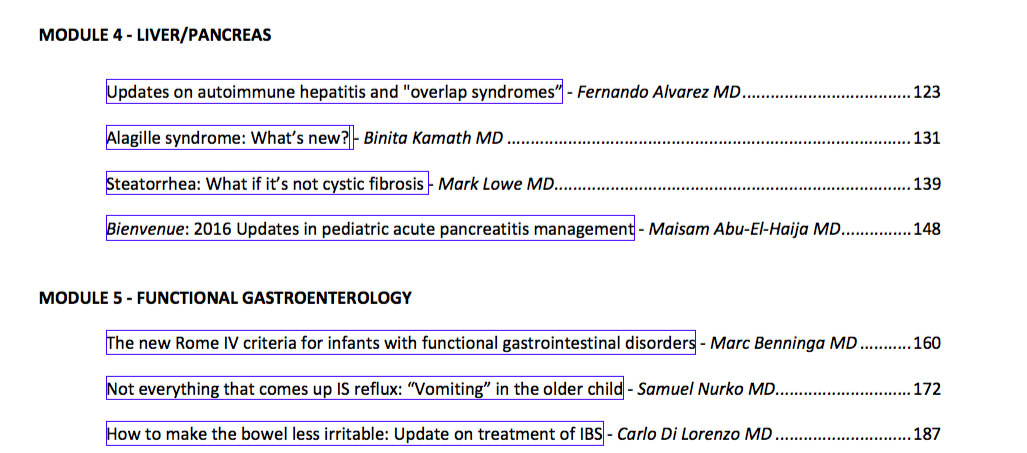
I’ve attached (with permission) the syllabus from the World Congress 2016 Postgraduate Course: 2016-world-congress-postgraduate-course-syllabus

screen-shot-2016-10-14-at-11-45-54-am

screen-shot-2016-10-14-at-11-46-04-am

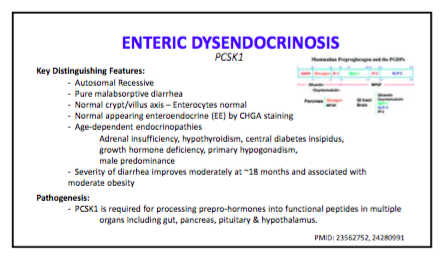
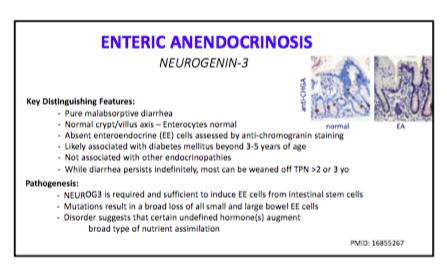
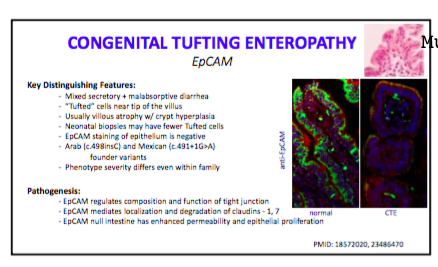
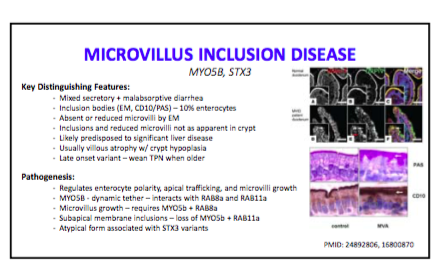
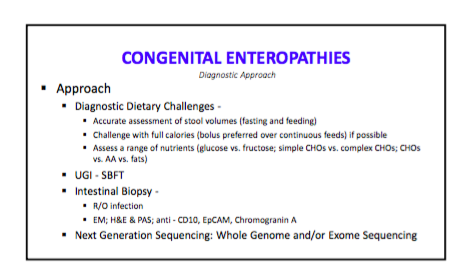
One lecture that I will highlight with a few slides is from Dr. Martin Martin (pg 53-62) which emphasizes a new model for evaluating neonatal intestinal failure/congenital diarrhea by using whole exome sequencing –see slides below.

Other pointers:

  • Pg 82.  Breastmilk associated with shorter duration of TPN dependence in short bowel syndrome
  • Pg 137. Look for vasculopathy (MRI/MRA) and renal disease in Alagille syndrome
  • Pg 152. Lactated ringer’s likely better in acute pancreatitis than normal saline.
  • Pg 171. If constipation at less than 1 year is untreated, >60% have issues with constipation at age 3.

screen-shot-2016-10-14-at-11-37-07-am screen-shot-2016-10-14-at-11-37-00-am screen-shot-2016-10-14-at-11-36-44-am screen-shot-2016-10-14-at-11-36-34-am screen-shot-2016-10-14-at-11-35-40-am


Disclaimer: These blog posts are for educational purposes only. Specific dosing of medications/diets (along with potential adverse effects) should be confirmed by prescribing physician/nutritionist.  This content is not a substitute for medical advice, diagnosis or treatment provided by a qualified healthcare provider. Always seek the advice of your physician or other qualified health provider with any questions you may have regarding a condition.

Total Pancreatectomy with Islet Autotransplantation for Refractory Recurrent Pancreatitis

A recent study (MD Bellin et al. Clin Gastroenterol Hepatol 2016; 14: 1317-23) describes the use of Total Pancreatectomy with Islet Autotransplantation (TPIAT) in 49 patients (mean age 32.8 years).  This study included 6 children.

All of these patients met strict criteria for recurrent acute pancreatitis and lacked imaging or functional evidence for chronic pancreatitis.  All 49 required narcotics for pain management prior to TPIAT.

The surgical technique for TPIAT is well-described in the report.  Patients underwent total pancreatectomy, splenectomy, cholecystectomy and partial duodenectomy with continuity restored via doudenoduodenostomy or Roux-en-Y duodenojejunostomy.  The islets were isolated and then infused intraportally.

Key findings:

  • At 1 year following TPIAT, 22 (46%) reported no use of narcotic pain medications.
  • Health-related quality of life scores improved (see Figure 3)
  • Diabetes is a common post-op concern.  Approximately half were insulin-independent at 1 and 2 years out from surgery, with one-third remaining so at 5 years.
  • Histopathology was consistent with chronic pancreatitis in 37 (76%) indicating that current imaging/functional features do not reliably identify chronic pancreatitis with adequate sensitivity.

In the discussion, the authors note the selected patients, due to having normal caliber pancreatitis ducts, were not candidates for surgical drainage procedures like the Puestow procedure.  They also note that the Puestow procedure can compromise later islet cell isolation.

My take: TPIAT is an important option in those with severe recurrent or persistent pancreatitis disease.

Related blog posts:

Quiet spot on Univ Virginia Grounds

Quiet spot on Univ Virginia Grounds

Smart Doctors Still Better Than Smartphones

The LA Times has reviewed a recent study: JAMA Intern Med. Published online October 10, 2016. doi:10.1001/jamainternmed.2016.6001

LA Times: Your phone may be smart, but your doctor still know more than an app

An excerpt:

In a head-to-head comparison, real human physicians outperformed a collection of 23 symptom-checker apps and websites by a margin of more than 2 to 1, according to a report published Monday in the journal JAMA Internal Medicine.

Even when the contestants got three chances to figure out what ailed a hypothetical patient, the diagnostic software lagged far behind actual doctors. Indeed, the apps and websites suggested the right diagnosis only slightly more than half of the time, the report says…

Though the humans trounced the computers across the board, there were situations in which doctors did a particularly good job of naming the correct diagnosis first. For instance, their margin in cases with common conditions was 70% to 38%. In cases with uncommon conditions, it grew to 76% to 28%.

My take:  According to the study, doctors still beat computer symptom algorithms.  But, there may be bias: “three of the study authors are doctors, and none are apps.”  At the same time, there is a likelihood of increased collaboration between physicians and computers.

NPR: Computerized Assistant for Cancer

screen-shot-2016-10-12-at-9-57-44-pm