Will Asymptomatic Patients with “Potential” Celiac Disease Benefit from a Gluten-free Diet?

A recent study (Volta et al. Clin Gastroenterol Hepatol 2016; 14: 686-93) indicates that those with “potential” celiac disease, who are asymptomatic, are unlikely to benefit from a gluten-free diet.  A useful summary is available on the AGA blog: What Happens to Patients with Markers of Celiac Disease but No Symptoms?

An excerpt:

Celiac disease is an immune-mediated gluten-dependent systemic disorder characterized by serologic and genetic factors and villous atrophy in the small intestine. Although some people test positive for antibodies and carry genetic alleles associated with celiac disease, they have relatively normal or slightly inflamed intestinal mucosa, with no or mild enteropathy. These patients are considered to have potential celiac disease (defined as increased serum levels of antibodies against tissue transglutaminase [tTG] without villous atrophy). They can have gastrointestinal and extra-intestinal symptoms or be completely asymptomatic…

To learn more about progression of potential celiac disease, Umberto Volta et al performed a prospective study to track clinical, serologic, and histologic features of 77 patients. The subjects had normal or slight inflammation of the small intestinal mucosa and were followed for 3 years.

Sixty-one patients had intestinal and extra-intestinal symptoms and 16 were completely asymptomatic at diagnosis…

Gluten withdrawal led to significant clinical improvement in all 61 symptomatic patients.

Of the 16 asymptomatic patients, who were left on the gluten-containing diets, only 1 developed mucosal flattening; levels of anti-endomysial and tTG antibodies fluctuated in 5 of these patients or became undetectable.

My take: In symptomatic patients (but not asymptomatic patients) with potential Celiac disease, a gluten-free diet may be worthwhile.

Related blog posts:

Mina Falls, El Junque

Mina Falls, El Junque

NY Times: “Never Diet Again”

A thought-provoking editorial from the NY Times provides a lot of reasons why dieting to lose weight may be counter-productive.  This editorial comes right after recent reports that many of the most successful “biggest losers” have regained their weight.  Here’s the link. Never Diet Again

Key points:

  • Dieting is not successful in adults, with less than 1% achieving long-term success
  • Our body’s neuroscience has a setpoint for normal weight and when we drop below this, our body deploys a number of mechanisms to regain weight
  • Dieting may result in long-term weight gain
  • Dieting may not improve health

Here a few excerpts:

Setpoint: “When dieters’ weight drops below it, they not only burn fewer calories but also produce more hunger-inducing hormones and find eating more rewarding.”

Diet industry: ” A report for members of the industry stated: “In 2002, 231 million Europeans attempted some form of diet. Of these only 1 percent will achieve permanent weight loss.”

Does dieting increase weight gain? “The causal relationship between diets and weight gain can also be tested by studying people with an external motivation to lose weight. Boxers and wrestlers who diet to qualify for their weight classes presumably have no particular genetic predisposition toward obesity. Yet a 2006 study found that elite athletes who competed for Finland in such weight-conscious sports were three times more likely to be obese by age 60 than their peers who competed in other sports.”

Obesity overrated as cause of mortality: “But our culture’s view of obesity as uniquely deadly is mistaken. Low fitness, smoking, high blood pressure, low income and loneliness are all better predictors of early death than obesity. Exercise is especially important: Data from a 2009 study showed that low fitness is responsible for 16 percent to 17 percent of deaths in the United States, while obesity accounts for only 2 percent to 3 percent, once fitness is factored out.”

My take: This short article explains quite well why obesity is so hard to treat with diet approaches.  Primary prevention of obesity at younger ages along with emphasis on staying active are likely to achieve more than focusing on diet alone.

University of Michigan, Law Quad

University of Michigan, Law Quad


538: Gut Science Week

While FiveThirtyEight garners a lot of attention for its political and sports forecasts, there are often health-related posts.  This week is devoted to Gut Science Week.

Here’s the link: Gut Science Week Introduction

Here’s an excerpt:

One of the major leaps forward in gut science began with an accidental shooting at a trading post on June 6, 1822. A fur trader named Alexis St. Martin took a bullet in the abdomen, leaving him with a hole ripped through his muscle, bone and internal organs…

His doctor, William Beaumont, could literally tie a bit of food on a string, shove it into St. Martin’s stomach through the hole, and pull it back out again. Using this one weird trick, Beaumont extracted samples of the man’s gastric juices. Over eight years and more than 200 awkwardly invasive experiments, St. Martin and Beaumont gave humanity its first real understanding of how digestion works.

Another post: Everybody is Constipated, Nobody is Constipated

Here’s an excerpt:

Doctors use diagnostic criteria for constipation, where patients have to experience two or more of six symptoms:

  1. Straining during at least 25 percent of defecations
  2. Lumpy or hard stools in at least 25 percent of defecations
  3. Sensation of incomplete evacuation in at least 25 percent of defecations
  4. Sense of obstruction in at least 25 percent of defecations
  5. Manual maneuvers needed to facilitate at least 25 percent of defecations
  6. Fewer than three defecations per week

And a video: What Your Poop Says About You — FiveThirtyEight

Gut Science Week --FiveThirtyEight

Gut Science Week –FiveThirtyEight

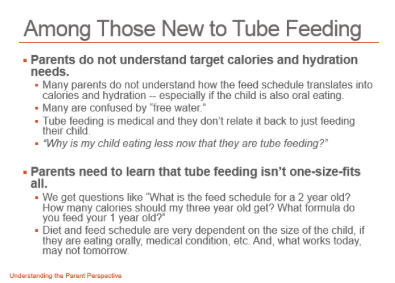
Parent Perspective, Pediatric Nutritionist and Traci Nagy

A recent post on The Pediatric Nutritionist blog (Kipp Ellsworth) provides a wealth of useful information for clinicians taking care of children with enteral tubes: Understanding the Parent Perspective: Communicating with Parents and Caregivers about Tube Feeding

The presentation was given by Traci Nagy who founded the FeedingTubeAwareness website, which I have been a big fan for several years.  I probably recommend this website at least once everyday at work.  Of course, I am not the only one familiar with this website which is why it has had more than 200,000 hits last year.

This post includes a 37 slide lecture and links to previous publications.  The “open letter number one” is particularly useful and is reviewed in the slide presentation.  The “open letter number two” also has some useful points, though many would disagree on the utility of testing gastric emptying before fundoplication.

My take: Look at this post -it will help you be a more effective clinician if you take care of kids with enteral tubes.

A few of the slides:

Screen Shot 2016-05-06 at 3.13.34 PM

Screen Shot 2016-05-06 at 3.28.53 PM Screen Shot 2016-05-06 at 3.27.36 PM Screen Shot 2016-05-06 at 3.27.24 PM

What Happened to Skepticism re: Lipid Emulsion Position Paper

A recent position paper (from ESPGHAN) (I Hojsak et al. JPGN 2016; 62: 776-92) made me wonder how different people can look at the same data and come to opposite conclusions.

In short, this article systemically reviews intravenous lipid emulsions and the risk of hepatotoxicity.  The review on the data is quite helpful.  The authors conclude that short-term use of the various emulsions currently in use do not result in a significant difference in neonates, infants and children.

The authors acknowledge that the data for long-term use of these emulsions is limited. They state that “there is evidence indicating that just tailoring and adjusting PN in children on long-term PN could improve liver disease, meaning that the focus should not only be on the type of ILE.”

“Although the quality of data are lacking there is some evidence that the use of multicomponent fish oil-containing ILE may contribute to a decrease” in liver toxicity.

What I don’t understand: The authors recommend: “it appears prudent to use multicomponent FO [fish oil]-containing ILE (GR C)” and literally the next sentence: “The present evidence base is inadequate to determine the optimal strategy for intravenous lipid supply.”

My take: I think we need to gather the data before having official position paper  recommendations.

Related blog posts:

2min warning doesn't help

Pacifiers & Reflux in Preterm Infants Plus Swallow Syncope

In a crossover study (J Pediatr 2016; 172: 205-8) with 30 preterm infants (adjusted age 33 weeks at time of study) showed that non-nutritive sucking with a pacifier had no effect on acid and nonacid gastroesophageal reflux based on esophageal pH-impedance.

My take: It is good that sucking a pacifier did not effect reflux.  What would the authors have proposed if it had?

Another curious report: “Syncope with Swallowing” J Pediatr 2016; 172: 209-11.  Case report of a teenager who had syncope with drinking and eating along with atrial septal defect; after repair of ASD, the symptoms persisted and ultimately the patient had a pacemaker placed due to an exaggerated vagoglossopharyngeal reflex leading to high-grade AV block.

Gibbs Gardens

Gibbs Gardens

Why a Diet History Can Be Helpful

A recent clinical problem-solving case report (D Hafez, et al. NEJM 2016; 374: 1369-74) highlights why a dietary history is important.  The initial paragraph indicated that a 2 year old with delayed speech and a picky eater presented with a 6 week history of progressive inability to bear weight.

The authors of this report explained the entire sequence of diagnosis which included extensive studies like bloodwork, radiographs, MRI, and bone marrow biopsy.  The last paragraph indicates that finally someone asked about the child’s diet: “approximately 1.4 liters of chocolate milk and ate two to four graham crackers per day. His mother acknowledged that these items were the mainstay of his diet.”

It turns out that the patient had vitamin C deficiency causing scurvy.  “Unfortunately, a comprehensive dietary review was performed only after an exhaustive and costly workup had been pursued.”  Personally, if I were involved in such a case, I would be embarrassed if it were published.

My take: While scurvy is interesting and rare in this country, the broader lesson of this report is to get a better dietary history before pursuing a huge workup.

Related blog posts:

Gibbs Gardens

Gibbs Gardens

What happens when anti-TNF therapy is stopped

Another study (NA Kennedy et al. Aliment Pharmacol Ther 2016; 43: 910-23) has examined the issue of outcomes after anti-TNF therapy withdrawal among patients with inflammatory bowel disease.

This study included 166 UK patient cohort (117 with Crohn’s disease [median 31 yrs], 19 with ulcerative colitis [median 40 years]) as part of a retrospective observational study and a meta-analysis incorporating 11 further cohorts totalling 746 patients (624 with Crohn’s dissease, 122 with ulcerative colitis).

Key findings:

  • In the UK cohort, relapse rates were 36% at year and 56% at 2 years for Crohn’s disease
  • In the UK cohort, relapse rates were 42% at year and 47% at 2 years for ulcerative colitis
  • Increased relapse rates were noted for those with a diagnosis prior to age 22 years (hazard ratio (HR) 2.78), calprotectin >50 mcg/g (HR 2.95).
  • In meta-analysis, 1-year relapse rates were 39% for CD and 35% for UC/IBDU patients
  • Retreatment with anti-TNF was successful in 88% for CD and 76% of UC/IBDU patients

To understand this study, it is important to note some of the study criteria.  In the UK cohort, inclusion criteria required the patient to have had at least 12 months of ant-TNF therapy and be in corticosteroid-remission for at least 6 months.  In addition, the relapse rate is likely to be underestimated due to using a definition of relapse that required either commencement of steroids, immunomodulator or anti-TNF therapy.  The meta-anlaysis cohort studies also used clinical relapse rather than endoscopic or other objective markers.

My take: Relapse of clinical symptoms occur in about 40% after withdrawal in highly-selected groups who were doing well prior.  Significantly higher rates of endoscopic relapse are likely.  This study provides strong reasons for not interrupting therapy when it is working.

Related blog posts:

Cures Tshirt


The “EAT” Study

A recent study from MR Perkin et al (NEJM 2016; 374: 1733-43) examined whether early introduction (3 months) of allergenic foods in 1303 infants lowered the rate of allergies to these foods at 3 years of life compared to standard introduction (after 6 months).  The six foods: peanut, egg, cow’s milk, sesame, whitefish, and wheat.

This EAT study (“Enquiring about Tolerance”) required parents in the intervention group to give 3 rounded teaspoons of smooth peanut butter, one small egg, two portions (40-60 g) of cow’s milk yogurt, 3 teaspoons of sesame paste, 24 g of white fish, and two wheat-based cereal biscuits every week.

While the study did not reach a statistical significance, the absolute rate of allergies was modestly lower in those in the early introduction group (5.6% compared with 7.1%).  In a per-protocol analysis of those who strictly adhered to the assigned treatment regimen, there was an even lower rate of 2.4% (compared to 7.3% in the standard group).  The associated editorial (pg 1783-84) indicates that the demanding protocol limited those who adhered to the protocol and points out that those who were not adherent could have been due to reverse causation (eg. subtle avoidance to certain foods due to reactions).  The editorial conclusion: “evidence is building that early consumption rather than delayed introduction of foods is likely to be more beneficial as a strategy for the primary prevention of food allergy.”

My take: Early introduction of allergenic solids at ~3 months of age probably lowers the risk of developing allergies to these foods.

Here’s a link to <2 minute quick take summary: The EAT Study NEJM

Screen Shot 2016-05-08 at 8.13.21 PM

Reference on consensus for guidance on introducing peanuts:  J Allergy Clin Immunol 2015; 136: 258-61.

Related blog posts:

Screen Shot 2016-05-04 at 8.23.59 PM

Antibiotic Overuse and Allergic Antibiotic Challenge

A recent study by Fleming-Dutra K et al (JAMA, May 2016), that has been widely reported, estimates that 1 in 3 antibiotic prescriptions in U.S. are unnecessary.  Here’s a CDC media release link: CDC: 1 in 3 antibiotic prescriptions unnecessary

“About 44 percent of outpatient antibiotic prescriptions are written to treat patients with acute respiratory conditions, such as sinus infections, middle ear infections, pharyngitis, viral upper respiratory infections (i.e., the common cold), bronchitis, bronchiolitis, asthma, allergies, influenza, and pneumonia.  An estimated half of these outpatient prescriptions are unnecessary.”

Some of the downside of unnecessary antibiotics:

  • Allergic reactions and other adverse reactions
  • Infections become more difficult to treat due to increased resistance
  • Expense
  • Clostridium difficile infection

My take: This study’s findings are NOT surprising.  Antibiotics are often prescribed without a clear indication.

Many children are labelled allergic to antibiotics like amoxicillin due to the development of a rash but have not undergone formal evaluation.  However, a recent study (Mill C et al. JAMA Pediatr 2016 Apr 4) shows that an oral provocative challenge that most will be able to tolerate amoxicillin.  Here is a summary of the article by DocAlert (forwarded to me by Mike Hart) -I highlighted in bold the key finding:

In an observational study, researchers offered a graded oral provocation test to all children referred to an allergy clinic in Montreal with suspected allergy to amoxicillin. Children were given 10% of the therapeutic dose of amoxicillin, observed for 20 minutes, then given 90% of the therapeutic dose and observed for at least 1 hour. Parents were instructed to report reactions that occurred the next week.

Of 818 participants (mean age, 1.7 years), 94% tolerated the provocation test and therefore were not allergic to amoxicillin. Of the others, 2% had immediate reactions (within 1 hour of the last dose) — all mild urticaria that resolved with antihistamines — and 4% had nonimmediate reactions (median of 12 hours after the last dose) — all mild maculopapular rash. Only 1 of the 17 children with immediate reactions tested positive on skin prick and intradermal testing 2 to 3 months later.

History of a rash lasting longer than 7 days and parental history of drug allergy were associated with nonimmediate reactions on the provocation test (adjusted odds ratios, 5 and 3, respectively); history of allergic reaction within 5 minutes was associated with immediate reactions (AOR, 10). During 3-year follow-up of children who tolerated the test, 55 received a subsequent full course of amoxicillin and 6 (11%) had nonimmediate reactions. All patients with reactions to amoxicillin tolerated cefixime.

My take (from summary): An oral provocation challenge to confirm either an immediate or nonimmediate allergic reaction to amoxicillin was found to be safe and more accurate than skin testing.

Screen Shot 2016-05-03 at 8.35.56 PM