Feeding Aversions -A Personal Journey

A terrific article in NY Times Magazine explains the difficulties of feeding aversions and describes some of the approaches, including feeding tubes and behavior feeding programs.

Link: When Your Baby Won’t Eat

For families struggling with feeding problems and for feeding programs, this article is well worth the read.

By the Chattahoochee

By the Chattahoochee

Emergency Medical Information -Easy Access on Your iPhone

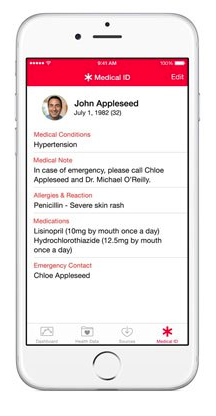
When I purchased a new iPhone, one of my sons was eager to show me all of the cool features.  If you do not have a teenager (i.e. house IT specialist) in the house, you may not have taken advantage of the health app built into the iPhone 6.  This can be very useful for you and your patients.

Screen Shot 2016-01-31 at 12.14.08 PM

One feature of the health app is that it allows you to store emergency contact information and health information that’s accessible from your device’s Lock screen. First responders or good Samaritans will be able to call the emergency contacts listed in Medical ID.  This health app also can function as an activity tracker.

Screen Shot 2016-01-31 at 12.12.38 PM

Here’s a link with additional information: How to set up your emergency medical ID

“Supplements and Safety”

There is a Frontline report (initially aired Jan 19th) on supplements.  A preview is available from the NY Times.

Supplements and Safety” –link includes a 5 minute video on fish oil. Here’s an excerpt:

The Frontline documentary investigates large outbreaks of disease tied to tainted vitamins and fat-burning supplements, including one case in which a workout supplement was linked to more than 70 cases of liver damage. The company whose products were at the center of that outbreak, USPlabs, is among 117 companies and individuals that the Justice Department filed criminal and civil enforcement actions against last year…

Despite their popularity, some studies have found that roughly three-quarters of fish oil supplements on the market do not contain the amount of omega-3 fatty acids advertised on their labels. Some have also found that fish oil supplements are prone to becoming rancid.

Fish oil supplements are widely marketed as beneficial to cardiovascular health. But the film points out that such claims are debatable at best. A majority of clinical trials have found no evidence that they protect against heart disease, according to a study published in JAMA Internal Medicine in 2014.

Related blog posts:

Mural in Old San Juan

Mural in Old San Juan

Systematic Review of Gluten Introduction

A recent systematic review/meta-analysis (MI Pinto-Sanchez et al. J Pediatr 2016; 168: 132-43) identified 15 eligible studies among an initial search of 1982 studies.

Key findings:

  • There was a 25% increase in celiac disease risk with late (>6 months) vs recommended (4-6 months) gluten introduction.
  • There was no significant effect of breastfeeding or not breastfeeding.

The authors state there is no evidence on whether early introduction (<4 months) of gluten would affect the risk of celiac disease.  Late introduction (>6 months) is associated with increase risk of celiac disease.

Related blog posts:

Isla Verde, San Juan

Isla Verde, San Juan

Piling on PPIs -Now Concerns about Dementia

A recent study (see abstract below -from Mike Hart) indicates the possibility that proton pump inhibitors (PPIs) could increase the risk of dementia to a small degree.  Despite the big numbers, this study cannot adequately control for numerous factors that could influence these results.  As is often said, association does not prove causation.  Nevertheless, this study is another reminder to use PPIs when indicated and to use them for the appropriate length of therapy.

Here’s NBC News Narrative: Popular Heartburn Drugs Linked to Dementia

ONLINE FIRST

Association of Proton Pump Inhibitors With Risk of Dementia: A Pharmacoepidemiological Claims Data Analysis

Willy Gomm, PhD1; Klaus von Holt, MD, PhD1; Friederike Thomé, MSc1; Karl Broich, MD2; Wolfgang Maier, MD1,3; Anne Fink, MSc1,4; Gabriele Doblhammer, PhD1,4,5,6; Britta Haenisch, PhD1

JAMA Neurol
. Published online February 15, 2016. doi:10.1001/jamaneurol.2015.4791
 
ABSTRACT

Importance  Medications that influence the risk of dementia in the elderly can be relevant for dementia prevention. Proton pump inhibitors (PPIs) are widely used for the treatment of gastrointestinal diseases but have also been shown to be potentially involved in cognitive decline.

Objective  To examine the association between the use of PPIs and the risk of incident dementia in the elderly.

Design, Setting, and Participants  We conducted a prospective cohort study using observational data from 2004 to 2011, derived from the largest German statutory health insurer, Allgemeine Ortskrankenkassen (AOK). Data on inpatient and outpatient diagnoses (coded by the German modification of the International Statistical Classification of Diseases and Related Health Problems, Tenth Revision) and drug prescriptions (categorized according to the Anatomical Therapeutic Chemical Classification System) were available on a quarterly basis. Data analysis was performed from August to November 2015.

Exposures  Prescription of omeprazole, pantoprazole, lansoprazole, esomeprazole, or rabeprazole.

Main Outcomes and Measures  The main outcome was a diagnosis of incident dementia coded by the German modification of the International Statistical Classification of Diseases and Related Health Problems, Tenth Revision. The association between PPI use and dementia was analyzed using time-dependent Cox regression. The model was adjusted for potential confounding factors, including age, sex, comorbidities, and polypharmacy.

Results  A total of 73 679 participants 75 years of age or older and free of dementia at baseline were analyzed. The patients receiving regular PPI medication (n = 2950; mean [SD] age, 83.8 [5.4] years; 77.9% female) had a significantly increased risk of incident dementia compared with the patients not receiving PPI medication (n = 70 729; mean [SD] age, 83.0 [5.6] years; 73.6% female) (hazard ratio, 1.44 [95% CI, 1.36-1.52]; P < .001).

Conclusions and Relevance  The avoidance of PPI medication may prevent the development of dementia. This finding is supported by recent pharmacoepidemiological analyses on primary data and is in line with mouse models in which the use of PPIs increased the levels of β-amyloid in the brains of mice. Randomized, prospective clinical trials are needed to examine this connection in more detail.

Related blog post: Proton Pump Inhibitors Webinar

Unrelated article (from Ben Gold): J Molina-Infante et al. Am J Gastroenterol 2015; 110: 1567-1575.  This study examined 75 patients (mean age 38 years) with proton-pump inhibitor responsive esophageal eosinophilia (PPI-REE).  55 (73%) had long-term sustained histologic remission with low-dose PPI therapy (20 mg once or twice daily). In addition, the article noted that 9 of 10 relapsers with distal eosinophilia were noted to have a CYP2C19 rapid metabolizer genotype and regained histologic remission with dose intensification.

Briefly noted: AI Sharara et al. Clin Gastroenterol Hepatol 2016; 14: 317-21.  Among 414 who met inclusion criteria (at least 6 months of PPI usage and at least 1 serum magnesium level), 57 (13.8%) had at least 1 low serum magnesium –44 of these patients had recognizable causes (eg. diuretics, chronic diarrhea).  Of the remainder who continued with PPI therapy, the level was normal at final measurement and only mildly low levels were noted previously.  Thus, in patients without other reasons for low magnesium, the authors found that use of a PPI does not appear to be associated with hypomagnesemia.

 

Trends in Non-medical Opiod Use and Heroin Addiction

Almost all physicians use opiods in their practice and need to keep up with the challenges of pain management and addiction.  An update on the problem of non-medical opiod use and heroin addiction from NEJM:

Full article link: Relationship between Nonmedical Prescription-Opiod Use and Heroin Use

An excerpt:

The transition from nonmedical use of prescription opioids to heroin use appears to be part of the progression of addiction in a subgroup of nonmedical users of prescription opioids, primarily among persons with frequent nonmedical use and those with prescription opioid abuse or dependence. Although some authors suggest that there is an association between policy-driven reductions in the availability of prescription opioids and increases in the rates of heroin use,16,18 the timing of these shifts, many of which began before policies were robustly implemented, makes a causal link unlikely…

In the majority of studies, the increase in the rates of heroin use preceded changes in prescription-opioid policies, and there is no consistent evidence of an association between the implementation of policies related to prescription opioids and increases in the rates of heroin use or deaths, although the data are relatively sparse. Alternatively, heroin market forces, including increased accessibility, reduced price, and high purity of heroin appear to be major drivers of the recent increases in rates of heroin use…

Fundamentally, prescription opioids and heroin are each elements of a larger epidemic of opioid-related disorders and death. Viewing them from a unified perspective is essential to improving public health. The perniciousness of this epidemic requires a multipronged interventional approach that engages all sectors of society.

Related blog posts:


Screen Shot 2016-01-14 at 8.01.08 PM


Guts and Valentines?

I learned this week that the Crohn’s & Colitis Foundation of America (CCFA) was founded in part  based on a love story:

From CCFA: Irwin M. Rosenthal, one of the visionary co–founders of CCFA, and Suzanne were due to be married in a few months time when suddenly Suzanne became very ill. Motivated by her struggle with Crohn’s disease, Irwin, along with William and Shelby Modell, and Dr. Henry D. Janowitz, established the Foundation for Research in Ileitis, now known as the Crohn’s & Colitis Foundation of America.

To send an CCFA eValentine: CCFA Valentine E-card

Screen Shot 2016-02-12 at 4.19.04 PM

What We Should Not Worry About

A few useful studies provide reassurances regarding exposures in the prenatal period and perinatal period that we should NOT worry about.

CN Bernstein et al. Clin Gastroenterol Hepatol 2016; 14: 50-7.

In this study with 1671 individuals with inflammatory bowel disease and 10,488 controls, “people with IBD were not more likely to have been born by cesarean section than controls or siblings without IBD.  These findings indicate that events of the immediate postpartum period that shape the developing intestinal microbiome do not affect risk for IBD.”

J Julvez et al. Am. J. Epidemiol. (2016) Full Text Link: doi: 10.1093/aje/kwv195. 

For parents of autistic kids who avoid fish, this article provides information indicating that this is counter-productive.  ” Seafood consumption during pregnancy is thought to be beneficial for child neuropsychological development, but to our knowledge no large cohort studies with high fatty fish consumption have analyzed the association by seafood subtype.” The authors “evaluated 1,892 and 1,589 mother-child pairs at the ages of 14 months and 5 years, respectively, in a population-based Spanish birth cohort established during 2004–2008…” Key finding: “Consumption of large fatty fish during pregnancy presents moderate child neuropsychological benefits, including improvements in cognitive functioning and some protection from autism-spectrum traits.”

My take: We often worry about the wrong things.  These articles provide reassurance that mode of birth and consumption of seafood during pregnancy are things we should not worry about.

Screen Shot 2016-01-30 at 3.22.06 PM