The Expanding Adalimumab Options

S White, R Morrow, I Pan, EF de Zoeten. JPGN 2023; 76: 701-703.
Riding the Wave of Adalimumab Biosimilars: Considerations for Pediatric Gastroenterologists

This article is a very handy update on approved adalimumab biosimilars, though even more biosimilars are expected to become available soon. The table below which is similar to a table in the article outlines the similarities and differences in these products compared to the reference product.

These biosimilars are FDA-approved for the treatment of adult and pediatric patients aged 6 and older with Crohn disease. “However, the biosimilar products are only approved for treatment of adult patients” (18 and older) with ulcerative colitis. “This may be due to the recent change in pediatric ulcerative colitis Humira FDA-approved dosing.”
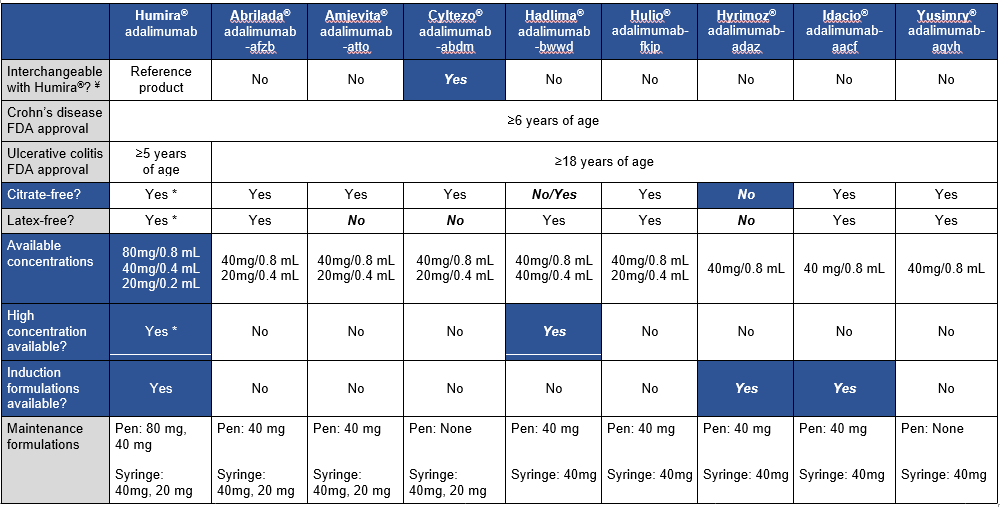
My take (borrowed in part from authors): Insurance coverage decisions are likely to overlook some of these factors which are very important for pediatric patients. “The adalimumab biosimilars will likely provide a clinically effective, cost saving option for our patients, but consideration of a number of factors will be key when selecting between” them.

Related posts:

Disclaimer: This blog, gutsandgrowth, assumes no responsibility for any use or operation of any method, product, instruction, concept or idea contained in the material herein or for any injury or damage to persons or property (whether products liability, negligence or otherwise) resulting from such use or operation. These blog posts are for educational purposes only. Specific dosing of medications (along with potential adverse effects) should be confirmed by prescribing physician.  Because of rapid advances in the medical sciences, the gutsandgrowth blog cautions that independent verification should be made of diagnosis and drug dosages. The reader is solely responsible for the conduct of any suggested test or procedure.  This content is not a substitute for medical advice, diagnosis or treatment provided by a qualified healthcare provider. Always seek the advice of your physician or other qualified health provider with any questions you may have regarding a condition.


Adalimumab Biosimilars on the Horizon (Finally) Plus Two Studies

GoodRx Health (Jan 3, 2023): Humira Biosimilar Boom: 8 Meds Launching in 2023 There are more than 17 billion reasons why there are 8 new adalimumab (Humira) biosimilars coming to the market.

Excerpts:

1. Amjevita

Amjevita (adalimumab-atto) will be available in prefilled autoinjector pens (40 mg) and prefilled syringes (20 mg, 40 mg). Amjevita products will come in low-concentration forms, but they will be citrate-free. It’s expected to launch on January 31, 2023.

2. Cyltezo

Cyltezo (adalimumab-adbm) became the first biosimilar to be designated as interchangeable with HumiraInterchangeable biosimilars go through additional studies to determine whether you can switch back and forth between the biosimilar and the original product without issues. Biosimilars without this designation haven’t gone through these same studies. 

Cyltezo will only be available in a prefilled syringe and will come in two doses: 20 mg and 40 mg. Both are low-concentration forms and citrate-free. Cyltezo is expected to launch in the U.S. as early as July 1, 2023.

3. Hyrimoz

Hyrimoz (adalimumab-adaz): a 40 mg dose will be available in both a pen and a syringe. A 10 mg syringe will also be available. Both are low-concentration forms. These products contain citric acid, which is closely related to citrate. Citric acid can also make injections more painful. A citrate-free high-concentration form of Hyrimoz is currently under FDA review. Hyrimoz is expected to launch in the U.S. on September 30, 2023.

4. Hadlima

Hadlima (adalimumab-bwwd) will be available in both an autoinjector and a syringe in a 40 mg dose. And it will come in both low- and high-concentration forms. The high-concentration form will be citrate-free. Hadlima is expected to launch in the U.S. on or after July 1, 2023.

5. Abrilada

Abrilada (adalimumab-afzb) will be available in a prefilled pen (40 mg) and in a syringe (10 mg, 20 mg, 40 mg). All Abrilada products will be low-concentration forms and citrate-free. Abrilada’s manufacturer has applied for interchangeable status with Humira. Abrilada is expected to launch in the U.S. as early as July 1, 2023.

6. Hulio

Hulio (adalimumab-fkjp) will be available in a prefilled pen (40 mg) and in a syringe (20 mg and 40 mg). All forms are low-concentration and citrate-free. Hulio is expected to launch in the U.S. on or after July 1, 2023.

7. Yusimry

Yusimry (adalimumab-aqvh) will only be available in a 40 mg prefilled syringe. It will be in a low-concentration form and citrate-free. Yusimry is expected to launch in the U.S. on or after July 1, 2023.

8. Idacio

Idacio (adalimumab-aacf) will be available in a 40 mg dose in both a pen and a syringe. Both forms will be low-concentration and citrate-free. Idacio is expected to launch in the U.S. as early as July 1, 2023.

My take: In high school, one of math teachers used to call me Hochman sub-1 and my twin brother Hochman sub-2. Perhaps, we can start designating biosimilars in a similar fashion?

Related blog posts:

Two other important studies I wanted to cite -both studies have Benjamin Gold, one of my better-known partners, as one of the authors:

  • KA Chien, C Thomas, V Cooley, T Weinstein, KF Murray, L Muir, C Hayes, BD Gold, LM Gerber, CG Sauer, G Tomer. JPGN 2023; 76: 25-32. Physician Burnout in Pediatric Gastroenterology In this survey with 408 responses (23% response rate), the authors found 29% reported high risk for emotional exhaustion, 18% reported high risk for depersonalization, and 33% reported overall burnout.
  • VC Cohran, BD Gold, DJ Spencer, CR Cole. JPGN 2022; 75: 689-691. Health Care Disparities in Gastroenterology: The Pediatric Gastroenterology Perspective This commentary reviewed survey results highlighting healthcare disparities which have been identified in IBD, NALFD, and liver transplantation. The authors outline some of the steps that NASPGHAN has taken as well as some of the work that is needed.

IBD Shorts: Pediatric Cost Savings with Biosimilars and Multiple Biosimilar Switch Data

GA Morris et al. Inflamm Bowel Dis 2022; 28: 531-538. Increasing Biosimilar Utilization at a Pediatric Inflammatory Bowel Disease Center and Associated Cost Savings: Show Me the Money

Key findings:

  • Biosimilar utilization initiation increased from a baseline of 1% in June 2019 to 96% by February 2021 among eligible patients; 20% of all patients (n-98) had insurance which preferred originator product
  • Estimated cost savings over the project duration were nearly $381,000 (average sales price) over the 20 month study

My take: The introduction of biosimilars have resulted in huge cost savings. In addition, for infliximab, the originator product price has also dropped substantially (more than 60% in some locations)

J Hanzel et al. Inflamm Bowel Dis 2022; 28: 495-501. Open Access: Multiple Switches From the Originator Infliximab to Biosimilars Is Effective and Safe in Inflammatory Bowel Disease: A Prospective Multicenter Cohort Study 

Methods: This was a prospective multicenter cohort study of adult IBD patients (n=176) who underwent 2 switches from the originator IFX to CT-P13 to SB2 (group 1), 1 switch from CT-P13 to SB2 (group 2), and 1 switch from the originator IFX to CT-P13 (group 3).

Key findings:

  • At 12 months after the most recent switch 76.9% (40 of 52, group 1), 65.7% (46 of 70, group 2) and 76.9% (20 of 26, group 3) of patients were in clinical remission. Treatment persistence at 12 months was 85.0%, 87.0%, and 70.1%, respectively.
  • There were no significant differences in the rate of clinical, CRP, FC remission, or treatment persistence at 12 months between the 3 groups.

My take: This study did not identify detrimental effects from multiple successive switching and switching between biosimilars of IFX. Longer followup and more clinical experience will be needed to confirm these findings.

Nonmedical Adalimumab Switches

G Tapete et al. Inflamm Bowel Dis 2022; 28: 62-69. Effectiveness and Safety of Nonmedical Switch From Adalimumab Originator to SB5 Biosimilar in Patients With Inflammatory Bowel Diseases: Twelve-Month Follow-Up From the TABLET Registry

Methods: Prospective enrollment (n=146) included a ADA and those with a nonmedical switch from the ADA originator (n=98). Clinical remission and safety were assessed at baseline and at 3, 6, and 12 months

Key finding:

  • In the naïve cohort, the overall remission rate at 12 months was 60% (similar to originator adalimumab results); the remission rate in the switching cohort it was 75% with a treatment persistency of 82% at 12 months after the switch
  • No differences were found in terms of ADA serum trough levels at baseline, 3, and 6 months after switching. No patient developed antidrug antibodies after the switch
  • Fecal calprotectin (FC) values trended lower in both cohorts. In the naive cohort, the mean value of FC dropped from 665 (baseline) to 231 at 12 months. In the switch cohort, the mean value of FC dropped from 212 (baseline) to 84 at 12 months

My take: In this cohort, SB5 biosimilar for adalimumab was effective and safe.

Related blog posts:

IBD Shorts: Fecal Calprotectin in UC & Medication Withdrawal, Outcome of Biosimilar Reverse Switches, Vedolizumab after Anti-TNF Therapy

TW Stevens et al. Inflamm Bowel Dis 2021; 19: 2333-2342. Open Access. Diagnostic Accuracy of Fecal Calprotectin Concentration in Evaluating Therapeutic Outcomes of Patients With Ulcerative Colitis

Key finding: A post hoc analysis of data from a phase 4 trial (the MOMENTUM trial) found that, even in patients (n=593 at week 8, n=305 at week 52) with complete endoscopic healing of UC, FC concentration can be used to discriminate patients with ongoing microscopic inflammation from patients with histologic remission.  The optimal FC cut-off concentrations for identification of patients with histologic remission were 75 μg/g at week 8 and 99 μg/g at week 52.

A Cassinotti et al. Clin Gastroenterol Hepatol 2021; 19: 2293-2301. Noninvasive Monitoring After Azathioprine Withdrawal in Patients With Inflammatory Bowel Disease in Deep Remission

Key finding: In this prospective study, 57 patients in deep remission stopped azathioprine after a median of 7 years. 26 (46%) relapsed within a median of 15 months. Fecal calprotectin (FC) levels were >50 mcg/g in all patients with relapse (FC specificity 100%) but the sensitivity was only 50%. Thus, having a normal FC does not preclude relapse but elevated FC is associated with relapse.

S Mahmmod et al. Inflamm Bowel Dis 2021; 27: 1954-1962. Outcome of Reverse Switching From CT-P13 to Originator Infliximab in Patients With Inflammatory Bowel Disease

In this retrospective study, 75 patients, 9.9% of all patients, who had been changed from originator infliximab to a biosimilar had clinical worsening. Key finding: Improvement of reported symptoms was seen in 73.3% of patients after reverse switching back to originator infliximab; alsor 7 out of 9 patients (77.8%) with loss of response regained response

J Kim et al. Inflamm Bowel Dis 2021; 27: 1931-1941. Clinical Outcomes and Response Predictors of Vedolizumab Induction Treatment for Korean Patients With Inflammatory Bowel Diseases Who Failed Anti-TNF Therapy: A KASID Prospective Multicenter Cohort Study

Key finding: Clinical remission rates with vedolizumab among patients with CD (n=80) and patients with UC (n=78) were 44.1% and 44.0%. Among patients with UC, the endoscopic remission rate was 32.4%

What Happens With Double Switches of Infliximab Products

N Trystram et al. Alimentary Pharmacology & Therapeutics, 01 Mar 2021, 53(8):887-899 Outcomes after double switching from originator Infliximab to biosimilar CT-P13 and biosimilar SB2 in patients with inflammatory bowel disease: a 12-month prospective cohort study.

Key findings:

  • Drug persistence was high (94.9%) after 54 weeks in cohort of 158 patients
  • Double switching from the originator Infliximab to CT-P13 and then to SB2 was associated with continued effectiveness; this study did not identify issues related to immunogenicity or safety of anti-TNF therapy after 54 weeks of follow-up.

My take: There is very limited data on repeated infliximab product changes; this small study did not identify any problems. Due to mandates from insurance, more frequent switching is likely to be more widespread and more definitive outcome data will emerge.

Abstract:

Related blog posts:

IBD Pediatric Costs & Cannabis Still No Data for IBD

Happy birthday to my favorite follower!!!


A recent single-center study (AW Fondell et al. Inflamm Bowel Dis 2020; 26: 635-40, editorial by Joel Rosh, 641-2) examined the first-year costs of children with inflammatory bowel disease (IBD) in 2016.  There were 67 patients (43 with Crohn’s disease (CD), and 24 with ulcerative colitis (UC)).

Key findings:

  • Mean cost was $45,753; $43,095 for CD, $50,516 for UC
  • Severe CD (n=11) was $71,176 and severe UC (n=5) was $134,178; it is notable that only one patient with CD had surgery and only one patient with UC had surgery.
  • Overall cost distribution: 37% from infusion costs, 25% hospital costs, 18% outpatient procedures, 10% outpatient oral medications, 7% outpatient imaging and 3% outpatient visits.
  • 69% of CD patients and 33% of UC patients received biologics
  • 21% (n=9) of CD patients and 45% (n=11) of UC patients were hospitalized
  • Private payer reimbursement was a mean of $51,269 compared to $24,610 mean for Medicaid.

Limitations: 

  • In any cost analysis, many assumptions are needed.  For medications, for example, the author used pharmaceutical retail prices.  The actual costs are near-impossible to calculate as every insurance policy and every hospital system has a multitude of charges based on proprietary negotiations.
  • While this data comes from a referral center, all of the patients in the study were from Connecticut.

Due to the expense of care, Dr. Rosh points out that many insurers have often mandated the use of “standard dosing” of biologic therapy, “ignoring that robust data” indicate that this dosing is “the exception rather than the rule in pediatric IBD patients.”  These type of short-sighted interventions could affect long-term medical outcomes.

My take: There clearly are areas where costs can be reduced (eg. lower infusion costs, lower endoscopy costs, biosimilars).  However, no amount of cost cutting will change the conclusion that good care for IBD is expensive.

Briefly noted: TS Kafil et al. Inflamm Bowel Dis 2020; 26: 502-9.   This study examined evidence for cannabis effectiveness in IBD.  After performing a literature search, the authors could only identify five randomized controlled trials (n=185).  Each study used different doses, formulations and routes of administration.  No studies evaluated maintenance treatment and relapse in CD or UC.  Findings: “no firm conclusions can be made regarding the safety and effectiveness of cannabis and cannabionoids in adults with CD and UC.”

Related blog posts:


Cobb County -Concord Covered Bridge Historic District


IBD Briefs: May 2019 (Part 2)

KP Quinn et la. Inflamm Bowel Dis 2019; 25: 460-71.  This is a terrific review of evaluation and management of pouch disorders.

A Armuzzi et al. Inflamm Bowel Dis 2019; 25: 568-79. This prospective cohort study examined infliximab biosimilar in 810 patients (PROSIT cohort).  This included 459 patients naive to anti-TNF therapy (group a) , 196 with previous exposure (group b), and 155 who were switched while on original infliximab (group c).  At 12 months, patients without a loss of response were 71%, 64%, and 82% respectively in these three groups.

S Coward et al Gastroenterol 2019; 156: 1345-53. This study from Canada used population-based health administrative data from multiple provinces and then applied autoregressive integrated moving average regression to predict prevalence of IBD in 2030. Key point: “In 2018, 267,983 Canadians were estimated to be living with IBD, which was forecasted to increase to 402,853 by 2030.” This is approximately 1% of the population (981 per 100,000).

F Castiglione et al. Aliment Pharm Ther 2019; 49: 1026-39. This observational longitudinal study with 218 patients with Crohn’s disease who completed 2-years of anti-TNF treatment examined transmural healing via ultrasonography (≤3 mm bowel wall thickness).  “Transmural healing was associated with a higher rate of steroid-free clinical remission (95.6%), lower rates of hospitalization (8.8%) and need for surgery 0%).”  The authors conclude that transmural healing is associated with better long-term clinical outcomes than mucosal healing.

“Magic Fountain” Barcelona


IBD Update March 2019

Briefly noted:

W El-Matary et al. Inflamm Bowel Dis 2019; 25: 150-5. This retrospective study of 667 children with Crohn’s disease who were prospectively enrolled in an inception study found that 85 (12.7%) had fistulizing perianal disease. The mean infliximab (pre-fourth dose) was 12.7 mcg/mL in responders compared with 5.4 mcg/mL in the active disease group.  My take: Higher trough levels are desirable in those with fistulizing disease.

LJT Smits et al. Inflamm Bowel Dis 2019; 25: 172-9. In a  prospective cohort with 83 patients with IBD (57 with Crohn’s disease) with at least 2 years of followup, 66% of IBD patients continued CT-P13 after switching from Remicade; two patients developed anti-drug antibodies.  The absolute numbers suggest no adverse impact of a single switch to the biosimilar product.

Related blog posts:

A Tinsley et al. Inflamm Bowel Dis 2019; 25: 369-76. This study documents the increased risk of influenza and increased influenza complications among IBD patients based on a database cohort of 140,480 patients (with and without IBD). The risk of hospitalization was 5.4% in patients with IBD compared with 1.85% in non-IBD patients.

Related blog post: Almost Everybody Needs Flu Shot -IBD Patients at Higher Risk

YY Xu et al. Inflamm Bowel Dis 2019; 25: 261-9. This meta-analysis included 18 nonrandomized controlled trial studies with 1407 patients who received preoperative infliximab and 4589 patients.  The authors showed that preoperative infliximab was not associated with any statistically significant differences for the 2 groups for any complications, reoperation, readmission or mortality.

CN Bernstein et alInflamm Bowel Dis 2019; 25: 360-8. This study, using population-based administrative health data (Manitoba) found increased burden of psychiatric disorders in IBD: compared with controls the incidence rate ratio for depression was 1.58, for anxiety 1.39, for bipolar disorder 1.82, and for schizophrenia 1.64.

Related blog post: #NASPGHAN17 Psychosocial Problems in Adolescents with IBD

View from Ryan Mountain, Joshua Tree National Park

ESPGHAN Position Paper: Biosimilars in Pediatric Inflammatory Bowel Disease

A recent position paper from ESPGHAN/Porto Group:

Full text: Use of Biosimilars in Pediatric Inflammatory Bowel Disease: An Updated Position Statement of the Pediatric IBD Porto Group of ESPGHAN. L de Riddler et al. JPGN 2019; 68: 144-53

Key points:

  • There are sufficient data (by extrapolation from different indications, adult data and limited pediatric data) to state that in children with IBD who are indicated for IFX treatment, CT-P13 is a safe and efficacious alternative to the originator IFX for
    induction, and maintenance, of remission. 97% agreement
  • A switch from the originator infliximab to CT-P13 may be considered in children with IBD in clinical remission, following at least 3 induction infusions. 84% agreement
  • Multiple switches (>1 switch) between biosimilars and reference drug or various biosimilars are not recommended in children with IBD, as data on interchangeability is limited and traceability of the drugs in case of loss of efficacy and/or safety signals may be compromised. 97% agreement
  • Physicians/institutions should keep records of brands and batch numbers of all biological medicines (including biosimilars) administered. 89% agreement

Related blog posts:

Disclaimer: These blog posts are for educational purposes only. Specific dosing of medications/diets (along with potential adverse effects) should be confirmed by prescribing physician/nutritionist.  This content is not a substitute for medical advice, diagnosis or treatment provided by a qualified healthcare provider. Always seek the advice of your physician or other qualified health provider with any questions you may have regarding a condition.