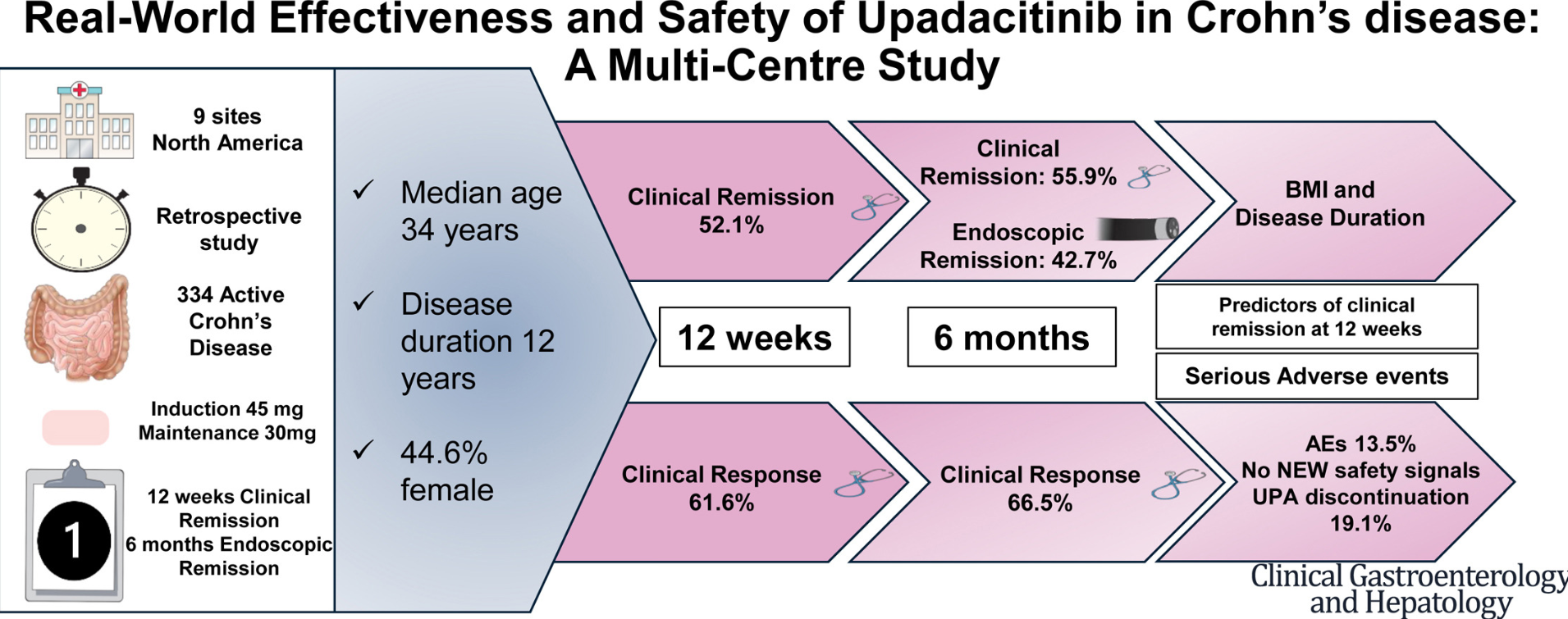
Methods: Clinical responders to 12 weeks of upadacitinib 45 mg once daily (QD) induction were randomized (1:1:1) to receive upadacitinib 15 mg QD (n = 221), upadacitinib 30 mg QD (n = 229), or placebo (n = 223) as maintenance therapy for 52 weeks
**This study presents data from the entire cohort (n=673); a previous report from ENDURE-3 analyzed data on 502 patients (though findings were nearly identical). EV Loftus et al. N Engl J Med 2023; 388:1966-1980 (Related post: Landmark Study: Oral Biologic for Crohn’s –Upadacitinib)
Key findings:
At week 52, more upadacitinib-treated vs placebo patients achieved CDAI clinical remission (upadacitinib 15 mg, 36.2% and upadacitinib 30 mg, 51.5% vs placebo, 15.2%)
The rates of endoscopic response were 27.3% for upadacitinib 15 mg and 40.7% for upadacitinib 30 mg vs 7.2% for placebo
Herpes zoster infections occurred more frequently in the upadacitinib groups compared with placebo; all were nonserious, and most involved a single dermatome
In U-ENDURE, no dose-dependent risk for MACE, VTE, or malignancy (excluding NMSC) was observed during the 52-week maintenance period
My take: Upadacitinib is a effective in a good number of patients with with moderately to severely active Crohn’s disease who have been refractory to other advanced therapies.
This recent commentary on the all-subcutaneous induction and maintenance treatment with guselkumab, an anti-IL23 agent, reviewed the GRAVITI study. Related post: Guselkumab for Crohn’s Disease: Pivotal GRAVITI Study
However, what captured my attention was the last sentence: “The convenience of subcutaneous induction enhances patient friendliness, positioning guselkumab as a strong market contender. Could an oral anti–IL-23 formulation be the next game changer?14“
“Johnson & Johnson (NYSE: JNJ) today announced positive topline results from ANTHEM-UC, a Phase 2b study of icotrokinra (JNJ-2113), the first investigational targeted oral peptide that selectively blocks the IL-23 receptor, in adults with moderately to severely active ulcerative colitis (UC)…
In the ANTHEM-UC study (n=252), three doses of once daily icotrokinra were tested with all meeting the primary endpoint of clinical response at Week 12. A response rate of 63.5% for patients treated with the highest dose of icotrokinra was achieved at Week 12 versus 27% for placebo (p<0.001). Further, 30.2% of patients treated with the highest dose of icotrokinra demonstrated clinical remission at Week 12 versus 11.1% of patients who received placebo (p<0.01). Remission and response rates continued to improve through Week 28.
Clinical response is defined as decrease from baseline in the modified Mayo score by greater than or equal to (>=) 30 percent (%) and >=2 points, with either a >=1-point decrease from baseline in the rectal bleeding subscore or a rectal bleeding subscore of 0 or 1.
Clinical remission is defined as a Mayo stool frequency subscore of 0 or 1 and not increased from induction baseline, a Mayo rectal bleeding subscore of 0, and a Mayo endoscopy subscore of 0 or 1 with no friability present on the endoscopy.”
My take: It would be terrific for patients with inflammatory bowel disease (and other immune-mediated diseases) to have another excellent oral therapy. A prior study of plaque psoriasis indicated that an oral IL-23 medication is feasible (Related post: In Trials: An Oral IL-23 Antagonist Peptide).
Related joke (regarding “caught my eye” in the title of this post):
A man who lived in a block of apartments thought it was raining and put his head out the window to check. As he did so a glass eye fell into his hand. He looked up to see where it came from in time to see a young woman looking down. “Is this yours?” he asked.
She said, “Yes, could you bring it up?” and the man agreed. On arrival she was profuse in her thanks and offered the man a drink. Shortly afterwards she said, “I’m about to have dinner. There’s plenty; would you like to join me?” He readily accepted her offer and both enjoyed a lovely meal. As the evening was drawing to a close the lady said, “I’ve had a marvelous evening. Would you like to stay the night?” The man hesitated then said, “Do you act like this with every man you meet?”
“No,” she replied, “only those who catch my eye.”
The Manneporte by Claude Monet (at the Metropolitan Museum of Art)
I was recently listening to a radio program (On Point) about the beneficial effects of sunlight.
The program notes that the potential beneficial effects of sunlight are much greater than the risks. Increased sunlight has been associated with lower rates of death, as well as lower rates of cardiovascular disease and autoimmune conditions like multiple sclerosis, type 1 diabetes, and Crohn’s disease.
When dermatologists recommend avoiding sunlight, they may be focused on the risks but not the benefits (though this varies among individuals). In addition, despite the more than 5-fold rise of melanoma diagnosis (especially in wealthy communities), there has not been a change in the rate of deaths due to melanoma. Skin cancers associated with sun exposure are mainly basal cell tumors and squamous cell tumors. These non-melanoma skin cancers have excellent survival rates.
Here is a link: The Healing Power of Sunlight (48 minutes) The most important part of this is in the middle, starting around 20 minutes.
My take: It’s a good idea to avoid sunburns but getting sunshine is good for health.
Related article:
Environ Epidemiol 2025. 9(3):e401. doi: 10.1097/EE9.0000000000000401. The association between time spent outdoors during daylight and mortality among participants of the Adventist Health Study 2 Cohort. Conclusion: “Moderate time outdoors in daylight during warmer months could be associated with lower risks of all-cause, CVD, and noncancer non-CVD mortality”
Methods: “GALAXI-2 and GALAXI-3 were identically designed, phase 3, randomised, double-blind, triple-dummy, treat-through trials with active and placebo comparators…1048 participants were randomly assigned, treated, and followed up until week 48, of whom 1021 participants were included in the primary analysis population: 508 (49·8%) in GALAXI-2 and 513 (50·2%) in GALAXI-3.” The studies enrolled adult patients with moderately to severely active Crohn’s disease.
Key findings:
Discussion points:
“Guselkumab treatment in participants with moderately to severely active Crohn’s disease was also evaluated in the GRAVITI study, which had a fully subcutaneous induction and maintenance treatment regimen. Clinical and endoscopic outcomes reported with subcutaneous guselkumab induction in the GRAVITI study were similar to those in the phase 3 GALAXI studies following intravenous guselkumab induction.”
“The incidence of adverse events with guselkumab during induction was low and similar to placebo.”
My take(borrowed from authors): In GALAXI-2 and GALAXI-3, both guselkumab dose regimens (each including intravenous induction and subcutaneous maintenance) were superior to placebo for short-term (week 12) and long-term (week 48) endpoints and both guselkumab dose regimens were also superior to ustekinumab
From editorial (which is more expansive than the study):
Kappelman et al4 report the US prevalence of pediatric-onset IBD (diagnosed before the age of 20 years by a physician) as well as rates of disease based on race and ethnic background. To ensure that a representative population was captured, they combined multiple health administrative databases…
The authors report that the US currently has a pediatric IBD prevalence of 125 per 100,000 population, increased from 110 per 100,000 in 2011. This is higher than previously reported in Canada (82 per 100,000 in 2023)6 and Sweden (75 per 100,000 in 2010).7These differences may be due to the older age cutoff used in the US data, <20 years vs <18 years in the Canadian and Swedish studies. However, misclassification bias may also play a role...
Nevertheless, understanding the approximate prevalence of pediatric IBD in the US allows for adequate human and financial resource planning for this important population of children with an impactful chronic disease. The high prevalence should raise concerns among health care practitioners and policy makers that we have under-resourced IBD care in children, especially considering the high rate of use of biologics and the growing direct health costs incurred in the treatment of this population.11
The burden of IBD in pediatrics goes beyond that of the child. Compared with adult IBD, it disproportionately affects caregivers and families (owing to missed work for appointments, hospitalizations, and home care), mental health of both the patient and the parents, and the health system...
They report that pediatric IBD is more frequent among White children and adolescents (145 per 100,000) compared with Black (91 per 100,000) and Hispanic (88 per 100,000) children, whereas children of Asian origin have markedly lower rates (52 per 100,000).“
My take: The updated prevalence data helps understand the increasing frequency of pediatric IBD. The associated commentary reminds us of the broader burden the disease has for families and for our communities.
This was a cross-sectional observational study in pediatric IBD-patients (n=238) with 104 (43.6%) with Crohn disease (CD), 130 (54.6%) with ulcerative colitis (UC) and 4 (1.6%). Only patients who filled out the Rome IV questionnaire for FC, through dedicated symptom recall at the next clinic appointment or telephone recall, were finally enrolled in the study for subsequent analysis.
Key findings:
Forty-seven out of 238 (19.7%) had a functional constipation history before the IBD diagnosis. In the CD children the prevalence of constipation before the IBD diagnosis was 19/104 (18.2%) and in the UC patients was 28/130 (21.5%).
The difference in terms of endoscopic localization was statistically significant in UC patients presenting FC (p = 0.026) with a prevalence of proctitis and left side colitis (30% and 15%, respectively)
There was a delay in the diagnosis of patients with preceding constipation
Discussion Points:
The main limitations of the present study are certainly related to the retrospective nature and, therefore, the possibility of recall biases must be taken into account.
Rectal bleeding that persists despite stool softener therapy should be investigated
My take: While this study shows that constipation is fairly common prior to a diagnosis of IBD, many times a parent is told that their child is constipated on the basis of an xray or simply because the child complained of stomach pain. This likely increases the risk of recall bias. My guess is that a prospective study involving careful questioning at the time of the initial colonoscopy would yield a lower number of children who had constipation at the time of diagnosis.
Methods: In this prospective cohort study, consecutive adults (n=271) from 2 large IBD centers in Israel with newly diagnosed CD were recruited and followed prospectively. MED adherence was assessed by repeated food frequency questionnaires (FFQs) using a predefined inflammatory bowel disease Mediterranean diet score (IBDMED score), alongside validated MED adherence screeners. Crohn’s disease activity index (CDAI), C-reactive protein, fecal calprotectin, and microbial composition (16S-ribosomal RNA sequencing) were assessed each visit. Baseline serum and fecal samples were analyzed for targeted quantitative metabolomics.
Demographic/Clinical data indicate 68% received biologics and 40% receiving immunomodulators. 32% received 5-ASA medications (despite lack of proven efficacy)
Key findings:
Adherence to MED was associated with a noncomplicated CD course, and inversely correlated with CDAI, fecal calprotectin, C-reactive protein, and microbial dysbiosis index (all P < .05)
Increasing adherence to MED over time correlated with reduced CDAI and inflammatory markers (P < .05)
Adherence to MED correlated with a beneficial microbial cluster of commensals and short-chain fatty acid producers including Faecalibacterium, and with plant metabolites, vitamin derivatives, and amino acids
Adherence to MED in the cohort group was comparable to the general non-IBD population in Israel
Limitations: This was an observational study rather than an interventional study with a control group. Thus, the results could be influenced by reverse causality
In the associated commentary by Abreu et al, it is noted that in Israel, “MED is more commonplace than in the US and other Western countries…Godny et al found that IBD patients had an average MED adherence score of 7.8, which is similar to that of the general non-IBD population in Israel; in contrast, the average MED adherence score in the US is 4–5.Godny et al’s CD patients consumed an average of 21 g of fiber per day; in a study we just completed, American CD patients consumed less than half that amount.13 Indeed, the baseline diets of American IBD patients are characterized by high amounts of saturated animal fat and almost no fresh fruits and vegetables…Another difference between the Israeli population and the typical American population is body mass index (BMI). The average BMI of patients in this study was 21.9 kg/m2 (interquartile range 20–25.3 kg/m2). This contrasts with the average BMI of the general US population of 30 kg/m2.”
My take: This study shows an association between MED diet and better outcomes/less complications in adults with Crohn’s disease. Eating a good diet is an important part of treatment.
Additional notes on dietary scores: “The IBDMED screener positively scored high consumption of MED-recommended dietary components such as fruits, vegetables, olive oil, legumes, nuts and seeds, and fish. It also positively scored low consumption of MED non-recommended dietary components such as red and processed meat, soft drinks, and sweets. To this we added several dietary features based on previous data associated with microbial composition and function. These included a positive score for plant diversity27 by scoring for different colors in the diet, consumption of fermented foods28 (specifically yogurt), and inclusion of starchy vegetables like potato in the whole grain category to promote diversity in the carbohydrate-rich food group, as well as support butyrate producers as we had previously shown.29 In addition, we aimed to positively score for relatively low UPF intake. To this end, we evaluated the average intake of sweets, snacks, sweet and savory pastries, soft drinks, and foods and drinks containing artificial sweeteners.”
Also, from Kim Beall, Cofounder and Managing Director of Nutritional Therapy for IBD:
“If you haven’t been to the website recently, we have expanded the recipe database to over 1,000 recipes with many filterable aspects and we’ve just released a new nutrition tool, the IBD Nutrition Navigator to facilitate nutrition conversations between providers and patients to find the right nutritional starting point. This is a project led by Dr. Ananthakrishnan and a dedicated team of pediatric and adult medical advisors in a two year long development process. Many have told us this is a useful tool particularly for those less familiar with nutrition in IBD. We’re excited about it’s potential to integrate nutrition in practice, with “an option for every patient”. We appreciate your support in sharing our information, tools, and resources to advance IBD nutrition care.” Here’s the link to their website:
This was a prospective, double-blind, placebo-controlled trial with 204 patients examining the clinical outcomes of anti-TNF with or without methotrexate (COMBINE).
Key findings:
Treatment failure in HLA DQA1*O5: A trend toward increasedtreatment failure amongHLA DQA1*05-positive participantswas not statistically-significant (hazard ratio 1.58; P = 0.08).
HLA DQA1*05 and Treatment Failure Rate: During the followup period, HLA DQA1*05-positive patients had a 35% failure rate compared to 26% for those who were HLA DQA1*05-negative (P=0.098). The overall failure rate was 30%
Methotrexate Combined with HLA DQA1*05Effect: Patients who were HLA DQA1*05 negative and assigned to methotrexate experienced less treatment failures than HLA DQA1*05-positive patients on placebo (hazard ratio 0.31, 95% CI 0.13-0.70; P = 0.005).
Anti-TNF Medication Comparison: Treatment failure was similar between infliximab and adalimumab, 29% and 33% respectively
Antidrug antibodies (ADA): A trend toward increased ADA development among HLA DQA1*05-positive participants was not significant (odds ratio 1.96, P = 0.09). The addition of methotrexate to the treatment regimen mitigated the risk of treatment failure among individuals positive for HLA DQA1*05 and reduced the odds of developing ADA by 90%.
Rate of ADA: “After further stratification, HLA DQA1*05-negative participants assigned to methotrexate were less likely to develop ADA relative to HLA DQA1*05-positive patients on placebo (odds ratio 0.12; P = 0.008).”
Discussion Points:
“A retrospective by Fuentes-Valenzuela et al …found that if patients underwent proactive TDM, there was no increase in the rate of treatment discontinuation among those who were HLA DQ-A105 positive compared with HLA DQ-A105 negative”
“The totality of evidence suggests that HLA DQ-A1*05 seems to confer a risk of both immunogenicity and treatment failure, particularly among infliximab-treated patients. Furthermore, this risk may be mitigated by the use of proactive TDM and/or concomitant immunomodulators.”
My take (borrowed in part from authors): “40% of patients were HLA DQ-A1*05 positive, which was associated with a trend toward increased risk of both treatment failure and ADA. These risks were mitigated, but not eliminated, by adding oral methotrexate.” The use of combination therapy (methotrexate with anti-TNF) was associated with the lowest failure rates.
Methods: This post hoc analysis evaluated upadacitinib outcomes in patients with fistulizing disease in the following studies: phase 3 induction (U-EXCEL, U-EXCEED) and maintenance (U-ENDURE) trials. It was noted that there were 1021 patients in U-EXCEL and U-EXCEED; 143 (14.0%) had any fistulas at baseline (66 draining). Most (n = 128) had perianal fistulas (56 draining).
Key findings:
Fistulizing disease (primarily perianal) treated with upadacitinib achieved higher rates of resolution of drainage, closure of external openings, clinical remission, and endoscopic response vs placebo
These slides from Figure 1 show the resolution of drainage in perianal draining fistulas, closure of external perianal fistula openings, and closure of external openings for any fistula at week 12 of the induction trials and week 52 of the maintenance trial.
Discussion points:
Patients with draining fistulas often experience higher disease burden
Most patients in U-EXCEL and U-EXCEED had failed at least 2 prior biologic treatments (which often included anti-TNF therapy), reflecting a more refractory and difficult-to-treat population in CD
Despite the presence of perianal disease, patients with fistulizing CD treated with upadacitinib showed concurrent improvements in CD symptoms (CDAI, SF, and APS), luminal disease (endoscopic response and SES-CD), and markers of inflammation
My take: This study shows that upadacitinib is more effective than placebo; however, the majority of patients continued with ongoing perianal disease.
This case report of four patients provides a good review of metastatic Crohn’s disease (MCD). MCD indicates that there is noncontiguous dermatological spread of CD involving the genitalia and perineum.
Key points:
“Less than 100 cases of pediatric MCD have been reported in the literature to date. These lesions are characterized by swelling, plaques, nodules, fissures, ulcerations, or crusts. In children, MCD typically presents as genital swelling with or without erythema in approximately 85% of cases.”
“Prior studies have shown that MCD co-occurs with CD in 50.8% of children, while others may develop GI symptoms after MCD diagnosis (15.3%) or even lack signs of CD (11.9%).”
“Scrotal histopathology revealed granulomatous inflammation, and genetic testing identified pathogenic variants in NOD2, COL7A1, and Chek2, as well as additional variants of uncertain significance.”
The optimal treatment is not clear. “Prior case reports and case series have shown positive responses to TNF-α inhibitors, but relapses may be common. Similarly, only partial improvement was noted in our patients treated with infliximab and adalimumab.”
Discussion: “Many patients do not demonstrate GI symptoms and may experience significant delays in diagnosis.”
My take: This article provides a good review of metastatic Crohn’s disease which is a rare problem. I have had two patients with this disorder. This problem fits the adage of “the more you see, the more you know; and, the more you know, the more you see.”