Marriage, Divorce and Separation with Anti-TNF Therapy

This review article (Inflamm Bowel Dis 2014; 20: 757-66) examines the question of whether and when anti-tumor necrosis factor (anti-TNF) agents can be stopped in Crohn’s disease (CD) patients in remission.  This topic is particularly helpful since this comes up frequently in clinical practice.

As recently as a few years ago, one expert advised me that starting an anti-TNF agent (like infliximab or adalimumab) was like getting married.  Once you committed, you stayed in that relationship indefinitely.  Of course, it is well-known that individuals get divorced.  In medical terms, I guess that would be the equivalent of developing antibodies to the anti-TNF agent or other adverse reactions.  Switching from one anti-TNF to another would be equivalent to marital infidelity.

So what does this review article say about all of this?  The article examines nine studies with a little more than 500 patients.  “Current evidence suggests that a group of CD patients, possibly 30% to 40% in clinical remission while on IM (immunomodulators) and infliximab can stop the latter and maintain clinical remission for a relatively long interval.  It seems that, if followed long enough, virtually all patients (including those on IM) will eventually develop clinical recurrence.”

If tempted to separate but not divorce anti-TNF therapy, the authors recommend, in addition to clinical remission, “normal colonoscopy (and/or normal surrogate markers of disease activity) should be adopted as a criterion when stopping therapy and during follow-up….As of today, many authors do not recommend to routinely stop anti-TNF agents in patients responding to this therapy and in the absence of other issues.  Others propose to stop them after a minimum of 2 years of clinical and endoscopic remission or longer if only clinical remission can be documented…

If costs or other issues are present, we suggest to cautiously stop anti-TNF agents only in patients on combination therapy with profound (clinical, biochemical, and endoscopic) and long lasting (>1 year) remission and continuing the IM.  Such patients should be closely followed by serial determinations of fecal calprotectin and inflammatory indices, and the medication immediately restarted in the presence of a flare. When in doubt, colonoscopy should be performed.

Take-home message: Most patients are better off staying married to their anti-TNF therapy.

Also noted: Inflamm Bowel Dis 2014; 20: 742-56.  Clinical Utility of Fecal Biomarkers for the Diagnosis and Management of Inflammatory Bowel Disease.  This is a useful review with 103 references.

Superiority of Anti-TNF Therapy (Part 2)

A recent blog (Superiority of Anti-TNF Therapy in Children | gutsandgrowth) described a recent article showing that kids treated with anti-TNF therapy at the time of diagnosis had improved outcomes compared to children who were treated with other medications.  In this day of multimedia, there is a video explaining the study which may be helpful for families and clinicians alike –here’s the link:  Dr. Michael Stephens discusses the research findings: .

An excerpt from the explanation with the video:

The current research study looks at outcomes and compares three different types of treatments. The first group receives anti-TNF therapy. The second group received immune modulating therapy. The third group received no treatment within the first three months. This study was an observational study and the choice of treatment was at the discretion of the physician. In order to correct for this factor, a statistical technique was used. Patients with similar characteristics were paired within the three groups . The results showed that patients who received the anti-TNF therapy had an improved outcome, such as a higher remission rate and some indications of improved growth, at one year. All three groups had improvements in weight and body mass index but only the anti-TNF group had improvements in linear growth.

How Long Will Infliximab Work?

Given the limited therapeutic options, the question of infliximab (IFX) durability in pediatrics is quite important.  One center has published its 10-year retrospective experience (Inflamm Bowel Dis 2014; 20: 606-13).

Inclusion criteria for the 188 patients included initiating IFX prior to age 21 years and patients who had a minimum of 1-year followup.

Demographics: Median age at diagnosis was 11 years for Crohn’s disease (CD) and 12 years for ulcerative colitis (UC). Indication for IFX due to steroid refractory disease was present in 42% of UC patients compared with 14% of CD patients.  Monotherapy was more common in UC patients, 65%, compared to 35% of CD patients.

Methotrexate was administered in 69 (44%) of CD patients at time of IFX with the majority (n=56) as oral treatment (low-dose <10 mg every week).  In addition, MTX was initiated after IFX induction in another 38 (24%).  Only 36 (23%) remained on IFX mono therapy throughout the duration of treatment in CD patients.

Key findings:

  • 88% of CD patients remained on IFX at 1 year, 80% at 2 years, and 72% at 5 years.
  • Only 7 of 157 CD patients were primary nonresponders.
  • 65 of 89 CD patients who did not achieve a sustained durable remission underwent dose escalation. 40 of 65 responded to dose escalation.
  • Of those who lost response to IFX, the majority were transitioned to adalimumab (ADA) and among this group, 82% remained on ADA treatment at last followup.
  • Among UC patients (n=31), 9 were primary nonresponders. At last followup, 41% (9) remained in a durable sustained response at last followup.
  • While the authors used MTX due to favorable effects on IFX pharmacokinetics (Arthritis Rheum 1998; 41: 1552-63), there was “not a significant difference in IFX durability or efficacy between this group and patients with CD on IFX monotherapy”
  • Availability of antibodies to infliximab (ATIs) and IFX trough levels were only assessed in a subset.  However, “we did see a significant difference in those that responded to dose intensification when ATIs were undetectable.”

Bottomline: The majority of CD patients can remain on IFX for >5 years.  Among those who lose response, adalimumab was a durable alternative.  A much lower durable response was evident with the subset of patients with UC.

Related blog post:

Also noted:

Inflamm Bowel Dis 2014; 20: 614-21. In this study of 78 youth with IBD, depressive symptoms warranting additional evaluation were present in 13% which was lower than in the community comparison group.  Disease severity was noted to be inactive in 63% and mild in another 18%.

Inflamm Bowel Dis 2014; 20: 495-501. This study showed that 25 children exposed to anti-TNFs prenatally for maternal IBD seemed to show good safety.  Immunologic investigation undertaken in 17 of the children was normal.  No control group limited the ability to determine if increased infections were present.

And, here’s a link to Mar-April Circle Newsletter from ImproveCareNow -topics include group medical appointments, parent working group, dieting with IBD, and includes link to self management handbook.


EXTEND & MUSIC: Optimizing Crohn Disease Care

As noted in recent posts (see links below), there is increased interest in showing direct mucosal healing and achieving optimal drug levels in controlling Crohn disease (CD).

  1. Clin Gastroenterol Hepatol 2014: 12: 414-422.
  2. Clin Gastroenterol Hepatol 2014: 12: 423-431.

The first study examines the rates of deep remission induced by adalimumab.  Deep remission is “defined as the absence of mucosal ulceration and CD Activity Index scores less than 150.”

Design: The data is derived from the EXTEND (EXTend the Safety and Efficacy of Adalimumab Through ENDoscopic Healing) trial.  EXTEND was a 52-week randomized, double-blind, placebo-controlled trial of adalimumab (ADA) for adults (n=135) with moderate to severe ileocolonic CD.  All patients received open-label induction with ADA (160/80 mg at weeks 0/2), then were randomized to ongoing ADA 40 mg every other week or placebo.

Results: Rates of DR were 16% in ADA patients compared with 10% of placebo-treated patients at week 12.  By week 52, 19% of ADA patients were in DR compared with 0% of placebo-treated patients.

Key findings:

  • Analysis showed that shorter disease duration was associated with DR.  One-third of patients with CD for <2 years achieved DR.
  • Patients with DR had better outcomes than those with only mucosal healing (n=8); those with isolated clinical remission (n=19, no mucosal healing), but not DR, had similar outcomes to those with DR.  The associated editorial (pg 432) notes “symptoms will still make patients go to the emergency department, or miss work, or feel miserable, regardless of how good their mucosa looks.”
  • The authors state that during the 40 weeks after early CR, “estimated savings were $6117 for direct medical costs and $4243 for indirect costs” (total $10,360).  This monetary savings may not be offset in clinical practice by ileocolonoscopy which is not only invasive but also expensive.

Conclusion (from the authors): “Before any recommendation to adopt DR as a treatment target, establishing a clear association between achievement of DR and better long-term prognosis is necessary.”  The editorial advises against adopting DR as a treatment goal: “combining symptoms and mucosal healing into 1 end-point should be reconsidered as a measure of response to anti-inflammatory therapies.”

The second study, referenced above, examined plasma concentrations of certolizumab pegol (CZP) and endoscopic outcomes of patients with Crohn disease.

Design: The authors analyzed data (post hoc analysis) from the MUSIC (The Endoscopic MUcoSal Improvement in Patients with Active CD Treated with CZP) study. Adult patients received subcutaneous CZP (400 mg) at weeks 0, 2, and 4 followed by every 4 week treatment for 52 weeks.  Endoscopic evaluation took place at weeks 0, 10, and 54 and CZP concentrations were measured at weeks 8 and 54. At week 10, there were 45 patients analyzed and at week 54, 18 patients.

Key findings:

  • Mean CZP concentrations: 11.1 mcg/mL at week 8 (4 weeks after previous dosing) and 14.9 mcg/mL at week 54 (2 weeks after previous dosing).
  • Higher CZP concentration (by quartile values) correlated with endoscopic response (P=.0016) and remission (P=.0302) at week 10.
  • Among those with the highest CZP values, their 8-week CDEIS (CD Endoscopic Index of Severity) remission rate was 75% (12/16).  Overall, CDEIS remission was noted in 56% (25/45) at week 8.
  • At week 54, endoscopic remission correlated with plasma CZP values (P=.0206).
  • Both high CRP and high body weight inversely correlated with CZP concentrations.

Conclusion from this study: As with other anti-TNF agents, higher serum levels were associated with mucosal healing.  However, the data do not prove causality.  “It is possible that higher trough concentrations at week 8 may be a consequence of mucosal healing” rather than the reverse.

Bottomline: These two studies together show that achieving optimal long-term response correlates with therapeutic drug levels and mucosal healing.  At the same time, these studies along with many other indicate that we have along way to go in order for us to achieve these objectives consistently.

Related blog posts:


Digging into the COMMIT Study

“Lies, damned lies, and statistics” –Mark Twain (who attributed this quote to Benjamin Disraeli)

Using statistics, the recent COMMIT study (Gastroenterol 2014; 146: 681-88) showed that the combination therapy of methotrexate (MTX) and infliximab (IFX) was not more effective than IFX alone. Does this result makes sense? No.

Before getting back to that question, here’s the background: this 50-week study was a randomized, double-blind, placebo-controlled trial with patients assigned to either methotrexate at dose escalated gradually to 25 mg/week (n=63) or placebo (n=62); both groups received a prednisone induction (with tapering starting at week 1) along with IFX (5 mg/kg) at weeks 1, 3, 7, 14, 22, 30, 38, and 46.  Remission was considered to be a CD Activity Index (CDAI) of <150 in individuals off prednisone.  The patients enrolled in this study were on average about 40 years of age and had similar baseline characteristics, including disease duration of more 9 years.

Amazing to me was the fact that nearly 40% of both the treatment and control group included current smokers (since smoking clearly worsens CD).

Key Results:

  • Combination therapy resulted in fewer antibodies to IFX (ATIs): 4% vs. 20% (P=.01)
  • Combination therapy resulted in higher IFX trough levels: 6.35 mcg/mL vs. 3.75 mcg/mL (P=.08); the proportion with detectable trough levels was also higher in the combination group: 52% compared with 46%.
  • Safety was similar.  “No clinically relevant hepatotoxicity was identified.” However, 14 patients did experience an increase in liver enzymes. Infusion-related reactions were infrequent: 1 in combination group, and 3 in IFX monotherapy.
  • At week 14, 76% of combination group achieved prednisone-free remission and 78% of IFX monotherapy.  At week 50, these numbers were 56% and 57% respectively.

Getting back to the question about why this does not add up as a negative study –the combination group had lower ATIs and better IFX drug levels, this usually translates into better response.  As such, the limitations of this study deserve to be scrutinized:

  • Relatively small numbers of patients
  • Objective markers like colonoscopy were not included
  • Short duration of study period.  While a 1 year study is not really all that short, some benefits of medications can take a longer time to appreciate
  • Prednisone induction may have obscured MTX benefit
  • Treatment group had long duration of disease.  Those with shorter disease duration may have a more inflammatory component to their disease and respond more favorably.

Bottomline: this study showed that the combination of MTX/IFX was not statistically-superior to IFX alone.  Given the favorable benefit on ATIs and IFX drug levels, MTX combination may still be useful, particularly in those with more recent onset of IBD.

Plus One More Reference:

Clin Gastroenterol Hepatol 2014; 12: 434-42.  This retrospective study of 425 patients (1975-2012) examined features associated with failure of medical treatment. “Patients prescribed thiopurine or anti-TNF therapy when they have a complicated stage of CD are more likely to require surgery.  Better patient outcomes are achieved by treating CD at early inflammation stages.”

Related blog entries:


Cannabis: Feel better, Worse Crohn Disease

To my amazement, the Georgia legislature has voted to eliminate all speed limits for those individuals with a gun permit.  After all, if you need a gun for self-defense, you might need to get somewhere quick to use it.  In addition, they have mandated that all dictionaries sold in the state to list “Obamacare” as an official synonym for the word “evil.”

The first part of this post is in jest. Today’s post is not all fiction:

While cannabis is not a frequent pediatric GI issue, it has received a lot of press of late.    A recent article has shown that cannabis is associated with worse disease prognosis in Crohn disease despite symptom relief (Inflamm Bowel Dis 2014; 20: 472-80).

Design: 313 consecutive patients (69% response of initial 461 distributed questionnaires) seen in Calgary (2008-2009) completed a structured anonymous questionnaire.  Subjects who had taken cannabis for IBD symptom relief were compared with those who had not.  Cannabis user had a mean age of 36.6 yrs compared with 40.2 yrs for nonusers.

Key findings:

  • Cannabis had been used by 17.6% of respondents to relieve IBD symptoms, mostly by inhalation (96%).  It reportedly improved abdominal pain, joint pain, and diarrhea.
  • The use of cannabis for more than 6 months at any time for IBD symptoms was a strong predictor of requiring surgery (odds ratio =5.03) after controlling for other demographic factors including tobacco smoking.

Limitations:

  1. Questionnaire honesty, though authors indicate several reasons why the number of cannabis users is likely fairly accurate.
  2. Previous surgery was higher in the cannabis users.  It is possible that patients with greater disease severity take cannabis more frequently; in this situation, cannabis would be a marker of disease severity rather than a potentially causative factor.
  3. The average patient had long-standing disease, >13 years.  Cannabis could potentially be more helpful (or less harmful) at an earlier inflammatory stage.

The study findings are in contrast to a small study previously reviewed on this blog which indicated that cannabis may improve Crohn disease: Crohn’s Research: Going to Pot | gutsandgrowth.

Take home message: For those of you planning to move to Colorado, cannabis does not cure all ills.  In this single center, tertiary care study, it was associated with a worse prognosis in adults with Crohn disease.

CCFA Conference Notes 2014 (part 2)

Yesterday’s notes highlighted the most useful discussion at this year’s meeting regarding mucosal healing (MH) in inflammatory bowel disease.

Many points were intriguing but often at odds. For example, the speakers noted that symptoms and scoring systems like CDAI are unreliable in establishing remission.  It was noted that the FDA is mandating more objective measures (like endoscopic improvement) in future studies. Yet, the studies cited for their arguments often were derived from studies which did not use objective endpoints. Similarly, some of the arguments were based on small studies and yet experts often caution to use evidence-based medicine.

Bo Shen (Cleveland Clinic) “Surgerical Options in IBD”

  • 50-71% of CD patients require some type of surgery within 10 years of diagnosis
  • End-ileostomy may be a cure for some CD patients,  For UC, end-ileostomy 98% are cured.  2% develop enteritis.
  • Can use infliximab after surgery.  Immune system different after surgery and may work even
  • ‘Don’t operate until a CD patient develops a complication. But, don’t wait until further complications develop.’

Different type strictures –web-like strictures are suitable for dilatation, others are more difficult: spindle-like (longer) , ulcerated stricture, and anastomotic.

  • Classification: Gast Endosc 2013; 78: 8181-35.
  • Etiology: primary, secondary (anastomotic), benign, malignant
  • Short-long: Length (<4cm) if dilating
  • Degree: high-grade, low-grade
  • Number: single, multiple
  • Associated conditions: abscess, others

Determining resection margin –does not depends on absence of histologic activity (Ann Surg 1996; 224: 563-71).  Try to save as much bowel as possible, often based on how thick bowel is rather than histologic margins.

Save the gut –stricturoplasty.  1st surgery –usually is a resection rather than stricture plasty.  Heineke-Mikulicz (most common) <10 cm for short , Finney for strictures 10-20 cm, Michelassi >20 cm (sid-to-side isoperistaltic). (Dis Colon Rectum 2007) Stricturoplasty –best for mid small bowel, minimum inflammation, no fistula

Fistula –Hollow-organ to hollow-organ fistula –treat surgically. Whereas if fistula is perianal, start with medical treatment. Perianal fistulas often treated with seton; seton often kept in place for a long time (“forever if not bothering patient”).

Abscess—avoid surgical drainage if possible.  Delineate anatomy and consider elective surgery later.  If less than 3 cm, could aspirate and not leave in drain. If >3 cm, start with interventional radiology

Post-op management –Ruttgerts score.  Rescope 6 months post-op to determine if needs more aggressive treatment.

UC Surgery: issues: preoperative biologics, 2- or 3-stage operations, what type of pouch

  • There may be increased risk with biologics (studies have not shown this consistently) –depends on type of surgery.  If very sick, use 3-stage rather than 2-stage operation.  Don’t do pouch at time of 1st operation if very sick DCR 2013; 56: 1243-52).
  • J-pouch now standard.  Kock pouch –catheterize pouch/no ostomy.  S-pouch –problemswith mechanical obstruction.
  • Even with mucosectomy (vs. stapler/no mucosectomy)–can still develop cuffitis and malignancy.  Mucosectomy may increase risk of incontinence.

Edward Loftus (Mayo Clinic) “Optimizing Biologic Therapy: Maximizing Benefit and Minimizing Risk”

Is azathioprine an effective drug? Should we be using biologics sooner?

Key points:

  • ACT1 and ACT2 were pivotal studies for infliximab approval for UC.  1/3rd chance of going into full remission, 1/3rd chance of response, 1/3rd chance of not responding.  Infliximab lowers risk of colectomy.  Favorable studies of other anti-TNFs as well: adalimumab (Gastroenterol 2012; 142: 257-65) and golimumab (Gastroenterol 2014; 46: 85-95 & 96-109). No head-to-head anti-TNF trials.
  • Crohn disease:  5-ASA products don’t work for Crohn disease.  Reviewed pivotal trials of anti-TNF agents (infliximab, adalimumab, certolizumab)-30% in remission.
  • Natalizumab (anti-alpha 4 integrin) for refractory disease was discussed (NEJM 2005; 353: 1912-25).  Takes longer to work then anti-TNFs but maintenance data look good. PML risk: 395 cases among 118,100 patients treated as of August 2013.  Lots of paperwork and physicians have to be certified.  If you are JC virus serology is negative, “your risk is about 1 in one million in the next year. If you are positive, about a 1% risk in the following year.”
  • Azathioprine (AZA) not very effective (Gastroenterol 2013; 145: 766-74 & 758-65).  Prospective double-blind Spanish study (n=131) –no statitistical benefit.  2nd reference is French study. N=132. No significant difference at 36 months in patients with added AZA.  In U.S., most “thought leaders” going straight to anti-TNFs.
  • Combination therapy works best in adults (SONIC study for Crohn disease, UC Success for UC).  UC Success only studied 16 weeks, no maintenance therapy trial.  However, methotrexate (MTX) with anti-TNFs combination has not been proven to be effective (Gastroenterol 2014; 146: 681-8).  Reason this was a negative study, per lead author, may have been related to steroid use.

Other pointers:

  • Don’t rely on symptoms alone.  Symptoms/CDAI do not correlate with CDEIS (endoscopic improvement).  FDA mandating all future trials have an endoscopic endpoint and not rely on use of CDAI alone. Other factors cause symptoms including IBS, infections, and bacterial overgrowth. Take-home point: Need to look (endoscopy) if someone is not doing well.
  • In the SONIC trial –if there was inflammation on endoscopy, there was an impressive 30% delta in response to treatment (with combination therapy compared with AZA monotherapy). Whereas if you have no lesions, combination therapy no more effective than either monotherapy agent.  Patients whose complaints are due to irritable bowel rather than inflammation do not respond well to treatment.
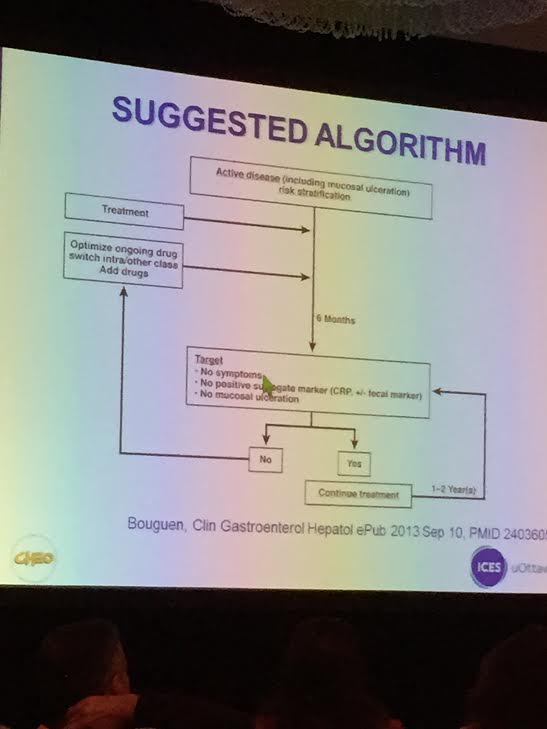
  • OLD paradigm –treat based on symptoms.  NEW paradigm–treat based on biologic/radiographic markers or endoscopic findings.  “Treat to target” has been approach used by Dr. Sandborn. Target mucosal healing and then assess mucosal healing every 6 months until target achieved, then less frequently.  Yet mucosal healing cannot be achieved in many/most patients.
  • Therapeutic drug monitoring.  For example, 6-TGN >235 associated with better response to AZA (OR 5.0)
  • Pharmacokinetics of anti-TNFs: lower clearance if concomitant use of immunomodulators, increased clearance if high CRP, higher BMI
  • New drugs: Ustekinumab –three phase 3 trials underway.  Should be available in about 2 yrs for Crohn disease. Vedolizumab –under FDA review (NEJM 2013; 369: 699-710).  Infusion (similar to remicade frequency). Blocks lymphocyte homing in the gut. UC data much more robust than with CD, but probably will be approved for both.  Rate of adverse events were low. Etrolizumab—similar to Vedolizumab, but SC administered. Currently, this drug is in phase 2 studies.

Eva Szigethy (Pittsburgh Pediatrics) “Psychological evaluation and assessment in IBD”

Key points:

  • Anxiety/depression ~25-40% of pediatric IBD.  Occurs in both active and inactive disease.
  • IBD effects on brain: inflammation, drugs (steroids, biologics)–both have direct effects on brain.
  • 15% of kids and 25% of adults are having thoughts of death on screening tools. Pain is frequent trigger for suicidal thoughts.
  • Simple depression screen: Mood, Energy, Sleep, Suicide/Self-esteem, Anhedonia (lack of pleaure), Guilt, Eating (change in appetite)
  • We should not ignore adjustment disorders.  We may be able to prevent a full-blown psychiatric disorder.  Each time we let problems like anxiety or depression go untreated, this can leave long-term changes in brain.
  • Anxiety screen: Tense, Tired, Recurrent worries/fear, Restless, Avoidance, Poor sleep/nightmares, Poor concentration
  • Important to look at patient perspective of their disease: identity (what they see as their symptoms), cause/etiology, timeline (how long the patient believes that the illness will last), consequences, cure/control.
  • Catastrophizing –more persistent pain and increased visceral hyperalgesia.  Abnormal brain activation. Poor coping drives development of depression and anxiety.
  • With adult IBD, 20% of patients consume up to 80% of medical costs.  Chronic pain and depression are key factors (Binion et al 2010).
  • Management of anxiety/depression: Cognitive Behavioral therapy –changing behaviors and thinking, problem-solving. ACT –activities, calm (relaxation, guided imagery, hypnosis), think positive (cognitive reframing). Antidepressants: TCA, SSRI, SNRI.  SSRI/SNRI –few side effects or drug interactions.  Overdose risk is highest with TCA (but typically using low doses of these agents).  No pediatric studies in IBD and only small studies in adults. If inactive IBD, SSRI often 1st line. If active IBD, Bupropion often used as 1st line.
  • For anxiety, most likely use SSRI if comorbid anxiety
  • For pain, most likely use SNRI  or low dose TCA
  • Opiates are problematic due to psychological/physical dependence, increased mortality/infection risk, narcotic bowel
  • Sleep –don’t go to bed if not tired, aim for consistency, if not asleep in 20 minutes, then do something else.  1st line pharmacology: consider antihistamines or melatonin.

Sachin Kunde (Michigan State University, Helen DeVos Children’s Hospital) “FMT for IBD”

Key points:

  • Microbial diversity altered in IBD –can we modulate dysbiosis to treat IBD?
  • Issues with cause and effect.  Is dysbiosis due to IBD or causing IBD.
  • FMT –“the ultimate probiotic.” Application of FMT.  For recurrent C difficile, cure rate nearly 90% –?better with lower GI route. For any indication besides C difficile infection (CDI), can only be given through clinical trials (FDA IND).  Currently 9 ongoing trials for IBD (1 pediatric, 3 in U.S).

FMT in IBD: Studies:

  1. -Anderson et al.  Aliment Phar Ther 2012: 13/18 without CDI had some resolution of IBD symptoms.
  2. -Kunde et al JPGN 2013: n=10. PUCAI decrease by 15 indicated response found in 78% (7/9) at 1 week, and 67% (6/9) at 1 month, 3 (33%) went into remission.
  3. -Kump et al IBD 2013: n=6. FMT for UC was not effective.  Transient improvement in 2/6 patients, 1/6 improved on Mayo sub score.

Bottomline for FMT & IBD: More questions than answers: efficacy, route of administration, # of infusions needed, fresh vs. frozen, adverse effects, best donor, etc.

For today’s post today and yesterday’s post, I may have made some transcription errors and these notes were not reviewed with the speakers.  Also, due to brevity, some useful information was not included.  Thus, the disclaimer with these posts is particularly important.

Disclaimer: These blog posts are for educational purposes only. Specific dosing of medications (along with potential adverse effects) should be confirmed by prescribing physician.  This content is not a substitute for medical advice, diagnosis or treatment provided by a qualified healthcare provider. Always seek the advice of your physician or other qualified health provider with any questions you may have regarding a condition.

Related blog posts:

Teaching an Old Drug New Tricks

A couple recent articles focused on the new uses of methotrexate (MTX) and how to handle potential hepatotoxicity:

  1. J Pediatr 2014; 164: 231-36
  2. Inflamm Bowel Dis 2014; 20: 47-59

In the first medical review article, the authors note the efficacy of MTX for the following:

  • Juvenile idiopathic arthritis
  • Uveitis
  • Psoriasis
  • Crohn disease
  • Juvenile dermatomyositis
  • Localized scleroderma
  • Vasculitis

This review article discusses mechanism of action which is poorly understood along with pharmacogenomics and practical issues in usage.  The latter includes the need for supplemental folic acid.  Other points:

  • “The long-term safety of MTX is remarkable”
  • “The issue of nausea and vomiting…can be especially disturbing.”  They note that one study demonstrated that ondansetron 1 hour prior to MTX from the first injection prevented nausea, which was often difficult to treat once developed.
  • “Liver enzyme abnormalities occur frequently (up to 30% of patients) but are usually of minimal clinical significance.”  Best to draw blood tests 1-2 days before MTX dosing.
  • “In children, unlike adults, MTX-related pulmonary adverse events are very rare.”
  • “In recent years it was shown that live vaccine boosters are effective and safe during MTX use (caution may be needed if MTX is used with other immunosuppression medications)” Ref: JAMA 2013; 309: 2449–56.
  • “Use during pregnancy or within 3 months of planning pregnancy is contraindicated”

The second article was a systemic review which identified 12 high-quality studies which focused on MTX hepatotoxicity in children.  Key findings:

  • 57 of 457 developed some degree of abnormal liver biochemistries.
  • Due to hepatotoxicity, dose reductions were undertaken in 6.4% and 4.5% discontinued MTX.

The authors note that studies of MTX in adults with IBD have not demonstrated cumulative liver toxicity from MTX.  In addition, many of the patients with hepatotoxicity may have had  other reasons for abnormal liver biochemistries including other medications (eg. glucocorticoids).  “Confirmation of MTX hepatotoxicity with a liver biopsy is seldom performed in children;” as a consequence, the exact rate of MTX hepatotoxicity is unknown.

The authors propose that liver biochemistry monitoring occur at baseline, biweekly x 2, then every 2-3 months.  Also, the authors recommend:

  • If ALT < 2 times upper limit of normal (ULN), check liver biochemistries every 2 weeks
  • If persistent abnormalities, the authors recommend an ultrasound
  • If ALT ≥ 2 times ULN, repeat testing should be obtained and consider consultation with a hepatologist

Bottomline: Methotrexate is an important medication for Crohn disease –there are not very many available.  If there are persistent liver enzyme elevations, dose reduction of MTX (or cessation) may be necessary.  As a practical matter, it is advisable to obtain blood draws 1-2 days prior to MTX rather than afterwards. Nausea can be minimized with ondansetron and weekend dosing.

Related blog posts:

Superiority of Anti-TNF Therapy in Children

This study’s conclusion comes as no surprise:

“In children newly diagnosed with comparably severe CD, early monotherapy with anti-TNFα produced better overall clinical and growth outcomes at 1 year than early monotherapy with an immunomodulator. Further data will be required to best identify children most likely to benefit from early treatment with anti-TNFα therapy.”

Here’s the reference:

Gastroenterology Volume 146, Issue 2 , Pages 383-391, February 2014

Here’s a link to the full text article:  Increased Effectiveness of Early Therapy with Anti-Tumor Necrosis Factor-α Versus an Immunomodulator in Children with Crohn’s Disease

Methods: “From 2008 through 2012 at 28 pediatric gastroenterology centers in North America. Patients were managed by physician dictate. From 552 children (median age, 11.8 y; 61% male; 63% with pediatric CD activity index scores >30; and median C-reactive protein level 5.6-fold the upper limit of normal), we used propensity score methodology to identify 68 triads of patients matched for baseline characteristics who were treated with early anti-TNFα therapy, early immunomodulator, or no early immunotherapy.”

Another reference/link from same issue:

Accuracy of Magnetic Resonance Enterography in Assessing Response to Therapy and Mucosal Healing in Patients with Crohn’s Disease

Does Sun Exposure Lower the Risk of Crohn Disease?

An intriguing recent study suggests that individuals who spend more time outside are less likely to develop Crohn disease (CD) (Inflamm Bowel Dis 2014; 20: 75-81).

In this prospective cohort study from France, 123 cases of inflammatory bowel disease (45 CD, 71 ulcerative colitis, and 7 indeterminant colitis)  developed among the 91,870 women in the study.  The study period had a mean followup of 13.1 years and followed women between 40 and 65 years. The authors estimated residential sun exposure by utilizing a database (derived from satellite collection) containing the mean daily ultraviolet radiation dose for each French county.

Key findings:

  • Higher levels of sun exposure were associated with a decreased risk of Crohn disease with a Hazard Ratio (HR) of 0.49.
  • Sun exposure did not affect the likelihood of developing UC (HR 1.21).
  • In women with information about dietary vitamin D intake, higher sun exposure had a HR of 0.29 for developing CD.  That being said, the authors note a low dietary vitamin D intake in their population.

Despite the large cohort, this study has a number of limitations. The absolute number of IBD patients can lead to a Type 1 error (false-positive conclusion).  In addition, the age of the study population and the lack of data regarding individual sun exposure limit the conclusions as well.  Besides these factors, there may be confounders such as changes in diet and soil exposure which are not accounted for.

At the same time, there have been other studies which have shown a latitude effect.  As with this study, those living in sunny areas had a lower incidence of CD.

Bottomline: This study suggests that additional sun exposure is associated with a lower risk of developing Crohn disease.  Whether this lower risk is directly through better vitamin D levels or simply an epiphenomenon is unclear.

Other recent unrelated studies:

Gut 2013; 62: 1122-30.  A randomized phase 1 study of etrolizumab (rhuMAb β-7) in moderate to severe ulcerative colitis.  Etrolizumab is an adhesion cell molecular blocker.

Inflamm Bowel Dis 2014; 20: 21-35.  Meta-analysis of 23 randomized controlled trials of probiotics for UC, Pouchitis, and CD.  Probiotics, in particular VSL#3, increased UC remission rates and helped maintain remission in patients with pouchitis.

Inflamm Bowel Dis 2014; 20: 213-27. Review article of cutaneous manifestations of inflammatory bowel disease.  Good pictures of multiple problems including metastatic Crohn disease, erythema nodosum, pyoderma gangrenosum, Sweet’s syndrome, aseptic abscess syndrome, and epidermolysis bullosa acquisita.

Inflamm Bowel Dis 2013; 19: 1753-63.  Review on hair loss associated with inflammatory bowel disease. Remember telogen effluvium?

Related posts:

For those who read from the top to the very bottom, here’s a tangential question: Do you know what a “sun dog” is?   Sun dog – Wikipedia, the free encyclopedia