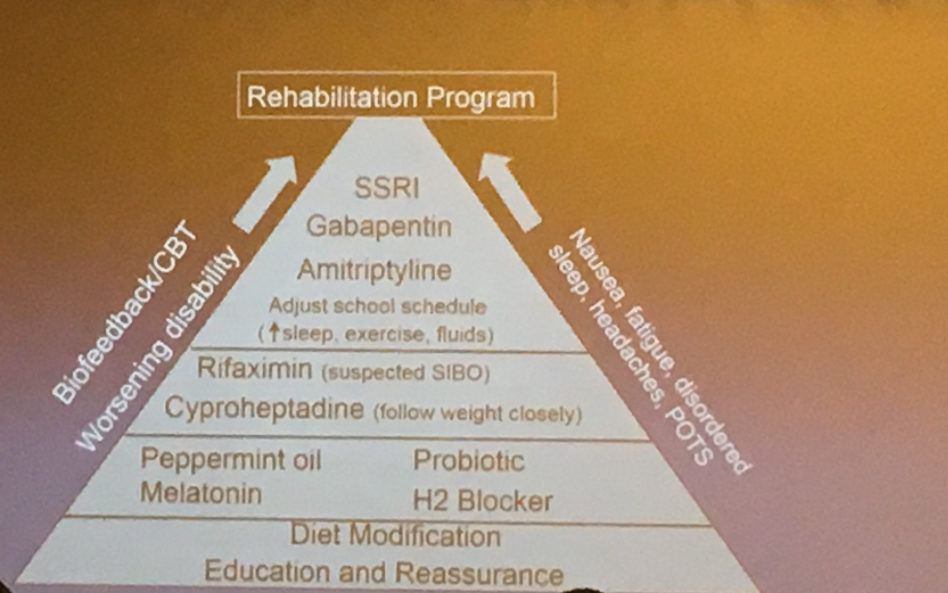
Dreaded Nausea (2017)

This post provides followup to a previous post: Dreaded Nausea.

A recent study (AC Russell, AL Stone, LS Walker, Clin Gastroenterol Hepatol 2017; 15: 706-11) provides even more reasons to dread nausea.

This prospective study of 871 children with functional abdominal pain examined the comorbidity of nausea.  Followup data were collected from 392 patients at median of 8.7 years later.
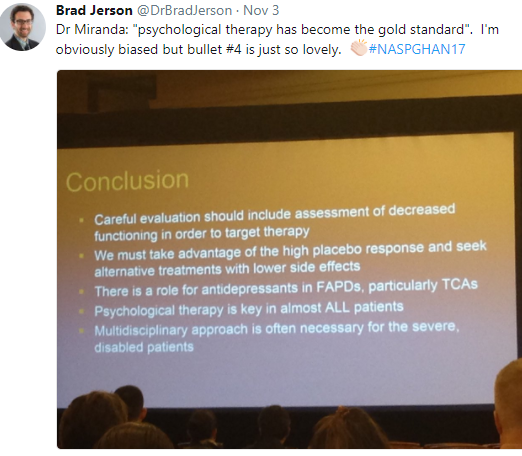
Key findings:

  • At baseline, 44.8% of patients reported nausea. This group reported worse abdominal pain, somatic symptoms and depression than those without nausea.
  • At followup, “those with nausea in childhood continue to have more severe GI (P<.001) and somatic symptoms (P=.003)…as well as higher levels of anxiety (P=.02) and depression (P=.02).”  Anxiety and depression remained significant after controlling for baseline abdominal pain severity.

  • At the followup evaluation, the prevalence of any functional GI disorder (FGID) was 85 (48%) of those who had nausea at baseline compared with 77 (36%) for those without nausea at baseline.

In their discussion, the authors reiterate findings from previous work on this patient sample: “current and lifetime diagnoses of anxiety disorders are substantially higher in adolescents with a history of FAP [functional abdominal pain] compared with healthy controls (lifetime, 51% vs. 20%; current 30% vs 12%). The lifetime risk of depressive disorder is also significantly higher in those with FAP (40% vs. 16%).”  They also note some limitations in their work, including the absence of formal screening for postural orthostatic tachycardia syndrome (POTS).

My take (borrowed from authors): This study “suggests that nausea is more than just a comorbid symptom of FAP and may have a different underlying etiology” and increases likelihood of persistent symptoms as well as anxiety and depression.

Briefly noted: RJ Shulman et al. Clin Gastroenterol Hepatol 2017; 15: 712-9. This randomized, double-blind study showed that added psyllium reduced frequency (but not severity) of abdominal pain in children (n=103) with irritable bowel syndrome. Psyllium was dosed at 6 g/day for 7-11 year olds, and 12 g for 12-18 year olds. Interestingly, this study did not show that psyllium caused a difference in normal stools or other mechanistic reasons for improvement, like breath hydrogen, breath methane, intestinal permeability or microbiome composition.

Related posts:

Atlanta Zoo, Bald Eagle


Correlation between Microbiome and Irritable Bowel Syndrome

I vaguely remember jokes that I heard as a teenager about computers that could analyze stool or urine and then come to remarkable conclusions about the person’s health or extramarital problems.  Fast-forward a few decades and these jokes are not so far off.

A recent study (J Tap, M Derrien, et al. Gastroenterol 2017; 152: 111-23) describes an intestinal microbiome ‘signature’ associated with severity of irritable bowel syndrome (IBS).  Thanks to Ben Gold for highlighting this article.  (He placed this one on my desk: “Jay -FYI -It is all about the poop!”)

In this study, the authors collected fecal and mucosal samples from adult patients who met Rome III criteria for IBS.  They started with an exploratory set of 149 subjects (110 with IBS, 39 controls).  Subsequently, they used a validation cohort of 46 subjects (29 with IBS, 17 controls).

Key findings:

  • “By using classic approaches, we found no differences in fecal microbiota abundance or composition between patients with IBS vs healthy patients.”  But, “a machine learning procedure, a computational statistical technique, allowed us to reduce the 16S ribosomal RNA data complexity into a microbial signature for severe IBS, consisting of 90 bacterial operational taxonomic units.”
  • This microbial signature showed IBS to be associated negatively with microbial richness, exhaled CH4, presence of methanogens, and enterotypes enriched with Clostridiales or Prevotella species.  Figure 6 provides a graphic summary of the study and the microbial signature.
  • The authors note their findings were not explained by differences in diet or medications.
  • Overall, the microbial signature has a low sensitivity and thus at this point does not have clinical applicability.

My take: There are a number of studies showing that our gut microbiome is associated with numerous conditions, including IBS, inflammatory bowel disease, and metabolic syndrome.  Having our poops analyzed by a computer to tell us what is wrong does not seem all that funny anymore.

Related blog posts:

Bridge on Seine River

Image Only: Living with Irritable Bowel Syndrome

Related blog posts:

Chronic Diarrhea Recommendations

Recent guidelines for adults with chronic diarrhea (>4 weeks):

Full text link: LR Schiller, DS Pardi, JH Sellin. Clin Gastroenterol Hepatol 2017; 15: 182-193.

A few key points:

  • The authors advocate treatment, not testing, for adults who meet Rome criteria for irritable bowel syndrome (IBS) without alarm symptoms.
  • Dietary history is essential.
  • “True food allergies are rare causes of chronic diarrhea in adults”
One of my colleagues questioned whether this product could be part of an effective cleanout

One of my colleagues questioned whether this product could be part of an effective cleanout


Blind Men and The Elephant: Lasting Consequences of Enteric Infections

Recently, Ben Gold handed me a supplement which alluded to the case of “the blind men and the elephant.”  So, of course, I wanted to know more about this.

According to Wikipedia:

In various versions of the tale, a group of blind men (or men in the dark) touch an elephant to learn what it is like. Each one feels a different part, but only one part, such as the side or the tusk. They then compare notes and learn that they are in complete disagreement. The stories differ primarily in how the elephant’s body parts are described, how violent the conflict becomes and how (or if) the conflict among the men and their perspectives is resolved.  In some versions, they stop talking, start listening and collaborate to “see” the full elephant. When a sighted man walks by and sees the entire elephant all at once, the blind men also learn they are all blind. While one’s subjective experience is true, it may not be the totality of truth. If the sighted man were deaf, he would not hear the elephant bellow.

It has been used to illustrate a range of truths and fallacies; broadly, the parable implies that one’s subjective experience can be true, but that such experience is inherently limited by its failure to account for other truths or a totality of truth. At various times the parable has provided insight into the relativism, opaqueness or inexpressible nature of truth, the behavior of experts in fields where there is a deficit or inaccessibility of information, the need for communication, and respect for different perspectives.

The rest of the supplement regarding chronic health consequences following acute enteric infections was less interesting but probably more important than learning a new anecdote.

The introduction notes that nearly 600,000 children under 5 years die from dehydrating diarrhea each year.  Many more suffer from consequences of disease-associated malnutrition with both physical and cognitive deficits.

Articles in supplement:

  • Am J Gastroenterol Suppl 2016; 3: 4-11. –details diarrhea-associated years lived with disability 51 per 100,000 in developed regions compared with 685 in developing regions.
  • Am J Gastroenterol Suppl 2016; 3: 12-23. –details the likelihood of consequences following enteric infections, including functional GI disorders, inflammatory bowel disease, celiac disease (data limited), Guillain-Barré syndrome, hemolytic uremic syndrome, chronic fatigue, and neurologic sequelae.
  • Other articles in the supplement describe changes in the microbiome, the micorbiome-gut-brain axis, and the relationship between autoimmunity and irritable bowel.


Yoga Therapy for Abdominal Pain

A recent study (JJ Korterink et al. JPGN 2016; 63: 481-7) showed that yoga treatment may be helpful with children (8-18 years) with functional abdominal pain.  The authors studied 69 subjects who received either standard medical care or standard care with yoga therapy.  Pain intensity was followed with a pain dairy as was quality of life with KIDSCREEN-27. Key finding: At 1 year follow-up, 58% of the yoga group had a treatment response compared to 29% in the control group.  Yoga therapy was associated with reduction in school absences as well as reduced abdominal pain.

While yoga is considered helpful in stress management and has been suggested as treatment for adults with irritable bowel, an associated editorial by Yvan Vanderplas (pg 451) notes that the scientific basis for yoga therapy remains weak. He notes that yoga trials are biased due to selection bias and the results are tainted due to lack of blinding with regard to the intervention.

My take: If families are interested in yoga therapy, this should be encouraged.  Yoga therapy is safer and at least as effective as many other therapies offered for abdominal pain.

screen-shot-2016-12-12-at-8-44-13-pm


Learned Fear of Gastrointestinal Sensations Plus Two

Briefly noted: The authors of a recent study (E Ceunen et al. Clin Gastroenterol Hepatol 2016; 14: 1552-58) set out to study whether it is likely that healthy adults could learn to fear “innocuous visceral sensations.”  Fifty-two healthy subjects received  2 types of esophageal balloon distentions –one that was perceptible and non-painful and one that was painful.  Not surprisingly, when the researchers paired these two interventions in the experimental group, the experimental group learned to fear the innocuous stimulation as well as the painful distention.  This study provides theoretical support for one mechanism that could trigger ongoing functional gastrointestinal symptoms and a potential rationale for therapies, like cognitive behavioral therapy, which attempt to extinguish these symptoms.

In a retrospective study (AM Moon et al. Clin Gastroenterol 2016; 14: 1629-37) with 6451 patients with cirrhosis (mean age 60.6 yrs), the authors note that use of antibiotics during upper gastrointestinal bleeding (which is currently recommended) is associated with reduced mortality by ~30% at 30 days.  Despite its benefit, this intervention is often overlooked.  In the current study, only 48.6% of admissions received timely antibiotics; however, during the course of the study, the rate of antibiotic use improved from 30.6% in 2005 to 58.1% in 2013.

A recent retrospective study (N Goossens et al. Clin Gastroenterol 2016; 14: 1619-28) with 492 subjects showed that histologic NASH (in 12% of cohort) was associated with increased risk of death in patients who underwent bariatric surgery compared to patients without NASH.  Overall, bariatric surgery reduced the risk of death during the study period with HR of 0.54; the median follow-up was 10.2 years, with surgery taking place 1997-2004.  However, in patients with NASH the HR 0.90 which indicated that there was not a significant reduction in the risk of death.

Bar Harbor, ME (low tide)

Bar Harbor, ME (low tide)

Is there a link between the microbes in your colon and depression?

A recent study (Y Liu et al. Clin Gastroenterol Hepatol 2016; 14: 1602-11) showed that fecal microbiota signatures were similar between patients with diarrhea-predominant irritable bowel syndrome (IBS-D) and in patients with depression.

The authors analyzed stool samples from 100 Chinese subjects.  In addition to analyzed stool microbiota, the authors evaluated visceral hypersensitivity with a barostat and assessed for mucosal disease with immunohistochemical analyses of sigmoid biopsies.

In both IBS-D patients and patients with depression, the stool diversity was much less than controls and had similar abundance of many alterations, including higher proportions of Bacteroides and Prevotella (see below).

My take: It is interesting to speculate on whether changes in our microbiome could trigger/be related to the pathogenesis of not only IBS-D but other non-GI disorders like depression.

In the screenshot below, the term “COMO” refers to the 25 subjects who had both IBS and depression.

screen-shot-2016-11-14-at-12-10-03-pm

Psychological Therapies for Irritable Bowel Syndrome

A recent meta-analysis (KT Laird et al. Clin Gastroenterol Hepatol 2016; 14: 937-47) of 41 randomized, controlled trials shows that psychological therapies improved symptoms of irritable bowel in adults.

Key finding:

  • “On average, individuals who received psychotherapy had a greater reduction in GI symptoms after treatment than 75% of individuals assigned to a control condition…This effect remained significant” for at least 6-12 months.

A summary of this study from GIHepNews.com:  Psychological Therapies for Irritable Bowel Syndrome

Excerpt of commentary by Dr. Christopher Almario:

While these findings are impressive and continue to support the use of psychotherapy in IBS, important issues remain. First, these results are based on data gathered in the highly controlled environment of randomized controlled trials (RCTs), and it is unclear whether they will translate to the “real world.” RCT participants may be more willing to complete psychotherapy because they know they are being observed by research staff (referred to as the Hawthorne, or observer, effect). However, in real clinical practice, patients with IBS not subject to the Hawthorne effect may be less compliant with such therapies.

Other issues relate to the current limited adoption of psychotherapy in clinical practice. Factors contributing to the low uptake include variable third-party reimbursement and poor patient and provider acceptance (JAMA. 2015 Mar;313:949-58). Another factor is limited access to qualified psychotherapists.

My take: I often refer patients to a “pain psychologist” who works in our office.  With the right psychologist, this can be very helpful.  In addition, I feel that families are more willing to see a psychologist than in the past.

Related blog posts:

JulyClinGastroCover


Gluten-Free for IBS-D?

A recent study (I Aziz et al. Clin Gastroenterol Hepatol 2016; 14: 696-703) shows that a 6 week gluten-free diet reduced IBS-D symptoms in 29 of 41 (71%) patients.

  • The authors performed a prospective study with all patients receiving a gluten-free diet.  At 6 weeks, 21 of 29 who had responded to GFD continued GFD through 18 months followup.
  • One difference with this study compared to prior studies –these patients were irritable bowel syndrome with diarrhea and fulfilled Rome III criteria.  Celiac disease had been excluded with serology and histology; thus, these patients did not have “potential” celiac disease.
  • In addition to GI symptoms like abdominal pain, distention, and stooling problems, patients experienced improvement in mood, fatigue and quality of life.
  • The authors note that the response rate of 71% is much higher than they would have expected if the response was related solely to a placebo effect.

My take: This small study shows that a gluten free diet may be effective in improving the symptoms in many patients with IBS-D.  Other studies have shown that several other diets are effective as well.

Related blog posts:

IBS diagram