Oral GLP-1 Receptor Agonist for Obesity: Orforglipron

S Wharton et al. NEJM 2023; DOI: 10.1056/NEJMoa2302392. Daily Oral GLP-1 Receptor Agonist Orforglipron for Adults with Obesity

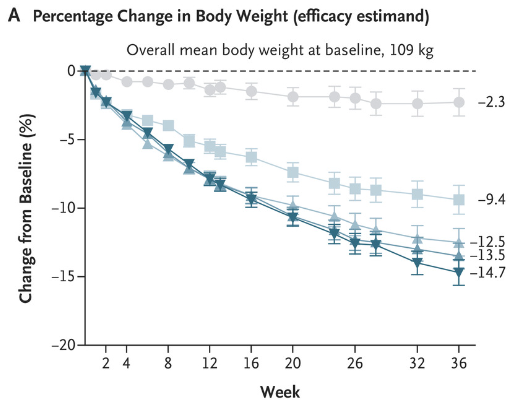
In this phase 2 randomized, double-blind trial with 272 adults with obesity (mean weight at baseline 108 kg), participants were randomly assigned to receive orforglipron at one of four doses (12, 24, 36, or 45 mg) or placebo once daily for 36 weeks. “The pharmacokinetic profile of orforglipron, with a half-life of 29 to 49 hours, supports once-daily oral administration.”

Key findings:

  • At week 36, the mean change ranged from −9.4% to −14.7% with orforglipron and was −2.3% with placebo.
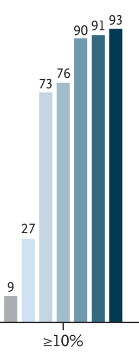
  • A weight reduction of at least 10% by week 36 occurred in 46 to 75% of the participants who received orforglipron, as compared with 9% who received placebo.
  • Adverse events reported with orforglipron were similar to those with injectable GLP-1 receptor agonists.

Weight reduction of at least 10% at week 36:

My take: This is an exciting time for drug development for obesity. Given the low success rates of traditional ‘lifestyle’ management approaches, these medications have the potential to reduce a great deal of morbidity. Oral agents, rather than injections, would hasten the use of these agents more broadly. Long term outcomes are still unclear.

Related blog posts:

Another Promising Medication (Retatrutide) for Obesity

AM Jastreboff et al. NEJM 2023; DOI: 10.1056/NEJMoa2301972. Triple–Hormone-Receptor Agonist Retatrutide for Obesity  — A Phase 2 Trial.

Background: Retatrutide (LY3437943) is an agonist of the glucose-dependent insulinotropic polypeptide, glucagon-like peptide 1, and glucagon receptors.

Methods: This study enrolled 338 with BMI of at least 27 in a a phase 2, double-blind, randomized, placebo-controlled trial with once-weekly injections of retatrutide.

Key Findings:

The number who achieved at least a 10% weight loss:

“The safety profile of retatrutide was consistent with reported phase 1 findings in persons with type 2 diabetes13 and similar to those of therapies based on GLP-1 or GIP–GLP-1 for the treatment of type 2 diabetes or obesity”

My take: There are a number of effective agents for obesity that have been developed very recently. Long term efficacy and safety are still not well-understood.

Related blog posts:

How Obesity Permeates Transplant Medicine

A Mathur. Liver Transplantation 2023; 29: 465-466. Open Access! Salvaging the fatty liver for transplant: is short duration NMP enough? (ed)

 “As of 2020, the Center for Disease Control (CDC) notes that 40% of the ~258 million US adults suffer from obesity. This represents just more than a 100 million people suffering from obesity. In addition, about 23 million people suffer from severe obesity with a body mass index >40 kg/m2.” Fatty liver disease (aka NAFLD), driven primarily by obesity, is a leading cause of liver transplantation. In addition, fatty liver disease is impacting the ability to treat liver failure.

“The end result of this epidemic is that we are identifying a greater proportion of organ donors with varying degrees of liver steatosis. Transplantation of steatotic livers is associated with an increased degree of ischemia-reperfusion injury (IRI) and release of inflammatory cytokines from the graft. The consequences of this can range from severe reperfusion syndromes with immediate vasoplegia and circulatory collapse to distant organ dysfunction with acute kidney injury, liver allograft dysfunction, and primary nonfunction (PNF).”

In order to try to identify suitable liver organs for transplantation, researchers are trying to identify strategies to utilize steatotic grafts safely. Patrono et al (Liver Transplantation 2023; 29: 508-502) examined the feasibility of using normothermic machine perfusion (NMP) in the setting of macrovesicular steatosis (MaS) ≥30%. They identified 10 patients who had liver transplants using NMP in patients with MaS ≥30%; 4 additional organs were not used despite NMP. 8 of 10 patients showed good liver function, representing 57% (8 of 14) of NMP fatty organs.

Another study in the same issue (NB Ha et al. Liver Transplantation 2023; 29: 476-484) showed that patients with sarcopenic obesity (=low muscle mass obesity) had high waitlist mortality of 40% compared to 21% and 12% for those with sarcopenia without obesity and for those with obesity without sarcopenia, respectively.

My take: Obesity increases the risk of fatty liver associated cirrhosis/liver failure, and is impacting the availability of suitable organs for those in need. Furthermore, in those with obesity, the presence of sarcopenia increases the risk of death on transplant waitlist.

Tucson Botanical Gardens

Weight Gain If Semaglutide Stopped

This article discusses several conditions like Prader-Willi and pregnancy that can result in increase hunger and then elaborates on genetic tendency towards obesity in an age of abundant ultra-processed high calorie foods. Excerpts:

A famous 1990 study of identical twins born in Sweden showed that pairs who were separated at birth and adopted had weights more similar to each other than to their adoptive families…The ability to sense such fullness — and hunger — varies, the result of genetic differences in brain circuits that control appetite.

The new drugs are the first to manipulate the hormonal regulatory systems governing energy balance. The drugs simulate the action of our native GLP-1 but with longer-lasting effects, amplifying the fullness signal inside the body…At the very least, though, the way the drugs work can teach us that people who are larger did not necessarily choose to be, just as people who are smaller did not — and are not morally superior. This “isn’t a free pass, either to individuals who do have the capacity to choose better, nor does it take the heat off of food industries,” said a University of Sydney nutritional biologist, Stephen Simpson, but it’s “evidence that obesity isn’t a personal lifestyle choice.”

My take: For those who benefit from GLP-1 medications, it is important to recognize that weight gain is likely when the medications are discontinued; this indicates once treatment is started, the goal would be to use indefinitely –until something better comes along.

Related blog posts:

Disclaimer: This blog, gutsandgrowth, assumes no responsibility for any use or operation of any method, product, instruction, concept or idea contained in the material herein or for any injury or damage to persons or property (whether products liability, negligence or otherwise) resulting from such use or operation. These blog posts are for educational purposes only. Specific dosing of medications (along with potential adverse effects) should be confirmed by prescribing physician.  Because of rapid advances in the medical sciences, the gutsandgrowth blog cautions that independent verification should be made of diagnosis and drug dosages. The reader is solely responsible for the conduct of any suggested test or procedure.  This content is not a substitute for medical advice, diagnosis or treatment provided by a qualified healthcare provider. Always seek the advice of your physician or other qualified health provider with any questions you may have regarding a condition

POSE 2.0 Procedure for Obesity

Anyone who follows this blog closely knows my inherent attraction for study acronyms; it is too bad I am not a leading researcher because it would be really fun to come up with some hilarious acronyms.

The Primary Obesity Surgery Endoluminal (POSE) Procedure for the treatment of obesity (GL Nava et al. Clin Gastroenterol Hepatol 2023; 21: 81-89) prospectively enrolled 44 adult patients who underwent “a novel pattern of full-thickness gastric body plications to shorten and narrow the stomach using durable suture anchor pairs.”

Key findings:

  • This procedure used an average of 19 suture anchor pairs, with a mean duration of 37 ± 11 minutes, and was technically successful in all subjects
  • Mean percentage total body weight loss (%TBWL) at 12 months was 15.7% ± 6.8%. >15% TBWL was achieved by 58%
  • Improvements in lipid profile, liver biochemistries, and hepatic steatosis were seen at 6 months
  • Repeat assessment at 24 months (n = 26) showed fully intact plications. No serious adverse events occurred

My take: This study shows that endoscopic therapies for obesity are quite promising. However, endoscopic therapies and bariatric surgery may become 2nd or 3rd line therapies if oral medications are available that can achieve similar success. Though, medications could require indefinite treatment.

Related blog posts:

Semaglutide in Adolescent Obesity

D Weghuber et al NEJM 2022; DOI: 10.1056/NEJMoa2208601. Once-Weekly Semaglutide in Adolescents with Obesity

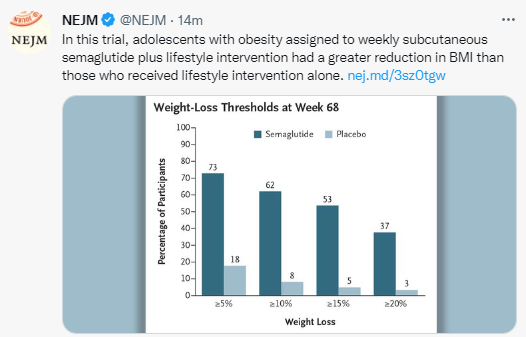
Methods: In this double-blind, parallel-group, randomized, placebo-controlled trial, we enrolled 201 adolescents (12 to <18 years of age) with obesity (a body-mass index [BMI] in the 95th percentile or higher) or with overweight (a BMI in the 85th percentile or higher) and at least one weight-related coexisting condition.  180 (90%) completed treatment. Participants were randomly assigned in a 2:1 ratio to receive once-weekly subcutaneous semaglutide (at a dose of 2.4 mg) or placebo for 68 weeks, plus lifestyle intervention.

Key findings:

  • The mean change in BMI from baseline to week 68 was −16.1% with semaglutide and 0.6% with placebo
  • At week 68, a total of 95 of 131 participants (73%) in the semaglutide group had weight loss of 5% or more, as compared with 11 of 62 participants (18%) in the placebo group
  • Improvement with respect to cardiometabolic risk factors (waist circumference and levels of glycated hemoglobin, lipids [except high-density lipoprotein cholesterol], and alanine aminotransferase) were greater with semaglutide than with placebo
  • “The safety of semaglutide in this adolescent population appeared to be consistent with findings among adults with overweight or obesity… Gastrointestinal disorders (primarily nausea, vomiting, and diarrhea) were the most frequent adverse events with semaglutide (occurring in 62% of participants, as compared with 42% in the placebo group) and were generally mild or moderate in severity and of short duration (median duration, 2 to 3 days for nausea, vomiting, and diarrhea in the semaglutide group)”
  • “Permanent discontinuations because of gastrointestinal disorders were very low. Furthermore, semaglutide did not appear to affect growth or pubertal development during the trial period”

My take: As in adults, treatment with semaglutide results in weight loss.

Related blog posts:

AGA Guidelines for Adults with Obesity

AGA released new evidence-based guidelines strongly recommending patients with obesity use recently approved medications paired with lifestyle changes.

The following medications, paired with healthy eating and regular physical activity, are first-line medical options and result in moderate weight loss as noted as a percentage of body weight (reported as the difference compared to percent weight loss observed in the placebo group).

  1. Semaglutide (Wegovy®), weight loss percentage: 10.8%
  2. Phentermine-topiramate ER (Qsymia®), weight loss percentage: 8.5%
  3. Liraglutide (Saxenda®), weight loss percentage: 4.8%
  4. Naltrexone-Bupropion ER (Contrave®), weight loss percentage: 3.0%

Read the AGA Clinical Guidelines on Pharmacological Interventions for Adults with Obesity for the complete recommendations.

Tirzepatide: Promotes Impressive Weight loss

Source Study: AM Jastreboff et al NEJM 2022; DOI: 10.1056/NEJMoa2206038. Tirzepatide Once Weekly for the Treatment of Obesity

USA Today (6/6/22): Diabetes drug helps patients lose never-before-seen amounts of weight, study shows

An excerpt:

The drug, called tirzepatide, works on two naturally occurring hormones that help control blood sugar and are involved in sending fullness signals from the gut to the brain...Those taking the highest of three studied doses lost as much as 21% of their body weight – 50-60 pounds in some cases…

Another obesity treatment approved last year called semaglutide, from Novo Nordisk, provides an average of up to about 15% weight loss. Previous generations of diet drugs cut only about 5% of weight and many carried prohibitive side effects…

About 15% of participants who received the active drug dropped out of the 72-week trial, about a third because of gastrointestinal side effects. Twenty-six percent of trial volunteers who received a placebo dropped out.

On May 13, the Food and Drug Administration approved tirzepatide, under the trade name Mounjaro, for the treatment of Type 2 diabetes…The new tirzepatide trial, called SURMOUNT-1, included more than 2,500 volunteers [without diabetes]…Nine out of 10 lost weight, and on the highest dose, 15 mg, they lost an average of 52 pounds each...

It’s too soon to know what price Lilly will set for tirzepatide. Mounjaro, the same drug used to treat diabetes at the same doses, retails for almost $1,000 a month…Semaglutide went on the market last year for weight loss and has been in short supply ever since, Rind said. It costs about $1,600 a month for the 2.4 mg weight loss dose, which is higher than the 1 or 2 mg doses used to treat diabetes. Like other weight loss drugs, semaglutide isn’t covered by many insurance plans. 

My take: This therapy, already approved for Type 2 Diabetes, appears promising for obesity but costly. More time will be needed to understand the safety profile with extended use.

Related blog post: Are We On the Verge of Pharmacologic Management of Obesity (Again)?

Atalaya Hike, Santa Fe, NM

Does Motivational Interviewing Help Long-Term Outcomes for Obesity?

M Michalopoulou et al. Annals Int Med 2022; https://doi.org/10.7326/M21-3128. Effectiveness of Motivational Interviewing in Managing Overweight and Obesity

This review and meta-analysis examined forty-six studies involving 11 077 participants.

Key findings:

  • At 6 months, behavior weight management programs (BWMPs) using motivational interviewing (MI) were more effective than no/minimal intervention (−0.88) but were not statistically significantly more effective than lower-intensity (−0.88 ) or similar-intensity (−1.36 ) BWMPs.
  • “At 1 year, data were too sparse to pool comparisons with no/minimal intervention, but MI did not produce statistically significantly greater weight change compared with lower-intensity”

My take: Several years ago our hospital system strongly encouraged practitioners to learn motivation interviewing techniques. However, based on this review, “there is no evidence that MI increases effectiveness of BWMPs in controlling weight.”

Related blog posts:

Isle of Palms, SC

Timing of Solids and Weight Trajectory

CJ D’Hollander et al. J Pediatr 2022; 240: 102-109. Timing of Introduction to Solid Food, Growth, and Nutrition Risk in Later Childhood

Methods: A longitudinal cohort study was conducted among healthy children 0-10 years of age participating in The Applied Research Group for Kids study between June 2008 and August 2019 in Toronto, Canada.

Key findings:

  • Of 8943 children included, the mean (SD) age of infant cereal introduction was 5.7 (2.1) months
  • Children who were introduced to infant cereal at 4 vs 6 months had 0.17 greater body mass index z score (95% CI 0.06-0.28; P = .002) and greater odds of obesity (OR 1.82; 95% CI 1.18-2.80; P = .006) at 10 years of age. 
  • Earlier cereal introduction was associated with a less-favorable eating behavior score at 18 months to 5 years of age (0.18 units higher; 95% CI 0.07-0.29; P = .001).

Limitation: This study did not randomize children into early vs late cereal introduction; thus, there may be unidentified confounders that contribute to weight gain in children offered cereal at a younger age.

My take: This study indicates that introduction of cereal at 6 months of age, rather than 4 months of age, may be beneficial in limiting excess weight gain.