
Unknown's avatar

About gutsandgrowth

I am a pediatric gastroenterologist at GI Care for Kids (previously called CCDHC) in Atlanta, Georgia. The goal of my blog is to share some of my reading in my field more broadly. In addition, I wanted to provide my voice to a wide range of topics that often have inaccurate or incomplete information. Before starting this blog in 2011, I would tear out articles from journals and/or keep notes in a palm pilot. This blog helps provide an updated source of information that is easy to access and search, along with links to useful multimedia sources. I was born and raised in Chattanooga. After graduating from the University of Virginia, I attended Baylor College of Medicine. I completed residency and fellowship training at the University of Cincinnati at the Children’s Hospital Medical Center. I received funding from the National Institutes of Health for molecular biology research of the gastrointestinal tract. During my fellowship, I had the opportunity to work with some of the most amazing pediatric gastroenterologists and mentors. Some of these individuals included Mitchell Cohen, William Balistreri, James Heubi, Jorge Bezerra, Colin Rudolph, John Bucuvalas, and Michael Farrell. I am grateful for their teaching and their friendship. During my training with their help, I received a nationwide award for the best research by a GI fellow. I have authored numerous publications/presentations including original research, case reports, review articles, and textbook chapters on various pediatric gastrointestinal problems. In addition, I have been recognized by Atlanta Magazine as a "Top Doctor" in my field multiple times. Currently, I am the vice chair of the section of nutrition for the Georgia Chapter of the American Academy of Pediatrics. In addition, I am an adjunct Associate Clinical Professor of Pediatrics at Emory University School of Medicine. Other society memberships have included the North American Society for Pediatric Gastroenterology Hepatology and Nutrition (NASPGHAN), American Academy of Pediatrics, the Food Allergy Network, the American Gastroenterology Association, the American Association for the Study of Liver Diseases, and the Crohn’s and Colitis Foundation. As part of a national pediatric GI organization called NASPGHAN (and its affiliated website GIKids), I have helped develop educational materials on a wide-range of gastrointestinal and liver diseases which are used across the country. Also, I have been an invited speaker for national campaigns to improve the evaluation and treatment of gastroesophageal reflux disease, celiac disease, eosinophilic esophagitis, hepatitis C, and inflammatory bowel disease (IBD). Some information on these topics has been posted at my work website, www.gicareforkids.com, which has links to multiple other useful resources. I am fortunate to work at GI Care For Kids. Our group has 17 terrific physicians with a wide range of subspecialization, including liver diseases, feeding disorders, eosinophilic diseases, inflammatory bowel disease, cystic fibrosis, DiGeorge/22q, celiac disease, and motility disorders. Many of our physicians are recognized nationally for their achievements. Our group of physicians have worked closely together for many years. None of the physicians in our group have ever left to join other groups. I have also worked with the same nurse (Bernadette) since I moved to Atlanta in 1997. For many families, more practical matters about our office include the following: – 14 office/satellite locations – physicians who speak Spanish – cutting edge research – on-site nutritionists – on-site psychology support for abdominal pain and feeding disorders – participation in ImproveCareNow to better the outcomes for children with inflammatory bowel disease – office endoscopy suite (lower costs and easier scheduling) – office infusion center (lower costs and easier for families) – easy access to nursing advice (each physician has at least one nurse) I am married and have two sons (both adults). I like to read, walk/hike, bike, swim, and play tennis with my free time. I do not have any financial relationships with pharmaceutical companies or other financial relationships to disclose. I have helped enroll patients in industry-sponsored research studies.

“There is No ‘Healthy’ Microbiome”

While thinking about what you might eat later today and pondering how this may affect your GI tract, perhaps a recent editorial may provide some reassurance.

A recent editorial provides an insightful view regarding a ‘healthy’ microbiome.  Despite all of the publications on this subject (and the numerous posts on this blog), there is not a one-size fits all microbiome.

Here’s the link  “No Healthy Microbiome” and an excerpt:

These microscopic partners help us by digesting our food, training our immune systems and crowding out other harmful microbes that could cause disease. In return, everything from the food we eat to the medicines we take can shape our microbial communities — with important implications for our health. Studies have found that changes in our microbiome accompany medical problems from obesity to diabetes to colon cancer.

As these correlations have unfurled, so has the hope that we might fix these ailments by shunting our bugs toward healthier states. The gigantic probiotics industry certainly wants you to think that, although there is little evidence that swallowing a few billion yogurt-borne bacteria has more than a small impact on the trillions in our guts….

But how can you tell when it needs replacing? A bloom of C. difficile is an obvious problem, but most other communities are not so easily classified. The microbiome is a teeming collection of thousands of species, all constantly competing with one another, negotiating with their host, evolving, changing. While your genome is the same as it was last year, your microbiome has shifted since your last meal or sunrise.

We need to start thinking about it as an ecosystem, like a rain forest or grassland, with all the complexities that entails. And just as the gorillas and leopards of African forests differ from the wolves and moose of American ones, so, too, do microbiomes vary around the world.
Cornering the Generic Markup

Older generic drugs are not always a bargain these days.  A recent editorial (NEJM 2014; 371: 1859-62) highlights how some of these drugs have seen dramatic increases in prices.

  • Albendazole, an antiparasitic drug, used to cost $5.92 per daily dose. Now $119.58 per daily dose.  The total Medicaid costs for albendazole have increased from less than $100,00 per year in 2008 to more than $7.5 million in 2013.
  • Captopril, a blood pressure medication, increased from 1.4 cents per pill in 2012 to 39.9 cents per pill one year later.
  • Doxycycline, a commonly-used antibiotic, increased from 6.3 cents per pill to $3.36 per pill.

What’s driving these changes?  While these medications are not protected by patents or market exclusivity, some pharmaceutical companies attempt to corner a market and then unilaterally raise the prices.

Bottomline: Businesses that exert near monopolies don’t have to offer any “Black Friday” specials.

AGA Guidelines on Medicines for Irritable Bowel

New guidelines on the use of medicines for irritable bowel syndrome from Atlanta Gastroenterology Association (AGA) have been published (Gastroenterol 2014; 1146-48, technical review: 1149-72).

Here’s the link: AGA IBS Guidelines.

In brief:

For IBS-C

  • Linaclotide: AGA recommends as better than no drug treatment in adult. This is the only “strong” recommendation with high-quality evidence.
  • Lubiprostone: AGA suggests over no drug treatment.
  • PEG Laxatives: AGA suggests over no drug treatment.

For IBS-D:

  • Rifaximin: AGA suggests over no drug treatment.
  • Alosetron: AGA suggests over no drug treatment.
  • Loperamide: AGA suggests over no drug treatment.

For IBS:

  • Tricyclic antidepressants: AGA suggests over no drug treatment.
  • Selective Serotonin Reuptake Inhibitors: AGA suggests against using for IBS.
  • Antispasmotics: AGA suggests over no drug treatment.


Also noted:

Am J Gastroenterol 2014; 109: 1547-61. (Thanks to Ben Gold for this reference.) Meta-analysis of prebiotics/probiotics for IBS.  43 RCTs were eligible for inclusion.  Key finding: IBS symptoms, including pain, bloating and flatulence were improved with RR of 0.79 compared with placebo.  “Probiotics are effective treatments for IBS, although which individual species and strains are the most beneficial remains unclear.”

Related blog posts:

Clostridium difficile/Fecal Microbiota Transplantation Video

I have been a fan of OpenBiome (www.OpenBiome.org).  Their website provides a nice ~3 minute explanation of Clostridium difficile and the rationale for fecal microbiota transplantation (FMT). Here’s the link: C diff FMT video

In addition to this video, their website has a lot of information (for families and clinicians) about how to obtain and use safe, screened stool products. Here’s their background information (from their website):

Why we’re here:

We founded OpenBiome, a nonprofit 501(c)(3) organization, after watching a friend and family member suffer through 18 months of C. difficile and 7 rounds of vancomycin before finally receiving a successful, life-changing Fecal Microbiota Transplantation (FMT). The remarkable efficacy of this treatment and the great lengths required to receive it convinced us that we needed to help expand access. After many discussions with local clinicians and the FDA, we launched OpenBiome in 2012 to make FMT faster and easier for patients and doctors alike.

What we do:

We work with clinicians to make FMT easier, cheaper, safer and more widely available. We do so by providing hospitals with screened, filtered, and frozen material ready for clinical use. This service eliminates the time, staff, protocols, and facilities needed to screen and prepare material from new donors for each treatment. With OpenBiome, all that’s needed to deliver FMT is a doctor and an endoscope.

Related blog posts:

Is Drinking Milk Healthy?

A recent article in the Washington Post (thanks to Ben Enav for forwarding this link) which summarizes a study from Sweden questions the long held assumption that milk is a beneficial dietary element in adults.  In fact, drinking a lot of milk may have detrimental effects.

Here’s an excerpt:

a new study from researchers in Uppsala University in Sweden suggests that consuming more milk could actually be associated with higher mortality and bone fractures in women and higher mortality in men.

The study, published in the British Medical Journal, utilized data from two large, long-term Swedish studies of adult men and women, which asked about their dietary habits — how much and what types of milk and dairy products they consumed…

Recently, Americans — and indeed much of the world — have been coming down from their milk high for some time.

Since the 1970s, milk consumption in the United States has dropped from about 1.5 cups a day to about 0.8 cups a day today….

In children, encouraging milk consumption through the National School Lunch Program often takes the form of sugar-sweetened chocolate milk, which has sugar content similar to soda, points out David Ludwig, a Harvard professor of nutrition.

In a 2013 paper Ludwig co-wrote, he suggested that there is not enough scientific evidence to support federal milk consumption recommendations.

And in fact, he added, there is more evidence that humans — who only recently began consuming milk with the domestication of large animals — don’t need it at all.

“Until very very recently, from an evolutionary perspective, humans would have consumed no milk products at all and would have consumed calcium from other sources,” Ludwig said. “Populations that drink no milk at all have perfectly fine bones.


Pet Peeves -Cough and Cold Medicines and Antibiotic Usage

Although upper respiratory illnesses are not a primary focus for pediatric gastroenterologists, due to their frequency, we see them quite a bit.  Even with my limited exposure, I frequently receive requests for medications to reduce the symptoms of cough and runny nose.

My approach has typically been to explain that I don’t believe that cough and cold medicines (CCMs) are effective and can be harmful, especially in young children.  This explanation is in agreement with efforts that both the pharmaceutical industry and the Food and Drug Administration (FDA) took in 2007 and 2008 to limit the use of over the counter (OTC) CCMs in young children.  The American Academy of Pediatrics has gone further and advised against their usage in children under age 6 years.  These recommendations came in part due to lack of efficacy of these agents but also due to the recognized potential for adverse effects, including fatalities.

Recently, a study (J Pediatr 2014; 165:1024-8) has shown that despite labeling changes on CCMs there has been virtually no impact on the use of OTC CCMs.  Using information from administrative databases, this study compared prescribing patterns 2005-2006 with 2009-2010 in children aged ≤ 12 years.  Results: There was an increase in use of OTC CCM used in ambulatory clinics (6.3% to 11.1%) but a decrease in the use of prescription CCMs 6.7% to 2.9%.  The OTC CCM use in children <2 years was essentially unchanged between the two timeframes (6.8% compared to 6.5%)

Bottomline: If parents and physicians want to do what is best for the children they care for, then more effort is needed to stop the widespread use of CCMs.  Prevention with influenza vaccination and proper hand hygiene are measures which can help.

A separate problem is the misuse of antibiotics for upper respiratory illnesses.  This is widespread as well.  While this blog has discussed antibiotic resistance and antimicrobial stewardship, a recent article (NEJM 2014; 371: 1761-63) provided a few new ideas on this subject.

  • First, the authors note that modern medicine is entirely dependent on antibiotics.  “Two major ways that modern medicine saves lives are through antibiotic treatment of severe infections and the performance of medical and surgical procedures under the protection of antibiotics.”
  • Second, the authors note that “as people in wealthier regions run out of effective antibiotics, they come to share the lot of people in poorer regions who can’t afford them to begin with.”
  • Third, the authors point out that antibiotic resistance was recognized in 1945 by Alexander Fleming and Howard Walter Florey when they accepted the Nobel Prize for the discovery of penicillin.

The authors then outline the areas that need to be addressed to diminish the prospects of ineffective antibiotics:

  • Prevention with vaccination and sanitation
  • Leadership to coordinate global surveillance and manage rewards for proper usage
  • Access to subsidized appropriate usage in poorer countries
  • Conservation of antibiotic usage –restrain use of antibiotics in agriculture/farming
  • Conservation through appropriate use of prescriptions

Related blog posts:

Maternal Obesity and Neurodevelopmental Outcomes

If there were not enough reasons to be concerned about the prevalence of obesity already, here’s another: there is growing evidence that maternal obesity (i.e. obesity in the mother at the beginning or prior to pregnancy) is associated with an increased risk for a number of neurodevelopment outcomes (J Pediatr 2014; 165: 891-6).  According to this medical progress report, there are a number of limitations in interpreting the studies associating obesity with these outcomes.

  1. Unclear what is the best measure of obesity and the best timing of measuring obesity
  2. “It is unclear whether obesity per se is the entity that causes adverse outcomes, or whether  obesity is only a marker for other factors” (eg. diet and activity)

With these limitations in mind, the authors review a number of studies.  Key points:

  • Cerebral palsy: “a dose-response relationship was seen, with any diagnosis of maternal obesity carrying a relative risk (RR) of 1.30 (95% CI 1.09-1.55) for CP.  With any diagnosis of morbid obesity, the RR was 2.70 (CI 1.89-3.86)
  • Autism: the risk of developing ASD (OR 1.67; CI 1.10-2.56) and NDD [neurodevelopmental delay] (OR 2.08; CI 1.20-3.61)
  • Cognitive deficits: maternal BMI “was inversely associated wit age 5 years IQ”
  • Behavioral/psychiatric disorders: “children of women who were both overweight and gained excess weight during pregnancy had a 2-fold (OR 2.10; CI 1.19-3.72) increased risk of ADHD symptoms compared with offspring of normal-weight women.” Also, some studies have shown an increased risk for schizophrenia in children of mothers with BMI >30.

Bottomline: obesity is not good for individuals and is associated with increased neuodevelopmental risk in offspring as well.


Exceptions for Valproate-Associated Liver Failure

Recent guidelines (AASLD/NASPGHAN 2014 Guidelines for Evaluation of Pediatric …) have included valproate-associated acute liver failure (VPA-ALF) as an absolute contraindication to liver transplantation.  The reason is that most of these VPA-ALF patients have Alpers-Huttenlocher syndrome (AS) and have done poorly after transplantation due to progressive neurological decline.

AS in turn has been recognized as secondary to mutations in DNA polymerase subunit gamma (POLG1).  This gene product’s role is to maintain the integrity of mitochondrial DNA (mtDNA).

New data (Liver Transplantation 2014; 20: 1402-14, editorial 1287-89) suggests that there are exceptions for some cases of VPA-ALF.  In this report, 4 VPA-ALF patients with POLG1 mutations underwent successful liver transplantation.  Three are alive at followup 4-19 years later and one died suddenly 2 years after transplantation.

Key findings:

  • These cases had mutations in POLG1 associated with later onset and milder disease.
  • In the three long-term survivors, VPA was introduced at 14, 20 , and 21 years of life.

Take-home points:

  • For children less than 10 years of age, “VPA-ALF should remain an absolute contraindication to LT because neurological progression is almost inevitable.”  Supportive treatment, including N-acetylcysteine and carnitine should continue.
  • There is a “strong case for screening for POLG1 mutations before VPA use…even a single mutation should be seen as a contraindication to VPA.”

Related blog posts:

Also, I added a link on yesterday’s post regarding measles to a story on NPR which explores the most recent increase in cases and provides background information.  For example: “Before a vaccine was developed in the 1960s, measles caused more than 2 million deaths per year.”  And worldwide, even now, “nearly 400 kids die from measles each day. In 2013, more than 70 percent of measles deaths were confined to six countries: the Democratic Republic of Congo (DRC), Ethiopia, India, Indonesia, Nigeria and Pakistan.”

Measles Epidemic 1991 -Compelling Narrative

I saw two personal heroes yesterday –Donald Schaffner and Paul Offit.  This happened at the 13th annual Donald Schaffner conference.

Dr. Schaffner is a former surgeon at Children’s Healthcare of Atlanta .  In recent years, he has battled a number of medical problems.  During my early years as an attending, he and I worked together to help a number of children.  His patience, caring, and dedication to providing the best care were unrivaled.

I had never met Dr. Offit in person and this was the first time that I heard him speak.  However, he has been an outspoken advocate for vaccines and has written extensively on this subject; in addition, he has cast a critical eye on some alternative medicine practices.  I have quoted him numerous times on this blog (see links below). His topic for this conference: “The Philadelphia Measles Epidemic of 1991: Lesson from the Past or Prologue to the Future.”

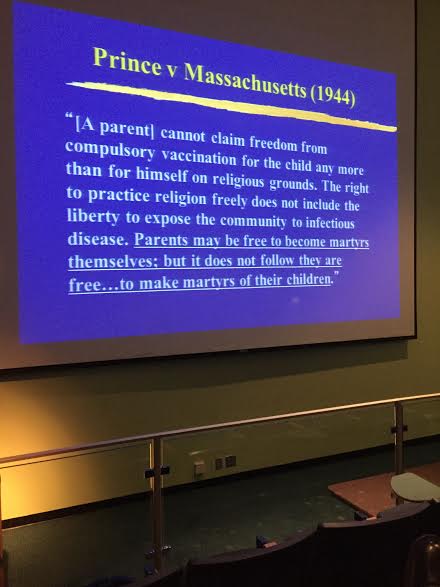
This was an amazing narrative of the measles epidemic combining the epidemiology, with journalism, law, politics, and the history of refusing vaccines.  I did not take any notes, though I did take two pictures.  The lecture was effective because it was presented like any good story with lots of details, facts, and passion.  The lies and mistakes were discussed as well.

Legal Foundation for Compulsory Vaccination during Measles Epidemic

Legal Foundation for Compulsory Vaccination during Measles Epidemic

High case fatality among those who claimed religious exemptions to vaccine

High case fatality among those who claimed religious exemptions to vaccine

Key points:

  • Religious vaccine exemption was claimed initially by Christian Scientists. This has been expanded by other groups claiming personal beliefs.
  • Vaccine successes have made people forget how dangerous diseases like measles can be; unfortunately, resurgence of these diseases may be necessary to convince people that vaccination is worthwhile

One more link -yesterday on NPR: Measles Still Kills

Related blog posts:

Microcytic Anemia Review

A useful review of microcytic anemia (NEJM 2014; 371: 1324-31) discusses the most common causes, mechanisms and treatment of microcytic anemia.

Common causes discussed include thalassemia, iron deficiency anemia, and anemia of inflammation.  With the latter, the authors review the pathophysiology: “the cause of this anemia is twofold. First, renal production of erythropoietin is suppressed by inflammatory cytokines, resulting in decreased red-cell production. Second, lack of iron availability for developing red cells can lead to microcytosis.  The lack of iron is largely due to the protein hepcidin, an acute-phase reactant that leads to both reduced iron absorption and reduced release of iron from body stores.

Treatment of iron deficiency anemia –pointers:

  • Ferrous sulfate (325 mg [65 mg of elemental iron] orally three times a day -considered first line for adults.  Ferrous gluconate at a daily dose of 325 mg [35 mg elemental] is an alternative.
  • “Several trials suggest that lower doses of iron, such as 15 to 20 mg of elemental iron daily can be as effective as higher doses and have fewer side effects.”
  • “There are many oral iron preparations, but no one compound appears to be superior to another.”
  • In those with an inadequate response to oral iron therapy, parenteral iron can be helpful.  The authors note that low-molecular-weight iron dextran (INFeD) is “associated with an incidence of reactions that is similar to that with the newer products but allows for higher doses of iron replacement.”  Typical dosing for adults: 25 mg test dose, and if tolerated for 1 hr, can give 975 mg (1000 mg total) over 4-6 hours.  The low-molecular-weight iron dextran should not be used in patients with previous iron dextran hypersensitivity reactions.
  • Alternative IV iron products: Ferric gluconate [Ferrlecit] 125 mg adult dose over 1 hour -given weekly (8 doses = 1000 mg) or Iron Sucrose [Venofer] 200 mg adult dose over 15-60 min, 300 mg over 1.5 hr, or 500 mg over 4 hr; can repeat in subsequent sessions until total dose of 1000 mg.

Related blog posts:

Disclaimer: These blog posts are for educational purposes only. Specific dosing of medications (along with potential adverse effects) should be confirmed by prescribing physician.  This content is not a substitute for medical advice, diagnosis or treatment provided by a qualified healthcare provider. Always seek the advice of your physician or other qualified health provider with any questions you may have regarding a condition.