Unknown's avatar

About gutsandgrowth

I am a pediatric gastroenterologist at GI Care for Kids (previously called CCDHC) in Atlanta, Georgia. The goal of my blog is to share some of my reading in my field more broadly. In addition, I wanted to provide my voice to a wide range of topics that often have inaccurate or incomplete information. Before starting this blog in 2011, I would tear out articles from journals and/or keep notes in a palm pilot. This blog helps provide an updated source of information that is easy to access and search, along with links to useful multimedia sources. I was born and raised in Chattanooga. After graduating from the University of Virginia, I attended Baylor College of Medicine. I completed residency and fellowship training at the University of Cincinnati at the Children’s Hospital Medical Center. I received funding from the National Institutes of Health for molecular biology research of the gastrointestinal tract. During my fellowship, I had the opportunity to work with some of the most amazing pediatric gastroenterologists and mentors. Some of these individuals included Mitchell Cohen, William Balistreri, James Heubi, Jorge Bezerra, Colin Rudolph, John Bucuvalas, and Michael Farrell. I am grateful for their teaching and their friendship. During my training with their help, I received a nationwide award for the best research by a GI fellow. I have authored numerous publications/presentations including original research, case reports, review articles, and textbook chapters on various pediatric gastrointestinal problems. In addition, I have been recognized by Atlanta Magazine as a "Top Doctor" in my field multiple times. Currently, I am the vice chair of the section of nutrition for the Georgia Chapter of the American Academy of Pediatrics. In addition, I am an adjunct Associate Clinical Professor of Pediatrics at Emory University School of Medicine. Other society memberships have included the North American Society for Pediatric Gastroenterology Hepatology and Nutrition (NASPGHAN), American Academy of Pediatrics, the Food Allergy Network, the American Gastroenterology Association, the American Association for the Study of Liver Diseases, and the Crohn’s and Colitis Foundation. As part of a national pediatric GI organization called NASPGHAN (and its affiliated website GIKids), I have helped develop educational materials on a wide-range of gastrointestinal and liver diseases which are used across the country. Also, I have been an invited speaker for national campaigns to improve the evaluation and treatment of gastroesophageal reflux disease, celiac disease, eosinophilic esophagitis, hepatitis C, and inflammatory bowel disease (IBD). Some information on these topics has been posted at my work website, www.gicareforkids.com, which has links to multiple other useful resources. I am fortunate to work at GI Care For Kids. Our group has 17 terrific physicians with a wide range of subspecialization, including liver diseases, feeding disorders, eosinophilic diseases, inflammatory bowel disease, cystic fibrosis, DiGeorge/22q, celiac disease, and motility disorders. Many of our physicians are recognized nationally for their achievements. Our group of physicians have worked closely together for many years. None of the physicians in our group have ever left to join other groups. I have also worked with the same nurse (Bernadette) since I moved to Atlanta in 1997. For many families, more practical matters about our office include the following: – 14 office/satellite locations – physicians who speak Spanish – cutting edge research – on-site nutritionists – on-site psychology support for abdominal pain and feeding disorders – participation in ImproveCareNow to better the outcomes for children with inflammatory bowel disease – office endoscopy suite (lower costs and easier scheduling) – office infusion center (lower costs and easier for families) – easy access to nursing advice (each physician has at least one nurse) I am married and have two sons (both adults). I like to read, walk/hike, bike, swim, and play tennis with my free time. I do not have any financial relationships with pharmaceutical companies or other financial relationships to disclose. I have helped enroll patients in industry-sponsored research studies.

How to Provide More Cost-Effective Celiac Care

PF Farmer et al. J Pediatr 2023; 259: 113487. Single-Center Analysis of Essential Laboratory Testing in Patients with Newly Diagnosed Celiac Disease

In this study, the authors analyzed laboratory testing results from pediatric patients newly diagnosed with celiac disease (2018-2021) to determine the usefulness of each test derived from recommended guidelines (J Snyder et al. Pediatrics 2016; 138: e20153147). Screening protocols in their center resulted in an estimated cost of approximately $320,000 during the study. Tests at diagnosis included hemoglobin, alanine/aspartate aminotransferase, ferritin, iron, TSH, Free T4, and vitamin D screening. These screening tests were done in ~80% of 468 patients.

Key findings:

  • Ferritin was abnormal in 29%, hemoglobin was abnormal in 12%, and iron was abnormal in 22%. Abnormal ferritin captured all patients in this cohort with an abnormal iron. If ferritin was used as an isolated screen with reflective iron testing, this would have reduced costs by about $12,000
  • AST and ALT were abnormal in 2% and 11% respectively
  • 25-OH Vitamin D was abnormal in 14%. Recent data indicated that low Vit D levels are similar among patients with and without celiac disease (R Ahlawat et al. JPGN 2019; 69: 449-454)
  • TSH and Free T4 were abnormal in 7% and 0.3% respectively. For thyroid disease, TSH and free T4 testing did not lead to any new diagnosis of thyroid disease (7 carried a preexisting diagnosis). There were 19 additional patients with abnormal lab values who had more testing due to initial abnormalities. If TSH alone were used for screening, costs savings would be about $29,000. If no thyroid testing were done, this would have reduced costs by about $40,000.
  • Hepatitis B immunity was NOT present in 69%. However, recent studies have shown similar levels of immunity in those with and without celiac disease. In addition, it is not clear that a low level hepatitis B surface antibody always indicates a lack of immunity. Eliminating hepatitis B screening would have reduced costs by about $63,000.
  • The authors note that the cost savings by adopting their recommendations would have saved about $104,000 (out of $320,000).

My take: This is a very useful study and indicates that curtailing initial testing for celiac disease could reduce costs substantially and without compromising care. This would include not checking a serum iron, a free T4, or hepatitis B studies. The authors note that the value of Vit D testing is also questionable but may be worthwhile due to increased risk of bone disease in individuals with celiac disease.

Related blog posts:

Blackwater Falls near Davis, WV
Seneca Rocks Trail, WV

Nonanaphylactic Alpha-Gal and Chronic Gastrointestinal Symptoms

D Glynn et al. J Pediatr 2023; 259: 113486. Nonanaphylactic Variant of Alpha-Gal Syndrome as an Etiology for Chronic Gastrointestinal Symptoms in Children

Background: A CDC report showed that between 2010 and 2022, more than 110,000 suspected cases of alpha-gal syndrome were identified. The majority of cases are linked to bites from the lone star tick which affects much of the U.S. (map below) as well as Central and South America, Asia, Africa, Australia and parts of Europe.

Findings: This study reports 3 pediatric patients who presented with only nonanaphylactic symptoms of alpha-gal syndrome. These patients with recurrent gastrointestinal distress and emesis after consuming mammalian meat, even in the absence of an anaphylactic reaction.

The diagnosis in these three patients was established by history, serum alpha-gal immunoglobulin E elevation and response to avoidance of red meat.

My take: Checking a serum Alpha-gal IgE seems like a good idea in some children with unexplained abdominal pain with episodic exacerbation with vomiting, especially if tick exposure. Anecdotally, I have checked this a few times and so far I have not I identified a case. Most cases of Alpha-gal will be associated with urticaria.

Related blog post: Tick Bites Can Lead to Allergy to Red Meat

CDC: Alpha-gal syndrome “Symptoms commonly appear 2-6 hours after eating meat or dairy products, or after exposure to products containing alpha-gal (for example, gelatin-coated medications).”

CDC: Food products that may contain alpha-gal: Mammalian meat (such as beef, pork, lamb, venison, rabbit, etc.) can contain high amounts of alpha-gal. Food products that contain milk and milk products typically contain alpha-gal (though many patients tolerate dairy products)

Foods that do NOT contain alpha-gal (unless cross contamination):

  • Poultry, such as chicken, turkey, duck, or quail
  • Eggs
  • Fish and seafood, such as shrimp
  • Fruits and vegetables
From CDC website: https://www.cdc.gov/ticks/maps/lone_star_tick.html

Case Report: 20 month old with Abrupt Vomiting and Multisystem Disease

Case history: A well-nourished previously healthy 20 month old was admitted to the hospital with a one week history of frequent vomiting. He had a history of frequent lint ingestion. He had been seen by three different health care providers during the week prior to his admission.

At the time of admission, he had numerous electrolyte derangements (Na 124, K 3.2, CL 76) and acute kidney dysfunction with a BUN of 118 and Creatinine of 3.06. He had severe multisystem disease including severe ventricular dysfunction (BNP 2196). He needed an oscillator ventilator, dialysis and cardiac medications (including epinephrine, and milrinone).

He had an extensive evaluation. After he had stabilized and then markedly improved (12 days after admission), an UGI study demonstrated an obstruction near the 2nd-3rd portion of the duodenum with a dilated proximal duodenum.

UGI study:

Due to the obstruction which was thought to be anatomic, the GI service deferred management to pediatric surgery. The surgical service requested GI inspection with endoscopy immediately prior to surgery. If a bezoar was identified, the surgical plan was for a mini-laparotomy. If not, the surgical plan was for laparoscopy repair.

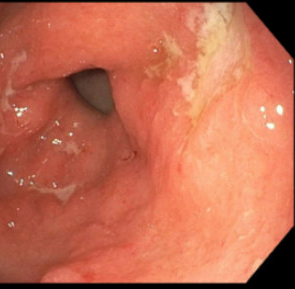
Endoscopy findings: There was a narrowed opening (different orientation of same narrowing in both pictures) with a string-like material.

Surgical findings: A duodenal web with a piece of lint was identified. The patient had a laparoscopic wedge excision with a transverse closure of the duodenotomy. The lint may have occluded the tiny opening of the web that he had been living with since he was born.

My take: This is the first time I have seen the endoscopic appearance of a duodenal web.

In my view, this was a ‘great case.’ In a commentary by Jerome Groopman (N Engl J Med 2004; 351:2043-2045), his wife noted that a case is “a great case because you not only make the diagnosis — you do something fundamental about it. You can really help.” However, Dr. Groopman stopped using the words, ‘a great case’ after his personal experience when his son was severely ill as an infant with a bowel obstruction due to intussusception: “For me and for Pam, the experience had no resonance of “a great case.” There was no intellectual pleasure in solving a clinical puzzle, no charge of exhilaration from the drama of the operation. Instead, there was terror, raw and palpable, as we realized how close we had come to burying our first son….I still find myself unable, except in retrospect, to retrieve the language of my youth and speak about “a great case.” It is as if medicine at this stage of my life has split into two streams — a current of marvelous biology and an undertow that pulls at the soul.”

Hepatitis C is Undertreated in the U.S.

C Wester et al. MMWR 2023; 72 (26): 716-720. Open Access! Hepatitis C Virus Clearance Cascade — United States, 2013–2022 (starts on page 16 of PDF)

Key findings:

  • Among the approximately 1.0 million persons in this analysis with initial infection, only 34% had laboratory evidence of viral clearance
  • Overall, viral clearance was lowest among persons aged 20–39 years (24%). Patients 0-19 were not included in this analysis
  • To overcome the low cure rate, some have recommended a subscription model for HCV treatment; this was piloted in Louisiana. In this pilot, the state paid a lump sum to make the drug available for free to all patients on Medicaid and federal prisoners. Francis Collins has indicated that a national program, while expensive, would save the government $13 billion in 10 years (Source: Infectious Disease Special Edition, 6/30/23: Most Americans With HCV Not Receiving DAAs)

My take: Improving access to HCV treatment has the potential to save livers, save lives and save money.

Related blog posts:

Good Review on Newest Medications for Obesity

For those wanting an in-depth review:

Eric Topol: “The GLP-1 and now triple G-Agonists are exceeding expectations as weight loss drugs. Benefits for cardiovascular outcomes, possibly Type 1 diabetes, addiction, and more are reviewed in the latest Ground Truths.” His newsletter also describes the early results of these medications with MASH/NASH with improvement in ~90%.

To get the full review, go to Ground Truths: http://erictopol.substack.com (can sign up to get regular emails on many current medical topics)

Related blog posts:

Subcutaneous Vedolizumab Now FDA-Approved for Adults with Ulcerative Colitis

9/27/23 Takeda: U.S. FDA Approves Subcutaneous Administration of Takeda’s ENTYVIO® (vedolizumab) for Maintenance Therapy in Moderately to Severely Active Ulcerative Colitis

” Takeda (TSE:4502/NYSE:TAK) today announced that the U.S. Food and Drug Administration (FDA) has approved a subcutaneous (SC) administration of ENTYVIO® (vedolizumab) for maintenance therapy in adults with moderately to severely active ulcerative colitis (UC) after induction therapy with ENTYVIO intravenous (IV).ENTYVIO SC is expected to be available in the U.S. as a single-dose pre-filled pen (ENTYVIO Pen) by the end of October. Additionally, a Biologics License Application for an investigational SC administration of ENTYVIO for the treatment of adults with moderately to severely active Crohn’s disease is currently under review by the FDA.”

From WJ Sandborn et al. Gastroenterol 2020; 158: 562-572. Open Access! Efficacy and Safety of Vedolizumab Subcutaneous Formulation in a Randomized Trial of Patients With Ulcerative Colitis

In the VISIBLE1 Trial, dosing was IV for week 0 and 2, then every other week SC for maintenance.

Out of Pocket Maximum (Sad Humor)

Dr. Glaucomflecken Twitter Link (w/o login): Out of Pocket Maximum (1:13 min)

There are a bunch of new videos (one for everyday in September) similar to this on related topics -search 30 Days of US Healthcare. Here’s another one: 30 Days of US Healthcare: Surprise Billing (YouTube)

My take: As usual, Dr. Glaucomflecken humor sheds light on the faults in our nation’s health care insurance coverage.

Management of Ostomies

TL Hedrick et al. Clin Gastroenterol Hepatol 2023; 21: 2473-2477. Open Access! AGA Clinical Practice Update on Management of Ostomies: Commentary

This article is a helpful review on ostomy care. The article reviews approaches to common problems including early high ostomy output, ostomy leakage, stoma retraction, mucocutaneous separation, dermatological problems, chronic high ostomy output, parastomal hernia, and stoma prolapse. A few of their comments:

  • “An estimated 750,000 Americans live with an ostomy and 130,000 new ostomy surgeries occur in the United States annually.1
  • “Reversal [of ostomy] before 6 weeks of the index surgery is associated with an increased risk of complications”
  • For leakage of ostomy: “Management steps involve thickening the stool with antidiarrheals to facilitate a more solid effluent and pouching techniques to bolster the height of the stoma off the peristomal skin (eg, convex appliance, ostomy belt, paste, or barrier rings). Each of these items is available through the patient’s medical equipment supplier. Additional pearls include heating the appliance with a hair dryer before application, lying flat for several minutes after application, ensuring the peristomal skin is dry before application, and use of a fine dusting of stomal powder followed by skin sealant on the peristomal skin before application.”
  • Stoma prolapse: “The rate of stomal prolapse is 5% to 10%.12 Acute prolapse can lead to incarceration and ischemia, which presents as pain, obstipation, and purple/black discoloration of the stoma…In the absence of ischemia, the prolapse may be reduced by laying the patient in a relaxed position and gently squeezing the ostomy back into the abdomen. If the stoma cannot be reduced with pressure alone, a cup of sugar applied directly to the stoma and left in place for 20 minutes can reduce stomal swelling and facilitate reduction of the prolapse. Surgery can be avoided if the prolapse is mild, easily reducible, and does not interfere with pouching.”
  • Medications for High Ostomy Output include bulking agents (fiber, guar gum, marshmellows), antimotility agents (eg. loperamide, diphenoxylate/atropine), and antisecretory agents (PPIs, Octreotide). Treatment of specific underlying disease may help, such as anti-inflammatory agents for IBD and GLP-2 analogues for short bowel.

Related blog posts:

Disclaimer: This blog, gutsandgrowth, assumes no responsibility for any use or operation of any method, product, instruction, concept or idea contained in the material herein or for any injury or damage to persons or property (whether products liability, negligence or otherwise) resulting from such use or operation. These blog posts are for educational purposes only. Specific dosing of medications (along with potential adverse effects) should be confirmed by prescribing physician.  Because of rapid advances in the medical sciences, the gutsandgrowth blog cautions that independent verification should be made of diagnosis and drug dosages. The reader is solely responsible for the conduct of any suggested test or procedure.  This content is not a substitute for medical advice, diagnosis or treatment provided by a qualified healthcare provider. Always seek the advice of your physician or other qualified health provider with any questions you may have regarding a condition.

The Quality of Evidence for Dietary Treatments in Inflammatory Bowel Disease

BN Limketkai et al. Clin Gastroenterol Hepatol 2023; 21: 2508-2525. Open Access! Dietary Interventions for the Treatment of Inflammatory Bowel Diseases: An Updated Systematic Review and Meta-analysis

This was a systematic review of prospective controlled trials (n=27) of solid food diets for the induction or maintenance of remission in IBD.

Key findings:

  • For induction of remission in Crohn’s disease (CD), the Mediterranean diet was similar to the Specific Carbohydrate Diet (low certainty of evidence), and partial enteral nutrition (PEN) was similar to exclusive enteral nutrition (very low certainty of evidence).
  • PEN reduced risk of relapse (very low certainty of evidence), whereas reduction of red meat or refined carbohydrates did not (low certainty of evidence).
  • For ulcerative colitis, diets were similar to controls (very low and low certainty of evidence).

My take: Most of the dietary treatments for IBD have low to very low certainty of evidence regarding their effectiveness. Dietary changes are very likely to be helpful but more studies with rigorous endpoints are still needed.

Related blog posts:

Gastroparesis is Frequently Misdiagnosed

D Cangemi, L Stephens, BE Lacy. Clin Gastroenterol Hepatol 2023; 2670-2672. Misdiagnosis of Gastroparesis is Common: A Retrospective Review of Patients Referred to a Tertiary Gastroenterology Practice

In this retrospective study with adult patients (n=339) referred specifically to a tertiary center for evaluation of gastroparesis (GP) from 2019-2021, the key findings:

  • Nausea was most common symptom (in 89%), followed by abdominal pain (76%, constipation (71%), vomiting (66%), bloating (38%) and early satiety (35%)
  • 196 (58%) had undergone a prior gastric emptying study; though only 23 (7%) had ingested radiolabeled eggs as the test meal.
  • 66 (19.5%) ultimately received a diagnosis of GP; 80.5% received alterative diagnosis including functional dyspepsia in 44.5%. In those with GP, diabetes was more common (40% vs. 17%, P=.017).
  • GP patients more often had retained food in the stomach during EGD (23% vs. 11%, P=.013)

My take: In adults (& probably in children), most individuals labelled as having gastroparesis actually have an alternative explanation, usually functional dyspepsia. The symptoms are indistinguishable and improperly performed scintigraphy contributes to confusion.

Related blog posts:

Nelson Rocks, Circleville, WV