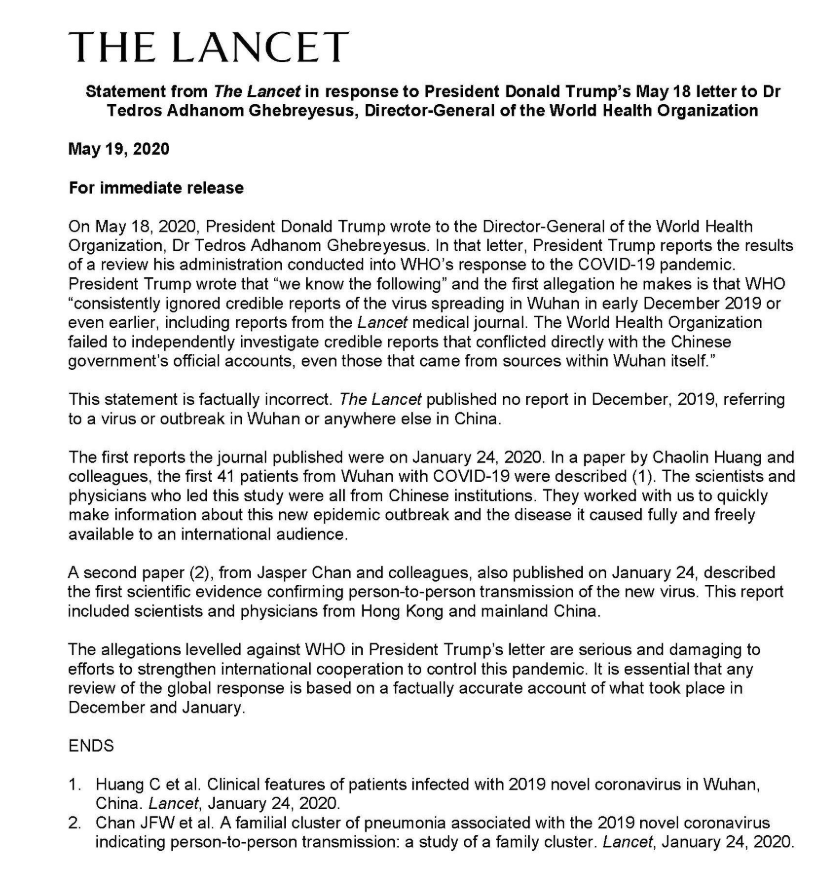
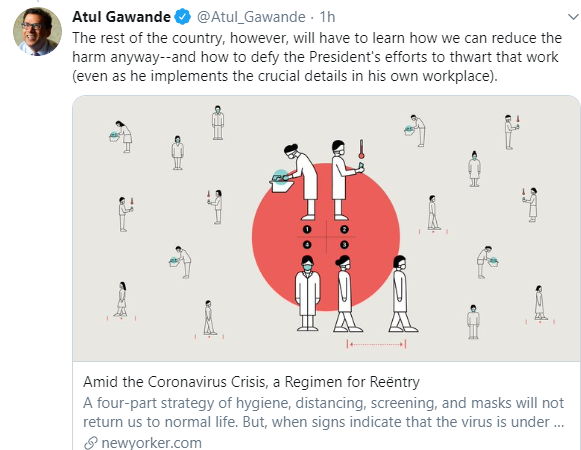
Costly Free COVID-19 Testing and Timely Tweets

From NPR: COVID-19 Tests That Are Supposed To Be Free Can Ring Up Surprising Charge

An excerpt:

This reality means some medical providers… must rule out other respiratory diseases before ordering a COVID-19 test, leaving some patients with a difficult choice. Do they seek medical attention and risk a high medical bill? Or do they forgo care altogether?

A second hole in these federal protections may leave patients holding the bill for their COVID-19 test. The law prohibits insurers from charging patients for testing, but it does not block medical providers from doing so. If an insurer does not cover the total amount charged by a provider, the patient may get balance-billed, or slapped with a surprise charge.

From USAToday:

Related blog post:‘Quietly’ Testing Famotidine for COVID-19

From NY Times:

COVID Toes

USA Today (4/27/20): Doctors find more cases of ‘COVID toes’ in dermatological registry. Here’s what they learned

An excerpt:

Dr. Esther Freeman, director of Massachusetts General Hospital Global Health Dermatology and member of the AAD task force on COVID-19, said COVID toes are pinkish-reddish “pernio-like lesions” that can turn purple over time…

While experts can’t confirm why COVID toes appear, they have some educated guesses. One could be inflammation in the toes’ tissue… Another hypothesis is inflammation of the blood vessel wall, medically known as vasculitis. And finally, … it is possible COVID toes could be caused by small blood clots that form inside the blood vessel…

COVID toes have appeared in some cases of asymptomatic patients. The majority of the toe cases manifested simultaneously or after more common COVID-19 symptoms, rather than before.  

My take: During this pandemic, I need to look at my patient’s feet.

Measles Outbreak, 2018-2019 & More on Coronavirus in Georgia

A recent report (JR Zucker et al. NEJM 2020; 382: 1009-17) highlights an outbreak of a vaccine-preventable disease, measles.  Measles is much more contagious than the recent coronavirus; this is one reason why a vaccine is so crucial.

In total, there were 649 cases confirmed –most of the cases were in a close-knit community in Brooklyn, NY.  86% of the cases with a known vaccination history occurred in those who were unvaccinated. 49 required hospitalization.  The cost to the Department of Health was $8.4 million.

My take:  The health consequences and cost of not preventing measles is staggering -though being eclipsed by the coronavirus pandemic.  The toll in Europe has been much higher.  Worldwide more than 140,000 died from measles in 2018.

Related blog posts:

From Georgia Department of Health: COVID-19 Status Report

It is important to understand that some data, particularly in the last 2 weeks, may not be reported yet.

Related blog post (April 24): Why Georgia Isn’t Ready to Reopen

“Quietly” Testing Famotidine for COVID-19

Yesterday, I received two emails (first from Steven Liu) about an article in Science and today I’ve already seen this article is referenced in a CNN report:

New York Clinical Trial Quietly Tests Heartburn Remedy Against Coronavirus

Key points:

  • In China, a review of ~6000 patients suggested lower mortality in those taking famotidine (not statistically significant)
  • Famotidine may interfere with viral replication protease in the coronavirus based on computer modeling
  • A randomized trial with IV famotidine (large quantities are not available) is underway in New York using 9 times the dose used for heartburn.
  • The article notes that increased heart problems are common in those with reduced renal function
  • “We still don’t know if it will work or not”

My take: Famotidine may be a hot commodity –at least until studies are completed.  Based on experience with hydroxychloroquine, some of our patients may need to look for alternative acid blockers.

Related blog posts:


NY Times: Why Georgia Isn’t Ready, You Shouldn’t Drink Disinfectants/Bleach, Masks Help


Correction: Today’s earlier blog post has been updated:

  • For >1000 [calprotectin], the sensitivity 38%, specificity 100%, PPV 98%, and NPV 92%
  • Previously this line started with the following: “For >100”

From NY Times: Why Georgia Isn’t Ready to Reopen

Key points:

  • Georgia’s infection rates have not started to decline
  • Georgia has a low testing rate compared to other states
  • Georgia’s population rate is vulnerable with increased rates of diabetes and the 4th highest rates of uninsured individuals

Timely Tweets & NY COVID-19 Study

From John Pohl Twitter Feed: Article about mortality/comorbidites from COVID-19 in NYC: Link: Presenting Characteristics, Comorbidities, and Outcomes Among 5700 Patients Hospitalized With COVID-19 in the New York City Area

Methods: Case series of patients with COVID-19 admitted to 12 hospitals in New York City, Long Island, and Westchester County, New York, within the Northwell Health system. The study included all sequentially hospitalized patients between March 1, 2020, and April 4, 2020, inclusive of these dates.

Key findings:

  • The authors report a 88% fatality rate among patients requiring mechanical ventilation, including >97% among those >65 years of age
  • Comorbidities were present in 94% of the 5700 patients.  Most common comorbities included  hypertension (57%), obesity (42%), and diabetes (34%). Asthma was present in 9%.
  • Among patients who were discharged or died (n = 2634), 14.2% were treated in the intensive care unit, 12.2% received invasive mechanical ventilation, 3.2% were treated with kidney replacement therapy, and 21% died.


From Emily Perito:

From The Onion


Get Ready for 2021 Coding Changes

MDEdge GI Hep News: Prepare for major changes to E/M coding starting in 2021

New Evaluation and Management (E/M) codes are coming in 2021 –this could simplify documentation.

Here’s an excerpt:

1.Elimination of history and physical as elements for code selection

2. Choice of using medical decision making (MDM) or total time as the basis of E/M level documentation

  • MDM. While there will still be three MDM subcomponents (number/complexity of problems, data, and risk), extensive edits were made to the ways in which these elements are defined and tallied.
  • Time. The definition of time is now minimum time, not typical time or “face-to-face” time. Minimum time represents total physician/qualified health care professional time on the date of service

3. Modification of the criteria for MDM:

  • Terms. Removed ambiguous terms (e.g., “mild”) and defined previously ambiguous concepts (e.g., “acute or chronic illness with systemic symptoms”).
  • Definitions. Defined important terms, such as “independent historian.”
  • Data elements. Re-defined the data elements to move away from simply adding up tasks to focusing on how those tasks affect the management of the patient (e.g., independent interpretation of a test performed by another provider and/or discussion of test interpretation with another physician).

4. Modifier/add-on code): GPC1X can be reported with all levels of E/M office/outpatient codes in which care of a patient’s single, serious, or complex chronic condition is the focus. CMS plans to reimburse GPC1X at 0.33 RVUs (about $12).

Resources:

“Contact your Electronic Health Records (EHR) vendor to confirm the system your practice uses will be ready to implement the new E/M coding and guidelines changes on Jan. 1, 2021.”

My take: The intent of these changes is logical.  The goal of coding is to align the reimbursement with the degree of effort and not simply allow pre-formatted templates justify upcoding.  They could lead to simplification of documentation and allow more documentation time for medical decision-making part of the visit.

Related blog posts:

AMA Table 2 for E/M codes 212-215, 202-205


NY Times: America can afford a world-class health system. Why don’t we have one?

Yesterday’s NY Times had a terrific review section of the paper with the theme of “The America We Need.”  The section highlighted the interaction between the coronavirus and inequality, unemployment, collective action, and emerging threats (eg. climate change).

The article with the most relevance for medicine was titled: America can afford a world-class health system. Why don’t we have one?

Here’s an excerpt:

The notion of price control is anathema to health care companies. It threatens their basic business model, in which the government grants them approvals and patents, pays whatever they ask, and works hand in hand with them as they deliver the worst health outcomes at the highest costs in the rich world.

The American health care industry is not good at promoting health, but it excels at taking money from all of us for its benefit. It is an engine of inequality…

America is a rich country that can afford a world-class health care system. We should be spending a lot of money on care and on new drugs. But we need to spend to save lives and reduce sickness, not on expensive, income-generating procedures that do little to improve health. Or worst of all, on enriching pharma companies that feed the opioid epidemic.

The first step to reform is to change the way we think…It would be more accurate to think of employer-provided health insurance as a tax….

Employer-based health  insurance is a wrecking ball, destroying the labor market for less-educated workers and contributing to the rise in “deaths of despair.”…

To meet those rising costs, states have cut their financing for roads, bridges and state universities. Without those crucial investments, the path to success for many Americans is cut off. We face a looming trillion-dollar federal deficit caused almost entirely by the rising costs of Medicaid and Medicare, even without the recent coronavirus relief bill…

Americans have too few doctors, too few beds and too few ventilators — but lots of income for providers. While millions suffer, our health care system has turned into an inequality machine, taking from the poor and working class to generate wealth for the already wealthy…

The health care industry has armored itself, employing five lobbyists for each elected member of Congress. But public anger has been building — over drug prices, co-payments, surprise medical bills — and now, over the fragility of our health care system, which has been laid bare by the pandemic…

Employer-based health care is a particular nightmare in this pandemic. In recent weeks, millions have lost their paychecks and their insurance, and will have to face the virus without either.

We are believers in free-market capitalism, but health care is not something it can deliver in a socially tolerable way.

My take: Many health care workers and hospital employees are showing incredible courage and compassion in this pandemic.  This article reminds us of all the work needed to improve our health care system.

Related blog posts:


Curbside humor -my wife is leaving different jokes everyday for neighborhood walkers


From CNN:

COVID-19 Daily Deaths & Asymptomatic Infections

Recent data show why experts were concerned about SARS-CoV-2 (COVID-19 Virus) several months ago, due to its potential for exponential spread. Even now many question whether this infection is more significant than influenza.

Link: COVID-19 Daily Deaths

Several screenshots:

NEJM Link: Universal Screening for SARS-CoV-2 in Women Admitted for Delivery

An excerpt:

Between March 22 and April 4, 2020, a total of 215 pregnant women delivered infants at the New York–Presbyterian Allen Hospital and Columbia University Irving Medical Center [NYC] …

Most of the patients who were positive for SARS-CoV-2 at delivery were asymptomatic, and more than one of eight asymptomatic patients who were admitted to the labor and delivery unit were positive for SARS-CoV-2. Although this prevalence has limited generalizability to geographic regions with lower rates of infection, it underscores the risk of Covid-19 among asymptomatic obstetrical patients. Moreover, the true prevalence of infection may be underreported because of false negative results of tests to detect SARS-CoV-2

My take: This study indicates that there are a lot of undetected cases of SARS-CoV-2.


Stony Brook Univeristy’s Innovations to manage COVID-19 Crisis -NEJM: Staying Ahead of the Wave

Some tips:

Related blog posts:


NEJM: Compassionate Use of Remdesivir

Full report, NEJM, J Grein et al. April 10, 2020, DOI: 10.1056/NEJMoa2007016: Compassionate Use of Remdesivir for Patients with Severe Covid-19

53 of 61 had adequate data for inclusion.  Indications of severe COVID-19: at baseline, 57% required mechanical ventilation and 4 (8%) were receiving ECMO.

With a median follow-up of 18 days, Key findings:

  • 36 patients (68%) had an improvement in oxygen-support class, including 17 of 30 patients (57%) receiving mechanical ventilation who were extubated.
  • 25 patients (47%) were discharged
  • 7 patients (13%) died; mortality was 18% (6 of 34) among patients receiving invasive ventilation and 5% (1 of 19) among those not receiving invasive ventilation.
  • By 28 days of follow-up, the cumulative incidence of clinical improvement, as defined by either a decrease of 2 points or more on the six-point ordinal scale or live discharge, was 84%

My take: Given the severity of the disease, this therapy looks promising. However, the authors note that “measurement of efficacy will require ongoing randomized, placebo-controlled trials of remdesivir therapy.”

For each oxygen-support category, percentages were calculated with the number of patients at baseline as the denominator. Improvement (blue cells), no change (beige) and worsening (gray) in oxygen-support status are shown. Invasive ventilation includes invasive mechanical ventilation, extracorporeal membrane oxygenation (ECMO), or both. Noninvasive ventilation includes nasal high-flow oxygen therapy, noninvasive positive pressure ventilation (NIPPV), or both.