Bariatric Surgery Helps NASH

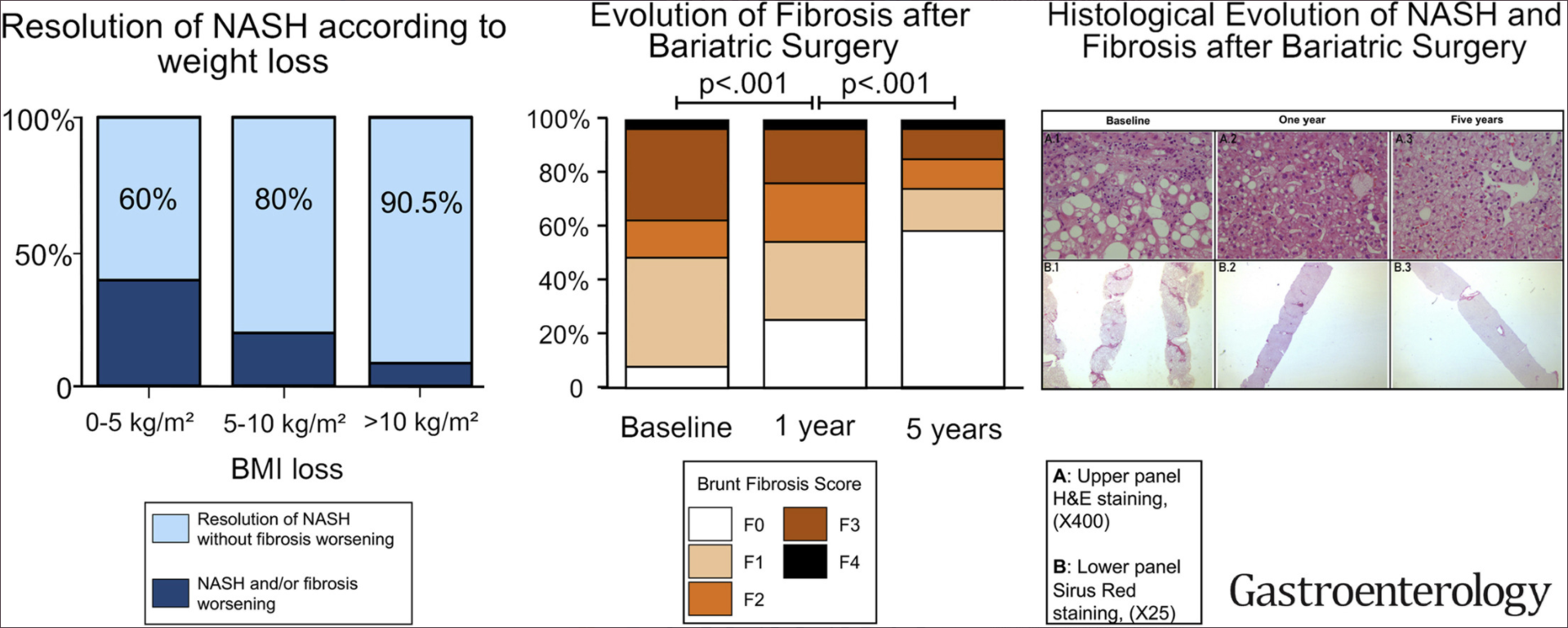
G Lassailly et al. Gastroenterol 2020; 159: 1290-1301. Bariatric Surgery Provides Long-term Resolution of Nonalcoholic Steatohepatitis and Regression of Fibrosis

This was a  prospective study of 180 severely obese patients with biopsy-proven NASH.

Key findings:

  • NASH: At 5 years after bariatric surgery, NASH was resolved, without worsening fibrosis, in samples from 84% of patients (n = 64; 95% confidence interval, 73.1%-92.2%). 
  • Fibrosis: Fibrosis decreased, compared with baseline, in samples from 70.2% of patients (95% CI, 56.6%-81.6%). Fibrosis disappeared from samples from 56% of all patients (95% CI, 42.4%-69.3%) and from samples from 45.5% of patients with baseline bridging fibrosis. 
Graphic Abstract

My take: This study showed that patients with NASH who underwent bariatric surgery had resolution of NASH in liver samples from 84% of patients 5 years later. The reduction of fibrosis was progressive, beginning during the first year and continuing through 5 years.

Related blog posts:

Insight Into Alpha-1 Antitrypsin Heterozygosity

CV Schneider, K Hamesch et al. Gastroenterol 2020; 159: 534-548Liver Phenotypes of European Adults Heterozygous or Homozygous for Pi∗Z Variant of AAT (Pi∗MZ vs Pi∗ZZ genotype) and Noncarriers)

Key findings:

  • Ten percent of subjects with the Pi∗MZ genotype vs 4% of noncarriers had LSMs (liver stiffness measurements) of 7.1 kPa or more (adjusted odds ratio, 4.8; 95% confidence interval, 2.0–11.8)
  • Obesity and diabetes were the most important factors associated with LSMs ≥7.1 kPa in subjects with the Pi∗MZ genotype.
  • AAT inclusions were detected in liver biopsies of 63% of subjects with the Pi∗MZ genotype, vs 97% of subjects with the Pi∗ZZ genotype, and increased with liver fibrosis stages.

The associated editorial (pg 433-34) noted that Pi∗MZ genotype is a disease modifier in cystic fibrosis, alcoholic liver disease, and nonalcoholic liver disease.

My take: This study indicates that Pi∗MZ genotype for alpha-one antitrypsin are more likely to develop liver fibrosis in the presence of other risk factors like obesity and diabetes mellitus.

Related blog posts:

Autoimmune Hepatitis -Early Response Associated with Remission

Briefly noted: S Pape et al .Clin Gastroenterol Hepatol 2020; 18: 1609-1617. Full Text: Rapid Response to Treatment of Autoimmune Hepatitis Associated With Remission at 6 and 12 Months

Methods: This was a retrospective cohort study, collecting data from 2 independent cohorts of adults (each with n=370) with AIH from 12 centers in 7 countries in Europe.

Key findings:

  • The authors found that a significant decrease in level of AST after 8 weeks of treatment was significantly associated with normalization of transaminase levels at 26 and 52 weeks (P < .001)
  • In both cohorts, rapid responders (≥80% decrease in level of AST after 8 weeks) were more likely to achieve normalization of transaminases at 26 and 52 weeks when compared to non-rapid responders
  • Rapid responders in the discovery cohort had lower risk of liver-related death or transplantation (adjusted hazard ratio 0.18)
  • Slow responders (without normalization of transaminases after 1 year) had the highest risk of liver transplantation or liver-related death.

My take: It is no surprise that patients who respond rapidly to treatment would fare better.  This study establishes a target of >80% improvement in AST at 8 weeks.

Related blog posts:

Liver Shorts -August 2020

V Cardenas et al. JPGN 2020; 71: 197-202.  Incidence and Sequelae of Liver Injury Among Children Treated for Solid Tumors: Analysis of a Large Single-Center Prospective Cohort

  • Of 1136 solid tumor patients, 160 (14%) experienced liver injury, and the overall frequency of DILI was 4%.
  • DILI was the leading identified cause of liver injury (31%), followed by infection (17%), metastatic/malignant biliary disease (13%), and perioperative liver injury (13%).
  • Most DILI cases (>90%) were mild acute hepatocellular injury episodes that did not result in modification to the chemotherapy plan, and all DILI eventually resolved.

N Kapila et al. Hepatology 2020; 72: 32-41. Full Text Link: Hepatitis C Virus NAT‐Positive Solid Organ Allografts Transplanted Into Hepatitis C Virus–Negative Recipients: A Real‐World Experience

Background: As of April 1, 2019, an estimated 103,000 kidney, 13,500 liver, and 3,800 heart transplant (HT) candidates are awaiting transplantation

Key findings:

  • Seventy‐seven patients who were HCV negative underwent solid organ transplantation from a donor who was HCV viremic. Only one has been a HCV-treatment nonresponder (though several have not completed SVR12).
  • “Our study is the largest to describe a real‐world experience of the transplantation of HCV‐viremic organs into recipients who are aviremic. In carefully selected patients, the use of HCV‐viremic grafts in the DAA era appears to be efficacious and well tolerated.”

M Martinello et al. Hepatology 2020; 72: 7-18Short‐Duration Pan‐Genotypic Therapy With Glecaprevir/Pibrentasvir for 6 Weeks Among People With Recent Hepatitis C Viral Infection

  • This was an  open‐label, single‐arm, multicenter, international pilot study; adults with recent HCV (duration of infection < 12 months) received glecaprevir/pibrentasvir 300/120 mg daily for 6 weeks.
  • At baseline, median estimated duration of infection was 29 weeks (range 13, 52) and median HCV RNA was 6.2 log10 IU/mL (range 0.9, 7.7). SVR12 in the intention‐to‐treat and per‐protocol populations was achieved in 90% (27/30) and 96% (27/28), respectively.

H Verkade et al. JPGN 2020; 71: 176-83. Systematic Review and Meta-analysis: Partial External Biliary Diversion in Progressive Familial Intrahepatic Cholestasis

  • With regard to  pruritus improvement, 104/155 (67%) were responders, 14/155 (9%) had partial response, and 37/155 (24%) were nonresponders.

K Patel et al. Hepatology 2020; 72: 58-71. Cilofexor, a Nonsteroidal FXR Agonist, in Patients With Noncirrhotic NASH: A Phase 2 Randomized Controlled Trial

  • “Cilofexor for 24 weeks was well‐tolerated and provided significant reductions in hepatic steatosis, liver biochemistry, and serum bile acids in patients with NASH.”

AASLD: Advice for Patients with Liver Diseases and Liver Transplants During COVID-19

AASLD: OK Fix et al. Hepatology 2020; 72: 287-304. Full Article Link: Clinical Best Practice Advice for Hepatology and Liver Transplant Providers During the COVID‐19 Pandemic: AASLD Expert Panel Consensus Statement

This is a lengthy article with extensive recommendations –here are a few:

  • Consider etiologies unrelated to COVID‐19, including other viruses such as hepatitis A, B and C, when assessing patients with COVID‐19 and elevated liver biochemistries.
  • Consider other causes of elevated liver biochemistries, including myositis (particularly when AST>ALT), cardiac injury, ischemia, and cytokine release syndrome.
  • Generally, this article supports continuation of ongoing treatments in those with liver disease who are without active infection.  “Do not reduce immunosuppression or stop mycophenolate for asymptomatic posttransplant patients without known COVID‐19”
  •  “As we learn more about how the COVID‐19 pandemic impacts the care of patients with liver disease, we will update the online document available at https://www.aasld.org/about-aasld/covid-19-and-liver.”

Fatty Liver Feast (of Articles): NAFLD 2020

An entire issue of Gastroenterology delved into the topics of “NAFLD 2020.”

This special May 2020 issue provides a comprehensive update on Nonalcoholic Fatty Liver Disease.

Here are a few links to some of the articles:

Related blog posts:

Big Advance for Hepatitis B, Plus One

A recent open-label randomized controlled study (M Bazinet et al. Gastroenterol 2020; 158: 2180-94https://doi.org/10.1053/j.gastro.2020.02.058) showed that the addition of nucleic acid polymers (NAPs) which inhibit assembly and secretion of hepatitis B virus (HBV) subviral particles significantly improved outcomes in a phase 2 HBV trial (n=40).

Full text: Safety and Efficacy of 48 Weeks REP 2139 or REP 2165, Tenofovir Disoproxil, and Pegylated Interferon Alfa-2a in Patients With Chronic HBV Infection Naïve to Nucleos(t)ide Therapy

NAP therapy was administered intravenously once a week.

Key findings:

  • During the first 24 weeks of tenofovir (TDF) and peg-Interferon (pegIFN) administration, significantly higher proportions of patients in NAP groups had decreases in HBsAg to below 1 IU/mL (P < .001 vs control) and HBsAg seroconversion (P = .046 vs control).
  • At the time patients completed the TDF + pegIFN + NAP regimen, HBsAg levels were 0.05 IU/mL or lower in 24/40 participants
  • During 48 weeks of treatment-free follow-up, virologic control persisted in 13 of 40 participants (2 lost to follow-up after 24 weeks), whereas functional cure persisted in 14 of 40 participants (all completing 48 weeks of follow-up) with persistent HBsAg seroconversion

The associated editorial (pg 2051-4 by D Durantel, T Asselah) makes the following points:

  • The authors call for larger multicenter studies with longer followup.  They note that more evaluation is needed to determine if seroconversion is sustained.
  • It remains unclear whether PEG-IFN is needed. TDF/NAP therapy without PEG-IFN was not studied.
  • They state that more information about flares during treatment are needed.  In this study, flares were safe and associated with beneficial outcomes.  It is not clear if therapy flares would be detrimental in those with advanced fibrosis.
  • Optimistically, they state that there are multiple competing therapies being studied (eg. small interfering RNA, and small molecule HBs-RNA destabilizer) which could be more easily administered.

My take (borrowed from authors): In a phase 2 randomized trial, “we found that addition of NAPs to TDF + pegIFN did not alter tolerability and significantly increased rates of HBsAg loss and HBsAg seroconversion during therapy and functional cure after therapy.”

A related commentary (Gastroenterol 2020; 158: 2028-32) calls for investment/study of treatment for immune-tolerant patients along with curative therapy when it becomes available.  The authors also argue for a study of long-term viral suppression with either entecavir or tenofovir alafenamide.

Plus one: N Rodriguez-Baez et al. JPGN 2020; 71: 99-105.  This study examined liver histology from 134 liver biopsies from treatment-naive children with chronic hepatitis B infection. 60% acquired infection vertically, 69% were HBeAg-positive.   Interface hepatitis was mild in 31%, moderate in 61% and severe in 6%; lobular inflammation was mild in 54%, moderate in 29% and severe in 7%. Fibrosis: 18% had no fibrosis, 59% had portal fibrosis without bridging, 19% had bridging fibrosis and 4% had cirrhosis. Alanine amnotransferase was a fairly good indicator of the severity of hepatic inflammation and extent of fibrosis.

Related blog posts:

ACG Review (Zobair Younassi, MD): NAFLD and NASH

For PDF copy of slides: NAFLD and NASH

Dr. Zobair Younassi gave a recent virtual grand rounds –here are some of the slides:

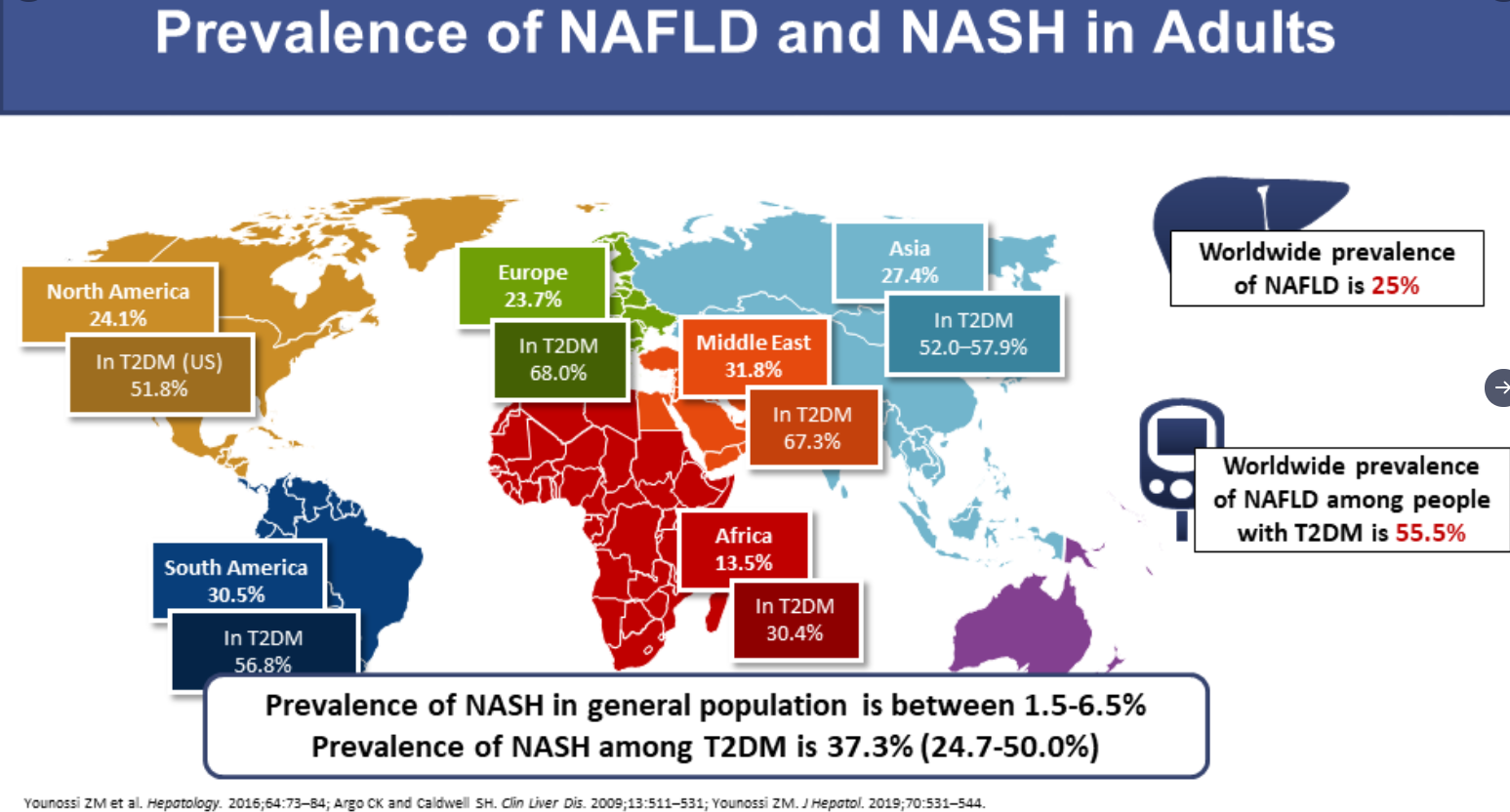
Epidemiology:

Natural History:

  • Progression of disease is not linear
  • Fatty liver disease is a multisystem disorder.  Cardiovascular disease is leading cause of death in patients with fatty liver disease
  • Fatigue (~50%) is common with fatty liver disease

Main treatment:

  • Weight loss -Mediterranean diet may be helpful
  • Exercise
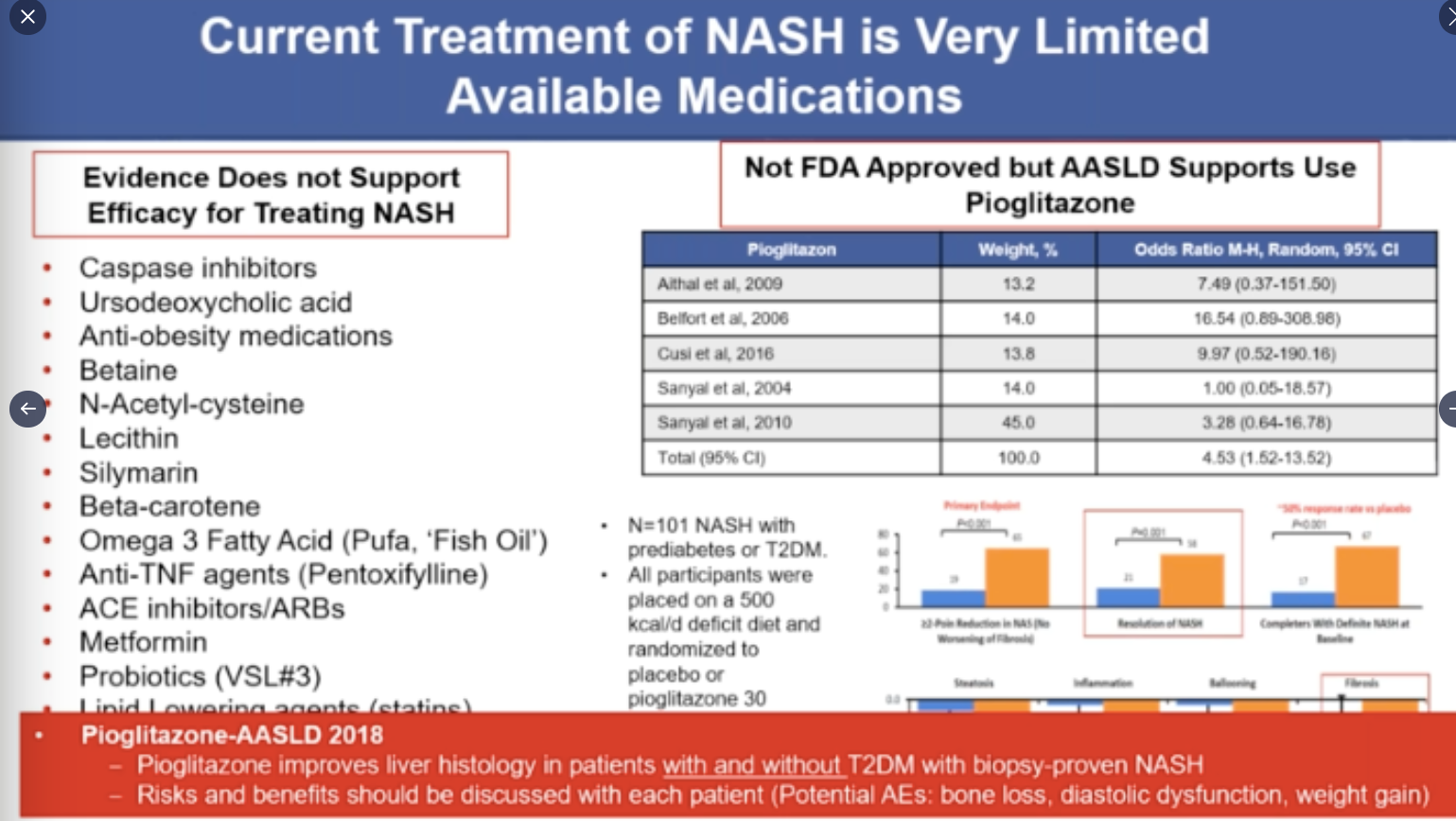
  • No FDA-approved treatments, though pioglitizone supported by AASLD for biopsy-proven NASH
  • Public health interventions are needed

Surprised This Was Published: Liver Transplantation in Undocumented Immigrants

I was keenly interested in a recent study: BP Lee, NA. Terrault. Liver Transplantation in Unauthorized Immigrants in the United States. Hepatology 2020; 71: 1802-12.  Given the potential for causing a political firestorm, I was surprised it was published.

Definitions: “Unauthorized immigrants, also termed illegal aliens in US federal statures are…all foreign-born non-citizens who are not legal residents.”  Since March 2012, UNOS has required transplant centers to record citizenship…”primarily to better understand transplant tourism.” The authors excluded international transplant tourists in their cohort.

Key findings: 

  • 116 of 43,192 (0.4%) liver transplant (LT) recipients were unauthorized immigrants
  • The majority were from Mexico (52%).  Others came from Guatemala (7%), China (6%), El Salvador (5%) and India (5%).
  • Unauthorized immigrant recipients had a similar risk of graft failure (sHR 0.74) and death (sHR 0.68), though at time of LT, there was higher disease severity (higher MELD scores and increased need for renal replacement therapy).
  • Most LTs for unauthorized immigrants took place in California (47%) and New York (18%).  Texas (3%) and Florida (4%) had a lower proportion of LTs for unauthorized immigrants based on population distribution.
  • The authors note that unauthorized immigrants are different that transplant tourists  –they pay social security tax/other taxes and contribute to organ donation (~3% of donated organs) whereas transplant tourists do not.
  • The authors note that unauthorized immigrant LTs were less than half the number of transplant tourist LTs; the later LT recipients are commonly individuals from Persian Gulf countries.
  • Current federal law mandates that LT be distributed based on “established medical criteria” which does not suggest a “tiered allocation system by citizenship.”  Almost half of the unauthorized immigrant LTs were covered by Medicaid.

My take: Unauthorized immigrants are underrepresented as LT recipients compared to their total population distribution in the U.S.  This likely is due to a number of barriers.  Interestingly, this population is not underrepresented when it comes to organ donation.


Liver Shorts -May 2020 & CDC Recommendations for Office (NY Times Summary)

NY Times:  C.D.C. Recommends Sweeping Changes to American Offices


FDA Approves Hepatitis C Pangenomic Treatment for Children (Mar 19, 2020):

The U.S. Food and Drug Administration today approved a supplemental application for Epclusa (sofosbuvir and velpatasvir) to treat hepatitis C virus (HCV) in children ages 6 years and older or weighing at least 37 pounds (17 kilograms) with any of the six HCV genotypes—or strains—without cirrhosis (liver disease) or with mild cirrhosis.

Review: NAFLD in China 1999-2018 J Zhou et al. Hepatology 2020; 71: 1851-4.

  • NALFD increased by 8-9% in prevalence, to 29.1%.  This means there are more than 230 million individuals with NAFLD in China.

Use of HCV-positive donors for liver transplantation to HCV-negative recipients. N Anwar et al. Liver Transplantation 2020; 26: 673-80. Key finding: HCV-positive organs had similar outcomes regarding graft function, patient survival and post-LT complications.

Recent Decline in Hepatocellular Carcinoma Rates in U.S. MS Shiels, TR O’Brien. Gastroenterol 2020; 158: 1503-5. Using SEER-21 population based cancer registries covering 37% of U.S. population, the authors found a recent decline in rates of HCC:

  • 2000-2016: 119,078 cases of HCC in SEER-21 registries, 5.84/100,000
  • Rates increased b 5.6% per year from 2000-2007, then by 2.7% per year from 2007 to 2013, subsequent rate reached a plateau and declined with drop of 1.4% per year (P=.12)
  • Improvement could have been due in part to improvement in viral hepatitis treatment; a less favorable explanation could be that the drop occured due to a death from another cause (eg. non-HCC death due to cirrhosis, opioid-related death

Related blog posts:

Potential Treatment for Nonalcoholic Steatohepatitis N Chalasani et al. Gastroenterol 2020; 158: 1334-45. The study explored the use of Belapectin, an inhibitor of Galectin-3, in patients with nonalcoholic steatohepatitis and cirrhosis. n=162, phase 2 randomized, double-blind study. Key finding: 1 year of every 2 week infusions were safe but not associated with significant reductions in hepatic venous pressure gradient (HVPG) or fibrosis. However, in a subgroup without varices, there was lowered HVPG and lowered risk of new varices.

Treatment Options for Minimal Hepatic EncephalopathyRK Dhiman et al. Clin Gastroenterol Hepato 2020; 18: 800-12.  This meta-analysis which included 25 trials (n=1563) found the following:

  • For reversing minimal hepatic encephalopathy (MHE), rifaximin (OR 7.53) and lactulose  (OR 5.39) were effective with moderate quality evidence.  Probiotics had OR 3.89 and L-ornithine L-aspartate had OR 4.45 —both with low quality evidence.
  • For prevention of HE, L-ornithine L-aspartate had OR 0.19 (‘high moderate’ quality), and lactulose had OR 0.22 (moderate quality) were effective. Probiotics had OR 0.27 with low quality evidence.
  • The authors conlude that lactulose is the most effective agent for prevention and reversal of MHE.

Related blog posts:


Curbside Humor