K Gottlieb, J Requa et al. Gastroenterol 2021; 160: 710-719. Central Reading of Ulcerative Colitis Clinical Trial Videos Using Neural NetworksKey finding: A deep learning algorithm can be trained to predict levels of UC severity from full-length endoscopy videos with excellent agreement with human central readers; endoscopic healing accuracy was 97% for UC endoscopic index of severity (UCEIS) and 95.5% for endoscopic Mayo score.
This was a retrospective study which relied on large national databases.
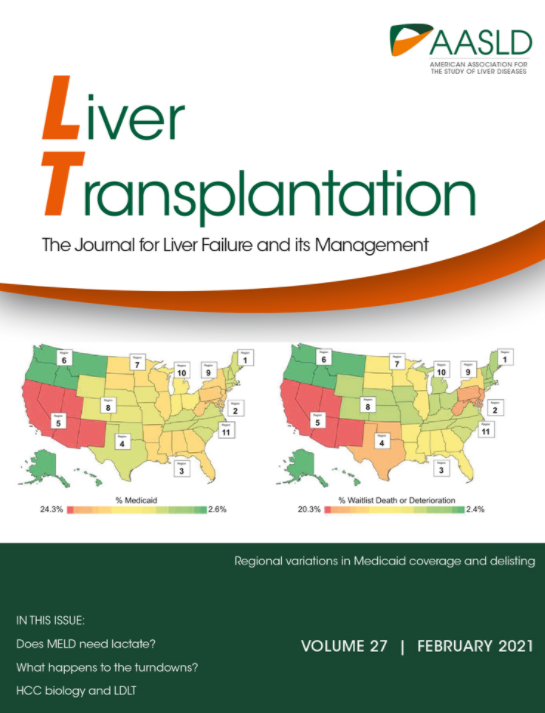
The 1‐year cumulative incidence of delisting was 9.0% (95% confidence interval [CI], 8.3%‐9.8%) for patients with private insurance, 10.7% (95% CI, 9.9%‐11.6%) for Medicare, and 10.7% (95% CI, 9.8%‐11.6%) for Medicaid
Medicare (HR, 1.20; 95% CI, 1.17‐1.24; P < 0.001) and Medicaid (HR, 1.20; 95% CI, 1.16‐1.24; P < 0.001) were independently associated with an increased hazard of death or deterioration compared with private insurance.
The article highlights regional variation in payor coverage and change in watilist death or deterioration from 2002-2018 (Figure 1)
Higher levels of education and employment were protective against waitlist mortality and deterioration
Female sex was a risk factor for delisting which may be in part to body size as women are more likely to have an organ declined as a result of small stature
“In patients hospitalized with decompensated cirrhosis, [daily] albumin infusions to increase the albumin level to a target of 30 g per liter or more was not more beneficial than the current standard care.” The standard of care included giving albumin under specific circumstances: large volume paracentesis, spontaneous bacterial peritonitis, or hepatorenal syndrome. Infusions (20% albumin) were infused at a rate of 100 mL/hr. In addition, the albumin group, which received 10 times as much albumin as the standard group, had more severe or life-threatening adverse events, especially pulmonary edema or fluid overload.
F Wong et al. NEJM 2021; 384: 818-828. Terlipressin plus Albumin for the Treatment of Type 1 Hepatorenal Syndrome In this multicenter, randomized controlled study, terlipressin was associated with improved renal function -reversal of HRS occurred in 32% compared to 17% in placebo group; however, it was associated with increased serious adverse events (eg. respiratory failure) and increased death (51% vs 45% in placebo group).
ER Perito et al. JPGN 2021; 72: 417-424.A Learning Health System for Pediatric Liver Transplant: The Starzl Network for Excellence in Pediatric Transplantation The Starzl Network for Excellence in Pediatric Transplantation (SNEPT) is the first multicenter effort by pediatric liver transplant teams. Its goal is to establish and share evidence-based care to improve liver transplantation outcomes. If successful, SNEPT should be to liver transplantation as ImproveCareNow network is for pediatric inflammatory bowel disease.
70 patients completed the trial (44 PSC, 24 PBC, 2 SSC) (SSC =secondary sclerosing cholangitis). Treated patients received bezafibrate 400 mg once a day for 21 days.
For the primary end point, bezafibrate led in 45% (41% PSC, 55% PBC) and placebo in 11% to >/=50% reduction of severe or moderate pruritus (P ¼ .003).
Bezafibrate also reduced serum alkaline phosphatase (35%, P ¼ .03 vs placebo) correlating with improved pruritus (VAS, P ¼ .01) suggesting reduced biliary damage.
Serum bile acids and autotaxin activity remained unchanged.
My take: While the majority of patients did not reach the primary end point, bezafibrate merits further investigation and may be a useful agent for pruritus in the setting of cholestatic liver disease. From the associated editorial (pg 649, JK Dyson et al. Bezafibrate for the Treatment of Cholestatic Pruritus: Time for a Change in Management?): “FITCH is an important study and provides novel and important data. It suggests that bezafibrate can be part of the answer to cholestatic pruritus.”
From Editorial:
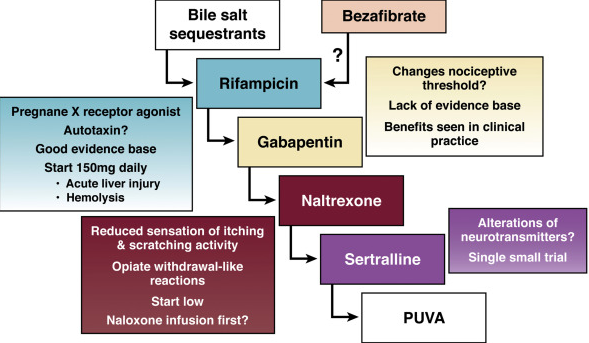
“Current treatment ladder for pruritus and the potential positioning of bezafibrate in the future.“
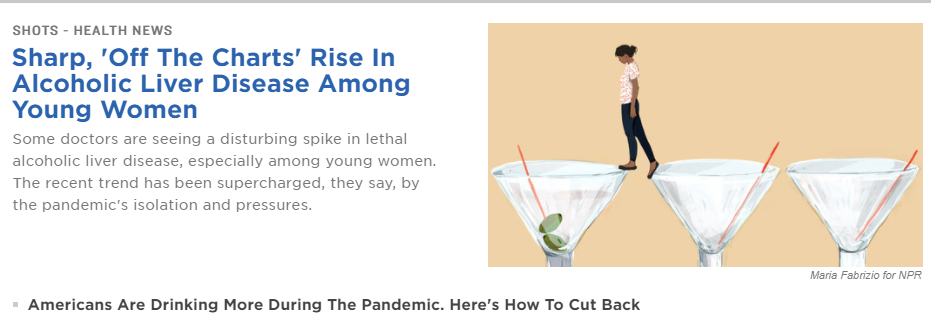
Cases of alcoholic liver disease — which includes milder fatty liver and the permanent scarring of cirrhosis, as well as alcoholic hepatitis — are up 30% over the last year at the University of Michigan’s health system, says Dr. Jessica Mellinger, a liver specialist there….
This study had 42 patients who had alcohol detectable in blood and/or urine matched with 84 controls among patients who received liver transplantation for alcohol-associated liver disease (ALD); this study had a median follow-up of 12.9 years..
Key findings:
Long‐term survival was not different between the groups; however, rates of recurrent cirrhosis and cirrhosis‐related deaths were more frequent in the alcohol consumption group
Relapse to any alcohol consumption rate was higher in the case group (59.5%) than in the control group (38.1%, odds ratio 2.44; CI95% = [1.13; 5.27]), but sustained excessive consumption was not significantly different between the groups (33.3% versus 29.8% in case and control groups respectively, χ2 = 0.68).
My take: Yikes.! Fortunately, alcohol consumption is not a significant factor in pediatric liver disease. For adult hepatologists, this study highlights the need for patient support due to the frequency of alcohol relapse.
In this retrospective study with 31 children with Wilson’s disease (most of whom had had previous penicillamine), those who received more than 20 mg/kg/day of trientine therapy had increased adverse effects compared to those who received less than 20 mg/kg/day: 63% vs 7%; median followup was 60 months. In addition, there was not increased response to higher doses. The authors note that trientine had lower incidence of adverse effects compared to penicillamine and “appears to be the preferred” as a first-line treatment.
In this prospective cohort with 350 participants (all with either PiZZ (90%) or PiSZ (10%) and native livers), 278 (79%) entered the cohort (in 2007 or later) without portal hypertension and 18 developed portal hypertension during follow-up. Portal hypertension was defined by development of ascites, varices or combination of splenomegaly/thrombocytopenia. Thirty participants required liver transplantation; 2 patients died during 1077 person-years of follow-up. Median length of followup was 2.5 years. My take: While most children with Alpha-1-Antitrypsin Deficiency do well, monitoring is warranted as some will develop progressive liver disease (even in the absence of neonatal cholestasis).
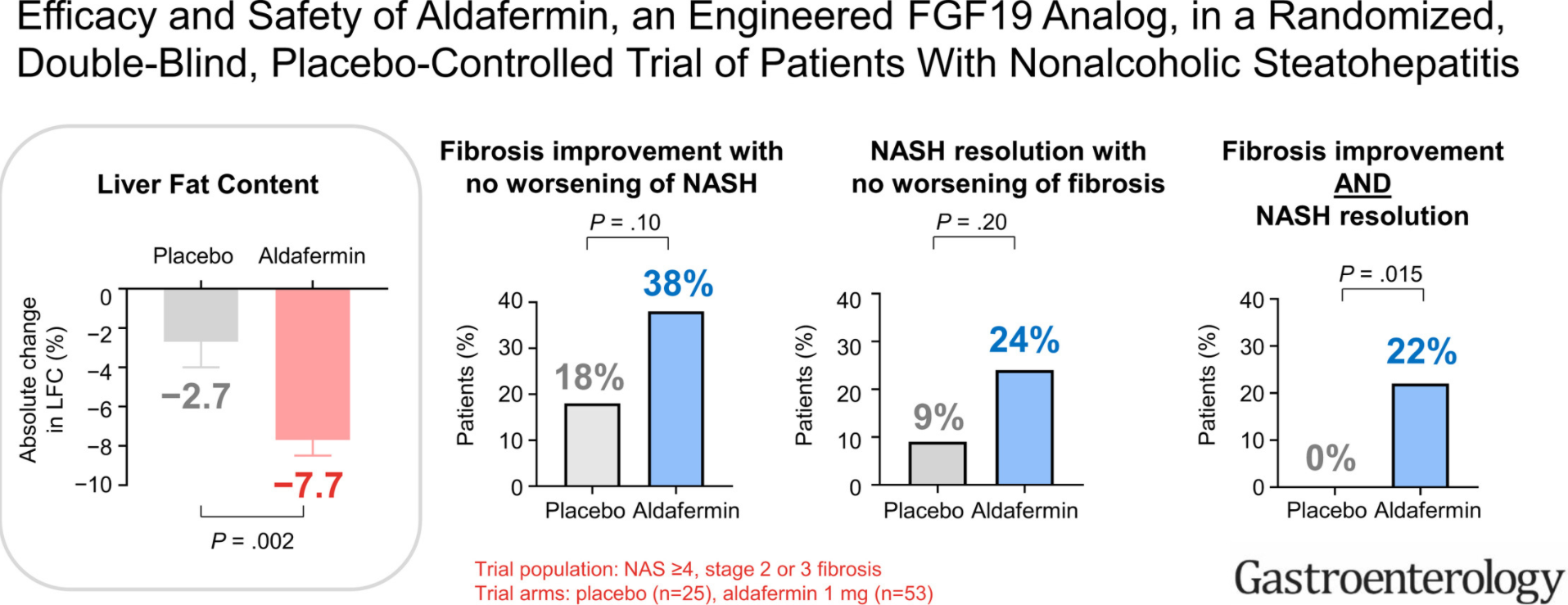
In this phase 2 double-blind study with 78 patients with NASH, at week 24, the aldafermin group had a significant reduction in absolute liver fat content (reduction of 7.7%) compared with placebo (reduction of 2.7%) (P=.002). Fibrosis improvement (1 stage) with no worsening of NASH was achieved in 38% of patients receiving aldafermin vs 18% of patients receiving placebo (P = .10). And, NASH resolution with no worsening of fibrosis was observed in 24% of patients given aldafermin vs 9% of patients given placebo (P = .20)
Excluding those who died within the first 3 months, the 10‐year patient survival and graft survival rates were 92.6% and 77.1%, respectively, in the PSC with IBD (PSC‐IBD) group and 97.1% and 83.2% in the isolated PSC group, respectively.
The rate of recurrent PSC was 21% in the PSC‐IBD group and 11% in the isolated PSC group
Thus, it appears that having pre-existing IBD did not significantly influence survival after transplantation.
The study utilized data and plasma markers from 110,761 individuals from Copenhagen, Denmark, and 334,691 individuals from the UK Biobank. GRS scores were from 0 to 6 based on three common genetic variants: PNPLA3, TM6SF2, and HSD17B13.
Key finding:
A GRS of 5 or 6 (compared to GRS of 0) for fatty liver disease confers up to a 12‐fold higher risk of cirrhosis and up to a 29‐fold higher risk of HCC in individuals from the general population
Only 0.5% of individuals had a GRS of 5 or 6. “A GRS of 4 [or more] which still conveyed large risks (cirrhosis, OR =5.2; HCC, OR =3.3) was found in approximately 5% of this population.”
Using a GRS of 4 or more, the positive predictive value of GRS-based test in the Danish population is “0.008 for cirrhosis and 0.003 for HCC. In other words, among 1000 persons with GRS greater than or equal to 4, only 8 will develop cirrhosis and 3 will develop HCC.”
My take: This study confirms that specific genetic variants increase the risk of complications from fatty liver disease. However, poor predictive value will likely preclude routine application.
It is very difficult to try to understand potential toxic substances in our environments. Some of the reasons for this are that there are always numerous simultaneous exposures and harm from substances can accrue over long periods. Once a substance is identified, it can take a long time to develop convincing evidence and even longer time frames to try to enact policy changes.
Background/Methods: Per- and polyfluoroalkyl substances (PFAS) are widespread and persistent pollutants that have been shown to have hepatotoxic effects in animal models. However, human evidence is scarce. PFAS chemicals have a myriad industrial/household applications which include nonstick cookware and products that confer resistance to stains. According to the editorial (MC Cave, pg 1518-21), some refer to PFAS as “forever chemicals” due to their decades-long half-lives.
The study authors used data from 1105 mothers and their children (median age 8.2 years) from the European Human Early-Life Exposome cohort. Key findings:
High prenatal exposure to PFAS resulted in children who were at higher risk of liver injury (odds ratio, 1.56; 95% confidence interval, 1.21–1.92)
PFAS exposure is associated with alterations in key amino acids and lipid pathways characterizing liver injury risk.
Overall, this article details the estimated shortage of hepatologists in the coming years.
Key points:
One of the more interesting suggestions in this article is the need to change the name of specialty training from “transplant hepatology” to “advanced hepatology” to more accurately reflect the type of liver conditions managed by hepatologists.
In 2018, the adult and pediatric workforce included 7,296 and 824 hepatology providers, respectively, composed of hepatologists, gastroenterologists, and advanced practice providers whose practice was ≥50% hepatology
The modeling analysis projects that in 2023, 2028, and 2033, there will be shortages of 10%, 23%, and 35% adult hepatology providers, respectively, and 19%, 20%, and 16% pediatric hepatology providers, respectively
The authors note that there are many challenges when predicting workforce needs. The main reasons for the predicted shortfall with hepatology include the following:
Older age of current clinicians
Increasing amount of liver disease (~34% increase from 2018 to 2033), particularly fatty liver disease. This is happening among adults and children.