Good Food and Bad Food for Crohn’s Disease -No Agreement

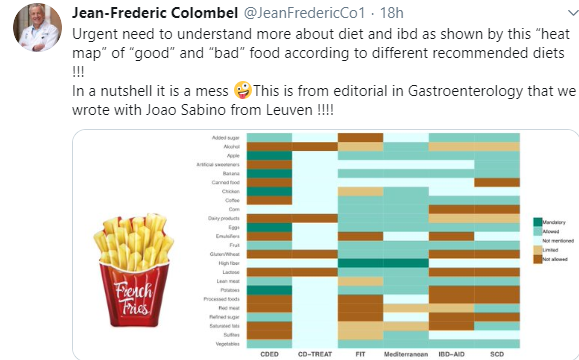
As noted in a previous blog (IBD Briefs August 2019), there have been numerous diets proposed to help with Crohn’s disease.   The chart below illustrates the lack of any consensus.

Related blog posts:

NY Times: “Our Food is Killing Too Many of Us”

NY Times: D Mozaffarian, D Glickman Our Food is Killing Too Many of Us

“Improving American nutrition would make the biggest impact on our health care”

An excerpt:

“Instead of debating who should pay for all this, no one is asking the far more simple and imperative question: What is making us so sick, and how can we reverse this so we need less health care? … our food…

Poor diet is the leading cause of mortality in the United States, causing more than half a million deaths per year. Just 10 dietary factors are estimated to cause nearly 1,000 deaths every day from heart disease, stroke and diabetes alone…

Taxes on sugary beverages and junk food can be paired with subsidies on protective foods like fruits, nuts, vegetables, beans, plant oils, whole grains, yogurt and fish….Levels of harmful additives like sodium, added sugar and trans fat can be lowered through voluntary industry targets or regulatory safety standards

Nutrition standards in schools, which have improved the quality of school meals by 41 percent, should be strengthened; the national Fresh Fruit and Vegetable Program should be extended beyond elementary schools to middle and high schools…

Coordinated federal leadership and funding for research is also essential. This could include, for example, a new National Institute of Nutrition at the National Institutes of Health. Without such an effort, it could take many decades to understand and utilize exciting new areas, including related to food processing, the gut microbiome, allergies and autoimmune disorders, cancer, brain health, treatment of battlefield injuries and effects of nonnutritive sweeteners and personalized nutrition.”

Related blog posts:

Crater Lake, OR


Sunshine and Inflammatory Bowel Disease

A recent provocative study (EA Holmes et al. JPGN 2019; 69: 182-88) describes an inverse association between sunshine exposure and the development of pediatric inflammatory bowel disease (IBD).  Among a cohort of 99 children with IBD and 396 controls, the authors used questionnaires to estimate past sun exposure along with other variables.

Key finding:

  • “For each 10 min increment in leisure-time sun exposure in summer or winter there was a linear 6% reduction in the odds of having IBD (P=0.002)”

There was no corresponding data with regard to vitamin D status.

My take:  Being active and going outside are likely good for one’s health and there have been other studies suggesting more sun exposure could reduce the rate of Crohn’s disease. Does Sun Exposure Lower the Risk of Crohn Disease? | gutsandgrowth  Despite this, in my view, this study’s findings have limited value.

  1. There may be many confounders that separate children with more sun exposure from those with less exposure, including diets, exercise, camping, exposure to animals and soil, and many other variables. In addition, there may have been problems with recall bias.
  2. The role of vitamin D was not studied. In previous studies, the importance of vitamin D in its effect on the IBD/immune system have yielded inconsistent results.
  3. In those with IBD, suggesting that more sun exposure may have prevented IBD would not be helpful; this is due to the flimsy evidence and this information could be interpreted  as blaming the family.
  4. Correlation does not prove causation.  For example, a far-fetched association of correlation that is not likely to have a causal association: Rates of Drowning by Falling in Pools and Nicholas Cage Films (National Geographic: Nicholas Cage Movies vs. Drownings)

Related blog posts:

View from Wahkeenah Falls Trail, OR


Jejunal Tube Feeding –ESPGHAN Position Paper

A recent position paper (IJ Borekaert et al. JPGN 2019; 69: 239-58) makes 33 recommendations on the use of jejunal tube feedings.

Full Text Link: The Use of Jejunal Tube Feeding in Children: A Position Paper by the Gastroenterology and Nutrition Committees of the European Society for Paediatric Gastroenterology, Hepatology, and Nutrition 2019.

Here are a few of the recommendations:

  • #1 Jejunal feeding is route of choice for enteral nutrition with failure of oral and intragastric feeds or gastric outlet obstruction
  • #5 Expert group recommends the use of jejunal feeding in children with acute pancreatitis only in cases in which oral or gastric feeding is not tolerated
  • #6 Recommends trial of continuous gastric feeds or a hydrolyzed or elemental formula prior to jejunal feedings
  • #8 & 9 Expert group recommends to consider UGI/SBFT and an upper GI endoscopy in all patients before jejunal tube placement
  • #12 Recommends NOT to use jejunal tube feedings in preterm infants (<37 weeks gestation).  This is based on systemic reviews including Cochrane review which concluded “that there is no evidence of any benefit for transpyloric feeding in preterm infants compared to gastric feeding”
  • #21 Recommends monitoring for nutrient deficiencies –checking copper, zinc, selenium, and iron every 6-12 months (Low level of evidence).  The authors note that some studies have shown reductions in these nutrients; this may be related in part to be due to bypassing the duodenum
  • #24 Avoiding using jejunal tube for medication unless absolutely essential or delivery into the stomach is not possible

Hood River Bridge (crossing Columbia River). Hood River, OR


Ensuring Safe Infant Formula Use -More Complicated Than You Think

A recent commentary (SA Abrams, SR Daniels. J Pediatr 2019; 211: 201-6) highlight some important issues regarding infant formula use/misuse.

The authors indicate that their commentary is not intended to undermine the use of breastmilk in infants.  However, they note that only about 25% of infants are exclusively breastfed until 6 months of age; thus, utilizing formula appropriately is crucial.

Annual Costs per article estimates (based on powder formula):

  • $1109 generic store-brand formula
  • $2021 name-brand routine formula
  • $222 Typical out-of-pocket for WIC clients –store brands (this assumes about 20% of formula is not covered by WIC)
  • $404 Typical out-of-pocket for WIC clients –name brands (this assumes about 20% of formula is not covered by WIC)
  • $215 Whole cow milk (not recommended)

Key points:

  • The authors discuss the role of the WIC program which is a supplemental program –does not provide 100% of an infant’s needs.
  • They describe deceptive formula marketing practices and the difficulty of ascertaining the best value of formulas.  In addition, “marketing of more expensive formula choices as having unique health benefits can easily lead families to spend more money than might be necessary” based on “meaningless” claims of being ‘closest to mother’s milk.’
  • Additives such as oligosaccharides and formulas marketed as organic or free of genetically modified organisms can be used to increase the cost of formula.
  • Use of WIC has decreased by 15% from 2010 to 2017; some may be related to fears related to immigration status of some WIC recipients.
  • Families faced with increased costs may dilute formula or use inadequate substitutes (eg. juice, cow’s milk, prepare home-made alternative)
  • Recent government shutdown placed many infants at risk.

Mistrust Concerns:

  • Many families, abetted by social media, have become distrustful of standard formulas as well as government and even pediatrician advice.
  • There has been an increase in importation of foreign formulas, especially from Europe.  THESE FORMULAS ARE NOT FDA MONITORED OR APPROVED. These illegally imported formulas have no proven advantages and their safety has not been ensured.  They do not undergo routine testing for 30 nutrients which are required by FDA monitored formulas.
  • Raw cow’s milk and raw goat milk have been promoted to ‘improve immune or gastrointestinal function.’ These products have no scientific proof of any advantage and place infants at risk as they are unpasteurized and nutrient deficient.

Author Recommendations:

  • Provide educational programs focused on formula feeding for medical providers and families
  • Increase information and regulation from government and industry about contamination issues
  • Protect the WIC program from consequences of potential government shutdown
  • Mandate improved price clarity
  • Fund research into all aspects of formula feeding, including behavioral interventions to limit inappropriate formula use
  • Monitor social media and provide correct information

Related blog posts:

Outside Portland, OR

Is Cognition Affected by Obesity/Metabolic Disease?

A recent provocative study : “Childhood Metabolic Biomarkers Are Associated with Performance on Cognitive Tasks in Young Children” ALB Shapiro et al. J Pediatr 2019; 211: 92-7

Methods: Data were obtained from children (n=137, 4.6 years old on average) participating in the Healthy Start study, a pre-birth cohort in Colorado. This included metabolic markers (HOMA-IR, glucose, insulin) and cognitive performance markers (Flanker task, Dimensional Change Card Sort test (which assesses cognitive flexibility), and Picture Vocabulary test).

Key findings:

  • HOMA-IR, glucose, and insulin were all inversely significantly-associated with cognitive flexibility testing. Thus, the authors found that “greater blood biomarkers of poor metabolic health are related to lower cognitive flexibility and inhibitory control in healthy, young children.”

Discussion:

  • The authors note that their findings “contribute to the large body of literature in children with overt type 1 and type 2 diabetes that demonstrates consistent and negative effects of poor metabolic health on cognition.”
  • The metabolic effects on cognition may be more critical in childhood due to brain maturation as well as potential for longer exposure periods.  However, studies from adults indicate that “adults without overt diabetes, the cumulative burden of metabolic conditions (eg. obesity, hyperglycemia) was significantly associated with lower cognitive scores.”

My take: While the effects of metabolic disease on cardiovascular disease is well-recognized, this study adds to the body of knowledge that indicates the potential harm of metabolic disease on the brain as well.

Near Chattahoochee River

SMOF Neurodevelopmental Data Looks Good –In Five Years We’ll Know More

A recent study (C Binder et al. J Pediatr 2019; 211: 46-53) examined electrophysiological brain maturation in a randomized double-blinded controlled trial of SMOF lipid compared to soybean lipid emulsion for extremely low birth weight (ELBW) premature infants. This was a prespecified secondary outcome analysis of a randomized trial of 230 infants (2012-2015).

It is recognized that the ELBW infants have very little nutritional reserve.  In addition, DHA which is transferred to the fetus in high amounts in the last trimester is absent from parenteral soybean lipid emulsions.  Thus, the authors explored whether SMOF lipid which is a mixture of lipids (30% soybean oil, 30% medium-chain triglycerides, 25% olive oil, and  15% fish oil) and contains DHA would have a favorable effect on neurocognitive outcomes.

In this study, the authors examined amplitude-integrated electroencephalography measurements (aEEG)  to assess neurodevelopment. Both groups received similar lipid dosing, SMOF 2.2 g/day and Soybean 2.1 g/day.

Key findings:

  • Among the available 121 infants in the subgroup with aEEG (n=63 SMOF, n=58 soybean), maximum maturational scores on aEEG were achieved 2 weeks earlier in the SMOF group (36.4 weeks vs 38.4 weeks, P<.001).

Limitation:

  • aEEG is a marker of neurocognitive development; however, more adequate outcomes of  neurodevelopmental progress are needed. The authors plan to follow these infants up to 5 years of age.

My take: This study is very favorable for the use of SMOF lipids in premature infants.  — SMOF lipid emulsion by itself may improve neurocognitive outcomes. In addition, clinicians are more likely to provide adequate amounts of lipid calories with SMOF as compared to soybean emulsion which is often restricted to minimize liver injury.  Giving adequate lipid calories is also likely to enhance neurological outcomes.

Related blog posts:

Incredibly blue waters of Crater Lake, Oregon -from Wizard Island


Bariatric Surgery Survival – 5 Countries, 500,000 Participants

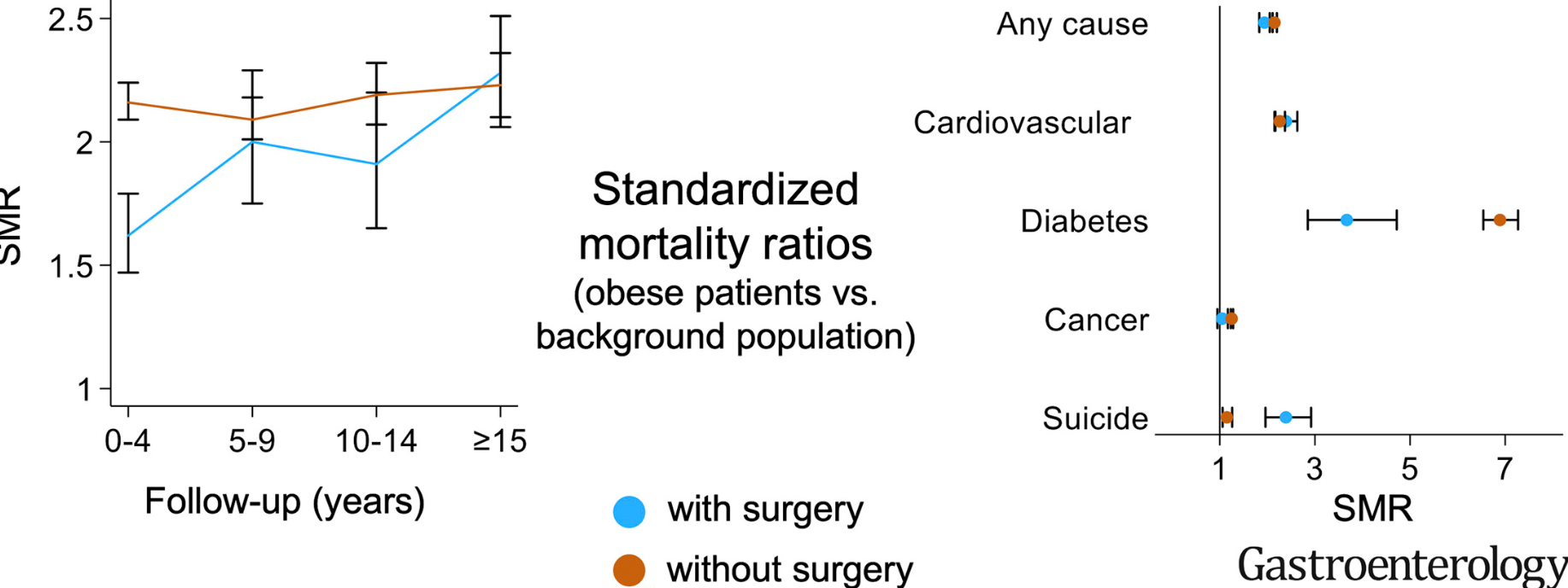
A recent population-based cohort study (JH Kauppila et al. Gastroenterol 2019; 157: 19-27) examined the effects of bariatric surgery on survival from Nordic countries between 1980-2012.

Link: Effects of Obesity Surgery on Overall and Disease-Specific Mortality in a 5-Country Population-Based Study

Among 505,258 obese individuals, 49,977 had bariatric surgery.

Key findings:

  • Overall mortality rates were lower in the surgery group during the first 14 years but higher after 15 years (HR 1.20 with CI 1.02-1.42).  Thus, overall, obese patients who underwent bariatric surgery had longer survival times than obese patients who did not have surgery.  Both groups had higher mortality than the general population
  • The improved survival compared to those without surgery was related to decreased mortality from cardiovascular mortality, diabetes and cancer.  However mortality due to suicide was increased.
  • Limitations: lack of detailed data including BMI, smoking and alcohol consumption

Graphical abstract (available online)

Related blog posts:

Red Meat for Dietary Cynics

A recent randomized study (L Albenberg et al. Gastroenterol 2019; 157: 128-36) examined whether a diet low in red or processed meats could reduce rates of Crohn’s disease (CD) flares.

Methods: Adults with CD were recruited into the FACES (Food and Crohn’s Disease Exacerbation Study) trial from 2013 to 2015. Participants were recruited from an internet-based cohort (n=15,600).  Eligible participants (consumed red meat at least once a week & in remission) were randomly assigned to high meat, n=118 (minimum of 2 servings per week) or low meat, n=96 (no more than 1 serving per month).  Outcomes were based on changes in sCDAI scores or need for treatment (new medication or surgery)

Key findings:

  • Any relapse occurred in 62% of participants in the high meat group compared to 42% in the low meat group.  This was not statistically significant.
  • At week 20, 18 participants in each arm had a stool calprotectin with the high meat group having a higher median: 74.5 mcg/g compared to 36.0 mcg/g (P=.13)
  • The high meat group did consume at least 2 servings per week in 98.5% of observed weeks compared to 18.8% of the low meat group.

Limitations:

  • Small number of diet participants
  • Study was not blinded and only a subset included more objective markers of response
  • Whether complete avoidance of red meat/processed meats would be more effective is unclear
  • In those in remission at baseline, it could take longer for the benefits of a dietary intervention to become evident

My take:  Limiting consumption of red and processed meats (particularly if meat is not lean) has been shown to have cardiovascular benefits.  While this study does not show a statistically-significant improvement in relapse rates in this cohort with Crohn’s disease, there are still strong arguments that a diet with increased fruits/vegetables and less red/processed meats would be beneficial.

Related Blog Posts:

Disclaimer: These blog posts are for educational purposes only. Specific dosing of medications/diets (along with potential adverse effects) should be confirmed by prescribing physician/nutritionist.  This content is not a substitute for medical advice, diagnosis or treatment provided by a qualified healthcare provider. Always seek the advice of your physician or other qualified health provider with any questions you may have regarding a condition.

Sagrada Familia, Barcelona