Methods: In a population‐based prospective cohort study of 1,940 infants, we assessed sugar‐containing beverage intake (juice or soda) at 1 year with a validated Food Frequency Questionnaire. Liver fat fraction and NAFLD (liver fat fraction ≥5.0%) were assessed with MR. Key findings:
Compared to infants with <1.0 serving/day, those with >2.0 servings/day had the highest odds of NAFLD at 10 years of age (OR, 3.02; 95% CI, 1.34, 6.83). This was independent of sugar‐containing beverage intake and body mass index at school age
Liver fat fraction greater than or equal to 5% in school-aged children was almost 3-fold higher in those who consumed more than two servings of juice per day at age 1 (4.0%) than in those who drank less than one per day (1.4%)
The associations between juice intake in infancy and NAFLD were strongest in children with overweight or obesity at age 10 and those in families with more limited education
Major strengths of this study are the population‐based prospective longitudinal design with a large sample size, with information on sugar‐containing beverage intake in infancy and liver fat fraction measured with MR at 10 years of age.
My take: Juice and other high sugar beverages (eg soda) should be avoided, particularly at younger ages.
In this study, the authors used a state-transition model to assess cost-effectiveness of hepatitis C virus (HCV) infection in children; the model treated a hypothetical cohort of 10,000 children with chronic HCV at age 6 years with combination therapy of sofosbuvir/ledipasvir for 12 weeks vs deferring treatment until 18 years of age.
Key findings:
The incremental cost effectiveness of early treatment of young children was $12 690 per QALY gained after 20 years, which is considered cost effective compared with deferred treatment.
The authors note that if the cost of DAA medications dropped by 60%, then early treatment would not be more cost effective.
However, early treatment of 10,000 children would prevent 330 cases of cirrhosis, 18 cases of hepatocellular carcinoma, and 48 liver-related deaths.
The investigators presented an additional scenario treating children as young as 3 years of age and using alternative treatment with the pan-genotypic combination of glecaprevir/pibrentasvir for 8 weeks; using glecaprevir/pibrentasvir resulted in an incremental cost effectiveness of $12 563 per QALY compared with deferring treatment to age 18 years.
All cost effective models have built in assumptions. This model, for example, presumes each patient is offered treatment only once and does not get reinfected before age 18 years.
Other aspects about early treatment that are difficult to quantitate:
Improved adherence at younger age which improves cost effectiveness
Reduction in transmission of HCV as a consequence of successful treatment
Detrimental effects of untreated/deferred treatment HCV on quality of life, psychosocial health, and cognitive functioning
My take: This study (& editorial) demonstrate that early treatment of HCV is a good value and delivers non-economic benefits as well. Every child (>3 years) with HCV should be treated and cured of HCV infection.
This was a retrospective study which relied on large national databases.
The 1‐year cumulative incidence of delisting was 9.0% (95% confidence interval [CI], 8.3%‐9.8%) for patients with private insurance, 10.7% (95% CI, 9.9%‐11.6%) for Medicare, and 10.7% (95% CI, 9.8%‐11.6%) for Medicaid
Medicare (HR, 1.20; 95% CI, 1.17‐1.24; P < 0.001) and Medicaid (HR, 1.20; 95% CI, 1.16‐1.24; P < 0.001) were independently associated with an increased hazard of death or deterioration compared with private insurance.
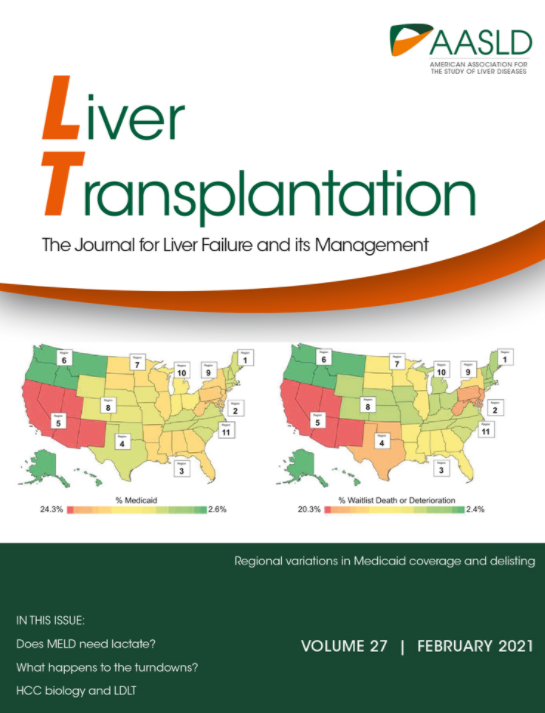
The article highlights regional variation in payor coverage and change in watilist death or deterioration from 2002-2018 (Figure 1)
Higher levels of education and employment were protective against waitlist mortality and deterioration
Female sex was a risk factor for delisting which may be in part to body size as women are more likely to have an organ declined as a result of small stature
“In patients hospitalized with decompensated cirrhosis, [daily] albumin infusions to increase the albumin level to a target of 30 g per liter or more was not more beneficial than the current standard care.” The standard of care included giving albumin under specific circumstances: large volume paracentesis, spontaneous bacterial peritonitis, or hepatorenal syndrome. Infusions (20% albumin) were infused at a rate of 100 mL/hr. In addition, the albumin group, which received 10 times as much albumin as the standard group, had more severe or life-threatening adverse events, especially pulmonary edema or fluid overload.
F Wong et al. NEJM 2021; 384: 818-828. Terlipressin plus Albumin for the Treatment of Type 1 Hepatorenal Syndrome In this multicenter, randomized controlled study, terlipressin was associated with improved renal function -reversal of HRS occurred in 32% compared to 17% in placebo group; however, it was associated with increased serious adverse events (eg. respiratory failure) and increased death (51% vs 45% in placebo group).
ER Perito et al. JPGN 2021; 72: 417-424.A Learning Health System for Pediatric Liver Transplant: The Starzl Network for Excellence in Pediatric Transplantation The Starzl Network for Excellence in Pediatric Transplantation (SNEPT) is the first multicenter effort by pediatric liver transplant teams. Its goal is to establish and share evidence-based care to improve liver transplantation outcomes. If successful, SNEPT should be to liver transplantation as ImproveCareNow network is for pediatric inflammatory bowel disease.
In this cross-sectional study with 50 children with Type 1 Diabetes Mellitus (T1DM), MRE and MRI-PDFF studies were undertaken to determine whether the participants had nonalcoholic fatty liver disease (NAFLD). Key findings:
The median age and duration of T1D were 16.9 years (IQR, 13.6-20 years) and 6.5 years (IQR, 4-11 years), respectively. 26% of the cohort were overweight or obese.
The prevalence of NAFLD was 10% (more than half had normal ALT values). Four out of 5 patients with NAFLD were overweight/obese, and 2 had an and elevated alanine aminotransferase (ALT) level. None had liver fibrosis (defined as MRE >2.9 kPa).
High BMI-SDS (body mass index standard deviation score) was the sole independent risk factor associated with NAFLD (OR, 5.79; 95% CI, 1.04-32.18).
My take: This study is reassuring regarding the prevalence of NAFLD in children and young adults with T1D which was comparable to that in the general population. Routine screening for NAFLD in patients with T1D does not appear to be useful.
S Kemme et al. JPGN 2021; 72: 194-201. Outcomes of Severe Seronegative Hepatitis-associated Aplastic Anemia: A Pediatric Case Series This small case series (n=4) with HAAA found that this condition was poorly responsive to steroids, azathioprine and tacrolimus; however, Anti-Thymocyte Globulin (ATG) was associated with sustained biochemical remission of the hepatitis. Two patients underwent hematopoietic stem cell transplantation. All patients had extensive investigations. All had evidence of systemic hyperinflammation (with markedly-elevated ferritin and soluble IL-2 R levels) and CD8+ T cell predominant liver tissue infiltration.
Workup: In the well and stable premature with elevated DB, “aminotransferases, AP, GGT, glucose, T4, TSH, UC, urine CMV PCR, and US with Doppler evaluation should be obtained…Coagulation studies in well babies with other evidence of good synthetic function are not necessary.” Empiric ursodeoxycholic acid may be given with weekly evaluation.
Genetic testing: “Genetic panels are indicated in babies with no obvious risk factors after the first tier of studies…In critically ill babies with multisystem disease, critical whole exome sequencing (WES) is faster and provides broader results.”
Sepsis: Babies with sudden increase in DB and ALT should be evaluated for sepsis (including urosepsis) and CMV.
Nutritional support: Infants should be “supported with MCT and vitamin supplementation.”
Severe liver disease: “Babies with coagulopathy and marked elevation of aminotransferases who have multiorgan failure in the first few days of life need to be evaluated for perinatal complications, severe metabolic disease, and gestational alloimmune liver disease (GALD). In this period, ischemic shock or infectious disease is much more common than primary liver disease, but the presentations can overlap.”
Liver biopsy: “Liver biopsy should be pursued in babies whose cholestasis is not improving and the diagnosis is unclear.”
Etiology: Infection, genetic disease, cardiac dysfunction, large heme loads, and hypothyroidism are common causes of liver dysfunction in the NICU. Common findings included trisomy 21-associated liver dysfunction (n=12), and thyroid disease. 6 patients had type 2 Abenathy shunts -only one required closure. Two patients had biliary atresia. Other liver diseases identified included GALD (n=2), PFIC2, Alagille, Alpha-one-antitrypsin, Cystic Fibrosis, and Niemann-Pick.
Wahid N et al. AASLD 2020, Abstract 153. Summary from GI & Hepatology News: Liver-related deaths decline after Medicaid-expansion under ACA. “Beginning around 2015, liver-related deaths began to decline in expansion states by a mean of –0.6%, while they continued on an upward trajectory in the nonexpansion states…“It’s a no-brainer that the lack of insurance accessibility for the most vulnerable people in the United States meant that they were dying of cirrhosis instead of being transplanted,” said Elliot Benjamin Tapper, MD, of the University of Michigan, Ann Arbor.”
Disclaimer: This blog, gutsandgrowth, assumes no responsibility for any use or operation of any method, product, instruction, concept or idea contained in the material herein or for any injury or damage to persons or property (whether products liability, negligence or otherwise) resulting from such use or operation. These blog posts are for educational purposes only. Specific dosing of medications (along with potential adverse effects) should be confirmed by prescribing physician. Because of rapid advances in the medical sciences, the gutsandgrowth blog cautions that independent verification should be made of diagnosis and drug dosages. The reader is solely responsible for the conduct of any suggested test or procedure. This content is not a substitute for medical advice, diagnosis or treatment provided by a qualified healthcare provider. Always seek the advice of your physician or other qualified health provider with any questions you may have regarding a condition.
All of these patients underwent extensive evaluations. Key findings:
Central venous pressures and VAST scores decreased significantly post-transplantation
Fontan liver MRI score maximum was 10 pretransplantation and decreased significantly post-transplantation
Pretransplantation and post-transplantation liver biopsy scores did not differ in 4 paired biopsy specimens
Patients with FALD and MELD <15, MELD-XI <16 (MELD XI excludes INR), Fontan liver MRI score <10, and VAST (varices, ascites, splenomegaly, thrombocytopenia) score ≤2 can have successful short-term isolated heart transplantation outcomes
My take: This study provides reassurance that heart transplantation can proceed in patients with FALD, which is helpful as hepatic fibrosis is nearly universal in this population. After transplantation, surveillance is still needed for hepatic complications including hepatocellular carcinoma.
This retrospective study enrolled a total of 819 patients, 89.6% with AIH-1 and 10.4% with AIH-2
Key findings:
The overall survival was 93.0%, with a native liver survival (NLS) of 89.9%; 4.6% underwent liver transplantation
The risk of death or liver transplantation during follow-up was 3.2 times greater in patients with AIH-1 ( P = .024).
Normal C3 levels was associated with longer NLS ( P = .017). The chance of death or liver transplantation during follow-up was 3.4 times greater in patients with C3 level below normal
Death or liver transplantation during follow-up was 2.8 times greater in patients with associated sclerosing cholangitis ( P = .046).
My take: This large cohort from Brazil shows that a significant portion of children with AIH do NOT do well, especially if they have associated sclerosing cholangitis.
The first lecture by Dr. Melissa Gilbert was an excellent overview of the genetics of Alagille Syndrome.
Key points:
JAG1 mutations account for ~95% of Alagille syndrome mutations and NOTCH2 about 3%
Many mutations identified are due to missense mutations which are often variants of unknown clinical significance (VOUS). In these patients, to determine if it is pathogenic, one has to correlate the clinical picture along with specific amino acid change, location of variant, and frequency of variant in normal population. Dr. Gilbert noted that among the ~97% of cases with genetic abnormalities, about 80% have recognized pathogenic mutations and about 17% have VOUS.
There is variability of severity of Alagille syndrome in the same family, likely related to genetic modifiers
When using genetic panel, if panel uses only single nucleotide variants, this will miss the deletion/duplication variants which account for ~10% of cases
The second lecture by Binita Kamath was a terrific review and compared the differences between Alagille Syndrome with JAG1 mutations and NOTCH2; the latter are much less likely to have cardiac abnormalities and butterfly vertebrae. The liver phenotype/survival is similar.
Key points:
Outcomes of Alagille syndrome by 25 years of age including frequent bone fractures and development of portal hypertension.
Severe liver disease is common. 75% in a multi-center cohort (CHILDREN) required liver transplantation by age 18 years and 10% died; in contrast, a large GALA cohort of 911 children, 41% survived with their native liver at 18 years.
After transplantation, renal sparing strategies are needed due to frequent renal insufficiency; patients with severe cardiac disease may not be candidates for liver transplantation.
There is work on an Alagille Syndrome growth curve.
Screening for brain vascular malformations/Moyamoya –Dr. Kamath tends to screen after age 8 years of age at baseline (when child does not need sedation for brain imaging) and then every 4-5 years. Also, an MRI/MRA is done prior to major surgery.
Hyperlipidemia in Alagille Syndrome is mainly due to lipoprotein X; this is not a risk factor for cardiac health.
The third (& also excellent) lecture by Saul Karpen (who disclosed his potential conflicts of interest) reviewed current treatments and emerging treatments.
Key points:
The current medical therapies have not been carefully tested; rifampin for pruritus may relieve cholestasis in about 50% of patients.
IBAT inhibitors interrupt enterohepatic circulation. These agents improve pruritus and decrease serum bile acids.
Dr. Karpen reminded the audience to follow fat soluble vitamin levels and if treatment is needed, to provide Vitamin D formulations with TPGS.
On the right hadd panel (above), the orange bar represents those with severe pruritus and the effects of PEBD on pruritus.
After the start of immunosuppressive therapy, bilirubin, albumin, and INR normalized in 70%, 77%, and 69%, respectively, in a median of 2.6 months, 3 months, and 4 weeks, respectively, in patients with A-AIH and AS-AIH
Deterioration of liver function (bilirubin, INR) after 2 weeks of treatment should lead to rapid evaluation for LT and consideration of second-line medication.
The cumulative incidence of waitlist mortality was 5.2%. Median waitlist time was 83 days.
In multivariable analysis (n = 2253), increasing bilirubin level ( P < .001), portal vein thrombosis ( P = .03), and ventilator dependence ( P < .001) at listing were associated with a higher risk, whereas weight ≥10 kg at listing ( P = .009) was associated with a lower risk of waitlist mortality.
In this retrospective study with 31 children with Wilson’s disease (most of whom had had previous penicillamine), those who received more than 20 mg/kg/day of trientine therapy had increased adverse effects compared to those who received less than 20 mg/kg/day: 63% vs 7%; median followup was 60 months. In addition, there was not increased response to higher doses. The authors note that trientine had lower incidence of adverse effects compared to penicillamine and “appears to be the preferred” as a first-line treatment.
In this prospective cohort with 350 participants (all with either PiZZ (90%) or PiSZ (10%) and native livers), 278 (79%) entered the cohort (in 2007 or later) without portal hypertension and 18 developed portal hypertension during follow-up. Portal hypertension was defined by development of ascites, varices or combination of splenomegaly/thrombocytopenia. Thirty participants required liver transplantation; 2 patients died during 1077 person-years of follow-up. Median length of followup was 2.5 years. My take: While most children with Alpha-1-Antitrypsin Deficiency do well, monitoring is warranted as some will develop progressive liver disease (even in the absence of neonatal cholestasis).
In this phase 2 double-blind study with 78 patients with NASH, at week 24, the aldafermin group had a significant reduction in absolute liver fat content (reduction of 7.7%) compared with placebo (reduction of 2.7%) (P=.002). Fibrosis improvement (1 stage) with no worsening of NASH was achieved in 38% of patients receiving aldafermin vs 18% of patients receiving placebo (P = .10). And, NASH resolution with no worsening of fibrosis was observed in 24% of patients given aldafermin vs 9% of patients given placebo (P = .20)