Linaclotide -Now FDA-Approved for Children

FDA 6/12/23: FDA approves first treatment for pediatric functional constipation

“FDA has approved Linzess (linaclotide) capsules to treat functional constipation in pediatric patients 6 to 17 years of age. Linzess is the first treatment for pediatric functional constipation. The recommended dosage in pediatric patients 6 to 17 years is 72 mcg orally once daily.”

“The efficacy of Linzess for the treatment of functional constipation in pediatric patients 6 to 17 years of age was established in a 12-week double-blind, placebo-controlled, randomized, multicenter clinical trial (Trial 7; NCT04026113) and supported by efficacy data from adequate and well-controlled trials in adults with chronic idiopathic constipation (constipation that persists and isn’t connected to an underlying illness).”

Safety:

  • Most common adverse effect was diarrhea
  • Avoid in patients with known or suspected mechanical gastrointestinal obstruction (bowel blockage)
  • “Linzess contains a boxed warning that the medication should not be taken by patients less than 2 years of age”
  • See full prescribing information for additional information on risks associated with Linzess.

My take: While this is good news to have the first FDA-approved treatment for pediatric functional constipation, it is worth remembering that the estimated cost for a monthly supply is between $514-$536 (in Atlanta pharmacies per GoodRx.com).

Related blog posts:

Comparing Outcomes Between PEG Placement and Surgical GT Placement

K Tazi et al. JPGN Reports 4(2):p e316, May 2023. | DOI: 10.1097/PG9.0000000000000316. Open Access: Complications of Percutaneous and Surgical Gastrostomy Placements in Children: a Single-Centre Series.

In this retrospective single-center pediatric (n=124) study, the authors analyzed complications that occurred up to 1 year after placement. Key findings:

  • Fifty-nine patients (47.6%) underwent endoscopic placement, 59 (47.6%) surgical placement, and 6 (4.8%) laparoscopic-assisted percutaneous endoscopic gastrostomy. 
  • 29 (14.4%) major and 173 (85.6%) minor complications were reported
  • This study highlights at least 1 complication (regardless of severity) in 106 (85.5%) patients and reports a significantly lower complication rate in the PEG group (major and minor combined) compared to the surgical group (laparoscopy and laparotomy) (OR, 0.3; 95% CI, 0.07–0.9) (P = 0.001).
  • In the endoscopic group, patients with concomitant neurological disease had significantly more early complications (25.8 vs. 3.6%; OR, 9.1)
  • In the surgical group, patients with undernutrition had significantly more major complications (12.1% vs. 40%; OR, 4.7; 95% CI, 1.2–18; P = 0.01)

Discussion:

  • The authors note that although their results found fewer complications in the PEG group, other studies have reported lower complications in surgically-placed GTs. “Baker et al (4). report, like Sanderg et al (9)., an advantage of the laparoscopic technique compared to the endoscopy technique in terms of major complication (OR, 0.29; 95% CI, 0.17–0.51; P = 0.0001). Several other studies (9,20,21) show similar results.”
  • “Although a single prophylactic antibiotic therapy with cefazolin is systematically administered before each procedure, the rate of infectious complications remains high: 13 cases of abdominal wall abscess or cellulitis (6.4% of total complications) and 33 cases of minor infection (16.3% of total complications) requiring local treatment.”
  • The strengths of this study are an exhaustive collection of detailed data permitting a precise analysis of complications

My take: The majority of studies suggest that laparoscopic GT placement is safer, unlike this study. A more definitive answer would require a randomized prospective study with rigorously-collected data. Also, GT complications are common, ~85% in this study; thus, family education is important both before and after GT placement.

Related blog posts:

Disclaimer: This blog, gutsandgrowth, assumes no responsibility for any use or operation of any method, product, instruction, concept or idea contained in the material herein or for any injury or damage to persons or property (whether products liability, negligence or otherwise) resulting from such use or operation. These blog posts are for educational purposes only. Specific dosing of medications (along with potential adverse effects) should be confirmed by prescribing physician.  Because of rapid advances in the medical sciences, the gutsandgrowth blog cautions that independent verification should be made of diagnosis and drug dosages. The reader is solely responsible for the conduct of any suggested test or procedure.  This content is not a substitute for medical advice, diagnosis or treatment provided by a qualified healthcare provider. Always seek the advice of your physician or other qualified health provider with any questions you may have regarding a condition.

Skinny Babies with Cleft Lips and/or Cleft Palates

CM McKinney et al. J Pediatr 2023; 255: 181-189. A Cross-Sectional Study of the Nutritional Status of Infants with Orofacial Clefts in the First 6 Months of Life

In this cross sectional study (2010-2022) the authors calculated the proportion of infants (n=883) underweight and wasting with z scores below −2 SDs monthly from birth to 6 months of age at a single tertiary care center. Key findings:

  • Compared with expected proportion of underweight infants (2.3%), a larger proportion of infants with orofacial clefts were underweight between birth and 1 month (10.6%), peaking between 2 and 3 months (27.1%), and remaining high between 5 and 6 months (16.3%). 
  • Compared with the expected proportion of infants with wasting (2.3%), a higher proportion of infants with orofacial clefts experienced wasting between birth and 1 month (7.3%), peaking between 2 and 3 months (12.8%), and remaining high between 5 and 6 months (5.3%).
  • Similar findings were observed for all cleft types and regardless of comorbidities.
  • “The mean prevalence of underweight in our sample exceeded that observed in children in African countries such as Tanzania and Uganda.”

My take: This study shows a high prevalence of underweight and wasting in infants with orofacial clefts.

Lego Art at Tucson Botanical Gardens:

More Proof That Transpyloric Feeds Protect the Lungs

B Srivatsa et al. J Pediatr 2023; 255: 175-180. Transpyloric Feeding is Associated With Improved Oxygenation Compared With Gastric Feeding Among Nonintubated Extremely Low Birth Weight Infants

As noted in a previous blog, transpyloric (TP) feedings are equivalent to a fundoplication in reducing reflux. As such, it is not surprising that it is used in premature infants to minimize reflux-associated respiratory problems including aspiration and potentially mitigate bronchopulmonary dysplasia.

In this retrospective study with 56 extremely low birth weight infants, the authors analyzed oxygen saturation (SpO2) and action of inspired oxygen (FiO2) data (measured at 1-minute intervals) for 96 hours before and after institution of TP feeds.

Key findings:

  • No significant differences were observed in any oxygenation measures during TP vs gastric feeding among 14 intubated infants.
  • Among 42 nonintubated patients, significant improvements were observed in the median SpO2/FiO2 ratios (P = .001), median titration index (P = .05), median number of hypoxemic episodes (P = .02), and median severity of hypoxemic episodes (P = .008) after TP tube placement.

Discussion:

  • The authors note that a prior study (J Perinat Med 2021; 49: 383-387) had shown improvement in SpO2/FiO2 ratios in intubated patients (n=33). This discrepancy between the two studies could be due to differences in patient population, ventilation technique (high frequency vs conventional) and higher level of power due to more intubated subjects in the prior study.
  • The exact mechanism of improvement in oxygenation is a matter of speculation. “Does TP feeding in nonventilated patients result n fewer or less severe GER events, leading to less pulmonary microaspiration or laryngospasm?…Does aerophagia, more common among nonintubated patients on positive pressure support, exacerbate GER events and is it ameliorated with TP feedings?” It is also possible that TP feedings result in improvement due to a reduction in esophageal reflux mediated bronchoconstriction.

My take: TP feedings have been very helpful in clinical practice, especially in infants with feeding difficulties, reflux, and respiratory issues. Most of these problems are transitory. This study provides granular data showing the significant improvements in oxygenation following the initiation of TP feedings among non-ventilated ELBW.

Related blog posts:

Shorts: Hep E in Urine, Genetics in Autoimmune Enteropathy, EndoFlip Findings in EoE

D Ying et al. Hepatology 2023; 77: 1722-1734. Urine is a viral antigen reservoir in hepatitis E virus infection

Key findings:  HEV Ag was specifically taken up by renal cells and was disposed into urine, during which the level of Ag was concentrated >10‐fold, resulting in the higher diagnosing sensitivity of urine Ag than serum Ag. Moreover, Ag in urine appeared 6 days earlier, lasted longer than viremia and antigenemia, and showed good concordance with fecal RNA in a rabbit model.

F Charbit-Henrion et al. Clin Gastroenterol Hepatol 2023; 21: 1368-1371. Open Access! Genetic Diagnosis Guides Treatment of Autoimmune Enteropathy

Background: Autoimmune enteropathy (AIE) is a severe form of enteropathy characterized by chronic diarrhea refractory to any exclusion diet and associated with autoimmunity…In a recent cohort of 40 AIE patients, anti-enterocyte antibodies were reported in only 14% (4/28) of the cases, likely caused by the high frequency of patients with primary hypogammaglobulinemia…30%–50% of adult AIE can display anti-transglutaminase antibodies. The common histopathologic presentation of AIE includes intestinal villous atrophy with variable lymphocytic infiltration and various features of follicular lymphoid hyperplasia, cryptitis, graft-versus-host disease-like lesions, and loss of Paneth and goblet cells.

Key findings: Pathogenic variants were identified in 20/48 adult patients (41.6%); most common variants: CTLA4LRBASTAT3, and STAT1; 12/20; 60% of those with variants. Thus, specific therapeutics were available for more than half of the patients who received a molecular diagnosis

Representative endoscopic aspects in patients with CTLA4 variants and AIE.

NV Hoffmann et al. Clin Gastroenterol Hepatol 2023; 21: 1188-1197. Esophageal Distensibility Defines Fibrostenotic Severity in Pediatric Eosinophilic Esophagitis

Key finding: In this prospective pediatric cohort (n=59) with EoE, distensibility index (DI) <4.5 mm2/mmHg predicted grade 2 rings on endoscopy. Lower DI was associated with increased risk of food impaction but did not correlate with eosinophilic count. DI was “superior to diameter in assessing fibrostenotic severity.”

Related blog posts:

Seronegative Villous Atrophy

Bridge Therapy for Ustekinumab with Acute Severe Ulcerative Colitis

P Veyard et al. Clin Gastroenterol Hepatol 2023; 21: 1354-1355. Efficacy of Induction Therapy With Calcineurin Inhibitors in Combination With Ustekinumab for Acute Severe Ulcerative Colitis

This small retrospective study with 10 adults examined the efficacy of using a calcineurin inhibitor (cyclosporin (n=9) or tacrolimus (n=1)) as a bridge therapy for long-term ustekinumab treatment. Most patients had failed infliximab (90%) and vedolizumab (80%). Patients received an induction of ustekinumab (6 mg/kg) followed by every 8 week treatment. Calcineurin inhibitor use was used for a median of 45 days.

Key finding:

  • None of the patients underwent a colectomy at 6 months
  • One patient remained on steroids at 6 monhts and one patient failed to obtain a clinical response or remission

My take (borrowed from authors): This small retrospective study shows that bridging therapy with a calcineurin inhibitor followed by maintenance therapy with ustekinumab is feasible. Bridging therapy has also been used for vedolizumab (Pellet et al. Clin Gastroenterol Hepatol 2019; 17: 494-501; Ollech et al. Aliment Pharmacol Ther 2020; 51; 637-643)

Related blog posts

In Tucson, we stayed adjacent to a bunch of animals that we fed each morning.

Disclaimer: This blog, gutsandgrowth, assumes no responsibility for any use or operation of any method, product, instruction, concept or idea contained in the material herein or for any injury or damage to persons or property (whether products liability, negligence or otherwise) resulting from such use or operation. These blog posts are for educational purposes only. Specific dosing of medications (along with potential adverse effects) should be confirmed by prescribing physician.  Because of rapid advances in the medical sciences, the gutsandgrowth blog cautions that independent verification should be made of diagnosis and drug dosages. The reader is solely responsible for the conduct of any suggested test or procedure.  This content is not a substitute for medical advice, diagnosis or treatment provided by a qualified healthcare provider. Always seek the advice of your physician or other qualified health provider with any questions you may have regarding a condition.

VTE Protocol for Hospitalized Kids with IBD

Tucson Botanical Gardens

LG Hamant et al JPGN 2023; 76: 610-615. Venous Thromboembolism Prophylaxis in Pediatric Inflammatory Bowel Disease Patients Hospitalized With a Central Line

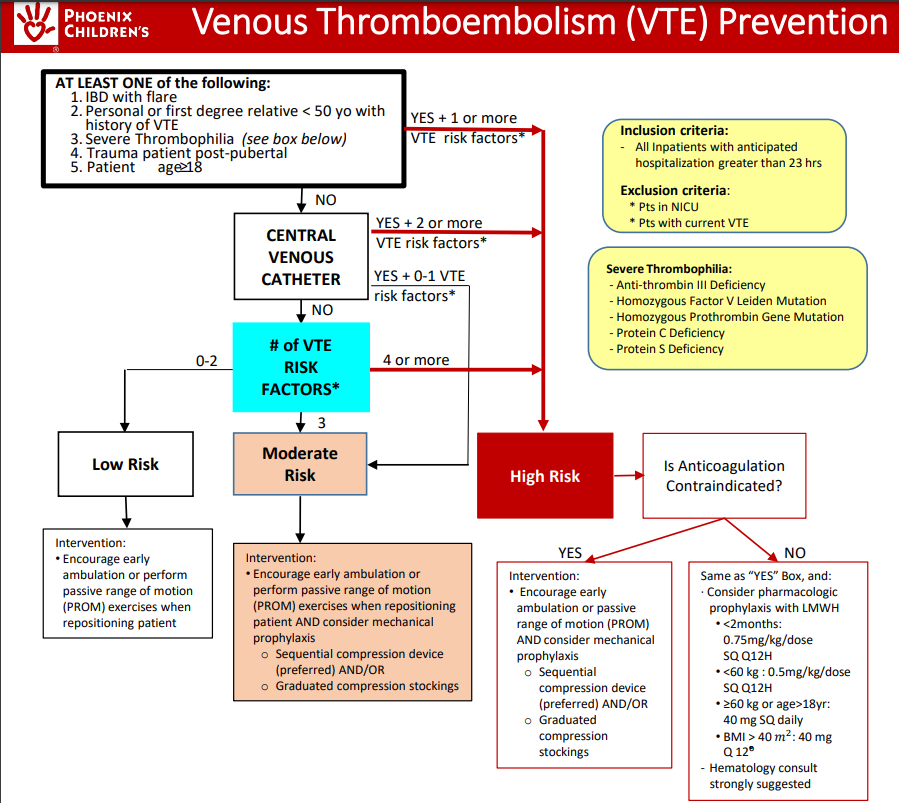
This article reviews the results of a venous thromboembolism (VTE) protocol that was implemented in 2018 in children with inflammatory bowel disease (IBD). A total of 313 hospitalizations across 187 different patients were identified that met criteria including IBD and central venous access. This retrospective review focused on children with IBD and and central venous catheter (CVC)  Key findings:

  • VTE prophylaxis increased from 5.24% (n = 12) prior to the intervention to 63.10% (n = 53) after the intervention
  • Rate of Doppler US increased from 9.17% (n = 21) prior to the intervention to 17.86% (n = 15) after the intervention
  • Diagnosis of VTE increased from 0.87% (n = 2) prior to the intervention to 7.14% (n = 6) after the intervention (attributed to better detection)

This article provides an algorithm for implementing VTE prophylaxis, recommending prophylaxis if 2 or more risk factors –both IBD and CVCs are risk factors. Mechanical prophylaxis (along with frequent ambulation, if feasible) is generally recommended if there are at least 2 risk factors, whereas anticoagulation prophylaxis is generally recommended if there are at least 4 risk factors. Other risk factors include being post-pubertal, obese, prolonged surgery (>90 minutes) within 2 weeks, altered mobility, and mechanical ventilation (see full protocol in article).

My take: In children at increased risk, the approach to reducing VTE in this article is quite sensible. Nevertheless, more research, especially with regard to institution of anticoagulation, is needed.

Related blog posts:

Disclaimer: This blog, gutsandgrowth, assumes no responsibility for any use or operation of any method, product, instruction, concept or idea contained in the material herein or for any injury or damage to persons or property (whether products liability, negligence or otherwise) resulting from such use or operation. These blog posts are for educational purposes only. Specific dosing of medications (along with potential adverse effects) should be confirmed by prescribing physician.  Because of rapid advances in the medical sciences, the gutsandgrowth blog cautions that independent verification should be made of diagnosis and drug dosages. The reader is solely responsible for the conduct of any suggested test or procedure.  This content is not a substitute for medical advice, diagnosis or treatment provided by a qualified healthcare provider. Always seek the advice of your physician or other qualified health provider with any questions you may have regarding a condition.

ARCH Study: Higher Doses of Infliximab in Acute Severe Ulcerative Colitis

KG Whaley et al. Clin Gastroenterol Hepatol 2023; 21: 1338-1347. Multicenter Cohort Study of Infliximab Pharmacokinetics and Therapy Response in Pediatric Acute Severe Ulcerative Colitis

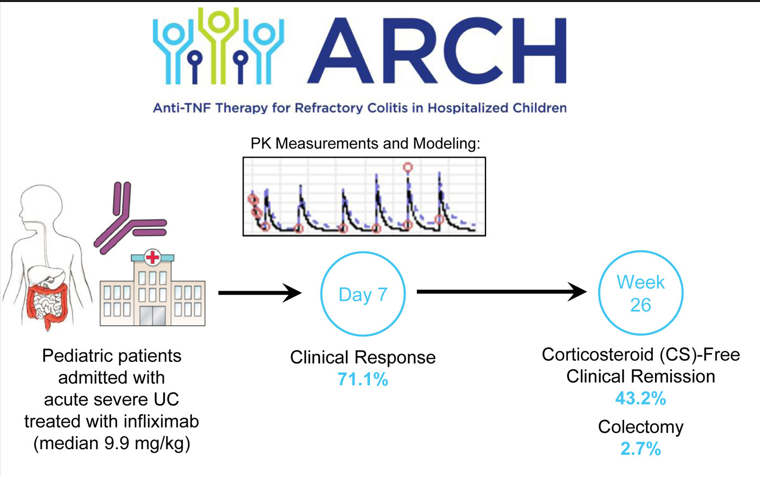
This was a multicenter prospective cohort of hospitalized children initiating IFX for ASUC or IBD-unclassified (n=38).

Key findings:

  • Compared to previous publications of pediatric ASUC, there was a low colectomy rate in this cohort of 2.7% at week 26 and 10.8% at 2 years
  • Median initial IFX dose was 9.9 mg/kg
  • Early rapid clearance was strongly associated with colectomy
  • Faster clearance was associated with higher WBC, presence of antibodies to infliximab and lower albumin. Higher platelets were associated with increased volumes of distribution. Concomitant immunomodulator use (26% with methotrexate, 13% thiopurine) “was not a significant covariate for PK parameters”

Discussion points:

  • Higher IFX dosing (10 mg/kg) may sufficiently optimize early outcomes in pediatric ASUC. Prior retrospective studies of adult and pediatric ASUC patients have supported lower colectomy rates with intensified induction regimens compared to standard induction regimens
  • The availability of vedolizumab may also have contributed to a lower colectomy rate
  • WBCs, “specifically neutrophils, may participate in the elimination of IFX”
  • Limitations: observational study, lack of dose standardization, lack of endoscopic outcomes

My take: Especially in pediatric patients, there is ample data to support using 10 mg/kg dosing for infliximab in patients with more severe inflammatory bowel disease, both ulcerative colitis and Crohn’s disease.

Related blog posts:

Durability of Biologics in Children with Inflammatory Bowel Disease

JL Kaplan et al. JPGN 2023; 76: 567-575. Open Access! Use, Durability, and Risks for Discontinuation of Initial and Subsequent Biologics in a Large Pediatric-Onset IBD Cohort

Methods: The authors analyzed pediatric inflammatory bowel disease (IBD) data from the ImproveCareNow Network registry (n= 17,649) between May 2006 and September 2016, including time to biologic initiation, choice of first subsequent biologics, biologic durability, and reasons for discontinuation

Key findings:

  • 7585 (43%) were treated with a biologic agent before age 18. 50% of children with Crohn’s disease (CD) received a biologic compared to 25% of children with ulcerative colitis (UC)
  • First biologic agents for all patients were anti-tumor necrosis factor agents (88% infliximab, 12% adalimumab)
  • Probability of remaining on first biologic in patients with CD: 93% at 6 months, 85% at 12 months, 79% at 24 months, and 74% at 36 months
  • Probability of remaining on first biologic in patients with UC: 84% at 6 months, 75% at 12 months, 66% at 24 months, and 55% at 36 months
  • First biologics were discontinued because of loss of response (39%), intolerance (23%), and nonresponse (19%).

My take: This is an important study that shows that anti-TNF therapy durability was 79% in patients with CD and 66% in patients with UC at 2 years. This pediatric-specific information will help with counseling families when starting biologic therapy. There was improvement in durability after 2013 compared to prior -so perhaps perhaps even better durability is occurring in 2023. It is a little ironic that this study is from ImproveCareNow given that the results are quite dated. There have been a lot of changes in the last seven years. These include the widespread use of dose optimization/therapeutic drug levels and the approval of several new classes of targeted medications.

Related blog posts:

Tucson Botanical Gardens

Pneumatosis Intestinalis in Children with Intestinal Failure

Tucson Botanical Gardens

ML Reppucci et al. JPGN 2023; 76: 561-565. Pneumatosis Intestinalis in Children With Intestinal Failure: The Result of Intestinal Stress From Enteral Feeding?

This was a single-center, retrospective review (n=111) of children with intestinal failure (2019-2022). Key findings:

  • 30.6% of patients (34 of 111) developed PI
  • Only one patient had a surgical cause (midgut volvulus) identified

The authors speculate that enteral feedings, in some, cause a stress (?relative ischemia, ?intraluminal pressure) which leads to pneumatosis.

My take: We still don’t understand pneumatosis intestinalis (PI) very well outside of the neonatal population where it is often a life-threatening medical condition.

Related blog post: Image Only: Pneumatosis Intestinalis in Necrotizing Enterocolitis