Treatment regimen: “A 1–2 ml/kg olive oil enema was given either alone or followed several hours later by a glycerin enema.”
Study population: “Forty-nine had functional constipation; 43 had anorectal malformation; 40 had Hirschsprung disease; 12 had spina bifida; and 10 had other maladies.”
Key finding: Olive oil enema was considered effective in treating fecal impaction in 77.6% of patients
My take: I don’t have any personal experience with olive oil but expect it would work similar to mineral oil.
It is well-recognized that obesity/overweight increases the risk of cancer (related blog post: Cancer due to Overweight/Obesity). Wang et al provide data regarding cancer risk due specifically to nonalcoholic fatty liver disease (NAFLD) from a large prospective adult cohort (n=54,187). Key findings:
Prevalence of NAFLD, based on ultrasonography, was 32.3%.
NAFLD was associated with increased risk of all cancers (hazard ratio [HR], 1.22; 95% CI, 1.10–1.36; P = .0001), thyroid cancer (HR, 2.79; 95% CI, 1.25–6.21; P = .01), and lung cancer (HR, 1.23; 95% CI, 1.02–1.49; P = .03).
Increased risk for colorectal cancer (HR, 1.96) and lung cancer (HR, 1.38) was demonstrated only in smokers. An association between NAFLD and kidney cancer (HR, 1.57; 95% CI, 1.03–2.40) was only observed in men without diabetes.
Risk of hepatocellular carcinoma was increased only in those with elevated ALT values of 80 U/L or more (HR 8.08)
My take: This study shows that NAFLD increases the risk of cancer; much of this risk may be due to obesity/metabolic syndrome and associated chronic inflammation. Overall, cardiovascular disease in patients with NAFLD represents a higher risk for morbidity and mortality.
The authors collected data from a multicenter randomized trial of the CD exclusion diet (CDED) in children (mean age, 14.2 ± 2.7 y) with Crohn’s disease who were randomly assigned to groups given either exclusive enteral nutrition (EEN, n = 34) or the CDED with 50% (partial) enteral nutrition (PEN) (n = 39).
The CDED has been discussed previously on this blog; it aims to avoid animal and saturated fat, milk fat, gluten, specific emulsifiers, taurine, red (reduced heme) and processed meat, and certain fibers from some fruits and vegetables. In addition to excluding patients who received competing therapies (eg. steroids, immunomodulators, and biologics), the authors excluded patients with isolated large bowel disease (L2).
Key findings:
At week 3 of the diet, 82% of patients in the CDED group and 85% of patients in the EEN group had a dietary response or remission. Median serum levels of C-reactive protein had decreased from 24 mg/L at baseline to 5.0 mg/L at week 3 (P < .001)
Among the 49 patients in remission at week 6, 46 patients (94%) had had a diet response or remission by week 3 and 81% were in clinical remission by week 3
The authors note that the rapid response to dietary therapy suggests a role for a ‘trial by diet’. As such, dietary therapy could be used as monotherapy, for patients failing other therapies, or as a bridge to biological therapy. The authors note that the exact reasons for response to dietary therapy are unsettled and could be “due to both foods excluded and foods enriched in the diet.” In addition, they note that diet appears to be a trigger for inflammation and that reintroduction of foods leads to rebound in inflammation (eg. higher calprotectin) and dysbiosis.
My take: This study shows that dietary therapy works quickly. In this small study, the effectiveness of combined CDED with 50% PEN was similar to EEN.
Almost everything we know about the microbiome is uncertain, including how our activities and environments influence its makeup...
Despite the now consensus recognition that air transmission, …we continue to annihilate every microbe in our midst, even though most are harmless…
Excessive hygiene practices, inappropriate antibiotic use and lifestyle changes such as distancing may weaken those [microbial] communities going forward in ways that promote sickness and imperil our immune systems. By sterilizing our bodies and spaces, they argue, we may be doing more harm than good…
Dr. Graham Rook, an emeritus professor of medical microbiology at University College London, likens the immune system to a computer. He says that the microbes we encounter in daily life — on other people and in our spaces — are the data that the immune system relies on to program and regulate its operations.
Deprived of these exposures, especially at the start of life, the immune system is prone to malfunction. The result can be allergies, asthma, autoimmune disorders, obesity, Type 2 diabetes and other chronic medical conditions...
“Even before the pandemic, we know that half of antibiotic use was inappropriate.”…
For those who aren’t yet able to mix and mingle — and right now, that’s most of us — there are other ways to support microbial health. “If you want to do something proactive right now, I would put eating a healthy diet high on your list,” says Dr. Emeran Mayer… plant foods (legumes, greens, whole fruits, a variety of vegetables), as well as fermented foods, support the richness and diversity of the gut microbiome. So, too, does limiting one’s intake of processed and fast foods, especially those that contain added sugar…
Before the pandemic, only one of the top 10 causes of death in America — influenza — was attributable to an infectious disease that someone could “catch.” Nearly all the rest, such as heart disease and stroke, cancer, brain disease and diabetes, are associated with poor microbiome health or dysfunction.
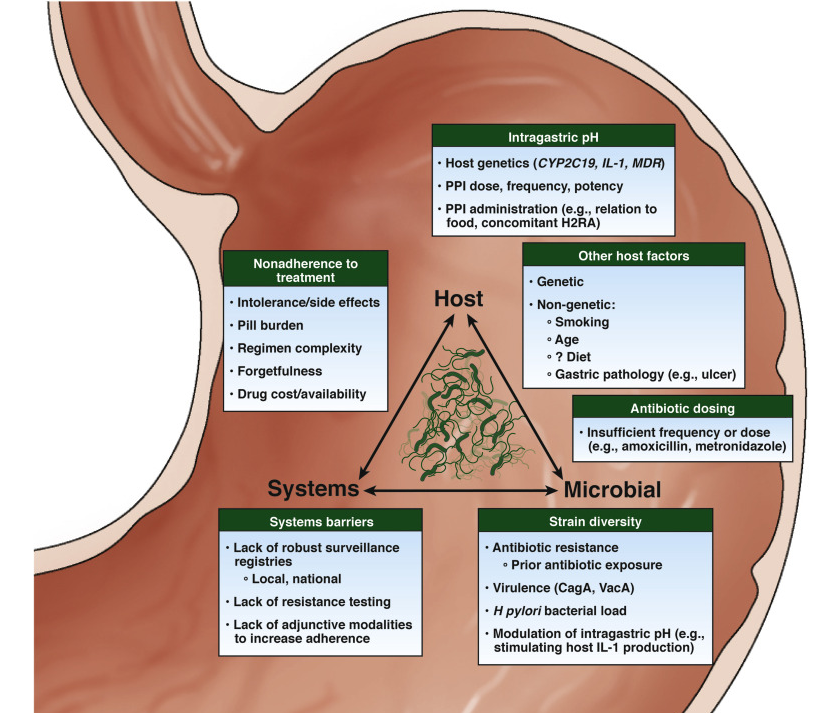
Best Practice Advice 4: If bismuth quadruple therapy failed as a first-line treatment, shared decision making between providers and patients should guide selection between (a) levofloxacin- or rifabutin-based triple-therapy regimens with high-dose dual proton pump inhibitor (PPI) and amoxicillin, and (b) an alternative bismuth-containing quadruple therapy, as second-line options
Best Practice Advice 5: When using metronidazole-containing regimens, providers should consider adequate dosing of metronidazole (1.5–2 g daily in divided doses) with concomitant bismuth therapy, because this may improve eradication success rates irrespective of observed in vitro metronidazole resistance.
Best Practice Advice 6: In the absence of a history of anaphylaxis, penicillin allergy testing should be considered in a patient labeled as having this allergy in order to delist penicillin as an allergy and potentially enable its use. Amoxicillin should be used at a daily dose of at least 2 g divided 3 times per day or 4 times per day to avoid low trough levels.
Best Practice Advice 8:Longer treatment durations provide higher eradication success rates compared with shorter durations (eg, 14 days vs 7 days). Whenever appropriate, longer treatment durations should be selected for treating refractory H pylori infection.
Best Practice Advice 10: After 2 failed therapies with confirmed patient adherence, H pylori susceptibility testing should be considered to guide the selection of subsequent regimens.
Children’s Healthcare of Atlanta has a good COVID-19 Vaccine information page for families/practitioners, including videos from infectious disease experts:
Background: Nonanastomotic biliary strictures are a major complication after liver transplantation, and ischemia–reperfusion injury is a key mechanism in their development. Although static cold preservation provides some protection against injury, preclinical studies have shown that a short period of hypothermic oxygenated machine perfusion restores mitochondrial function and reduces damage.
Methods: In this multicenter, controlled trial, we randomly assigned patients who were undergoing transplantation of a liver obtained from a donor after circulatory death to receive that liver either after hypothermic oxygenated machine perfusion (machine-perfusion group) or after conventional static cold storage alone (control group). A total of 160 patients were enrolled, of whom 78 received a machine-perfused liver and 78 received a liver after static cold storage only (4 patients did not receive a liver in this trial).
Key points:
Nonanastomotic biliary strictures occurred in 6% of the patients in the machine-perfusion group and in 18% of those in the control group, risk ratio, 0.36
Postreperfusion syndrome occurred in 12% of the recipients of a machine-perfused liver and in 27% of those in the control group; risk ratio, 0.43
Early allograft dysfunction occurred in 26% of the machine-perfused livers, as compared with 40% of control livers; risk ratio, 0.61
My take: Hypothermic oxygenated machine perfusion led to lower risk of nonanastomotic biliary strictures
As noted in previous blog posts (see below), adult guidelines for ulcerative colitis favor ustekinumab over vedolizumab for ulcerative colitis patients who have had anti-TNF therapy; recent pediatric guidelines appeared to do the opposite, possibly due to limited data with ustekinumab.
All patients had failed prior infliximab therapy, and 12 (48%) also had failed vedolizumab. Five patients discontinued ustekinumab after IV induction (four undergoing colectomy).
On intent to treat basis, 44% (n=11) achieved the primary endpoint of steroid‐free remission at week 52, including nine (69%) of 13 who previously treated with anti‐TNF only vs two (17%) of 12 who previously failed also by vedolizumab. Seven of 11 remitters met the criteria for endoscopic improvement.
Higher trough levels were not associated with a superior rate of clinical remission; the median (IQR) trough levels (μg/mL) were greater with q4 vs q8 weekly dosing (8.7 [4.6‐9.9] vs 3.8 [12.7‐4.8]) P = 0.02.
No adverse events were associated with therapy.
My take: Ustekinumab is a good option for pediatric patients with ulcerative colitis who are refractory to anti-TNF agents. More data are needed to help in positioning therapies.
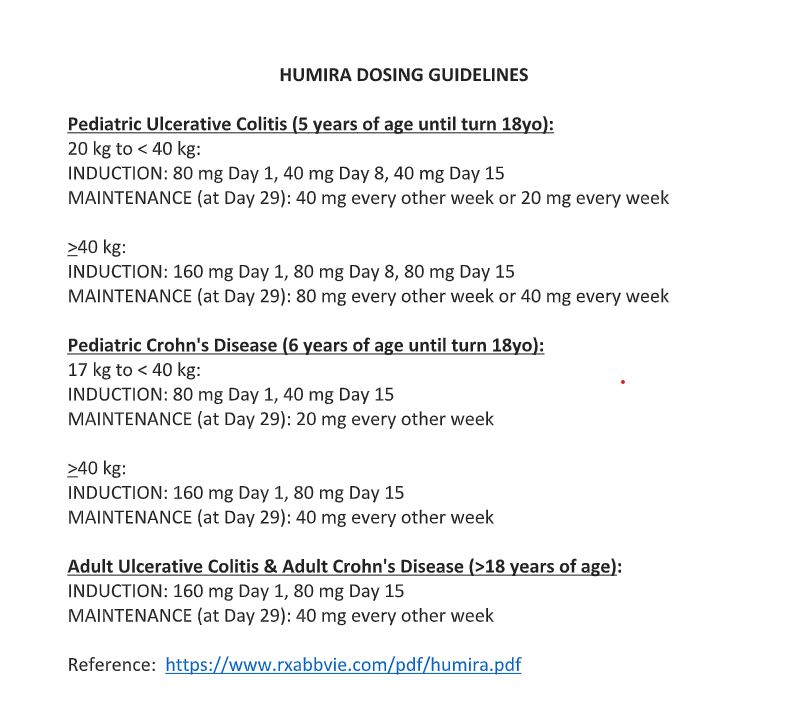
Also, Humira (adalimumab) is now FDA-approved for children as young as 5 years with ulcerative colitis: FDA Approves Adalimumab as Treatment for Children With Ulcerative Colitis (2/25/21). “This approval is based on results from the phase 3, randomized, double-blind, multicenter ENVISION I (NCT02065557) study.” Abbvie has now updated their Humira dosing recommendations (Reference: https://www.rxabbvie.com/pdf/humira.pdf). Thanks to Clair Talmadge for this update.
Disclaimer: This blog, gutsandgrowth, assumes no responsibility for any use or operation of any method, product, instruction, concept or idea contained in the material herein or for any injury or damage to persons or property (whether products liability, negligence or otherwise) resulting from such use or operation. These blog posts are for educational purposes only. Specific dosing of medications (along with potential adverse effects) should be confirmed by prescribing physician. Because of rapid advances in the medical sciences, the gutsandgrowth blog cautions that independent verification should be made of diagnosis and drug dosages. The reader is solely responsible for the conduct of any suggested test or procedure. This content is not a substitute for medical advice, diagnosis or treatment provided by a qualified healthcare provider. Always seek the advice of your physician or other qualified health provider with any questions you may have regarding a condition.









 gutsandgrowth