Why I Don’t Check Vitamin D Levels During IBD Flare-ups

A recent study (C Striscuiglio et al. JPGN 2018; 67: 501-6) helps explain the role of inflammation on vitamin D levels in pediatric patients (n=51) with inflammatory bowel disease (IBD).

Key findings:

  • The free/total 25-OH D ratio was higher in patients with newly-diagnosed IBD compared to healthy controls (P< .001)
  • A significant direct correlation was found between free/total 25-O D ratio and the activity index of disease (P= .01)
  • While there was frequent deficiency in total vitamin D levels,  the free 25-OH D which is the active form of vitamin D was normal or elevated in patients with newly-diagnosed IBD; this, in turn, was due to a decrease in vitamin-D binding protein which is related to inflammation. The authors hypothesized that at the cellular level in the intestine, there may be peripheral resistance due to inflammation and even supratherapeutic levels of free vitamin D could be needed to produce the active form (1,25-OH D).

My take: This study shows that 25-OH D levels (total) have almost no value at the onset of IBD.  Even normal or elevated free levels of 25-OH D which were found in this study does not preclude the potential need to supplement with vitamin D according to the study authors. In addition, as noted in previous posts, Vitamin D levels can normalize without supplementation when the patient’s IBD responds to therapy.

Related blog posts:

Disclaimer: These blog posts are for educational purposes only. Specific dosing of medications/diets (along with potential adverse effects) should be confirmed by prescribing physician/nutritionist.  This content is not a substitute for medical advice, diagnosis or treatment provided by a qualified healthcare provider. Always seek the advice of your physician or other qualified health provider with any questions you may have regarding a condition.

Dangerous animal –seen on our hike to the tea house, Banff
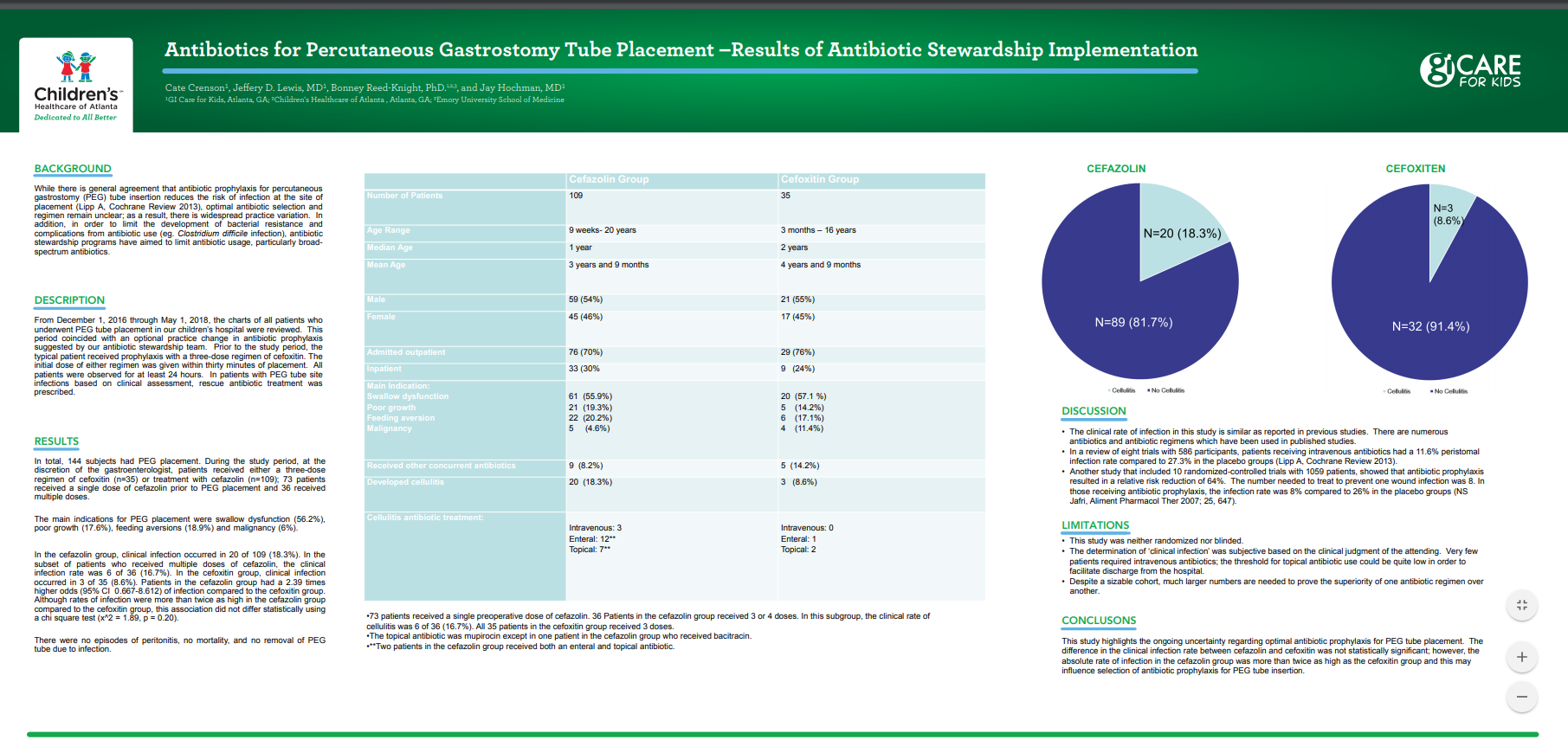
#NASPGHAN18 -Our Poster on Antibiotic Stewardship and PEG Placement

Thanks to Chelly Dykes for presenting poster later today and to co-authors for collaborating on this project: Jeffery Lewis, Bonney Reed-Knight and Cate Crenson.

Full abstract below.

ABSTRACT:

 Background: While there is general agreement that antibiotic prophylaxis for percutaneous gastrostomy (PEG) tube insertion reduces the risk of infection at the site of placement (Lipp A, Cochrane Review 2013), optimal antibiotic selection and regimen remain unclear; as a result, there is widespread practice variation.  In addition, in order to limit the development of bacterial resistance and complications from antibiotic use (eg. Clostridium difficile infection), antibiotic stewardship programs have aimed to limit antibiotic usage, particularly broad-spectrum antibiotics.

Methods: From December 1, 2016 through May 1, 2018, the charts of all patients who underwent PEG tube placement in our children’s hospital were reviewed.  This period coincided with an optional practice change in antibiotic prophylaxis.  Prior to the study period, the typical patient received prophylaxis with a three-dose regimen of cefoxitin.  During the study period, at the discretion of the gastroenterologist, patients received either a three-dose regimen of cefoxitin (n=38) or treatment with cefazolin (n=109); 73 patients received a single dose of cefazolin prior to PEG placement and 36 received multiple doses.  The initial dose of either regimen was given within thirty minutes of placement.  All patients were observed for at least 24 hours.  In patients with PEG tube site infections based on clinical assessment, rescue antibiotic treatment was prescribed.

Results: In total, 144 subjects had PEG placement. The main indications for PEG placement were swallow dysfunction (56.2%), poor growth (17.6%), feeding aversions (18.9%) and malignancy (6%).  In the cefoxitin group, clinical infection occurred in 3 of 35 (8.6%).  In the cefazolin group, clinical infection occurred in 20 of 109 (18.3%). In the subset of patients who received multiple doses of cefazolin, the clinical infection rate was 6 of 36 (16.7%). Patients in the cefazolin group had a 2.39 times higher odds (95% CI  0.667-8.612) of infection compared to the cefoxitin group. Although rates of infection were more than twice as high in the cefazolin group compared to the cefoxitin group, this association did not differ statistically using a chi square test (x^2 = 1.89, p = 0.20).

Conclusion: This study highlights the ongoing uncertainty regarding optimal antibiotic prophylaxis for PEG tube placement.  The difference in the clinical infection rate between cefazolin and cefoxitin was not statistically significant; however, the absolute rate of infection in the cefazolin group was more than twice as high as the cefoxitin group and this may influence selection of antibiotic prophylaxis for PEG tube insertion.


With Regard to Avoiding Excessive Weight Gain, Breastfeeding is Best

A recent study (AR Goetz et al J Pediatr 2018; 201: 27-33) examines the impact of breastfeeding on the growth of infants with high birth weight (HBW).

Background: “Exclusive breastfeeding is protective against high weight and is recommended by” the AAP for the first 6 months.  In this study, the authors hypothesized that “HBW infants would receive a lower percentage of breast milk and consume more formula than NBW infants.”

Key findings:

  • HBW infants with high weights at 7-12 months of age demonstrated a rapid decline in the percentage of breast milk feedings compared with HBW infants with normal weights at 7-12 months of age.
  • Normal birth weight infants with high weights at 7-12 months of age received a lower percentage of breast milk and more formula intake that those with normal weights at 7-12 months of age.

Because HBW is associated with later risk of obesity/overweight, identifying strategies early in life is important.  Furthermore, as a recent study in NEJM has shown (M Geserick et al. NEJM 2018; 379: 1303-12), a lot of weight gain issues happen in the first years of life:

  • Almost 90% of children who were obese at 3 years of age were overweight or obese in adolescence
  • Among obese adolescents, the most rapid weight gain had occurred between 2 and 6 years of age

My take: This study further shows a strong association between consumption of breast milk and normal weights at 7-12 months of age, both in HBW and NBW.

Related blog posts:

Near Lake Louise, Banff

Direct-Acting Antivirals in Patients Without Advanced Hep C Liver Disease

A recent study (LI Backus et al. Hepatology 2018; 68: 827-38, editorial 804-06) indicates that direct-acting antivirals (DAA) improve mortality in patients with hepatitis C virus (HCV) without advanced liver disease.

Using a registry from the Veterans Affairs, the authors identified 40,664 treated with interferon-free DAA regimens.  Overall there was a 96.8% sustained virologic response (SVR).  These patients were compare with 62,882 patients who did not receive DAA and without apparent advanced fibrosis.

Background: Long-term benefits have been established in patients with HCV and advanced fibrosis who have had viral eradication with DAA regimens with less hepatic decompensation and less hepatocellular carcinoma.

Key findings:

  • SVR in this cohort was associated with a 59% unadjusted reduction in all-cause mortality when compared to those who did not achieve SVR and a 69% reduction compared to the untreated cohort.
  • In absolute terms, 1-year mortality rates were reduced by 1.3% with SVR compared to treated group without SVR and by 2.9% compared to no treatments.

These declines in mortality occurred despite the fact that DAA-treated patients had more comorbid conditions and similar access to providers among the three groups.  The findings in this population of veterans will need to be replicated in other populations.

My take: This study is a big leap forward by showing that even in groups without advanced fibrosis, treatment with DAA improved a significant clinical endpoint not just a biomarker.  There are likely other unmeasured benefits in terms of health and quality of life that are likely to accrue after viral eradication

Related blog posts:

Lake Louise, Banff

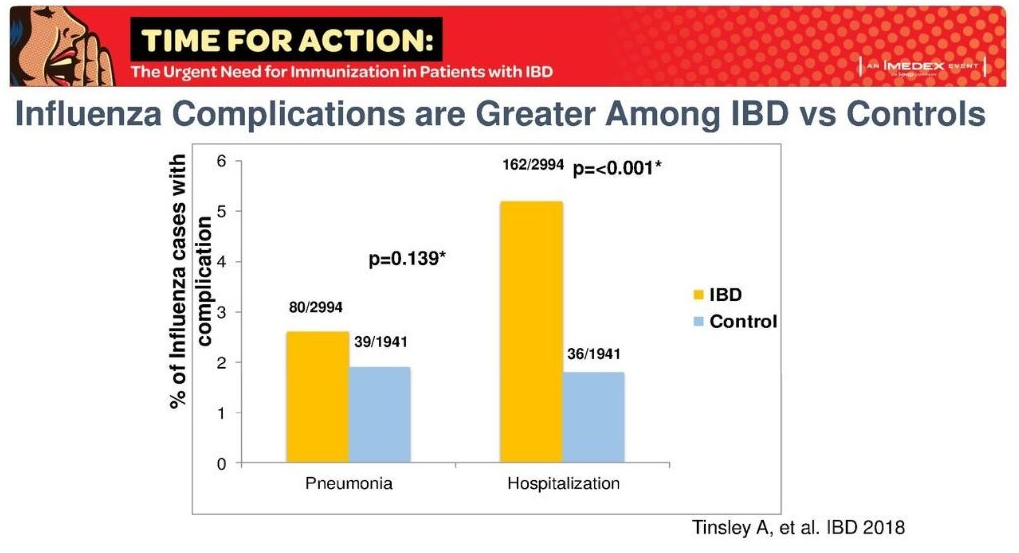
Almost Everybody Needs Flu Shot –IBD Patients at Higher Risk

Link: CDC Recommendations for Influenza Vaccination

  • Routine annual influenza vaccination is recommended for all persons aged ≥6 months who do not have contraindications.
  • Vaccination should be offered by end of October; however, vaccination should continue to be offered as long as influenza viruses are circulating and unexpired vaccine is available.


Expert Advice for Diagnosis and Treatment of Rumination Syndrome

Full text: M Halland et al Clinical Gastroenterol Hepatol 2018; 16: 1549-1555 provide an excellent review and practical recommendations for rumination syndrome.

The article describes the high prevalence which is ~0.8-0.9% of adults and ~5% of children.  Some populations like patients with eating disorders and fibromyalgia have even higher rates.

Other key points:

  • Long delay in diagnosis: patients “visit an average of 5 physicians over 2.7 to 4.9 years before being diagnosed correctly”
  • The diagnosis is a clinical based on Rome IV criteria, though most patients undergo an esophagogastroduodenoscopy or barium study to rule out other disorders
  • Best Practice Advice 1: Clinicians strongly should consider rumination syndrome in patients who report consistent postprandial regurgitation. Such patients often are labeled as having refractory gastroesophageal reflux or vomiting.
  • Best Practice Advice 2: Presence of nocturnal regurgitation, dysphagia, nausea, or symptoms occurring in the absence of meals does not exclude rumination syndrome, but makes the presence of it less likely.
  • Best Practice Advice 3: Clinicians should diagnose rumination syndrome primarily on the basis of Rome IV criteria after an appropriate medical work-up.
  • Best Practice Advice 4: Diaphragmatic breathing with or without biofeedback is the first-line therapy in all cases of rumination syndrome.
  • Best Practice Advice 5: Instructions for effective diaphragmatic breathing can be given by speech therapists, psychologists, gastroenterologists, and other health practitioners familiar with the technique.
  • This article gives instructions on this technique: “Diaphragmatic breathing can be learned easily by putting a hand on the chest and on the abdomen during respiration, and only allowing the hand on the abdomen to move out with inspiration while the chest remains in position (Figure 3). We instruct patients to take breaths by protruding the abdomen while keeping the chest as stationary as possible. Each inhalation or exhalation should be slow and complete, aiming for 6 to 8 respirations per minute. We recommend diaphragmatic breathing for 15 minutes after each meal, or longer if the sensation of impending rumination remains. The technique also should be practiced in the absence of meals to become expert at the technique. Uncontrolled studies and case series have reported resolution or improvement in rumination symptoms after diaphragmatic breathing in 20%–66% of patients. Figure 3: The patient slowly inhales through the nose while protruding the abdomen and keeping the chest stationary. (B) The patient slowly exhales via the mouth and allows the abdomen to retract.”
  • Best Practice Advice 6: Objective testing for rumination syndrome with postprandial high-resolution esophageal impedance manometry can be used to support the diagnosis, but expertise and lack of standardized protocols are current limitations.
  • Best Practice Advice 7: Baclofen, at a dose of 10 mg 3 times daily, is a reasonable next step in refractory [adult] patients.

My take: This is a useful review article.  Rumination needs to be considered particularly in patients with regurgitation, often labelled vomiting by families, that happens quickly after meals.

Related posts:

In the news…from Washington Post:

Time to Diagnosis in Eosinophilic Esophagitis

According to a recent retrospective study (CC Reed et al. Clin Gastroenterol Hepatol 2018; 16: 1667-9) the time to diagnosis of eosinophilic esophagitis (EoE) has NOT improved  between 2000 and 2014.  In this single tertiary-care center study with 677 cases, the predicted length of symptoms prior to diagnosis was the following:

  • 2000-2006: 6.1 years
  • 2007-2011: 7.2 years
  • 2011-2014: 7.2 years

While in the pediatric cohort the trend was the same, the length of symptoms preceding diagnosis was shorter: 2.8 years, 3.5 years and 3.7 years respectively for the above-mentioned time periods.

My take: In GI circles, EoE is quickly considered for a variety of clinical presentations.  This study suggests that

  • #1 for families and primary care doctors that many are unaware of this entity
  • #2 the symptoms of EoE are often insidious

Related blog posts:

Updated Consensus Guidelines for Eosinophilic Esophagitis

Full text: ES Dellon, CA Liacouras,  J Molina-Infante, GT Furuta et al. Gastroenterol 2018; 155: 1022-33.

This article provides a thorough review of EoE -including clinical features, differential diagnosis, diagnostic criteria, and treatments.

Key point: “The evidence suggests that PPIs are better classified as a treatment for esophageal eosinophilia that may be due to EoE than as a diagnostic criterion, and we have developed updated consensus criteria for EoE that reflect this change.”

Related blog posts: