NY Times: “Our Food is Killing Too Many of Us”

NY Times: D Mozaffarian, D Glickman Our Food is Killing Too Many of Us

“Improving American nutrition would make the biggest impact on our health care”

An excerpt:

“Instead of debating who should pay for all this, no one is asking the far more simple and imperative question: What is making us so sick, and how can we reverse this so we need less health care? … our food…

Poor diet is the leading cause of mortality in the United States, causing more than half a million deaths per year. Just 10 dietary factors are estimated to cause nearly 1,000 deaths every day from heart disease, stroke and diabetes alone…

Taxes on sugary beverages and junk food can be paired with subsidies on protective foods like fruits, nuts, vegetables, beans, plant oils, whole grains, yogurt and fish….Levels of harmful additives like sodium, added sugar and trans fat can be lowered through voluntary industry targets or regulatory safety standards

Nutrition standards in schools, which have improved the quality of school meals by 41 percent, should be strengthened; the national Fresh Fruit and Vegetable Program should be extended beyond elementary schools to middle and high schools…

Coordinated federal leadership and funding for research is also essential. This could include, for example, a new National Institute of Nutrition at the National Institutes of Health. Without such an effort, it could take many decades to understand and utilize exciting new areas, including related to food processing, the gut microbiome, allergies and autoimmune disorders, cancer, brain health, treatment of battlefield injuries and effects of nonnutritive sweeteners and personalized nutrition.”

Related blog posts:

Crater Lake, OR


Bariatric Surgery Survival – 5 Countries, 500,000 Participants

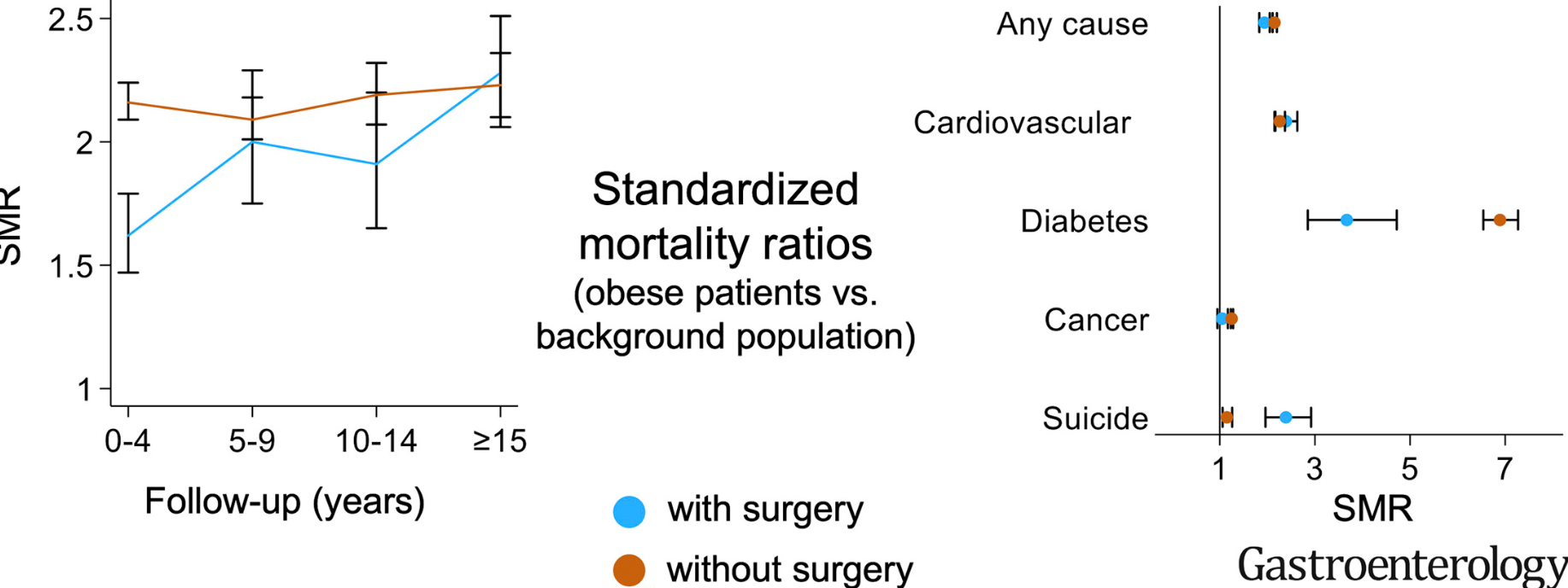
A recent population-based cohort study (JH Kauppila et al. Gastroenterol 2019; 157: 19-27) examined the effects of bariatric surgery on survival from Nordic countries between 1980-2012.

Link: Effects of Obesity Surgery on Overall and Disease-Specific Mortality in a 5-Country Population-Based Study

Among 505,258 obese individuals, 49,977 had bariatric surgery.

Key findings:

  • Overall mortality rates were lower in the surgery group during the first 14 years but higher after 15 years (HR 1.20 with CI 1.02-1.42).  Thus, overall, obese patients who underwent bariatric surgery had longer survival times than obese patients who did not have surgery.  Both groups had higher mortality than the general population
  • The improved survival compared to those without surgery was related to decreased mortality from cardiovascular mortality, diabetes and cancer.  However mortality due to suicide was increased.
  • Limitations: lack of detailed data including BMI, smoking and alcohol consumption

Graphical abstract (available online)

Related blog posts:

Bad Diets –>High Mortality

A recent article in Lancet (“Health effects of dietary risks in 195 countries, 1990–2017:
a systematic analysis for the Global Burden of Disease Study 2017″ -open access) estimated that bad diets lead to 11 million deaths per year. Thanks to Ana Ramirez for sending me this article. “High intake of sodium, low intake of whole grains, and low intake of fruits were the leading dietary risk factors for deaths and DALYs globally and in many countries.”

A summary of this study was reported on NPR: Bad Diets Are Responsible For More Deaths Than Smoking, Global Study Finds

An excerpt:

About 11 million deaths a year are linked to poor diet around the globe…

As part of a new study published in The Lancet, researchers analyzed the diets of people in 195 countries using survey data, as well as sales data and household expenditure data. Then they estimated the impact of poor diets on the risk of death from diseases including heart disease, certain cancers and diabetes. (They also calculated the number of deaths related to other risk factors, such as smoking and drug use, at the global level.)…

“Generally, the countries that have a diet close to the Mediterranean diet, which has higher intake of fruits, vegetables, nuts and healthy oils [including olive oil and omega-3 fatty acids from fish] are the countries where we see the lowest number of [diet-related] deaths,” …

What would happen if everyone around the globe began to eat a healthy diet, filling three-fourths of their plates with fruits, vegetables and whole grains? We’d run out…

Improving diets won’t be easy: A range of initiatives may be needed, including nutrition education and increased access to healthy foods, as well as rethinking agricultural production.

Related blog posts:


Liver Shorts April 2019

CL Mack et al. JPGN 2019; 68: 495-501. This multicenter prospective open-label phase I/III trial of IVIG in biliary atresia patients status-post Kasai indicated that the infusions were tolerated.  However, though this study was not powered to detect efficacy, survival with native liver was LOWER among patients who had received IVIG (n=29): 58.6% compared to the comparison placebo group 70.5% (n=64).  Thus, despite the theoretical advantages of IVIG which targets aspects of the immune system and improvement in a murine model, in practice IVIG does not appear promising for biliary atresia.

D Kim et al. Hepatology 2019; 69: 1064-74. This study shows that despite improvements in hepatitis C mortality rates associated with newer treatments, there is an overall increase in mortality rates from cirrhosis and hepatocellular carcinoma.  This increase is driven by increasing prevalence and severity of both alcoholic liver disease and nonalchoholic fatty liver disease. The overall cirrhosis-related mortality increased from 19.77/100,000 persons in 2007 to 23.67 in 2016 with an annual increase of 2.3%. Similarly, the overall HCC-related mortality increased from 3.48/100,000 persons in 2007 to 4.41 in 2016 at annual increase of 2%. The editorial on page 931 (TG Cotter and MR Charlton) notes that each year there are more than 40,000 deaaths associated with chronic liver disease.

H Park et al. Hepatology 2019; 69: 1032-45. This study, using Truven Health MarketScan Cata, examined the outcomes of more than 26,000 patients with newly-diagnosed hepatitis C virus (HCV) infection.  Among the 30% who received oral direct-acting antiviral (DAA) therapy, there were improved outcomes in those with and without cirrhosis. In those with cirrhosis (n=2157), DAA was associated with a 72% and 62% lower incidences of HCC and DCC [decompensated cirrhosis] respectively. In noncirrhotic HCV patients (n=23,948), DAA was associated with a 57% and 58% lower incidence of HCC and DCC respectively.  In addition to improved health outcomes, DAA treatment resulted in decrease health care costs, especially for patients with cirrhosis.

Z Kuloglu et al. JPGN 2019; 68: 371-6.  In this multicenter Turkish study, the authors identified 810 children (median age 5.6 years) with unexplained transaminase elevation (62%),unexplained organomegaly (45%), obesity-unrelated liver steatosis (26%) and cryptogenic fibrosis or cirrhosis (6%).  LAL-D [lysosomal acid lipase deficiency] activity was deficient in 2 siblings (0.2%); both had LDL ~155.  Overall, even in at risk groups, LAL-D is rare.

Related posts:

Joshua Tree National Park

Mortality Risk from Childhood Inflammatory Bowel Disease

A recent study (O Olen et al. Gastroenterol 2019; 156: 614-22) was summarized quite succinctly by NEJM journal watch:

Using the Swedish National Patient Registry data, investigators identified 9442 incident cases of IBD diagnosed in patients under age 18 years from 1964 through 2014. Based on 139,000 person-years of follow-up, results were as follows:

  • There were 259 deaths among people with IBD (133 were from cancer and 54 from digestive disease).
  • The all-cause mortality rate in these patients was 2.1/1000 person-years, compared with 0.7 in matched reference individuals from the general population.
  • The average age at death was 61.7 compared with 63.9 years in the reference group.
  • The hazard ratio for death was 3.2 and was higher in those with ulcerative colitis (HR, 4.0), especially if they had concomitant primary sclerosing cholangitis (HR, 12.2), a first-degree relative with ulcerative colitis (HR, 8.3), or a history of surgery (HR, 4.6).
  • Mortality risks were similar when limited to the period after the introduction of biologics (2002–2014).

My take: This study found that having IBD diagnosed in childhood increased the risk of mortality (~1 extra death for every 700 patients followed for 1 year) especially in patients with concomitant PSC and in patients with severe ulcerative colitis.  The study did not see an effect of the newest therapies but was underpowered to directly assess this effect.

Related blog post:


Chattahoochee River, near Azalea Drive


Interleukin 6 and Liver Disease Mortality

Briefly noted: J Remmler et al. Clin Gastroenterol Hepatol 2018; 16: 730-7.  This retrospective study with 474 patients showed that blood levels of interleukin 6 were associated with mortality.  In this cohort, those with levels in the lowest quartile (< 5.3 pg/mL) had zero fatalities within 1 year.  In those with the highest quartile (37 pg/mL or more), had a 67.7% mortality rate within 1 year.  The associated editorial (pg 630-32) notes that IL6 functions include liver regeneration, infection defense, and metabolic homeostasis.  “IL6 is synthesized during inflammatory conditions…persistent activation of the IL6 pathway may have detrimental effects in the livers and in other tissues.”

Pine Mountain Trail

Opiates, Inflammatory Bowel Disease and Mortality

A recent retrospective study (NE Burr et al. Clin Gastroenterol Hepatol 2018; 16: 534-41) with 3517 patient’s with Crohn’s disease (CD) and 5349 with ulcerative colitis (UC) examined the frequency of opioid prescriptions and the relationship to fatal outcomes.

Key findings:

  • Compared to 1990-93, the period of 2010-13 saw a sharp rise in the use of opiods in England: 10% compared to 30%.
  • Prescription of strong opioids (>3 prescriptions per calendar year) was associated with premature mortality: Hazard ratio 2.18 for CD and 3.3 for UC.

This study is in agreement with other data showing increasing use of opiate prescriptions worldwide for chronic noncancer pain (although there has been a drop in the past year).  As with other studies of patients with inflammatory bowel disease, this study shows an association between opioid use and mortality.

My take: Needing an opioid may be a marker for more severe disease. Whether the opioid use directly contributes to mortality remains unclear.


What’s Happening on the Edge of Viability

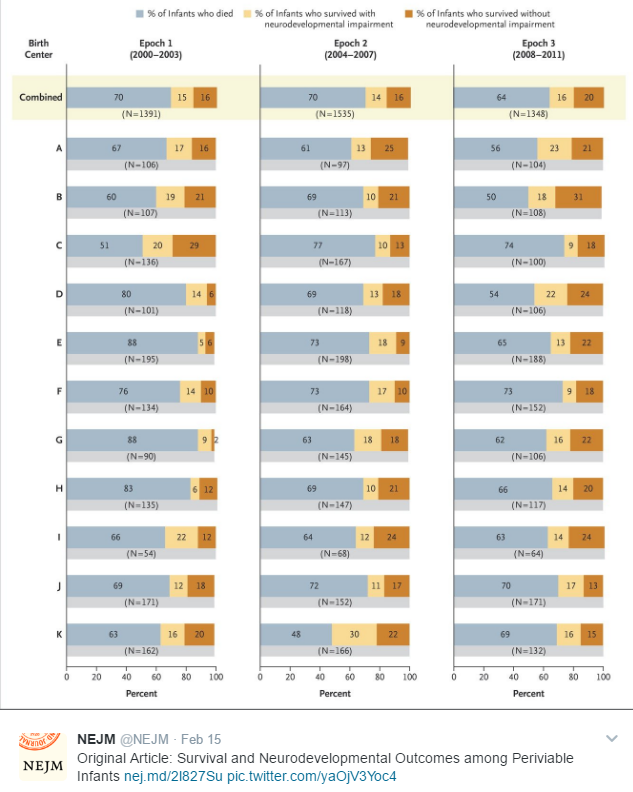
A study (N Younge et al. NEJM 2017; 376: 617-28) provides some data on the slowly changing survival and neurodevelopmental outcomes among periviable infants (22-24 weeks gestation).

From epoch 1 (2000-2003), to epoch 3 (2008-2011), there has been some improvements. Overall survival increased from 30% to 36% and the percentage without neurodevelopmental impairment increased from 16% to 20%.

Mortality and Neurodevelopmental Outcomes at ~18 months of age (combined data and 11 centers)

Mortality and Neurodevelopmental Outcomes at ~18 months of age (combined data and 11 centers)

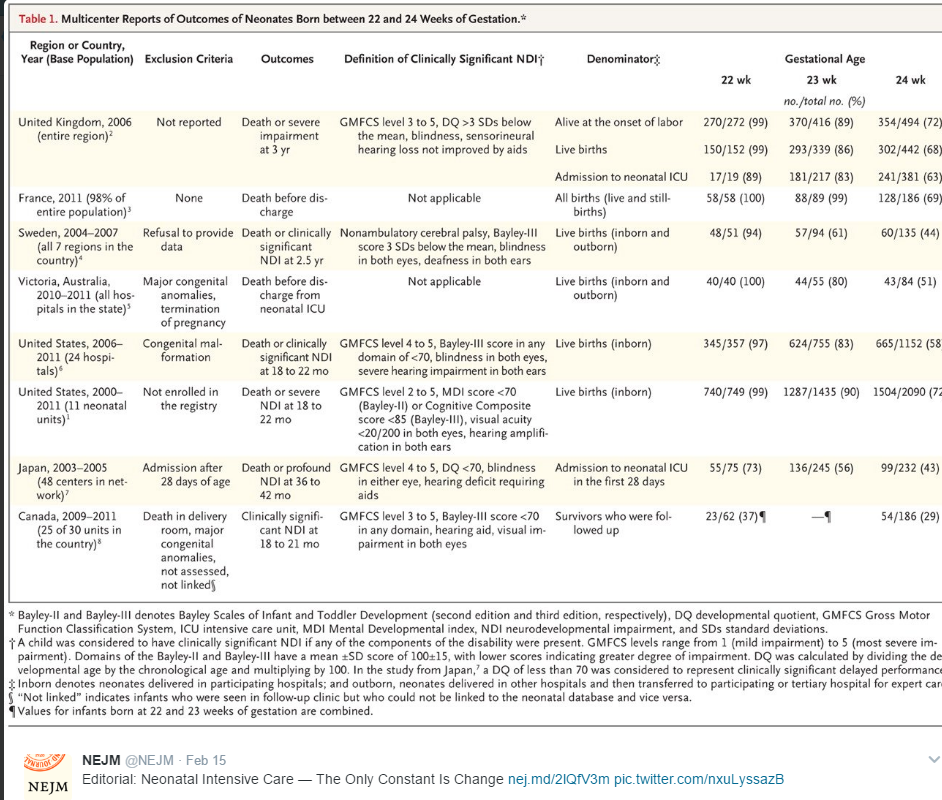
The insightful commentary (pgs 694-6) notes that there has not been improvement in survival in infants born at 22 weeks.  Furthermore, in reviewing multiple studies on outcomes, neurodevelopmental impairment was >94% in patients born at 22 weeks and between 80-90% for infants born at 23 weeks.  At 24 weeks, neurodevelopmental impairment was present between 51-72%

screenshot-137

Related blog posts:

The Dark Cloud Inside the Silver Lining -What’s Really Going on with Hepatitis C Infection

Despite the flood of articles touting the success and costs of the new hepatitis C virus (HCV) treatments, direct-acting antivirals (DAA), currently hepatitis C remains more dangerous than HIV and it is likely to continue to exert a huge mortality and morbidity for at least three more decades in the United States.

One study and an associated editorial look into this subject further:

  • J Chhatwal et al. Hepatitis C Disease Burden in the United States in the Era of Oral Direct-Acting Antivirals.  Hepatology 2016; 64: 1442-1450.
  • JM Pawlotsky. The End of the Hepatitis C Burden: Really?

In the study, the authors used a validated HCV burden simulation model (HEP-SIM) and noted the following:

“Even in the oral DAA era, 320,000 patients will die, 157,000 will develop hepatocellular carcinoma, and 203,000 will develop decompensated cirrhosis in the next 35 years.”

Part of the problems will be a large number of individuals who remain unaware of their diagnosis (560,000 by year 2020) but other barriers include medication costs.

From the editorial -some pushback on the cost-savings argument:

  • “Although current drug regimens were reported to be cost-effective, nothing justifies the current prices, except financial considerations on the drug makers’ side. On the one hand, one could consider that the money saved on liver disease-related expenses is not truly saved. Being cured from HCV and not dying from its complications will not prevent the same individual from dying from another cause at a very high cost.”

My take: To bend the HCV curve faster, there will need to be increased HCV screening, increased treatment capacity, and reasonable costs.

Related blog posts:

Acadia Natl Park

Acadia Natl Park