Probiotics -Lack of Efficacy for Acute Gastroenteritis (Part 2)

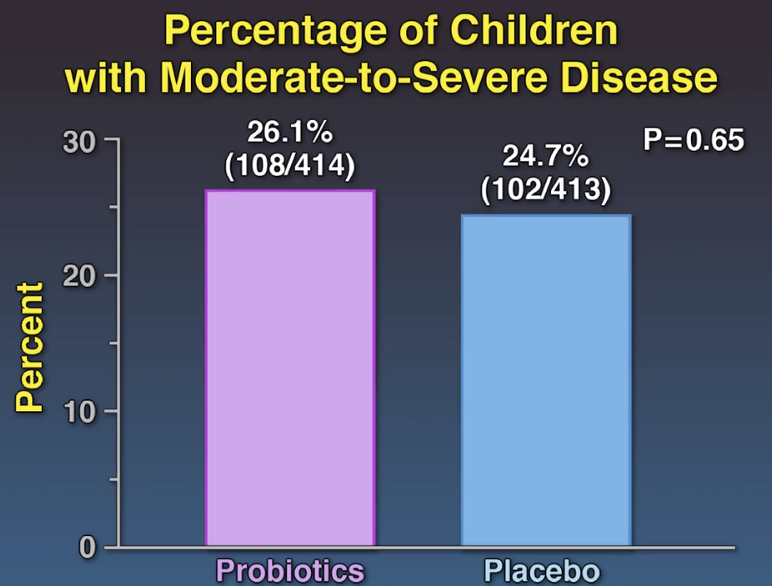
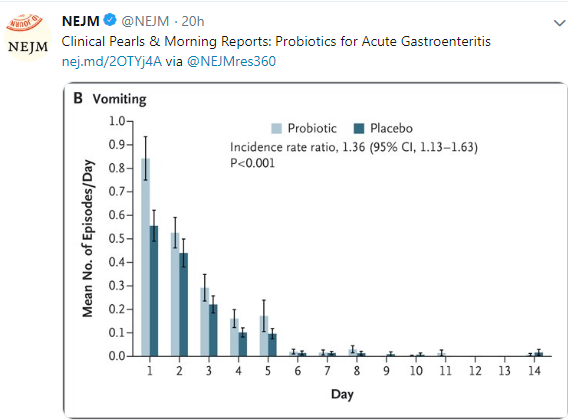
This blog post highlights a second study showing a lack of efficacy of probiotics for acute gastroenteritis.  Link to 2 minute Summary: Quick Take on Probiotics for AGE

My take: While some probiotic strains have been shown to be helpful in some conditions (eg. antibiotic associated diarrhea), this study indicates that probiotics are likely ineffective in altering the course of acute gastroenteritis.

SB Freedman et al. N Engl J Med 2018; 379:2015-2026 Link to abstract: Multicenter Trial of a Combination Probiotic for Children with Gastroenteritis
Related blog posts:

One for the Probiotic Skeptics: Lack of Efficacy in Acute Gastroenteritis (Part 1)

My opinion has been that probiotics are generally over-hyped and are likely ineffective for many conditions in which they are commonly used (see related blog posts below).

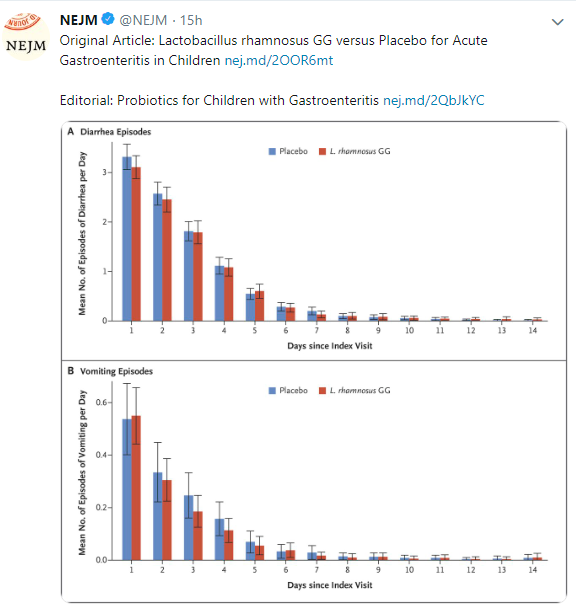
A recent study (D Schnadower et al.N Engl J Med 2018; 379:2002-2014) provided more data to support this skeptical view when probiotics are utilized for acute gastroenteritis.  Another study in the same issue will be highlighted tomorrow and reaches a similar conclusion.

Link to Abstract: Lactobacillus rhamnosus GG versus Placebo for Acute Gastroenteritis in Children

METHODS: We conducted a prospective, randomized, double-blind trial involving children 3 months to 4 years of age with acute gastroenteritis who presented to one of 10 U.S. pediatric emergency departments. Participants received a 5-day course of Lactobacillus rhamnosus GG … twice daily or matching placebo…

RESULTS Among the 971 participants, 943 (97.1%) completed the trial…There were no significant differences between the L. rhamnosus GG group and the placebo group in the duration of diarrhea (median, 49.7 hours in the L. rhamnosus GG group and 50.9 hours in the placebo group; P=0.26), duration of vomiting (median, 0 hours in both groups; P=0.17), or day-care absenteeism (median, 2 days in both groups; P=0.67) or in the rate of household transmission (10.6% and 14.1% in the two groups, respectively; P=0.16).

CONCLUSIONS Among preschool children with acute gastroenteritis, those who received a 5-day course of L. rhamnosus GG did not have better outcomes than those who received placebo

My take: While some probiotic strains have been shown to be helpful in some conditions (eg. antibiotic-associated diarrhea), this study indicates that probiotics are likely ineffective in altering the course of acute gastroenteritis.

Related blog posts:


Probiotics Lower Risk of Sepsis in Newborns

Summary of recent study from NPR: Probiotic Bacteria Can Protect Newborns from Deadly Infections

Previous studies have shown that probiotics lower the risk of necrotizing enterocolitis in premature infants.  Now, a study (full text link below) from India examines whether probiotics could lower other infections.

An excerpt:

Feeding babies the microbes dramatically reduces the risk newborns will develop sepsis, scientists report Wednesday in the journal Nature.

Sepsis is a top killer of newborns worldwide. Each year more than 600,000 babies die of the blood infections, which can strike very quickly…

Babies who ate the microbes [Lactobacillus plantarum] for a week — along with some sugars to feed the microbes — had a dramatic reduction in their risk of death and sepsis. They dropped by 40 percent, from 9 percent to 5.4 percent.

But that’s not all. The probiotic also warded off several other types of infections, including those in the lungs. Respiratory infections dropped by about 30 percent…

The only significant side effect seen in the study was abdominal distension, which occurred in six babies. But there were more cases reported in the placebo group than in the group that got the probiotic.

Full text link (thanks to Kipp Ellsworth’s twitter feed for this link): A randomized synbiotic trial to prevent sepsis in newborns in rural India. P Panigrahi et al.

My take: Whether probiotics would be useful broadly in full-term infants in developed countries is uncertain –more studies are needed.

Related blog posts:


Balanced Summary of Probiotics & Microbiome Effects on the Brain

A good updated summary on probiotics from 538 GutScienceWeek:

Do probiotics work? Are they good for me?

This link reviews a good deal of science and has a nice table explaining costs.

Take home message: Probiotics which vary greatly by strain and often lack rigorous production standards may be beneficial for specific conditions like preventing antibiotic-induced diarrhea but probably are not beneficial on an ongoing basis.

The final post in the series looks at How the Gut Affects Your Mood.

While the author explains that there is likely a microbiome effect on the central nervous system as well as some intriguing animal studies, it is too early to know that manipulation of the microbiome will have beneficial effects on neurological/developmental concerns.

Screen Shot 2016-05-19 at 6.32.33 PM

Is It a Good Idea for Pregnant Mothers to Take Probiotics?

A previous study has indicated that maternal probiotic administration was associated with a lower rate of atopic dermatitis.  The overall quality of evidence supporting this association is considered low.

A recent study (CK Dotterud et al. JPGN 2015; 61: 200-7) examined the effect on the intestinal microbiota in both mother and child following maternal perinatal probiotic supplementation. This randomized, double-blind trial examined the effect of probiotic administration (or placebo) from 36 weeks of gestation up to 3 months postnatally while breastfeeding. Stool microbiome was examined in both mother and child.

Key findings:

  • The changes in the infants microbiome were quite limited. “Only the Lactobacillus rhamnosus GG bacteria colonized the children at 10 days and at 3 months of age. There were no significant differences in the abundance of administered probiotic bacteria between the groups at 1 and 2 years of age.”

My take: We know very little about probiotics and their effects on the GI tract. We often do not even the basics: which strains? which dosage?  optimal timing/when to use?  Given the lack of persistent change in the infant’s microbiome, does administration to pregnant mothers really make any sense (outside of research endeavors)?

Keeping Up with Clostridium Difficile

It is difficult to keep up with all of the relevant publications regarding Clostridium difficile–there are so many.  This likely reflects its emergence as a frequent and important pathogen.

Recent references:

  1. Sandberg KC et al. “Disproportionate Rise in Clostridium difficile Associated Hospitalizations Among US Youth with Inflammatory Bowel Disease, 19978-2011.” JPGN 2015; 60: 486-92 (editorial 421-22).
  2. Leffler DA, Lamont JT. NEJM 2015; 372: 1539-48.

In the first study, the researchers note that there has been a 5-fold increase in inflammatory bowel disease (IBD) hospitalizations with concomitant Clostridium difficile infection (CDI).  Whereas, the hospitalization without CDI increased 2-fold.  Associated with this 5-fold increase in hospitalizations, there were increased costs and longer length of stays.  Interestingly, IBD patients with CDI had a  lower likelihood (OR 0.31) of colectomy in this study. This epidemiology yields more questions than answers.  Certainly, a significant fraction of this increase is due to the use of more sensitive PCR-based assay. In addition, many of these patients may not be symptomatic due to CDI; it can be difficult to determine if IBD symptoms are due to IBD or due to CDI. Even treatment with antibiotics like vancomycin does not fully differentiate as the response could be nonspecific.

In the second review, severe useful points were made.

Risk factors:

  • Antibiotics –this remains most important risk factor
  • Older age (especially if >65 years)
  • Possible acid suppression -not confirmed in some studies when adjusting for coexisting conditions
  • Inflammatory bowel disease
  • Immunosuppression
  • Chronic kidney disease

Diagnosis:

  • Use of DNA assays has allowed for detection of “low levels of toxigenic organisms of uncertain clinical significance.”  Thus, these assays may detect clinically-insignificant infections.
  • Endoscopy is rarely needed, but sometimes helpful in ovelapping conditions like coexistent CDI from IBD
  • Negative PCR assay has a negative predictive value of “more than 95% in average-risk groups.”
  • Testing and treating persons with solid stools is not recommended

Prevention:

  • Probiotics “have an uncertain effect on the prevention of C difficile infection, and their routine use for the prevention or treatment of active infection is not recommended.”  The authors note that initial favorable studies of antibiotic-associated diarrhea were underpowered and that more recent studies have shown mixed results.  In studies of patients with unusually high rates of CDI, probiotics were shown to confer benefit.

Treatment:

  • Metronidazole and vancomycin remain 1st line treatments.
  • Fidaxomicin use has been limited due to expense, but has been shown to reduce recurrence of CDI in those who do not have the b1/NAP1/027 strain.
  • Alternative antimicrobials, including rifaximin, nitazoxanide and others, are “not recommended except in cases of unacceptable adverse effects.”
  • For recurrent infection, 1st line approach is retreatment with either metronidazole & vancomycin. Second recurrences are often treated with fidaxomicin or tapered vancomycin course.
  • Fecal microbial transplantation –noted to be highly effective and safe as salvage therapy. The precise components that are important are uncertain; however, “the phyla Bactteroidetes and Firmicutes are thought to comprise critical components.”  “More work is neede to understand the possible role for fecal microbial transplantation for primary CDI”

Bottomline: CDI remains an important pathogen and significantly complicates the management of IBD.

Related blog posts:

Probiotics -Another Positive Study for Prevention of Necrotizing Enterocolitis

The topic of probiotics and necrotizing enterocolitis has been discussed several times on this blog (see some links below).  Here’s an abstract from a recent J Pediatr 2015;166: 545–51.

Objective

To test the efficacy of probiotic and prebiotic, alone or combined (synbiotic), on the prevention of necrotizing enterocolitis (NEC) in very low birth weight (VLBW) infants.

Study design

A prospective, randomized, controlled trial was conducted at 5 neonatal intensive care units in Turkey. VLBW infants (n = 400) were assigned to a control group and 3 study groups that were given probiotic (Bifidobacterium lactis), prebiotic (inulin), or synbiotic (Bifidobacterium lactis plus inulin) added to breastmilk or formula for a maximum of 8 weeks before discharge or death. The primary outcome was NEC (Bell stage ≥2).

Results

The rate of NEC was lower in probiotic (2.0%) and synbiotic (4.0%) groups compared with prebiotic (12.0%) and placebo (18.0%) groups (P < .001). The times to reach full enteral feeding were faster (P < .001), the rates of clinical nosocomial sepsis were lower (P = .004), stays in the neonatal intensive care unit were shorter, (P = .002), and mortality rates were lower (P = .003) for infants receiving probiotics, prebiotics, or synbiotic than controls. The use of antenatal steroid (OR 0.5, 95% CI 0.3-0.9) and postnatal probiotic (alone or in synbiotic) (OR 0.5, 95% CI 0.2-0.8) decreased the risk of NEC, and maternal antibiotic exposure increased this risk (OR 1.9, 95% CI 1.1-3.6).

Conclusions

In VLBW infants, probiotic (Bifidobacterium lactis) and synbiotic (Bifidobacterium lactis plus inulin) but not prebiotic (inulin) alone decrease NEC.

Related blog posts:

Liver Update -January 2015

Briefly noted:

1. Gastroenterology 2014; 147: 1327-37 (editorial 1216-18).  “Probiotic VSL#3 reduces liver disease severity and hospitalization in patients with cirrhosis: a randomized, controlled trial.” 66 patients received VSL#3 (9 x 10 to the 11th bacteria), 64 patients received placebo -both groups studied for 6 months. Treatment with lactulose and rifaximin were withdrawn a week prior to study entry. Key findings: ‘fewer hospitalizations for severe encephalopathy, better quality of life, and decreases in Child-Turcotte-Pugh class and Model for End-Stage Liver Disease.’  Hazard ratio for preventing hospitalization with VSL#3 was 0.52. However, the findings did not show that VSL#3 reached a statistically-significant reduction in recurrence rate for hepatic encephalopathy. No adverse events were noted.

2. NY Times: Gilead sued over cost of Sovaldi.

3. N Engl J Med 2014; 371:2375-2382.  Link to abstract: Interferon-free Antiviral Regimen for HCV after Liver Transplantation:  “Treatment with the multitargeted regimen of ombitasvir–ABT-450/r and dasabuvir with ribavirin was associated with a low rate of serious adverse events and a high rate of sustained virologic response among liver-transplant recipients with recurrent HCV genotype 1 infection, a historically difficult-to-treat population.

4. “Transplantation Traffic –Geography as Destiny for Transplant Candidates” NEJM 2014; 271: 2450-52.  Describes ongoing geographic inequality in organ distribution and obstacles to improving allocation.

5. Liver Transpl 2015; 21: 57-62. Immediate Extubation After Pediatric Liver Transplantation –feasible in 67% according to this retrospective review.

Local Law Office  --Truth in Advertising?

Local Law Office –Truth in Advertising?

Positive Results for Probiotics in Latest Study of Colicy Infants

While not all studies have demonstrated benefit of probiotics for infant colic, many have, particularly in breastfed infants.  The latest study (J Pediatr 2015; 166: 74-78) shows that “administration of L reuteri DSM 17938 significantly improved colic symptoms by reducing crying and fussing times in breastfed Canadian infants.”

This study was conducted between 2012-2014 and enrolled 52 infants.  These infants were randomized to either probiotics or placebo; the study was double-blind as well.

Key results:

  • For the 21 day study:  Total average crying and fussing times for probiotic group was 1719 ± 750 minutes compared with 2195 ± 764 minutes in the placebo group. (P=0.028)
  • At the end of the study, the probiotic group crying/fussing for 60 minutes per day compared with 102 minutes/day in the placebo group.  (P=0.045)

Take-home message: In breastfed infants, the probiotic L reuteri DSM 17938 reduced crying.

Related blog posts:

Probiotics For NEC -More Work is Needed (part 1)

From Kipp Ellsworth’s Twitter Feed:

The Time for a Confirmatory NEC Probiotic Prevention Trial in ELBW Infants is Now. Editorial in J Peds  (The Journal of Pediatrics
Volume 165, Issue 2 , Pages 389-394, August 2014)

This editorial reviews previous studies and recommends implementing a Probiotic Trial in North America. Here’s an excerpt:

An adequately powered double-blinded placebo-controlled trial replicating a previous effective NEC prevention study in VLBW infants was published (the ProPrem trial)…the study revealed a significant reduction of NEC: from 4.4%-2.0% but no effect on mortality (4.9% vs 5.1%)…A closer look at the results of the ProPrem study, however, reveals that the probiotic supplementation did not have any effect on NEC in the ELBW (<1000 g) infants, which is consistent with two small previous studies reporting data on these infants separately.3642 Thus, there is currently no compelling evidence for recommending prophylactic probiotics to prevent NEC in infants with a birth weight <1000 g. Especially important is the lack of safety information in these most immature and highly vulnerable babies…Probiotics appear promising for use as prevention strategy for NEC, but there is still insufficient data for general recommendation of the use of probiotics in the ELBW infant. We argue, therefore, that now is the time to conduct in the North American setting, a high quality confirmative NEC prevention trial using probiotics in at-risk ELBW infants.”

Related blog post: