Keep the Stool Cool for More Reliable Calprotectin

A recent study (S-M Haisma et al. Arch Dis Child http://dx.doi.org/10.1136/archdischild-2018-316584) shows that stool calprotectin levels stored at room temperature dropped nearly 20% after one day and dropped further over several days compared to baseline values, whereas calprotectin values remained reliable over six days for stool specimens stored at 4 degrees Celsius.

The authors conclude: “Calprotectin is not stable at room temperature. Children with IBD and their caretakers may be falsely reassured by low calprotectin values. The best advisable standard for preanalytical calprotectin handling is refrigeration of the stool sample until delivery at the hospital laboratory.”

Full text (link from KT Park’s twitter feed): Calprotectin instability may lead to undertreatment in children with IBD

Related blog posts:


Encouraging Healthy Eating in Hospitalized Children

Full Text (from J Peds twitter feed): All Aboard Meal Train: Can Child-Friendly Menu Labeling Promote Healthier Choices in Hospitals?  S Basak et al. J Pediatr 2019; 204: 59-65

Conclusion: “The combination of menu labeling techniques targeted to children in the inpatient hospital setting was an effective short-term tool for increasing the intake of healthier foods, although the effect of labeling waned over time.”

From the discussion: “Our findings in this study show a significantly higher odds of ordering green-light healthier option foods and lower odds of ordering red-light foods when exposed to child-friendly menu labeling. This effect waned over time, such that after 8 meals, proportions of red-light and green-light choices were similar with both menus…

Although most children’s hospital food environments include food items that have low nutritional value, this study highlights that nutrition education using menu labeling can be successfully implemented and can encourage children and their families to make healthier choices. It is our hope that labeling may also encourage hospital food providers to improve food quality at the hospital by decreasing red-light foods and increasing healthy food options at every meal. More research is needed to determine optimal techniques for various age ranges and develop menus that are age-appropriate and tailored for specific patient populations.”

My take: 1. This study from Sick Children’s is important.  We can determine more effective healthy eating strategies on a ‘captive’ audience.  2. I remember several years ago when one of my partners ruffled some feathers by asking the hospital to reconsider promoting sugar-sweetened beverages while at the same time posting billboards of obese children.

Related blog posts:


Low Free Sugar Diet for Nonalcoholic Fatty Liver Disease in Adolescent Boys

A recent randomized study (Jeffrey B. Schwimmer, MD1,2Patricia Ugalde-Nicalo, MD1Jean A. Welsh, PhD, MPH, RN3,4,5et al JAMA. 2019;321(3):256-265. doi:10.1001/jama.2018.20579) examined the beneficial effects of a low free sugar diet for Nonalcoholic Fatty Liver Disease (NAFLD) in adolescent boys.  Congratulations to the authors, particularly to Miriam Vos (my Emory colleague & corresponding author) and Jeffrey Schwimmer (whose training overlapped with mine in Cincinnati).

Key finding:

“In this randomized clinical trial that included 40 adolescent boys aged 11 to 16 years with nonalcoholic fatty liver disease followed up for 8 weeks, provision of a diet low in free sugars compared with usual diet resulted in a greater reduction in hepatic steatosis [based on MRI] from 25% to 17% in the low free sugar diet group and from 21% to 20% in the usual diet group, a statistically significant difference of −6.23% when adjusted for baseline.”

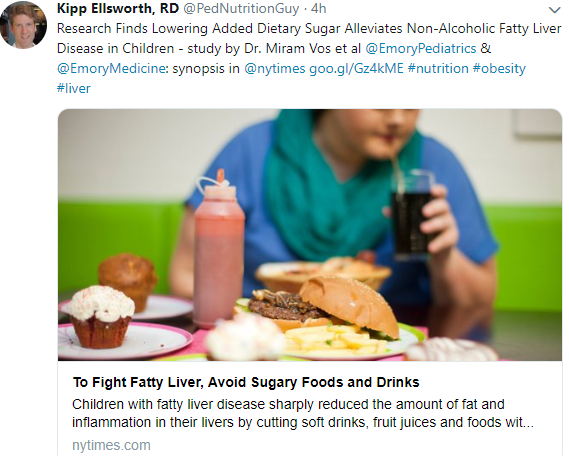
Summary of this study in NY Times: To Fight Fatty Liver, Avoid Sugary Foods and Drinks

An excerpt from NY Times:

To make the diet easier and more practical for the children in the limited-sugar group to follow, the researchers asked their families to follow it as well. They tailored the diet to the needs of each household by examining the foods they consumed in a typical week and then swapping in lower sugar alternatives. If a family routinely ate yogurts, sauces, salad dressings and breads that contained added sugar, for example, then the researchers provided them with versions of those foods that did not have sugar added to them.

Fruit juices, soft drinks and other sweet drinks were forbidden. They were replaced with unsweetened iced teas, milk, water and other nonsugary beverages. Dietitians prepared and delivered meals to the families twice a week, which helped them stick to their programs.

Full abstract:

Importance  Pediatric guidelines for the management of nonalcoholic fatty liver disease (NAFLD) recommend a healthy diet as treatment. Reduction of sugary foods and beverages is a plausible but unproven treatment.

Objective  To determine the effects of a diet low in free sugars (those sugars added to foods and beverages and occurring naturally in fruit juices) in adolescent boys with NAFLD.

Design, Setting, and Participants  An open-label, 8-week randomized clinical trial of adolescent boys aged 11 to 16 years with histologically diagnosed NAFLD and evidence of active disease (hepatic steatosis >10% and alanine aminotransferase level ≥45 U/L) randomized 1:1 to an intervention diet group or usual diet group at 2 US academic clinical research centers from August 2015 to July 2017; final date of follow-up was September 2017.

Interventions  The intervention diet consisted of individualized menu planning and provision of study meals for the entire household to restrict free sugar intake to less than 3% of daily calories for 8 weeks. Twice-weekly telephone calls assessed diet adherence. Usual diet participants consumed their regular diet.

Main Outcomes and Measures  The primary outcome was change in hepatic steatosis estimated by magnetic resonance imaging proton density fat fraction measurement between baseline and 8 weeks. The minimal clinically important difference was assumed to be 4%. There were 12 secondary outcomes, including change in alanine aminotransferase level and diet adherence.

Results  Forty adolescent boys were randomly assigned to either the intervention diet group or the usual diet group (20 per group; mean [SD] age, 13.0 [1.9] years; most were Hispanic [95%]) and all completed the trial. The mean decrease in hepatic steatosis from baseline to week 8 was significantly greater for the intervention diet group (25% to 17%) vs the usual diet group (21% to 20%) and the adjusted week 8 mean difference was −6.23% (95% CI, −9.45% to −3.02%; P < .001). Of the 12 prespecified secondary outcomes, 7 were null and 5 were statistically significant including alanine aminotransferase level and diet adherence. The geometric mean decrease in alanine aminotransferase level from baseline to 8 weeks was significantly greater for the intervention diet group (103 U/L to 61 U/L) vs the usual diet group (82 U/L to 75 U/L) and the adjusted ratio of the geometric means at week 8 was 0.65 U/L (95% CI, 0.53 to 0.81 U/L; P < .001). Adherence to the diet was high in the intervention diet group (18 of 20 reported intake of <3% of calories from free sugar during the intervention). There were no adverse events related to participation in the study.

Conclusions and Relevance  In this study of adolescent boys with NAFLD, 8 weeks of provision of a diet low in free sugar content compared with usual diet resulted in significant improvement in hepatic steatosis. However, these findings should be considered preliminary and further research is required to assess long-term and clinical outcomes.


Related blog posts:


Likelihood of Opioid Dependency If Opioid Given During an IBD Flare

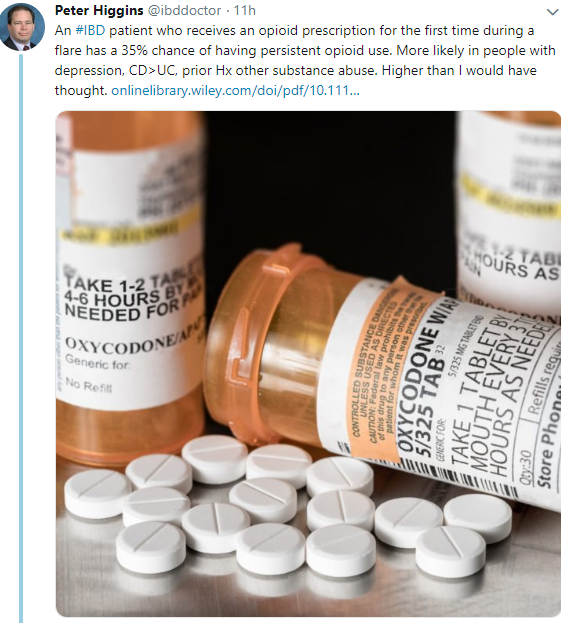
According to a recent study (Full Link: MR Noureldn, PDR Higgins et al. Aliment Pharmacol Ther. 2019;49:74–83. Incidence and predictors of new persistent opioid use following inflammatory bowel disease flares treated with oral corticosteroids), and with the limitation of using an insurance database –Key Findings:

  • 5411 (35.8%) were opioid‐naïve patients (mean age 43.9 yrs) of which 35.0% developed persistent opioid use after the flare
  • Factors associated with new persistent opioid use include a history of depression (hazard ratio [HR] 1.29, 95% confidence interval [CI] 1.13‐1.47), substance abuse (HR 1.36, 95% CI 1.2‐1.54), chronic obstructive pulmonary disease (COPD) (HR 1.17, 95% CI 1.04‐1.3), as well as, Crohn’s disease (HR 1.26, 95% CI 1.14‐1.4) or indeterminate colitis (HR 1.6, 95% CI 1.36‐1.88)

My take: As noted in previous blog (Increased Narcotic Usage in Pediatric Patients with IBD), opioid usage is an issue with pediatric IBD patients as well, particularly in those with associated depression and/or anxiety.

Related blog posts:

Negligible Effect of Eosinophilic Esophagitis Treatment on Longitudinal Growth

Briefly noted: ET Jensen et al. JPGN 2019; 68: 50-5. This retrospective study with 409 patients with eosinophilic esophagitis (EoE) examined longitudinal growth over 12 months.  “In general, treatment approach was not associated with any significant increase or decrease in expected growth.” In a subset of patients with combined elemental diet and topical steroids (n=13), there was a subtle decrease in linear growth with a change in height z-score of -0.04, CI -0.08 to  -0.01. Interestingly, in these patients with EoE, the baseline height z-scores were lower than expected indicating that a subset may have impaired growth prior to treatment.

Related blog posts:

pictures from Zabriskie Point at sunrise, Death Valley


Briefly Noted: Breastfeeding and Microbiome Diversity

A recent study (JH Savage et al J Pediatr 2018; 203: 47-54) examined the impact of breastfeeding compared with formula on microbiome diversity in 323 infants; this included 95 exclusively breastfed, 169 exclusively formula fed at time of stool collection.

Breastfed infants were more likely to have been born vaginally (74% vs 62%) and less likely to be African-American (11% vs. 36% for hispanic infants, and 52% for caucasian).

Key finding:

  • Breastfeeding was independently associated with infant intestinal microbiome diversity at age 3-6 months
  • Maternal diet during pregnancy and solid food introduction were less associated with infant gut microbiome changes than breastfeeding status

My take: We still don’t understand the long-term implications of these differences in microbiome alterations between breastfeeding and formula.  That being said, the development/evolution of breastmilk has taken place over thousands of years and it is likely that formula, while an important substitute, will never replicate all of the useful components.

Related blog posts:

Chattanooga Riverwalk Sculpture

Probiotics for Colic -Another Negative Study

A recent study (MD Cabana et al. JPGN 2019; 68: 17-9) enrolled 184 infants and found that administration of Lactobacillus GG probiotic, starting at the 4th day of life, was not effective in prevention of colic. Colic was ascertained in a secondary analysis of the ‘Trial of Infant Probiotic Supplementation’ (TIPS) study in which parents were asked monthly if their infant had either symptoms of colic or had been diagnosed with colic.

Key findings:

  • Overall the rate of colic was low at 9.8%, with at rate of 6.5% for control and 13.0% of probiotic

The authors note that there “is only 1 randomized controlled trial for the use of LGG for colic…which showed no difference.”

My take: As with all probiotic studies, the interpretation needs to be limited to this specific strain.

Related blog posts:
Golden Gulch Trail, Death Valley


Subclinical Liver Transplant Rejection

A recent study (S Feng, JC Bucuvalas, et al. Gastroenterol 2018; 155: 1838-51) found a high prevalence of chronic histologic injury even among highly selected long term liver transplant recipients with consistently normal liver biochemical tests. The authors were able to enroll 157 patients. In addition to histology, the authors examined gene expression/microarray transcriptional analysis, and immunohistochemical staining.

Key findings:

  • Three clusters of patients were identified: interface activity (group 1, n=34), periportal/perivenular fibrosis without interface activity (group 2, n=45), and a group with neither (group 3, n=78).
  • In this cohort, 96 (61%) had Ishak Fibrosis of Stage 0-1, 27  (17%) had Stage 2, 33 (21%) had Stage 3, and 1 (1%) had Stage 4-5.
  • The authors identified a module of genes that regulate T-cell-mediated rejection that were associated with interface activity. Thus, interface activity in these patients connotes subclinical rejection, even in patients with consistently normal liver biochemistries.

What to do with this information:

“For patients whose biopsy samples harbor neither inflammation nor fibrosis, immunosuppression dose reduction may be reasonable…For patients, whose biopsy samples show fibrosis in the absence of inflammation, our data do not support any recommendations…for patients whose biopsy samples show interface hepatitis, our data indicate that dose reduction may be unwise.  Although the intuitive response may be to escalate immunosuppression, data evidencing the benefit of this approach are lacking.”

My take: This study shows why a liver biopsy has been important prior to reducing immunosuppression (in liver transplantation and autoimmune hepatitis). My question is whether the authors could identify a gene signature/biomarker (like their gene module) that could be used as an alternative to a liver biopsy.

Related blog post:

View from Golden Gulch Trail, Death Valley

AntiTNF Therapy Associated with Reduced Surgical Resections

Full text: Increased prevalence of anti‐TNF therapy in paediatric inflammatory bowel disease is associated with a decline in surgical resections during childhood JJ Ashton et al. Alim Pham Ther 2019; https://doi.org/10.1111/apt.15094

From absract:

Design: All patients diagnosed with PIBD within Wessex from 1997 to 2017 were assessed. The prevalence of anti‐TNF‐therapy and yearly surgery rates (resection and perianal) during childhood (<18 years) were analysed

Results: Eight‐hundred‐and‐twenty‐five children were included (498 Crohn’s disease, 272 ulcerative colitis, 55 IBD‐unclassified), mean age at diagnosis 13.6 years (1.6‐17.6), 39.6% female. The prevalence of anti‐TNF‐treated patients increased from 5.1% to 27.1% (2007‐2017), P = 0.0001. Surgical resection‐rate fell (7.1%‐1.5%, P = 0.001), driven by a decrease in Crohn’s disease resections (8.9%‐2.3%, P = 0.001)…

Patients started on anti‐TNF‐therapy less than 3 years post‐diagnosis (11.6%) vs later (28.6%) had a reduction in resections, P = 0.047. Anti‐TNF‐therapy prevalence was the only significant predictor of resection‐rate using multivariate regression (P = 0.011).

Conclusion: The prevalence of anti‐TNF‐therapy increased significantly, alongside a decrease in surgical resection‐rate. Patients diagnosed at younger ages still underwent surgery during childhood. Anti‐TNF‐therapy may reduce the need for surgical intervention in childhood, thereby influencing the natural history of PIBD.

Related blog posts:
Big Pharma Neglecting ‘Required’ Pediatric Studies

A recent retrospective study (TJ Hwang et al. JAMA Pediatr 2019; 173: 68-74) examined the completion rate of FDA-required pediatric studies. Thanks to Ben Gold for this reference.

Background: In 2003, the Pediatric Research Equity Act (PREA) was signed into law and authorized the FDA to require clinical stuides to assess the safety and efficacy of new drugs and drugs with new indications in pediatric subpopulations.  However, the FDA cannot withdraw approval for a drug if a manufacturer fails to comply with PREA.  In addition, the authors note that “to our knowledge, to date, no financial penalties or enforcement proceedings have been brought against manufacturers fo noncompliance…and only 31 noncompliance letters have been issued.”

Key findings:

  • Between 2007-2014, there were 438 new drugs and/or new indications.  114 were subject to PREA. 84 were new drugs and 30 were new indications.
  • 222 studies required pediatric postmarketing clinical studies (in these 114 drugs). Only 75 (33.8%) were completed; rates were lower for efficacy studies (38 of 132 –28.8%) compared to pharmacokinetic studies (19 of 34 –55.9%).
  • As a result of the PREA-mandated studies, there was an increase in some pediatric information of drug labels in 41.2% after a median follow-up of 6.8 years, compared with 15.8% at time of approval of these 114 drugs.

The authors note that PREA is responsible for “nearly 80% of pediatric drug studies completed for FDA.” Congress also passed the Best Pharmaceuticals for Children Act which provides a financial incentive to companies if they perform certain pediatric studies.

My take: Pharmaceutical companies, for a multitude of reasons, are not completing requied pediatric studies.