High Rates of Denying Medical Care for Medicaid Patients Managed by Health Insurers

7/19/23 NY Times: Insurers Deny Medical Care for the Poor at High Rates, Report Says

Some excerpts:

Private health insurance companies paid by Medicaid denied millions of requests for care for low-income Americans with little oversight from federal and state authorities, according to a new report by U.S. investigators published Wednesday.

Medicaid, the federal-state health insurance program for the poor that covers nearly 87 million people, contracts with companies to reimburse hospitals and doctors for treatment and to manage an individual’s medical care. About three-quarters of people enrolled in Medicaid receive health services through private companies, which are typically paid a fixed amount per patient rather than for each procedure or visit.

The report by the inspector general’s office of the U.S. Department of Health and Human Services details how often private insurance plans refused to approve treatment and how states handled the denials.

Doctors and hospitals have increasingly complained about what they consider to be endless paperwork and unjustified refusals of care by the insurers when they fail to authorize costly procedures or medicinesThe investigators also raised concerns about the payment structure that provides lump sums per patient. They worried it would encourage some insurers to maximize their profits by denying medical care and access to services for the poor...

The investigators emphasized the insurers were much more aggressive in refusing to authorize care under Medicaid than under Medicare…Unlike with Medicare, if an insurer refuses to authorize a treatment, patients are not automatically provided with an outside medical opinion as part of their appeal...

The investigators also found that state oversight of coverage denials was lax. Many states do not routinely examine the insurers’ denials nor collect information about how many times a plan denies requests for prior authorization...

The denial rates recorded by the investigators varied widely by insurer and by state.

My take: This is more evidence of the distorted incentives in U.S. healthcare where health insurance companies profit when patients are denied beneficial care.

Related blog posts:

Le Jardin Exotique, Eze France
Narrow walkways in Eze, France

Comparative Efficacy: Infliximab vs. Ustekinumab

ECL Wong et al. Inflamm Bowel Dis 2023; 29: 1015-1023. Open Access! Comparative Efficacy of Infliximab vs Ustekinumab for Maintenance of Clinical Response in Biologic Naïve Crohn’s Disease

This post hoc analysis included data from separate trials examined the response of 220 biologic-naïve CD participants to either inflximab biosimilar or ustekinumab.

Key findings:

  • Clinical remission: One-year clinical remission (CR) and corticosteroid-free CR rates were similar between infliximab-treated and ustekinumab-treated patients (CR, 66 of 110 [60.0%] vs 63 of 110 [57.3%]; adjusted odds ratio [aOR], 1.15), corticosteroid-free CR, 11 of 28 (39.3%) vs 27 of 51 [52.9%]; aOR, 0.58)
  • Endoscopic response/remission:  infliximab-treated participants were more likely to achieve 1-year endoscopic response (43 of 92 [46.7%] vs 6 of 30 [20.0%], aOR, 3.59) and endoscopic remission (31 of 92 [33.7%] vs 4 of 30 [13.3%]; aOR, 3.35)

In the discussion, the authors note only 1 head-to-head study in CD with ustekinumab. “The SEAVUE trial (NCT03464136) compared adalimumab and ustekinumab among biologic-naïve CD patients. Ustekinumab demonstrated similar efficacy for the achievement of clinical and endoscopic outcomes compared with adalimumab.23 Similar rates of CR at 1 year were reported in SEAVUE (64.9% ustekinumab vs 61% adalimumab) as in our analysis (57.3% ustekinumab vs 60% infliximab)…ustekinumab demonstrated longer retention and lower immunogenicity and has practical advantages over adalimumab, including less frequent dosing intervals (every 8 weeks for ustekinumab vs every 2 weeks for adalimumab) while providing similar efficacy.”

My take: This study suggests that infliximab may be a little better than ustekimumab in biologic-naive patients due to the higher endoscopic response; however, the study was unpowered to provide a definitive answer. A prior study suggested similar endoscopic healing rates (P Riviere et al. Inflamm Bowel Dis 2023; 29: 923-931).

Related blog posts:

Waters off the Cap d’Ail Trail (near Eze, France)

What I Don’t Like About a “Multidisciplinary Approach” for Infants with GERD-Like Symptoms

MH Fishbein et al. JPGN 2023; 77: 39-46. A Multidisciplinary Approach to Infants With GERD-Like Symptoms: A New Paradigm

This was a retrospective study (2011-2019) with 174 full-term infants (<6 months of age). The physician in the study decided which infants needed evaluation by SLP and/or OT.

Key findings:

  • “GERD-like symptoms” were present in 109 with 46 having concerns for dysphagia, 37 having colic/unsettledness, and 26 with concerns combined for dysphagia/colic. 65 were determined to have uncomplicated GER.

The authors conclude that “a multidisciplinary approach, including SLP and OT, is recommended for the evaluation of infants with GERD-like symptoms.” Of note, all but one of the authors are either OTs or SLPs. The authors also promote their AAP book: The CALM Baby Method: Solutions for Fussy Days and Sleepless Nights as a resource for pediatricians and families

Here’s what I don’t like about the recommendations:

  • If taken literally, the authors essentially advocate that a huge percentage of infants need to be seen by OT and SLP as many infants have GERD-like symptoms. The authors cite a review that indicated that 10-25% of infants have GERD symptoms at 1 month; however, other studies have found much higher numbers.
  • While this article stresses the fact that medications are not helpful for GERD symptoms and the importance of not overlooking dysphagia, in my experience many SLPs and OTs are frequently advocating for infants to be placed on GERD medications. In addition, many SLPs and OTs attribute a variety of infant (non-reflux) behaviors to GERD.
  • In many infants with dysphagia, the clinical evaluation by SLP does not have a high sensitivity due to silent aspiration. As such, SLP involvement could be focused on those with objective evidence of dysphagia.

My take: Most infants with GERD-like symptoms do not need to be seen by SLPs or OTs. Dysphagia symptoms (eg. choking, cough with eating, stridor, congestion, poor feeding) need to be evaluated.

Related blog posts:

Coastal Trail, Cap d’Ail, France

Population-Based Study: Prevalence of Bowel and Bladder Dysfunction in Early Childhood (Good Bowel Control is Happening Later)

SJ Verkuijl et al. JPGN 2023; 77: 47-54. Open Access! The Prevalence of Bowel and Bladder Function During Early Childhood: A Population-Based Study

Methods: This cross-sectional questionnaire study (n=791 Dutch children) up to age 7 yrs of age.

Key findings:

  • The mean age at which parents/caregivers considered their child fully toilet-trained was 5.1 ± 1.5 years. “Compared to studies performed 15 years ago, we found toilet training to be completed at an older age (23,26–28).”
  • Prevalence of fecal incontinence among toilet-trained children was 12%.
  • Prevalence of constipation was 14%, with excessive stool retention (75.9%) and painful/hard stools (78.7%) as the 2 most common symptoms.
  • The prevalence of urinary incontinence among all toilet-trained children was 40%. The majority of these urinary incontinent children suffered from daytime incontinence (56%). Enuresis occurred in 22% and the other 22% suffered from combined daytime incontinence and enuresis.
  • There were significant associations between fecal incontinence and constipation [odds ratio (OR) = 3.88], fecal incontinence and urinary incontinence (OR = 5.26), and constipation and urinary incontinence (OR = 2.06)
  • Half of the children with constipation and almost all the children with fecal incontinence remained untreated.
Stool Frequency by age (Figure 1 B)

In the discussion, the authors note “treatment of constipation and/or fecal incontinence often leads to the resolution of urinary incontinence (34).”

In my experience, many families sent by urologists have been told that the constipation is causing urinary incontinence. For many children, the explanation is more complicated; association of constipation does not indicate causation. A lot of children have limited sensation of response to both bowel and bladder, rather than the rectum pushing on the bladder. Most children that I see with constipation/encopresis do not have urinary incontinence. However, behavior approaches to toileting can be helpful for both.

My take: This is a useful study providing an updated view on when to expect good toileting and highlighting the frequency of bowel/bladder dysfunction (which is often untreated).

Related blog posts:

More Data: Upadacitinib “is Effective and Safe” Plus 2 in Kids

S Friedberg et al. Clin Gastroenterol Hepatol 2023; 21: 1913-1923. Open Access! Upadacitinib Is Effective and Safe in Both Ulcerative Colitis and Crohn’s Disease: Prospective Real-World Experience

Methods: “We performed a prospective analysis of clinical outcomes on upadacitinib in patients with UC and CD using predetermined intervals at weeks 0, 2, 4, and 8 as part of a formalized treatment protocol.” 84 met inclusion criteria  (44 UC patients, 40 CD patients) -though complete data was available for only a fraction of these. All of the patients had received prior anti-TNF therapy and 89% had received 2 or more advanced therapies. 

Key findings:

  • Ulcerative colitis: At 4 and 8 weeks of treatment, 19 of 25 (76.0%) and 23 of 27 (85.2%) achieved clinical response and 18 of 26 (69.2%) and 22 of 27 (81.5%) achieved clinical remission, respectively. Of those who previously were tofacitinib-exposed, 7 of 9 (77.8%) achieved clinical remission by 8 weeks.
  • Crohn’s disease: In CD, 13 of 17 (76.5.%) achieved clinical response and 12 of 17 (70.6%) achieved clinical remission by 8 weeks. Of those with increased fecal calprotectin and C-reactive protein levels, 62% and 64% normalized by week 8, respectively. 
  • Results were seen as early as week 2 in both UC and CD, with clinical remission rates of 36% and 56.3.%,
  • Acne was the most commonly reported adverse event, occurring in 24 of 105 patients (22.9%) (Table 4). Six patients stopped upadacitinib due to adverse effects.

My take: “In this large real-world experience in medically resistant patients with UC or CD, we report that upadacitinib is rapidly effective and safe, including in those who had prior tofacitinib exposure.” In pediatrics, the effectiveness of this upadacitinib is a logical target for ImproveCareNow. More pediatric data will be needed to garner FDA approval.

Related articles:

LV Collen. Inflamm Bowel Dis 2023; 29: 1175-1176. Rapid Clinical Remission With Upadacitinib in a Pediatric Patient With Refractory Crohn’s Disease A pediatric patient with Crohn’s disease refractory to anti-tumor necrosis factor therapy, vedolizumab, ustekinumab, and 6-mercaptopurine achieved rapid clinical remission with upadacitinib.

A Bousvaros, BAR Schmidt, M Kurtz. Gastroenterology & Hepatology 2023; 19: 401-403. Open Access! “Treatment of Genital Crohn’s Disease with Upadacitinib in a Male Child: A Case Report”. This report describes the rapid response to upadacitinib in a 12 yo with refractory Crohn’s ileocolitis (x 5 yrs) with associated “granulomatous lymphangitis” affecting the penis and scrotum. It notes that “anti-TNF therapy was described as the most effective treatment, with either improvement or resolution of scrotal swelling in most patients. However, intermittent penile swelling persisted in a subset of the patients.18“…”Although data on the use of JAK inhibitors to treat pediatric IBD are limited, the fact that these are small molecules with wide systemic effects suggests that JAK inhibitors may be useful in the treatment of extraintestinal manifestations of IBD….[and]  that JAK inhibitors such as upadacitinib may play an important role in the treatment of such refractory patients.”

Related blog posts:

On an adventurous day, we climbed the Nietzsche trail to get from the coast to the top of Eze, France.

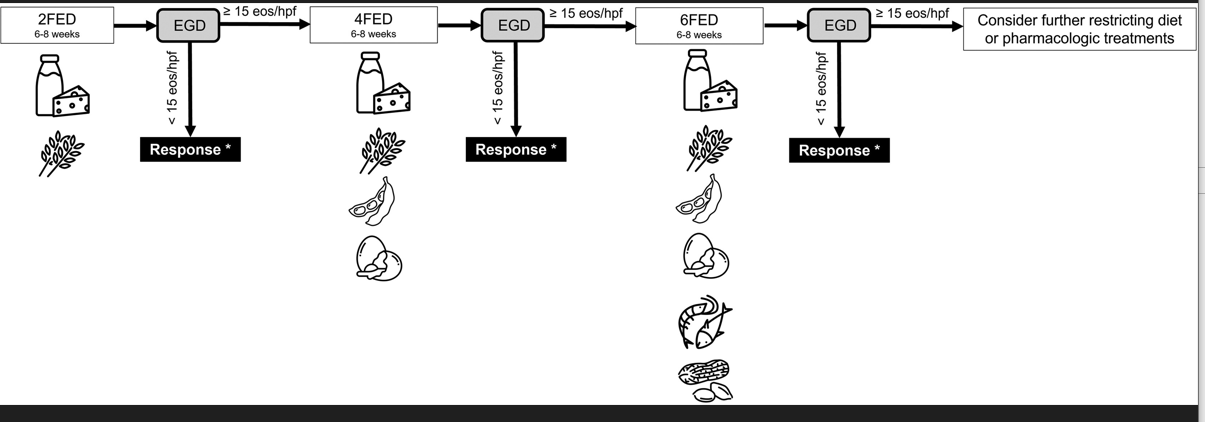
Practical Guide to Dietary Therapy for Eosinophilic Esophagitis

JW Chang et al. Clin Gastroenterol Hepatol 2023; 21: 1690-1698. Open access! Development of a Practical Guide to Implement and Monitor Diet Therapy for Eosinophilic Esophagitis

  • The authors note that dietary therapy is underutilized–“successful clinical implementation is hampered by the need for a multidisciplinary approach including dietitian support and provider expertise.”
  • “Because symptoms are often discordant with underlying disease activity, symptoms alone should not be used to make decisions about treatment changes.56 Relying on symptoms in isolation to guide food elimination or reintroduction is insufficient and can result in false identification of food triggers and unnecessarily prolonged dietary restriction. Patients should be warned that their trigger foods are not necessarily the foods that cause immediate symptoms related to obstruction (eg, commonly meats, bread, sticky textures). Endoscopy with biopsy is the gold standard for monitoring response to therapy and is recommended at least 6–8 weeks after a change in therapy, including elimination and reintroduction phases to identify of food triggers.57
  • “The most identified food triggers for EoE are animal milk (up to 90%) and wheat (up to 75%), and up to half of patients who undergo dietary therapy will have more than 1 dietary trigger. 58,62 In a recent study of adult patients undergoing dietary therapy with the SFED, 69% of patients had only 1 food trigger identified, making this a reasonable option for long-term therapy.59
  • “The most common reasons for nonresponse to the elimination phase include purposeful or inadvertent dietary nonadherence, cross-contamination, and incorrect or inadequate removal of potential food triggers”
  • While medications used for EoE treatment are expensive, repeated endoscopy for dietary therapy may be costly and is an important consideration
  • The Consortium of Eosinophilic Gastrointestinal Disease Researchers (CEGIR) 58 page Supplement in article: Resource Supplement for Dietary Management for Patients/families -includes guidance for selecting food, apps, websites
Step-up strategy: 1 food dairy, 2 foods dairy/wheat, 4 foods dairy/wheat/soy/eggs, 6 foods dairy/wheat/soy/eggs/fish/peanuts

Related blog posts: