Chronic Fatigue and Irritable Bowel Syndrome -10 years after Giardia Infection!

A recent study (S Litleskare et al. Clin Gastroenterol Hepatol 2018; 16: 1064-72) involved prospective follow-up of 1252 laboratory-confirmed cases of giardiasis from a 2004 outbreak in Norway.

Key findings:

  • Prevalence of irritable bowel syndrome (IBS) was 43% 10 years after the outbreak among 576 exposed individuals compared with 14% among 685 controls. Thus, the odds ration of developing IBS was 4.74 following Giardia exposure.
  • Chronic fatigue at 10 years was higher as well, reported in 26% in the exposed group compared with 11% in the control group.
  • The authors note that the change in IBS between 6 years and 10 years following the infection was 40% and 43% respectively and the change in chronic fatigue was 31% at 6 years and 26% at 10 years.

My take: Don’t get Giardia!! It may cause chronic fatigue and IBS 10 years after acquisition of an infection.  This study reinforces other studies which have shown that numerous enteric pathogens can increase the risk of IBS.  These other studies reported lower rates of IBS following infections, between 7-36%.

Moraine Lake, Banff

Global Prevalence of Celiac Disease

Briefly noted: P Singh et al. Clin Gastroenterol Hepatol 2018; 16: 823-36. After a systemic review which selected 96 articles from a pool of 3843 published between 1991 through 2016, the authors determined a pooled global prevalence of 1.4% in 275,818 individuals based on seroprevalence (positive TTG or EMA).  Biopsy-confirmed celiac disease was noted in 0.7% in 138,792 individuals.

In their study, biopsy-proven disease was most prevalent in Argentina, Egypt, Hungary, Finland, Sweden, New Zealand, and India.

Related blog posts:


Clostridium difficile Guidelines

Clinical Practice Guidelines for Clostridium difficile Infection in Adults and Children: 2017 Update by the Infectious Diseases Society of America (IDSA) and Society for Healthcare Epidemiology of America (SHEA)

Clinical Infectious Diseases, Volume 66, Issue 7, 19 March 2018, Pages e1–e48,https://doi.org/10.1093/cid/cix1085

Summary from Infectious Disease Advisor: Updated C difficile Infection Clinical Guidance From IDSA/SHEA

The comprehensive clinical practice guideline …was endorsed by the Infectious Diseases Society of America (IDSA) and the Society for Healthcare Epidemiology of America (SHEA)…

Recommendations for treatment of CDI in adults… now favors a 10-day course of vancomycin or fidaxomicin rather than metronidazole for first-line therapy of mild/moderate CDI in adults… Fidaxomicin, also a newly recommended first-line therapy for mild/moderate CDI in adults, may reduce the risk for recurrent CDI because of its narrow spectrum compared with vancomycin.

Recommended treatment strategies for recurrent CDI, a complication that occurs in approximately 25% of patients, have also been revised…Following initial CDI treated with a 10-day course of vancomycin, either a several-week tapered and pulsed course of vancomycin or a 10-day course of fidaxomicin is recommended. For most patients, probiotics can be considered because of favorable cost and safety, although definitive efficacy data for probiotics to prevent recurrent CDI are still lacking. For multiply recurrent CDI (ie, at least 3 CDIs), correction of the patient’s underlying intestinal microbiota perturbation with fecal microbiota transplantation (FMT) should be strongly considered..

The diagnosis of CDI… Molecular tests (eg, nucleic acid amplification tests [NAATs], such as polymerase chain reaction), which do not differentiate colonization and infection, are now the most commonly used test for CDI among US hospitals. NAATs have the potential to misdiagnose patients with colonization as having CDI, particularly when used in patients with low likelihood of CDI. Thus, this guideline strongly reinforces the importance of practicing good diagnostic stewardship and limiting C difficile testing to patients with new-onset, unexplained, and clinically significant (ie, at least 3 unformed stools in a 24-hour period) diarrhea…formed stools should not be tested for C difficile, nor should patients be retested within 7 days of a previous negative C difficile test. In pediatric populations, because of the unclear role of C difficile as a cause of diarrhea in infants, children less than 12 months of age should not be tested…

If diagnostic stewardship is not an achievable goal, use of NAAT alone is likely to lead to frequent misdiagnosis of CDI among patients with C difficile colonization. In these cases, NAAT alone should be avoided and a multistep algorithm that incorporates toxin testing is recommended.

Related blog posts:

Cumberland Island 2018

The Risk of Pancreatic Cancer After Acute Pancreatitis

A recent study (J Kirkegard et al. Gastroenterol 2018; 154: 1729-36) determined that acute pancreatitis is associated with an increased risk of pancreatic cancer. This finding is based on a nationwide (Denmark), matched cohort study of all patients admitted with acute pancreatitis from 1980 to 2012.  This involved 41,669 patients with acute pancreatitis and 208,340 comparison subjects.

Key finding:

  • Five year pancreatic cancer risk was 0.87% compared to a risk of 0.13% in the comparison group (HR 2.02)

Limitations: While this study is based on a Danish registry, the authors note that the data had been prospectively entered and has a high validitiy.

My take: While I have not seen pancreatic cancer in the pediatric population, it is concerning that episodes of pancreatitis are likely to increase this risk for the children as well (over their lifetimes).

Mountain Laurel (?) -Pine Mountain Trail

PPIs NOT Linked to Cognitive Decline/Dementia & PPIs NOT Linked to Heart Attacks

In a prospective study (M Wod et al. Clin Gastroenterol Hepatol 2018; 16: 681-89), data on middle-aged (n=2346, 46-67 yrs) and older individuals (n=2475) were collected in the Longitudinal Study of Aging Danish Twins.  This study showed that there was no difference in cognitive decline between PPI users and non-users.

The second study (SN Landi et al. Gastroenterol 2018; 154: 861-73) used a large administrative database and reviewed more than 5 million new  users of prescription PPIs and prescription H2RAs.  The authors found no significant difference in myocardial infarctions (MIs) between PPIs and H2RAs over a 12 month period.

Related blog posts:

Gut-Brain Modulators for Functional GI Disorders: Irritable Bowel, Dyspepsia, Functional Heartburn, and Cyclic Vomiting Syndrome

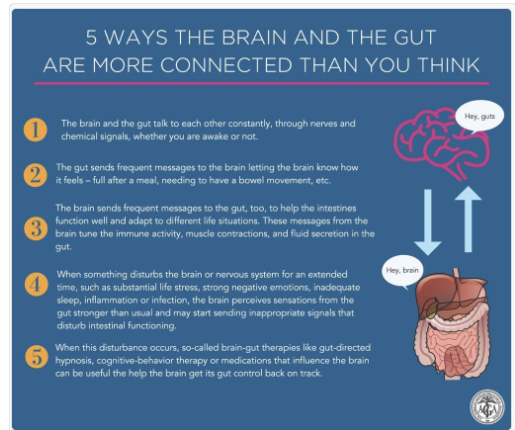
A lengthy report (DA Drossman et al. Gastroenterol 2018; 154: 1140-71) thoroughly reviews the evidence for neuromodulators for functional GI disorders, including Irritable Bowel, Dyspepsia, Functional Heartburn, and Cyclic Vomiting Syndrome.

“Some general recommendations include: (1) low to modest dosages of tricyclic antidepressants provide the most convincing evidence of benefit for treating chronic gastrointestinal pain and painful FGIDs and serotonin noradrenergic reuptake inhibitors can also be recommended, though further studies are needed; (2) augmentation, that is, adding a second treatment (adding quetiapine, aripiprazole, buspirone α2δ ligand agents) is recommended when a single medication is unsuccessful or produces side effects at higher dosages; (3) treatment should be continued for 6-12 months to potentially prevent relapse; and (4) implementation of successful treatment requires effective communication skills to improve patient acceptance and adherence, and to optimize the patient-provider relationship.”

The report makes specific recommendations for several functional conditions (Table 4).

  • For dyspepsia, the authors recommend categorizing as either postprandial distress syndrome (PDS) and epigastric pain syndrome (EPS) as per Rome IV criteria.
  • They state that “Buspirone…may be used for PDS where early satiety, fullness and nausea predominate.”
  • “Mirtazapine is a good treatment option for PDS when there is chronic nausea and vomiting, or weight loss, and it may also help coexisting abdominal pain.”
  • For EPS, “studies mainly support the use of TCAs, either initially or after an unsuccessful response to a proton pump inhibitor.”

Figure 5 outlines general treatment advice:

  • SSRIs -“when anxiety, depression and phobic features are prominent with FGIDs”
  • TCAs -“first-line treatment when pain is dominant in FGIDs”
  • Tetracyclic antidepressant (mirtazapine, mianserin, trazodone) -“treatment of early satiety, nausea/vomiting, weight loss and disturbed sleep”
  • SNRIs (duloxetiine, venlafaxine, desvenlafaxin, milnacipran) -“treatment when pain is dominant in FGIDs or when side effects from TCAs preclude treatment”
  • Augmentation therapies are subsequently delineated including atyipical antipsychotics, pyschological treatments (like cognitive behavioral therapy) and hypnosis

Related blog posts:

Disclaimer: These blog posts are for educational purposes only. Specific dosing of medications (along with potential adverse effects) should be confirmed by prescribing physician.  This content is not a substitute for medical advice, diagnosis or treatment provided by a qualified healthcare provider. Always seek the advice of your physician or other qualified health provider with any questions you may have regarding a condition.


Reassuring Study on Colonoscopy Safety in Adults

Full Abstract: Low Rates of Gastrointestinal and Non-Gastrointestinal Complicaitons for Screening or Surveillance Colonoscopies in a Population-Based Study

(L Wang, et al. Gastroenterol 2018; 154: 540-555https://doi.org/10.1053/j.gastro.2017.10.006)

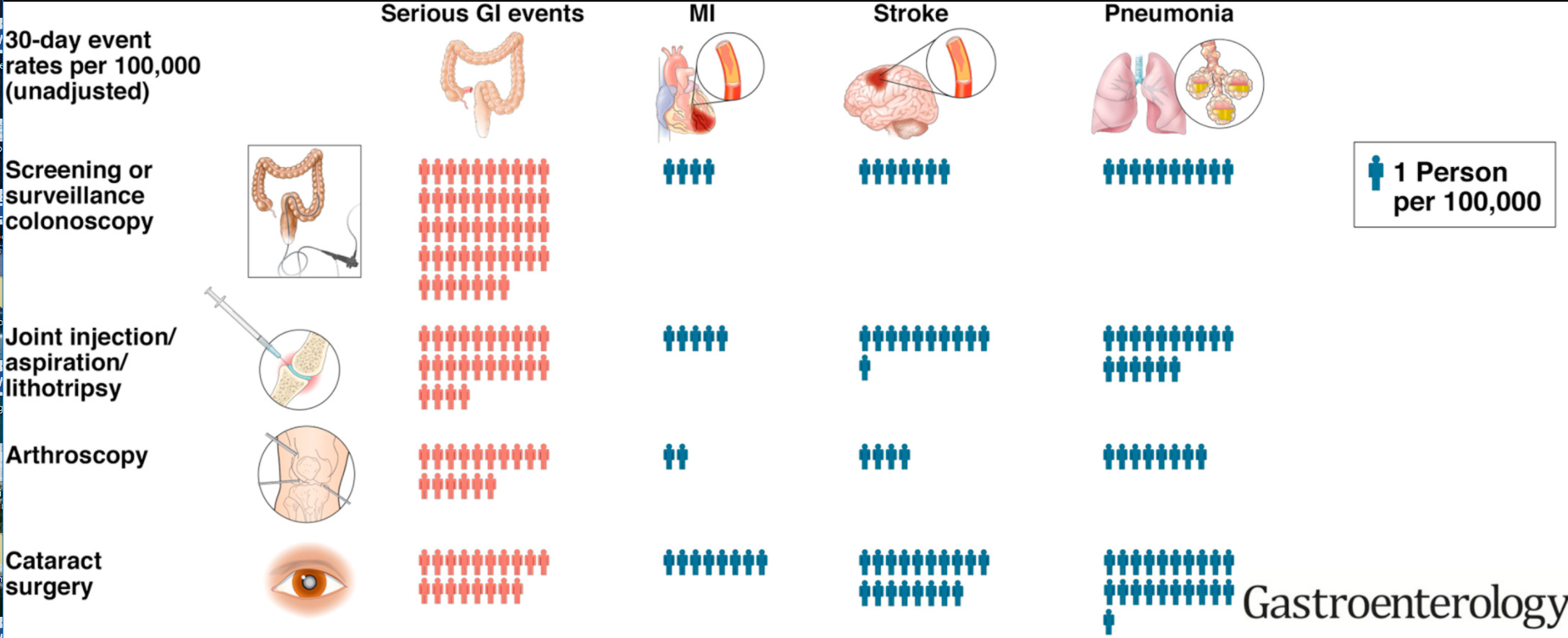
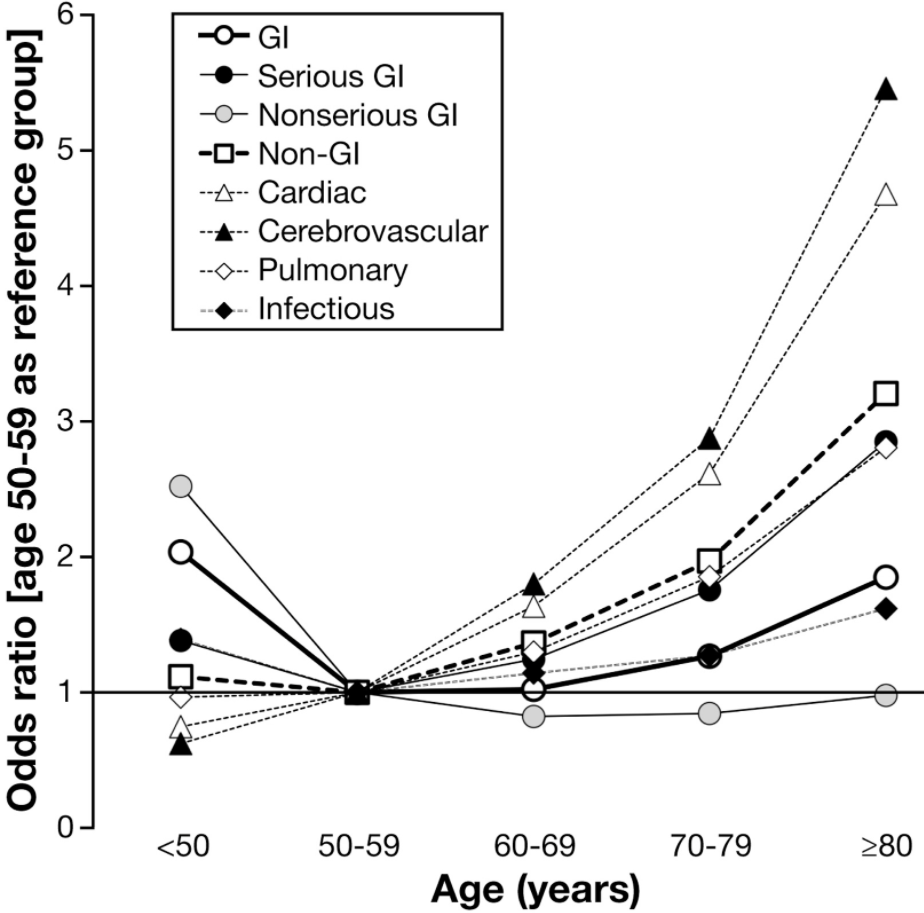
Using California’s Ambulatory Services Databases, the authors identified 1.58 million surveillance/screening colonoscopies (2005-2011) and compared complications to patients who underwent other ambulatory procedures like joint aspiration, arthroscopy and cataract surgery.

Availlable online: graphical abstract

Key findings:

  • GI complications including perforation and GI bleeding were low but more common with colonoscopy than comparator procedures
  • Rates of serious non-GI complications including myocardial infarction, stroke, and serious pulmonary events were no higher than other low-risk comparator procedures.
  • Complication rates were higher with advancing age, particularly in those >70 years. see Figure 2 below


Image available online: Figure 2


Screening for Colorectal Cancer in Cystic Fibrosis

Briefly noted:

A Gini, et al. “Cost Effectiveness of Screening Individuals with Cystic Fibrosis for Colorectal Cancer” Gastroenterol 2018; 154: 556-67.

  • Key point: “Colonoscopy every 5 years, starting at age of 40 years was the optimal colonoscopy strategy for patients with cystic fibrosis” without prior organ transplantation.

D Hadjuliais, et al. “Cystic Fibrosis Colorectal Cancer Screening Consensus Recommendations: Gastroenterol 2018; 154: 736-45.

  • There are 10 Task Force recommendations. These include “initiation of screening at 40 years” in those without organ transplantation. Among those who have had organ transplantation, CRC screening is recommended at age 30 years and/or within 2 years of transplantation. Link: Abstract

My take: Fortunately, more individuals with cystic fibrosis are living long enough to benefit from CRC screening.  Due to increased risk, these guidelines recommend screening at a younger age than the general population.

More pics from Hoover Dam. The figure in this picture is a art piece honoring those who died while working on the construction