How to Talk About Childhood Obesity

Pont SJ, et al. Pediatrics. 2017. doi: 10.1542/peds.2017-3034. A policy statement from the American Academy of Pediatrics addresses the issue of stigma associated wtih pediatric obesity.  This is summarized in the following links:

An excerpt form NY Times piece:

Dr. Pont is one of the lead authors of a new policy statement from the American Academy of Pediatrics titled “Stigma Experienced by Children and Adolescents With Obesity.” The statement, published online Monday in the journal Pediatrics, advises pediatricians to use neutral words like “weight” and “body mass index” rather than terms like “obese” and “fat.” …

In a study published earlier this year in the journal Preventive Medicine, Dr. Puhl and her colleagues looked at the longitudinal effects of teenagers being teased about their weight. The study involved over 1,800 people who had been followed for 15 years and are now in their mid 30s…

“These teasing experiences have long-lasting implications for health and for health behavior.” For women especially, these adolescent experiences of teasing by peers or family members were associated with binge eating, poor body image, obesity, and a higher B.M.I. 15 years later, she said; for men there were some of the same associations, including obesity as adults, if they had been teased by their peers as adolescents…

Weight stigma does exactly the opposite; criticizing and inducing shame only make people feel terrible about themselves, not motivated or capable of making changes…

“Recognize that a child is far more than what their weight is, praise them for all the positives, so when we get to some of the more challenging topics, they can still maintain their self-esteem,”…

The most effective way for parents to help a child is to make healthy changes for the whole family, regardless of shape or size, Dr. Pont said. Try making small changes slowly, like adding one new green vegetable into the family diet, not keeping sugary drinks in the home or walking to school instead of driving.

Related blog posts:

Smoke in Grand Canyon after recent brush fires

Fatty Liver Disease with Craniopharyngioma and with Down Syndrome

A recent retrospective study (SY Yung et al. Ann Pediatr Endocrinol Met 2017; 22 https://doi.org/10.6065/apem.2017.22.3.189 –thanks to Jeff Schwimmer for this reference) describes the problem of nonalcoholic fatty liver disease (NAFLD) in long-term survivors of childhood-onset (CO) craniopharyngioma.

This study reviewed 75 children with CO-craniopharyngioma who had surgery prior to 15 years of age. The mean followup was 4.3 years.

Key findings:

  • 51 had either elevated AST or ALT above 40 IU/L. ALT ≥60 IU/mL was observed in 15 patients.
  • Estimated prevalence of NAFLD based on mainly imaging was 47%. 27 underwent ultrasonography and 5 underwent CT scan.
  • Among those with available growth data, 41% were obese and 18% were overweight.
  • NAFLD developed within a year after surgery in many patients.

This study had many limitations, including reliance of ultrasonography for diagnosis and incomplete evaluations.  Despite this, it is clear that hypothalamic obesity places patients at a high risk for developing NAFLD.  In addition, NAFLD in this population may be more aggressive.

My take: This study documents the well-recognized phenomenon of NAFLD in CO-craniopharyngioma with obesity.  Current treatment relies on trying to preserve hypothalamic function and optimizing lifestyle/nutrition.

Briefly noted: D Valentini et al. J Pediatr 2017; 189: 92-7.  Using ultrasound in 280 Italian children with Down syndrome, the authors identified NAFLD in 45% of those considered nonobese and 82% of those overweight/obese. In a related commentary (pg 11-13 Full text: Down syndrome and Pediatric NAFLD …), the authors (AD Matteo, P Vajro) note that Down syndrome patients may have increased NAFLD due to less activity, more obesity including possible excess adiposity in those with normal BMI, obstructive sleep apnea, or perhaps other mechanisms.

Related blog posts:


Infant Feeding, Opportunity, and Asthma

A recent study (A Kloop et al. J Pediatr 2017; 190: 192-9) examined the relationship between mode of infant feeding and the development of asthma.  The authors used prospective data from 3296 Canadian children in the Canadian Healthy Infant Longitudinal Development (“CHILD” study) cohort.

Key finding:

  • “Compared with infants who received direct breast milk only [at 3 months of age], those who received some expressed milk had a 43% increased odds [of asthma at 3 years of life] …and those who received only formula had a 79% increased odds.”

The authors speculate that the direct breastfeeding may offer some advantages over expressed breast milk:

  • There may be alteration in breast milk components with storage
  • A nursing infant may trigger an increased immune response and be directly exposed to some beneficial commensal bacteria

Since this is an observational study and patients were not randomized there may be other unrecognized confounding variables.

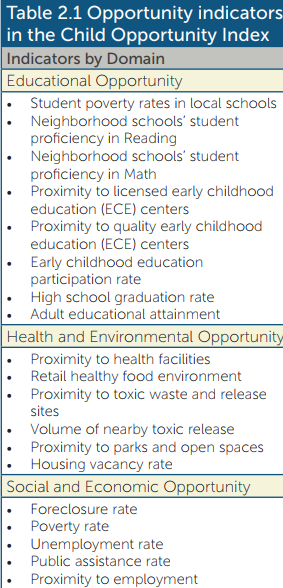
Another study in the same issue (AF Beck et al. J Pediatr 2017; 190: 200-6) assessed whether the Child Opportunity Index (COI) was associated with asthma outcomes in a retrospective cohort of 5462 children in Hamilton County, Ohio.  The COI (see below for the measures in this index) has previously been linked to life expectancy, low birth weight, and prematurity.  Interestingly, one can go to diversitydatakids.org to see how this affects your location (here is the link for a heat map of this index in the Atlanta area: Atlanta COI)

Key finding:

  • Median hospitalization rates varied based on COI –those with very high opportunity had a rate of 1.8 per 1000.  The other quintiles of COI were the following: high opportunity 2.1, moderate opportunity 4.6, low opportunity 7.6, and very low 9.1

My take: The first study indicates that direct breastfeeding is associated with lower rates of asthma.  The second study shows that issues related to education, environment, and social/poverty have an enormous impact on need for asthma-related hospitalization.


Advice on Arsenic in Baby Foods

The issue of arsenic, mainly in rice cereal, has been discussed on this blog: Arsenic in Rice –New Recommendations

Renewed widespread publicity on this is likely following a recent NY Times Article: Should You Be Worried About the Arsenic in Your Baby Food?

Here’s an excerpt:

Rice cereal is often a baby’s first solid food, but it contains relatively high amounts of arsenic, a source of growing concern…rice cereals still contain six times more inorganic arsenic, on average, than infant cereals made with other grains like barley or oatmeal.

The new report comes from Healthy Babies Bright Futures, an alliance of scientists, nonprofit groups and private donors that aims to reduce children’s exposures to chemicals that may harm developing brains. One step parents can take immediately to reduce children’s exposure to arsenic is to feed infants cereals made with other grains, the group suggests…

For years, pediatricians have encouraged parents to introduce babies to a wide variety of grains in order to minimize exposure to arsenic…

The Healthy Babies Bright Futures alliance … found that over all, oatmeal, barley, buckwheat, organic quinoa, wheat and rice-free multigrain baby cereals contained much lower amounts of inorganic arsenic than rice cereals..

The average level of arsenic in the rice cereals tested recently was 85 parts per billion, down from an average level of 103 parts per billion found by the F.D.A. when it tested baby cereals in 2013 and 2014…

To reduce your family’s exposure to arsenic, the report suggests choosing a variety of grains including those low in arsenic.

My take: While the levels of arsenic are low, for the infants who are likely more vulnerable, it makes sense to recommend oatmeal cereal rather than rice cereal when introducing solid foods.


Projected Obesity Rates: Majority of Today’s Children Will Be Obese in U.S.

A recent study (ZJ Ward et al. NEJM 2017; 377: 2145-53) pooled observations from 41,567 children and adults.  They extrapolated this data to created 1000 virtual  populations of 1 million children through the age of 19 years.  They performed simulations to predict future obesity levels.

Key findings:

  • Given current levels of childhood obesity the authors predict 57.3% of today’s children will be obese at the age of 35 years.  They defined obesity for adults as BMI ≥35 and for children as 120% or more of the 95th percentile.
  • For children with severe obesity at age 2 years, approximately 80% will be obese at 35 years; whereas approximately 95% of severely obese 19 year olds will be obese at 35 years of age.
  • About half of the total prevalence of obesity at age 35 years begins in childhood in these models.

Because these are simulations, these projections could be influenced by changing circumstances.  Though, the authors note that these projections have corresponded well to measurable trends thus far in NHANES data.

My take: The increasing rates of obesity projected in these models will have profound effects for health but has implications for a wide range of issues: transportation, housing, social, etc.

South Kaibab Trail, Grand Canyon

When to Check Gastric Residuals in Preterm Infants

A recent study (A Riskin et al. J Pediatr 2017; 189: 128-34) indicates that routine testing of gastric residual volumes is not needed. In this study of preterm infants ≤34 weeks gestation 239 infants were studied prior and 233 studied after dropping routine checks of gastric residuals.

Key findings:

  • Selective evaluation of gastric residuals was associated with achieving full enteral nutrition 1 day earlier
  • The rate of NEC (stage ≥2) was actually lower in the selective evaluation group (1.7% vs 3.3%) compared to the historic control group

Selective checking of gastric residuals was prompted by the following:

  • abdominal distention
  • vomiting or large regurgitation
  • bilious regurgitation or emesis
  • abnormal behaviors: restlessness, somnolence or apathy
  • increased apnea/bradycardia
  • change in vital signs

While checking gastric residuals had been used to determine feeding intolerance and/or development of necrotizing enterocolitis, this study indicates that routine evaluation is not necessary.

My take: This study challenged a common NICU practice and found that routine assessment of gastric residuals is not needed; selective checking of gastric residuals is sufficient.

12 Year Data: Pros and Cons with Bariatric Surgery

A recent study (TD Adams et al. NEJM 2017; 377: 1143-55) examines outcomes of bariatric surgery after 12 years.  The ‘skinny’ on this study is that the weight loss/improved metabolic measures associated with bariatric surgery were very durable but there was a small increased risk of suicide among those undergoing bariatric surgery.

In this study, there were three cohorts:

  • Surgery group: 418 patients
  • Nonsurgery group 1: 417 patients. This group had sought surgery but did not receive surgery (often due to insurance coverage)  (147 underwent subsequent surgery)
  • Nonsurgery group 2: 321 patients. This group had not sought surgery (39 underwent subsequent surgery)

Key findings:

  • At 12 yrs, mean change from baseline body weight was -35 kg in surgery group, compared with -2.9 kg in nonsurgery group 1 and 0 kg in nonsurgery group 2
  • Of those with type 2 diabetes in the surgery group, type 2 diabetes remitted in 75% at 2 yrs and remained remitted in 51% at 12 yrs.
  • The surgery group had higher remission rates of hypertension and dyslipidemia as well.
  • 7 deaths by suicide were noted -5 in the surgery group, and 2 in the nonsurgery 1 group but only after the patients had undergone subsequent bariatric surgery

My take: Weight loss and improved metabolic changes at 6 yrs were maintained over the following 6 yrs.  It is troubling that the surgery and/or weight loss is associated with suicide in a small number of patients.

Related blog entries:

#NASPGHAN 17 More Abstracts

This link for the NASPGHAN abstracts :NASPGHAN 2017 Scientific Abstracts

The following slides are from some of the abstract posters. This first poster (next 5 pics) showed that symptom association with meals is not predictive of aspiration among a selected group of children who underwent swallow study evaluations. In the figures, the blue bars are children who passed the swallow study whereas the red bars indicate the children who failed the swallow study.

This next slide demonstrated that a six food diet for EoE could be administered blenderized via a gastrostomy tube.

The next slide showed that irritable bowel syndrome was more frequent (overall hazard ratio of 1.52) following a urinary tract infection in the first year of life.

The next pictures are from a poster discussing high rates of recurrent C difficile infection following fecal microbial transplantation in pediatric patients with inflammatory bowel disease (mainly ulcerative colitis).  An inference from this study would be that many cases of C difficile that were attributed as causing symptoms could in fact have been from a flare up of their IBD.  More details about the diagnosis of C difficile (based on PCR or ELISA) would be helpful

The next poster provides data from CHOP experience with Ustekinumab.  Overall, in this highly-selected (refrcactory) population the long term improvement was low; while one-third had steroid-free remission at week 8, this was not maintained at week 16 and week 24.  In addition, among the 22 patients, one developed transverse myelitis.

This study that follows (next two pics) documented the relative safety of liver biopsies (mainly percutaneous without interventional radiology) in the post-transplant period.  The two most serious adverse events, cholangitis and bile leak, helped identify biliary strictures.

The following collaborative study examined the neurocognitive status of children with Alagille syndrome.  Overall, this study shows that children with Alagille syndrome are at increased risk of low IQ compared to children with other cholestatic diseases.


#NASPGHAN17 Selected Abstracts

Some of the abstracts that were presented at this year’s meeting –see below.  For a listing of the titles/authors presented, use this link: NASPGHAN Annual Mtg 2017

For complete abstracts: NASPGHAN 2017 Scientific Abstracts

Using a standardized approach along with a protocol for oral cleanouts and saline enemas if needed, the authors showed a marked decline in admissions for fecal impaction:

In this study, the authors found that low risk patients had a 91% likelihood of a negative scope.  However, on closer inspection, this rate OVERESTIMATES the likelihood of finding anything significant.  Most findings in the low risk group had questionable benefit from being identified on endoscopy including “acute colitis,” and H pylori.

The following abstract showed that in patients with EoE and not PPI-REE that topical steroids alone were as effective as PPI with topical steroids.

The following slides indicate the development of A4250, a bile acid transporter, which reduces pruritus. The presenter stated that this drug essentially is a chemical diversion which could replace biliary diversion for pruritic conditions like PFIC and Alagille syndrome.

#NASPGHAN17 Presentation: Reducing Hospitalization in Intestinal Failure Patients

This blog entry has abbreviated/summarized this presentation. Though not intentional, some important material is likely to have been omitted; in addition, transcription errors are possible as well.

Risk Factors for Hospitalization Among Pediatric Intestinal Failure Patients

Tatyana Hofmekler, Janet Figueroa, Hilina Kassa, Rene Romero, Andi Shane.

Dr Hofmekler is now part of GI Care for Kids (my group) and provided a terrific presentation.

NASPGHAN Annual Mtg 2017

Key points:

  • In this study, there were no social or demographic factors which were identified which were associated with increased hospitalization
  • Having a colon and an ileocecal valve lowered the risk of hospitalization
  • The use of SBBO treatment was associated with increased hospitalization though this may have been a marker of more severe disease
  • Vascular catheter infections were reduced compared to study at same institution previously but remained an important risk factor for hospitalization

My take: this study illustrates the challenges in reducing hospitalization.  While the authors did not identify social/demographic factors, my experience is that there are some families who are much more capable than others in taking care of children with complex problems.  If all children had the best parents, that would truly allow the hospitalization rate to be reduced much lower.