Improvements in Toddler Diet Quality: 1999-2018 Study

M Zimmer et al. Pediatrics 2024; 154: e2024067783.

Methods: This serial cross-sectional analysis of National Health and Nutrition Examination Survey (NHANES) data was performed with 2541 toddlers from 10 NHANES cycles from 1999 to 2018.

Key findings:

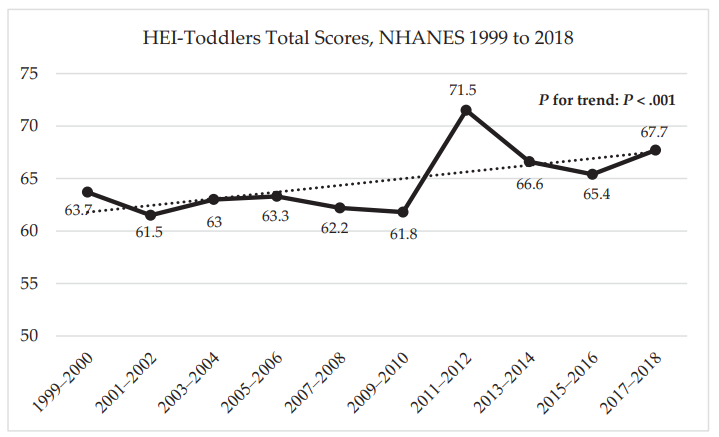
  • Toddler diet quality improved significantly from 1999 to 2018 (P < .001), from 63.7
    points on average in 1999-2000 to 67.7 points in 2017-2018
  • A significant positive linear trend in total diet quality was observed for all socioeconomic status groups (P < .05)
  • Several dietary component scores improved, as follows: Whole Fruits (P < .001), Whole
    Grains (P 5 .016), Fatty Acids (P 5 .002), Refined Grains (P 5 .009), and Added Sugars
    (P < .001)
HEI-Toddlers -Healthy Eating Index has total score ranging from 0-100 points with higher score indicating healthier diets.

In the discussion, the authors note that other age groups besides toddlers have seen modest improvements in diet. Even small improvements can be consequential on a population-basis. In adults, a 4-point increase in HEI scores has been associated with a reduced risk of cardiovascular disease. The strongest improvement between 1999 and
2018 in toddler diet quality was in scores for added sugars…attributed to declines in
added sugars from sweetened beverages. “A heightened awareness of added sugars in sweetened drink products among caregivers themselves may have led to a cultural shift
around feeding toddlers less sweetened drinks.”

While in toddlers there was no significant difference in dietary scores based on socioeconomic status, “, the diet quality gap for adults has widened over time by SES,14,15
race and Hispanic origin, and Supplemental Nutrition Assistance Program participation status.”

“Although toddlers do not receive school meals, their diets can be similarly impacted by other large-scale programs like the Special Supplemental Nutrition Program for Women, Infants, and Children (WIC) and the Child and Adult Care Food Program. Changes to the WIC food package have been consistently linked to improved child diet quality, and may have contributed to the gains in toddler diet quality observed in this study.”

Study limitations are related to self-reported dietary intake.

My take: It feels like improving diet quality is like swimming against a strong tide. Yet, this study shows improvements can happen. Ongoing efforts are needed to encourage healthier diets.

Related blog posts:

The Hidden Dangers of Early Sugar Exposure

Catherine Offord. Science 10/31/24: Britain’s postwar sugar craze confirms harms of sweet diets in early life. Reference article: T Gracner et al. Science 2024; 0,eadn5421. DOI:10.1126/science.adn5421 Exposure to sugar rationing in the first 1000 days of life protected against chronic disease

An excerpt:

In 1953, the United Kingdom got its sweet tooth back, ending the rationing of candies and sugar that had begun during World War II. Hordes of people descended on candy stores and started to sweeten more of their foods at home. Within the year, the nation’s sugar consumption doubled…. 

Combining food surveys and sugar sales from the 1950s with medical records of adults from the UK Biobank database, the team found that people conceived or born after 1953 had higher risks of type 2 diabetes and hypertension decades later than those born during rationing…

Public health authorities recommend no added sugar for infants during the first 1000 days from conception, a critical window for development. But … more than 80% of babies and toddlers have foods with added sugar on any given day…

Infants who reached age 1.5 before rationing ended fared even better, with a 40% lower risk of diabetes and a 20% lower risk of hypertension compared with the never-rationed group.

My take: Mae West was wrong. Too much of a good thing is not wonderful (if the good thing is sugar).

Related blog posts:

Isle of Palms, SC

Risk of Eating Disorders with Dietary Therapy of Functional Abdominal Pain

L Sims et al. JPGN 2024;79:1040–1046 Open Access! Eating concerns in youth with functional abdominal pain disorders

This retrospective cohort included 270 adolescents/young adults who attended an intensive, interdisciplinary pain treatment program, including 135 youth with functional abdominal pain (FAP) and an age- and gender-matched control group with a primary pain diagnosis of chronic headache.

Key findings:

  • Limitation of this study: The population attending this intensive pain program is NOT representative of typical outpatient setting
  • A history of an eating disorder was more common with FAP than in those with chronic headache (15.4% vs. 5.9%)
  • In this cohort, patients with FAP compared to patients with chronic headache had higher rates of prior exclusion diets to manage their symptoms (46% vs. 22%, p = 0.007), and prior requirement enteral or parenteral feeds (18% vs. 1.5%, p = 0.001)
  • The study found a significant association between a history of exclusion diets and meeting criteria for ARFID. “With regard to ARFID, the prevalence of patients in both groups who met diagnostic criteria (FAP: 50%; chronic headache: 36%) was also significantly higher than estimates from the general school-aged population (3%)”
  • Patients with FAP were also more likely than patients with chronic headache to be diagnosed with postural orthostatic tachycardia syndrome ([POTS]; 46% vs. 30%) and have a history of food allergies or intolerances (43% vs. 25%)
  • Significantly more adolescents with FAP (n = 68) than chronic headache (n = 45) had lost 4.5 kg or more, p = 0.004

My take: Most treatments for FAP, including dietary treatment, have some inherent risks. In patients placed on dietary therapies, screening and/or discussing the risk of dietary restriction need to be considered.

Related blog posts:

Boats Leaving Harbor -Claude Monet, National Gallery of Art (Washington, D.C.)

Impact of “Healthy Low-Carb Diet” and Time-Restricted Eating on Weight Loss

Li, Lin et al. Cell Reports Medicine, Volume 0, Issue 0, 101801. Effects of healthy low-carbohydrate diet and time-restricted eating on weight and gut microbiome in adults with overweight or obesity: Feeding RCT

    Methods: The participants (n=96 adults) in the combination of Healthy Low Carbohydrate Diet (HLCD) and Time Restricted Eating (TRE group were provided with HLCD and instructed to follow the 10-h TRE. The HLCD … consisted of approximately 30% of total energy from carbohydrates, 50% from fats, and 20% from proteins. Moreover, compared to a traditional low-carbohydrate diet that only focused on carbohydrate restriction, HLCD also emphasized healthy food sources and high-quality macronutrients such as unsaturated fatty acids, plant proteins, and high-quality carbohydrates, including whole grains, fresh vegetables, and fruits. Additionally, 25–35 g of mixed nuts were provided along with HLCD per day, which mainly included walnuts, peanuts, cashews, pistachios, pecans, almonds, and hazelnuts. 10-h TRE required participants to consume the provided meals within 10 h each day. Outside the eating window, only water, and noncaloric beverages were allowed.64 

    Key findings:

    • Each of the patient groups lost between 2.57 to 4.11 kg
    • HLCD was more effective in reducing fat mass
    • Both dietary interventions resulted in changes in the microbiome

    My take: It is still to work on improving diet quality and improving exercise –only a small percentage of patients will be receiving GLP-1 drugs or bariatric surgery. The Mediterranean diet likely has the most data supporting its use for obesity.

    Related blog posts:

    Rock Creek Park, Washington D.C.

    Ten-Year Outcomes of Adolescent Bariatric Surgery

    JR Ryder et al. N Engl J Med 2024;391:1656-1658. DOI: 10.1056/NEJMc2404054. Ten-Year Outcomes after Bariatric Surgery in Adolescents

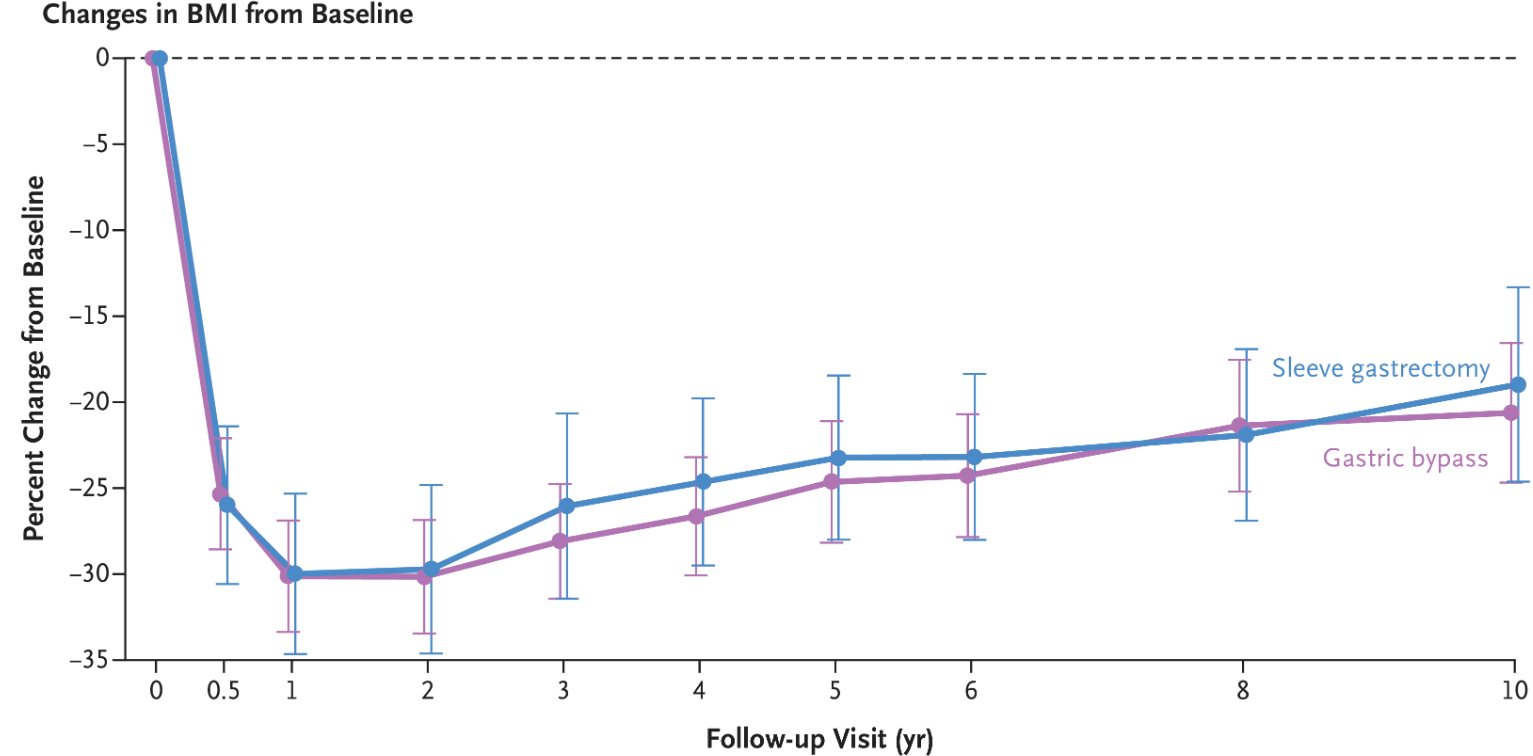
    Methods: The Teen Longitudinal Assessment of Bariatric Surgery (Teen-LABS) is a prospective multicenter observational cohort study involving adolescents (13 to 19 years of age) undergoing bariatric surgery. Participating adolescents underwent either gastric bypass (161 participants) or sleeve gastrectomy (99 participants) at a mean age of 17 years. Overall, 83% of the 10-year postoperative visits were completed.

    Key findings:

    • The changes in BMI were similar with gastric bypass (mean change, −20.6%) and sleeve gastrectomy (mean change, −19.2%)
    • Ten years after bariatric surgery, the modeled percentages of participants with remission of coexisting conditions (55% for type 2 diabetes, 57% for hypertension, and 54% for dyslipidemia)

    My take (borrowed from authors): “These findings show the long-term durability of weight loss and remission of coexisting conditions after bariatric surgery, as well as the greater health benefits and durability of the effects in adolescents than would be expected in similarly treated adults.”

    Related article: H Bliddal et al. N Engl J Med 2024;391:1573-1583. Once-Weekly Semaglutide in Persons with Obesity and Knee Osteoarthritis. Key finding: “treatment with once-weekly injectable semaglutide resulted in significantly greater reductions in body weight and pain related to knee osteoarthritis than placebo.”

    Related blog posts:

    Bariatric Surgery Declines as GLP-1 Medications Rise

    USA Today (10/25/24): Bariatric surgeries drop sharply as people turn to Wegovy, Saxenda for weight loss

    An excerpt:

    The researchers found a 25.6% drop in people undergoing bariatric surgery in the final six months of 2023 compared with the number of surgeries people had during the same period the year before. During the latter half of 2023, the number of patients who took a glucagon-like peptide 1, or GLP-1 medication for weight loss, surged by more than 130%, according to a study published Friday in JAMA Network Open…Another popular weight loss drug, Eli Lilly’s Zepbound, was not included because the Food and Drug Administration did not approve it until November 2023…[And there are] anecdotal reports of hospitals that shut down bariatric surgery programs as the number of patients seeking operations slumped…

    In 2022, nearly 280,000 metabolic and bariatric procedures were performed in the United States, according to the American Society for Metabolic and Bariatric Surgery. That represented about 1% of all U.S. residents eligible for weight loss operations…The CDC estimates that about 40% of U.S. residents have obesity and 1 in 10 have severe obesity.

    Reference: Lin, K., et al. (2024). Metabolic Bariatric Surgery in the Era of GLP-1 Receptor Agonists for Obesity Management. JAMA Network Opendoi.org/10.1001/jamanetworkopen.2024.41380.

    Methods: This cross-sectional study, we used 2022 to 2023 deidentified claims from 17 million unique deidentified adult patients with medical and pharmaceutical coverage through commercial and Medicare Advantage insurance in the OptumLabs Data Warehouse. We included only patients without diabetes and with obesity.

    **Only 6% of patients with obesity in the study population received either GLP-1 drugs or surgery, suggesting that many more patients could be receiving treatment.

    My take: The GLP-1 drugs have established a medical therapy with a good probability of effectiveness. This was lacking from prior medical treatments. It certainly is logical that their availability could reduce the use of bariatric surgery. The AAP may need to revise their bariatric surgery recommendations from 2020.

    Related blog posts:

    Bariatric surgery:

    GLP-1 Drugs:

    Woodley Park-Zoo Metro Station, Washington D.C.

    Worldwide Increase in Sugar-Sweetened Beverage Intake

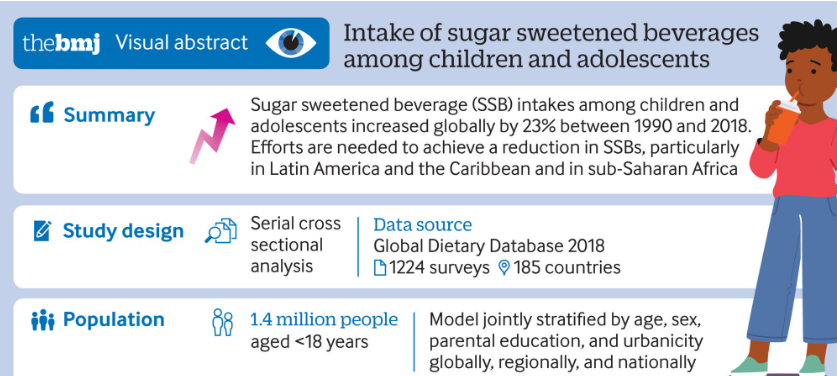
    L Lara-Castor et al. BMJ 2024;386:e079234. Open Access! Intake of sugar sweetened beverages among children and adolescents in 185 countries between 1990 and 2018: population based study

    Key findings:

    • Intakes of SSBs among children and adolescents aged 3-19 years in 185 countries increased by 23% (0.68 servings/week (0.54 to 0.85)) from 1990 to 2018, parallel to the rise in prevalence of obesity among this population globally
    • High income countries experienced an overall decrease in intakes of SSBs from 2005 to 2018. This might be explained by the increasing scientific and public health attention on the harms of SSBs as well as obesity in these nations during this period, which may have led to increased media and public awareness about the harms to health associated with SSBs
    National mean intakes of SSBs (standardized 248 g (8 oz) serving/week for this analysis) in children and adolescents aged 3-19 years across 185 countries in 2018. SSBs were defined as any beverage with added sugars and ≥209 kJ (50 kcal) per 237 g serving, including commercial or homemade beverages, soft drinks, energy drinks, fruit drinks, punch, lemonade, and aguas frescas. This definition excludes 100% fruit and vegetable juices, non-caloric artificially sweetened drinks, and sweetened milk

    My take: Despite the knowledge that sugary beverages are detrimental, consumption continues to increase.

    Related blog posts:

    Dr. Praveen Goday: Tips on Managing Feeding Problems (Part 2)

    Dr. Goday gave our group a great lecture on pediatric feeding disorders. I’ve included many of his slides along with some of my notes. There may be errors in omission and transcription on my part.

    Feeding tubes:

    • If taking >75% of feeds orally, only 13% still needing tube feeds 6 months later.  If taking <25%, 81% still needing tube feeds 6 months later (needs a GT)
    • Bridle: Dr. Goday recommends using up to 8 weeks.  If needing longer, GT placement is recommended
    • If needing an NG tube more than 3 months (possibly 6 months), GT placement is recommended
    • Pre-op studies are not predictive of who will need GJ feedings vs GT feedings

    Medications:

    • Cyproheptadine -Dr. Goday prefers single night time dose, usually cycles medicine (2 weeks on, 1 week off), uses as early as 8 months of age.  Watch for adverse effects on behavior.
    • Mirtazapine -often used in older children and adolescents though effects on appetite wane with usage.  Dosed as an oral disintegrating tablet.  Typically, 7.5 mg in older children and 15 mg in adolescents.
    • Vitamins -Gummy vitamins are NOT complete vitamins, Nano VM -minimal taste powder (costly)

    Choking phobia

    • Can occur with pharyngitis
    • Usually needs EGD and sometimes anxiolytic

    Formulas:

    • No clear nutritional role for toddler step-up formulas
    • Dr. Goday often will use infant formula between 1-2 yrs of life rather than pediasure in those without growth concerns.  Pediasure may reduce acceptance of solid foods (due to its sweet taste)
    • Get help from your nutritionists in kids with limited diets

    Autism:

    • Avoid adding medication/vitamins to the ‘one food/formula that child will take.’  He may stop taking that food/formula too

    Related blog posts:

    Disclaimer: This blog, gutsandgrowth, assumes no responsibility for any use or operation of any method, product, instruction, concept or idea contained in the material herein or for any injury or damage to persons or property (whether products liability, negligence or otherwise) resulting from such use or operation. These blog posts are for educational purposes only. Specific dosing of medications (along with potential adverse effects) should be confirmed by prescribing physician.  Because of rapid advances in the medical sciences, the gutsandgrowth blog cautions that independent verification should be made of diagnosis and drug dosages. The reader is solely responsible for the conduct of any suggested test or procedure.  This content is not a substitute for medical advice, diagnosis or treatment provided by a qualified healthcare provider. Always seek the advice of your physician or other qualified health provider with any questions you may have regarding a condition.

    Breastfeeding Associated with Infant Survival

    JL Ware et al. Am J Prev Med 2023; 65: 763-774. Associations Between Breastfeeding and Post-perinatal Infant Deaths in the U.S

    This study examined a prospective cohort linking data on breastfeeding on birth certificates (starting in 2016) to infant death rates. This included 9,711,567 live births and 20,632 post-perinatal infant deaths.

    Key findings:

    • The overall adjusted OR for breastfeeding initiation with post-perinatal infant mortality was 0.67.
    • Table 1 provides a ton of information about demographics and associated outcomes: Better education was associated with lower post-perinatal (7-365 days) death rate per 1,000 births. College graduate rate was 0.91 compared to 3.43 for lower than high school. Age 30-34 was 1.53 compared to 3.87 for <20 years. Non-hispanic Asian, Non-Hispanic White, and Hispanic were 1.11, 1.79 and 1.58 and much better than Non-Hispanic Black which was 4.07. Smoking during pregnancy rate was 5.68 compared to 1.83 for non-smoking during pregnancy
    • Preterm infant had a much higher post-perinatal mortality rate: 7.97 vs 1.36 for term babies

    One limitation that may contribute to an underestimate of the advantages of breastfeeding -this study determines only initiation of breastfeeding. Breastfeeding duration of >3 months has been associated with decreased infant mortality. In other words, in infants with longer breastfeeding, the advantages are likely to be more pronounced. Breastfeeding has been associated with lower rates of necrotizing enterocolitis and sudden unexpected infant deaths.

    My take: Breastfeeding appears to confer health benefits to infants and mothers. Some of the improvements in infant mortality likely are due to the association of breastfeeding with other characteristics that reduce infant mortality including education, non- smoking during pregnancy, older mothers and race. The authors note that race is a “social construct, but the systemic or structural disadvantages associated with race contribute to health disparities…A Black infant is 2.4 times more likely to die before his or her first birthday in the U.S. than a White infant.”

    Related blog posts:

    Mural from Funk Zone in Santa Barbara
    Santa Barbara Botanical Gardens

    Semaglutide Keeps Weight Off at Four Year Mark

    NBC News 5/14/24: Wegovy users keep weight off for 4 years, new analysis finds

    “The 17,604-patient trial tested Wegovy not for weight loss but for its heart protective benefits for overweight and obese patients who had preexisting heart disease but not diabetes. Participants were not required to track diet and exercise because it was not an obesity study…”

    “Patients in the trial, called Select, lost an average of nearly 10% of their total body weight after 65 weeks on Wegovy. That percentage weight-loss was roughly sustained year-on-year until the end of about four years, where weight loss stood at 10.2%…”

    “A third new analysis on Select published by Novo on Tuesday showed that the heart protective benefits of Wegovy to patients in the trial occurred regardless of their weight before starting on the drug and regardless of how much weight they lose on it.”

    “The weight loss in the heart trial was less than the average of 15% weight loss in earlier Wegovy obesity studies”

    Related blog posts: